
CHEM-103 · Lesson 2 of 5 · 36 min
Gases
Engineers handle gases constantly: natural gas in pipelines, compressed air in plants, combustion gases in furnaces and engines, oxygen and nitrogen in cylinders, refrigerants in heat pumps, and the air in every ventilation system. Unlike liquids and solids, gases expand to fill their containers and change volume dramatically with pressure and temperature. Getting those changes right is a matter of safety as well as design: a propane cylinder left in the sun, or a compressed-air receiver with a faulty relief valve, stores a great deal of energy.
This chapter develops the ideal gas law and its special cases, shows how to use it for gas stoichiometry and mixtures, explains the molecular picture behind it, and ends with real gases and when the ideal law stops being reliable.
Pressure and temperature
Pressure is force per unit area. The SI unit is the pascal (1 Pa = 1 N/m²), which is small, so engineers use kilopascals and megapascals. Standard atmospheric pressure is 101.325 kPa (1 atm, 1.01325 bar, 14.7 psi).
Two kinds of pressure reading cause frequent mistakes. Absolute pressure is measured from a perfect vacuum. Gauge pressure, what most tire gauges and plant pressure gauges show, is measured relative to the surrounding atmosphere:
Gas laws always use absolute pressure and absolute temperature. Temperature in kelvin is \(T(\text{K}) = T(^\circ\text{C}) + 273.15\). There are no negative temperatures on the kelvin scale: 0 K, absolute zero, is the lowest possible temperature.
The ideal gas law
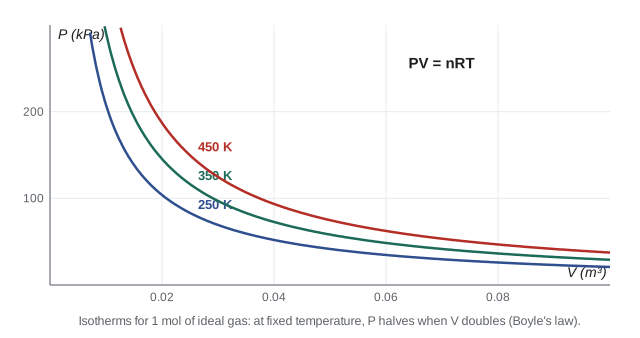
Experiments in the 1600s to 1800s established three relations for a fixed amount of gas: at constant temperature, \(PV\) is constant (Boyle's law); at constant pressure, \(V \propto T\) (Charles's law); and at constant volume, \(P \propto T\) (Gay-Lussac's law). Avogadro added that equal volumes of different gases at the same temperature and pressure contain the same number of molecules. Together these give the ideal gas law:
With \(P\) in kPa and \(V\) in litres, or \(P\) in Pa and \(V\) in m³, \(R = 8.314\) works directly. With \(P\) in atm and \(V\) in litres, use \(R = 0.08206\) L·atm/(mol·K).
Molar volume
At a given temperature and pressure, one mole of any ideal gas occupies the same volume. At 0 °C and 101.325 kPa it is 22.41 L; at 25 °C and 101.325 kPa it is 24.47 L. Be careful which "standard" conditions a data source uses: chemists, the natural gas industry and ventilation engineers each have their own reference states.
Worked problem
How much gas is in a propane cylinder?
A barbecue cylinder holds 9.07 kg (20 lb) of propane as liquid. What volume would that propane occupy as a gas at 15 °C and 101.3 kPa?
Show solution
- Moles: \(9070/44.10 = 205.7\) mol.
- \(V = nRT/P = (205.7)(8.314)(288.15)/(101\,300) = 4.86\) m³.
Answer: About 4.9 m³, roughly 270 times the volume of the liquid. That is why a small leak can fill a room, and why propane, being heavier than air, collects in basements and low spots
The combined gas law
For a fixed amount of gas whose conditions change, \(nR\) is constant, so
Worked problem
A hot tire
A tire is filled to 220 kPa gauge at 20 °C. After highway driving the air inside reaches 50 °C. Assuming the volume stays constant, what does the gauge read now?
Show solution
- Absolute: \(P_1 = 220 + 101.3 = 321.3\) kPa; \(T_1 = 293.15\) K; \(T_2 = 323.15\) K.
- \(P_2 = P_1 T_2/T_1 = 321.3 \times 323.15/293.15 = 354.2\) kPa absolute.
- Gauge: \(354.2 - 101.3 = 252.9\) kPa.
Answer: About 253 kPa gauge, a 15% rise. Using gauge pressures directly would give 243 kPa, a 30% underestimate of the change
Gas density
Rearranging the ideal gas law with \(n = m/M\) gives the density of a gas:
Dry air (\(M = 28.97\) g/mol) at 20 °C and 101.3 kPa has a density of 1.20 kg/m³. Methane (16.04 g/mol) is 0.67 kg/m³, lighter than air, so natural gas leaks rise and disperse; propane (44.10 g/mol) is 1.83 kg/m³, heavier than air. Hydrogen sulphide (34.08 g/mol), a deadly gas found in sour oil and gas fields, is also heavier than air and pools in low areas and confined spaces.
Gas stoichiometry
Because equal volumes of gases at the same temperature and pressure contain equal numbers of moles, volumes of gases react in the same ratios as the coefficients of the balanced equation. This shortcut makes combustion air calculations quick.
Worked problem
Air for natural gas
How many cubic metres of air are needed to burn 1.00 m³ of methane completely, both measured at the same temperature and pressure? Air is 20.95% O₂ by volume.
Show solution
- CH₄ + 2 O₂ → CO₂ + 2 H₂O, so 1 m³ of CH₄ needs 2 m³ of O₂.
- Air: \(2/0.2095 = 9.55\) m³.
Answer: About 9.5 m³ of air per m³ of natural gas, before excess air is added
Worked problem
Oxygen in a cylinder
A 50 L steel cylinder holds oxygen at 15 MPa and 20 °C. Find the mass of oxygen and the volume it would occupy at atmospheric pressure.
Show solution
- \(n = PV/RT = (15 \times 10^6)(0.050)/(8.314 \times 293.15) = 308\) mol.
- Mass: \(308 \times 32.00 = 9.85\) kg.
- At 101.3 kPa and 20 °C: \(V = 308 \times 8.314 \times 293.15/101\,325 = 7.4\) m³.
Answer: About 9.8 kg of O₂, which would fill 7.4 m³ at atmospheric pressure. (At 15 MPa oxygen deviates a few percent from ideal behaviour; for accurate cylinder contents engineers use compressibility data.)
Mixtures and partial pressures
In a mixture of gases, each gas behaves as if it alone filled the container. Its partial pressure is the pressure it would exert on its own, and Dalton's law says the partial pressures add to the total:
where \(y_A\) is the mole fraction of A (moles of A divided by total moles). For ideal gases, mole fraction equals volume fraction, which is why gas compositions are usually quoted by volume.
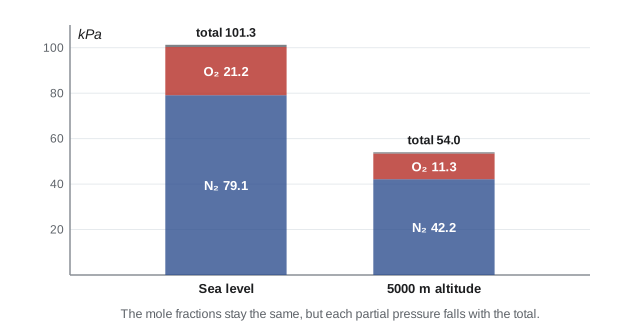
Partial pressure is what matters for breathing, for how much gas dissolves in a liquid, and for chemical reaction rates. At 5000 m the air is still 20.95% oxygen, but its partial pressure has fallen from 21.2 kPa to 11.3 kPa, which is why climbers need supplemental oxygen and why aircraft cabins are pressurized.
Worked problem
What a combustion analyser reads
Methane is burned with 15% excess air. Find the flue gas composition on a dry basis (water removed, as analysers measure it), and the partial pressure of water vapour in the wet flue gas at 101.3 kPa.
Show solution
- Per mole of CH₄: theoretical O₂ = 2 mol; supplied O₂ = 2.30 mol, so 0.30 mol is left over.
- Nitrogen comes with the oxygen: \(2.30 \times 79.05/20.95 = 8.68\) mol N₂.
- Products: 1 mol CO₂, 2 mol H₂O, 0.30 mol O₂, 8.68 mol N₂. Total wet 11.98 mol; dry 9.98 mol.
- Dry basis: O₂ \(= 0.30/9.98 = 3.0\%\); CO₂ \(= 1/9.98 = 10.0\%\); N₂ 87.0%.
- Water partial pressure: \((2/11.98)(101.3) = 16.9\) kPa.
Answer: About 3% O₂ and 10% CO₂ dry. The water vapour at 16.9 kPa condenses below roughly 56 °C, which is why condensing furnaces cool their exhaust below that temperature and need plastic vent pipes and a condensate drain
The kinetic-molecular picture
Why do all gases follow the same law? The kinetic theory of gases models a gas as a huge number of tiny molecules in constant random motion, colliding elastically with each other and the walls. Pressure is the average force of those collisions per unit area. Working through the mechanics shows that the average kinetic energy of a molecule depends only on the temperature:
with \(M\) in kg/mol. At 25 °C, nitrogen molecules move at about 515 m/s on average, faster than sound in air. Lighter molecules move faster at the same temperature, which is why hydrogen leaks through seals that hold nitrogen, and why gases with different masses can be separated by diffusion.
Worked problem
Molecular speed
Find the rms speed of N₂ molecules at 25 °C.
Show solution
- \(v_{\text{rms}} = \sqrt{3(8.314)(298.15)/0.02801}\).
Answer: About 515 m/s
Real gases
The ideal gas law assumes the molecules take up no space and do not attract each other. Both assumptions fail at high pressure, where the molecules are crowded together, and at low temperature, near condensation. Engineers measure the deviation with the compressibility factor \(Z = PV/(nRT)\), which is exactly 1 for an ideal gas. Natural gas in high-pressure pipelines typically has \(Z\) around 0.85 to 0.95, and gas meters at custody-transfer points correct for it.
A simple model that captures both effects is the van der Waals equation:
The constant \(b\) accounts for the volume of the molecules themselves, and \(a\) for the attraction between them, which reduces the pressure on the walls.
Worked problem
When the ideal law fails
Find the pressure of 1.00 mol of CO₂ in 0.500 L at 300 K using the ideal gas law and the van der Waals equation (\(a = 0.364\) Pa·m⁶/mol², \(b = 4.27 \times 10^{-5}\) m³/mol).
Show solution
- Ideal: \(P = nRT/V = (8.314)(300)/(5.00 \times 10^{-4}) = 4.99\) MPa.
- Van der Waals: \(P = \dfrac{RT}{V - b} - \dfrac{a}{V^2} = \dfrac{2494}{4.57 \times 10^{-4}} - \dfrac{0.364}{2.50 \times 10^{-7}} = 5.45 - 1.46 = 4.00\) MPa.
Answer: The ideal law overestimates by about 25%. At these conditions CO₂ is close to condensing, and intermolecular attraction dominates
As a rule of thumb, the ideal gas law is accurate to a few percent for air and similar gases at pressures up to about 1 MPa and temperatures well above their boiling points. Beyond that, use compressibility charts, an equation of state such as Peng–Robinson, or property tables.
Common mistakes
MistakeUsing °C in the gas laws.
InsteadAlways convert to kelvin: T(K) = T(°C) + 273.15.
MistakeUsing gauge pressure in PV = nRT.
InsteadAdd atmospheric pressure to get absolute pressure first.
MistakeMixing units with R, e.g. kPa with m³ and R = 8.314.
InsteadkPa with L, or Pa with m³, both work with R = 8.314. Check the units cancel.
MistakeAssuming a gas at "standard conditions" always occupies 22.4 L/mol.
InsteadThat is at 0 °C. At 25 °C it is 24.5 L/mol. Check which reference state is meant.
MistakeUsing the ideal gas law for high-pressure gas or near condensation without checking.
InsteadEstimate Z or use a real-gas equation when pressures are high or temperatures low.
Summary and key terms
- Gas laws need absolute pressure and absolute temperature (kelvin).
- Ideal gas law: PV = nRT with R = 8.314 J/(mol·K); combined law P₁V₁/T₁ = P₂V₂/T₂.
- One mole of ideal gas occupies 22.4 L at 0 °C and 24.5 L at 25 °C (101.3 kPa).
- Gas density ρ = PM/RT; heavy gases (propane, H₂S) collect in low places.
- Gas volumes react in the ratio of the equation's coefficients.
- Dalton's law: partial pressures add; P_A = y_A P_total.
- Kinetic theory: average molecular KE depends only on T; v_rms = √(3RT/M).
- Real gases deviate at high pressure and low temperature; Z = PV/nRT measures the deviation.
- Absolute pressure
- Pressure measured from a perfect vacuum.
- Gauge pressure
- Pressure measured relative to the atmosphere.
- Ideal gas law
- PV = nRT.
- Molar volume
- The volume of one mole of gas at stated conditions.
- Partial pressure
- The pressure one component of a mixture would exert alone.
- Mole fraction
- Moles of a component divided by total moles.
- Kinetic theory
- The model of a gas as molecules in random motion.
- Compressibility factor
- Z = PV/nRT, equal to 1 for an ideal gas.
Practice problems
Work each problem on paper first, then reveal the answer to check.
A gauge reads 450 kPa on a tank. Atmospheric pressure is 95 kPa (typical in Calgary). What is the absolute pressure?
Show answer
545 kPa absolute.
How many moles of gas are in a 2.0 m³ room at 21 °C and 101.3 kPa?
Show answer
n = PV/RT = (101 300)(2.0)/(8.314 × 294.15) = 82.8 mol.
A gas occupies 12.0 L at 300 kPa. What is its volume at 100 kPa and the same temperature?
Show answer
Boyle: V₂ = 12.0 × 300/100 = 36.0 L.
A sealed aerosol can at 101 kPa (absolute) and 20 °C is heated in a fire to 400 °C. What is the pressure inside?
Show answer
P₂ = 101 × 673/293 = 232 kPa absolute, enough to burst a thin can. Hence the warnings.
Find the density of CO₂ at 0 °C and 101.3 kPa, and compare with air (1.29 kg/m³ at 0 °C).
Show answer
ρ = (101 300)(0.04401)/(8.314 × 273.15) = 1.96 kg/m³, about 1.5 times as dense as air.
What volume of CO₂ at 25 °C and 101.3 kPa is produced by burning 1.00 kg of methane?
Show answer
62.3 mol CO₂ × 24.47 L/mol = 1525 L ≈ 1.5 m³.
A gas mixture at 200 kPa is 80% CH₄, 15% C₂H₆ and 5% N₂ by volume. Find the partial pressure of each.
Show answer
CH₄ 160 kPa, C₂H₆ 30 kPa, N₂ 10 kPa.
By what factor is the rms speed of H₂ greater than that of O₂ at the same temperature?
Show answer
√(32.00/2.016) = 3.98, about four times faster.
A compressed-air receiver of 0.50 m³ is at 800 kPa gauge and 25 °C. What mass of air does it hold (M = 28.97 g/mol, atmosphere 101 kPa)?
Show answer
P = 901 kPa abs. n = (901 000)(0.50)/(8.314 × 298.15) = 181.7 mol; mass = 5.26 kg.
A pipeline gas has Z = 0.90 at 6.0 MPa and 15 °C. How many moles are in 1.00 m³, compared with the ideal estimate?
Show answer
Ideal: n = (6.0 × 10⁶)(1.00)/(8.314 × 288.15) = 2504 mol. Real: 2504/0.90 = 2783 mol, about 11% more gas than the ideal law predicts.
Lesson quiz · 5 questions
Score 60% or more to complete this lesson.
Create a free account to save your progress, take quizzes and earn a certificate.