
CHE-460 · Lesson 6 of 12 · 21 min
Distillation and separation models
The ester column C-301 is the heart of the line's product quality. It takes the organic phase from the decanter, about 63.8 kmol/h of ethyl acetate with ethanol and water, and produces ethyl acetate of at least 99.7 % from the bottom. The overhead, which approaches the light ester-ethanol-water azeotrope, returns to the decanter. The column is also the largest steam user on the line, which is why option D put a vapour recompression unit on it. Getting its model right matters for the product, the energy bill and the recompressor size.
Simulators offer distillation models at three levels. Shortcut models estimate the number of stages and the reflux from a few correlations, in a fraction of a second. Rigorous equilibrium stage models solve the full set of balance and equilibrium equations on every stage. Rate-based models go further and calculate the mass and heat transfer between phases on each stage or packed section, without assuming equilibrium. Each level has its place, and Theo uses all three before the column design is fixed.
Shortcut methods
The classic shortcut is the Fenske-Underwood-Gilliland method, often called FUG. The Fenske equation gives the minimum number of stages, at total reflux, from the relative volatility and the required separation of two key components. The Underwood equations give the minimum reflux ratio, at infinite stages. The Gilliland correlation then relates the actual stages to the actual reflux between those limits. A shortcut column block in a simulator does all three, and adds the Kirkbride equation for the feed stage location.
For the ester column Theo treats the problem as a pseudo-binary: ester as the heavy key leaving at the bottom, and a lumped light pseudo-component, the azeotrope-forming ethanol and water, as the light key going overhead. The relative volatility of the light lump to the ester is about 2.5 at the column conditions. The feed is 59.1 % light lump, the distillate must carry 98.5 % light, and the bottoms only 0.3 % light, which is the 99.7 % ester specification. The Underwood form above is for a saturated liquid feed in a binary.
# Ester column as a pseudo-binary: shortcut (Fenske-Underwood-Gilliland) versus stage-by-stage calculation
# light key = overhead azeotrope pseudo-component, heavy key = ethyl acetate (illustrative alpha)
import math
alpha = 2.5
F, zF = 63.8, 0.591          # kmol/h, light mole fraction, saturated liquid feed
xD, xB = 0.985, 0.003
D = F * (zF - xB) / (xD - xB); B = F - D
print(f"D = {D:.1f} kmol/h, B = {B:.1f} kmol/h (ester product)")
Nmin = math.log((xD / (1 - xD)) * ((1 - xB) / xB)) / math.log(alpha)
Rmin = (xD / zF - alpha * (1 - xD) / (1 - zF)) / (alpha - 1)
print(f"Fenske Nmin = {Nmin:.1f} stages, Underwood Rmin = {Rmin:.2f}")
def gilliland(R):
    X = (R - Rmin) / (R + 1)
    Y = 1 - math.exp((1 + 54.4 * X) / (11 + 117.2 * X) * (X - 1) / math.sqrt(X))
    return (Y + Nmin) / (1 - Y)
def stage_by_stage(R):
    # step from the top with y = K x equilibrium and constant molar overflow
    L, V = R * D, (R + 1) * D
    Ls, Vs = L + F, V            # saturated liquid feed
    x, y, n, feed = None, xD, 0, None
    while True:
        n += 1
        x = y / (alpha - (alpha - 1) * y)          # equilibrium on stage n
        if x <= xB: return n, feed
        if feed is None and x < zF:              # switch to the stripping line at the best stage
            feed = n
        if feed is None: y = (L / V) * x + D * xD / V
        else: y = (Ls / Vs) * x - B * xB / Vs
        if n > 200: return None, None
print(" R     R/Rmin   Gilliland N   stage-by-stage N (feed stage)")
for R in (1.15, 1.25, 1.34, 1.50, 1.80, 2.50):
    n, f = stage_by_stage(R)
    print(f"{R:4.2f}   {R / Rmin:5.2f}    {gilliland(R):8.1f}        {n:4d} ({f})")
R = 1.34
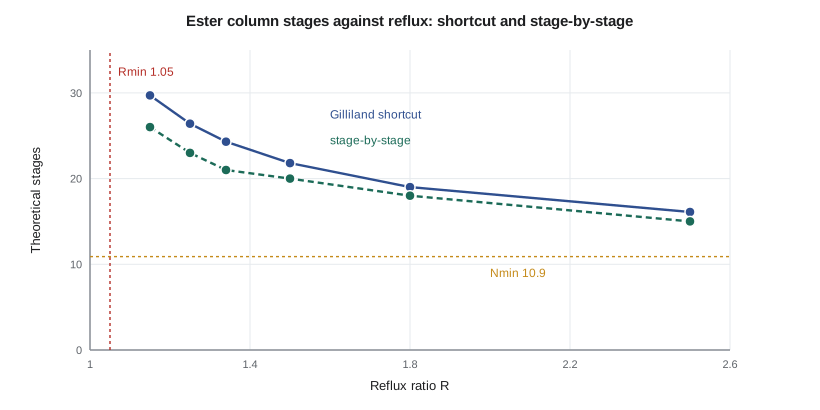
print(f"design R = {R}: reflux {R * D:.1f} kmol/h, boil-up {(R + 1) * D:.1f} kmol/h")D = 38.2 kmol/h, B = 25.6 kmol/h (ester product) Fenske Nmin = 10.9 stages, Underwood Rmin = 1.05 R R/Rmin Gilliland N stage-by-stage N (feed stage) 1.15 1.10 29.7 26 (13) 1.25 1.19 26.4 23 (11) 1.34 1.28 24.3 21 (10) 1.50 1.43 21.8 20 (8) 1.80 1.71 19.0 18 (7) 2.50 2.38 16.1 15 (6) design R = 1.34: reflux 51.2 kmol/h, boil-up 89.4 kmol/h
The shortcut gives a minimum of 10.9 stages and a minimum reflux ratio of 1.05. At the design reflux of 1.34, about 1.28 times the minimum, Gilliland gives 24.3 stages. The stage-by-stage calculation, which steps down the column through the operating lines and the equilibrium curve, needs 21 stages with the feed on stage 10. The Gilliland correlation is an average fit over many columns and is typically within ten or twenty per cent, which is the agreement here. Both show the familiar trade-off. Near minimum reflux the stages climb steeply; at high reflux they approach the minimum, but energy use rises.
Worked problem
Fenske by hand
With \(\alpha = 2.5\), \(x_{D} = 0.985\) and \(x_{B} = 0.003\), find the minimum number of stages.
Show solution
- Separation factor: \(\frac{0.985}{0.015} \times \frac{0.997}{0.003} = 65.67 \times 332.3 = 21{,}820\).
- \(\ln 21{,}820 = 9.99\).
- \(\ln 2.5 = 0.916\).
- \(N_{\min} = 9.99 / 0.916 = 10.9\).
Answer: About 10.9 theoretical stages at total reflux, including the reboiler, which counts as one equilibrium stage.
Rigorous equilibrium stage models
A rigorous column model writes the MESH equations on every stage: Material balances for each component, Equilibrium relations between the vapour and liquid leaving the stage, Summation of mole fractions to one in each phase, and the Heat balance. A column of 24 stages with five components has several hundred equations, coupled tightly through the flows between stages. Simulators solve them by specialized methods. The bubble point method and the sum-rates method suit narrow-boiling and wide-boiling mixtures respectively; the inside-out method, developed in the 1970s and early 1980s and now standard in many simulators, separates the simple and expensive parts of the property calculations so that most iterations use approximate models; and simultaneous Newton methods solve all the equations together and handle strongly non-ideal and reactive columns.
The user specifies the number of stages, the feed stage, the pressure profile, and two more variables for a conventional column with a condenser and a reboiler. Common pairs are the reflux ratio and the distillate rate, or the reflux ratio and the bottoms rate. Specifying a purity directly is possible as a design specification, in lesson 8. Lesson 8 also shows that when the distillate rate is fixed, a change in feed composition can make the product specification impossible, a point that matters for control as well as for modelling.
Real trays do not reach equilibrium. The usual correction is an overall efficiency: the number of real trays is the number of theoretical stages divided by the efficiency. For the ester column, the licensor's data suggest an overall tray efficiency of about 70 %, so 21 theoretical stages, less the reboiler, become about 29 real trays. A more refined approach applies a Murphree efficiency to each stage within the model, which changes the composition profile, not just the tray count. Theo uses Murphree efficiencies from the demonstration data in the rating model.
Rate-based models
A rate-based, or non-equilibrium, model does not assume equilibrium on each stage. It calculates the mass transfer of each component across the vapour-liquid interface from transfer coefficients, interfacial area and driving forces, using correlations for the tray or packing type. It needs the column hardware to be specified, and its results depend on the correlations. For the ester column, where the components are of similar size and the trays well designed, an efficiency-corrected equilibrium model is adequate. Rate-based models are most valuable for packed columns, for absorbers with chemical reactions such as amine gas treating, and for multicomponent mixtures where components transfer at different rates. ChemSep, available free in a lite version and used with COCO and DWSIM, was developed with rate-based column models as a central feature.
Column pressure and the pressure profile
Every column model needs a pressure at the top and a pressure drop through the column. The top pressure is set by the condenser: it must be high enough that the overhead vapour condenses against the available cooling water with a reasonable approach, and low enough that the bottoms do not need steam hotter than the site supplies. For the ester column, a top pressure near atmospheric gives a condensing temperature of about 70 °C, comfortably above cooling water, and a bottom temperature near 80 °C, well within the range of low-pressure steam. With vapour recompression, the compressed overhead vapour becomes the heating medium for the reboiler, so the compressor must lift it to a pressure at which it condenses a few kelvin above the bottom temperature. The model links the two: a change in column pressure drop changes the bottom temperature, which changes the compressor ratio and power.
The pressure drop per tray, typically between 0.5 and 1 kPa for valve or sieve trays at moderate loads, comes first from a rule of thumb and later from the tray hydraulic design. Theo starts with 0.7 kPa per tray and updates it when the contractor's tray vendor supplies hydraulic calculations. Because relative volatility falls slightly as pressure rises, the pressure profile also has a small effect on the number of stages, which the rigorous model captures and the shortcut does not.
When a column will not converge
Rigorous columns fail to converge for a handful of reasons, and Ingrid has seen them all. The most common is an infeasible specification: a distillate rate larger than the light material in the feed, or a purity that the number of stages cannot reach at any reflux. The second is poor initial estimates, especially for columns with wide-boiling feeds, side draws or a second liquid phase; the solver starts so far from the answer that the Newton steps go astray. The third is a property method that finds an unexpected liquid-liquid split on some trays, which the solver handles badly unless it is told to look for three phases. The remedies follow from the causes: check feasibility with a shortcut; converge first with easy specifications such as reflux ratio and distillate rate, then switch to the harder ones; and turn on three-phase checking on the trays where water may separate.
Reactive distillation and the decanter
The reactive column C-201 combines reaction and separation. In the model, a reactive column is a rigorous column in which some stages contain catalyst and have a reaction term in their material and energy balances. The holdup of liquid on each reactive stage, or the catalyst mass in each packed section, enters the kinetic rate. Reactive distillation models are among the hardest to converge, because the reaction and the separation interact strongly. Good initial estimates, often from a converged non-reactive column, and a simultaneous Newton solver help.
The decanter V-210 is a three-phase separator: the condensed overhead splits into an organic and an aqueous liquid. It is modelled as a liquid-liquid equilibrium flash at the decanter temperature, using the liquid-liquid parameters chosen in lesson 3. In some simulators the decanter can be built into the column model as a condenser with a liquid-liquid split, returning one phase as reflux. Theo keeps it as a separate block so that its temperature and phase split can be studied directly.
| Model | Needs | Gives | Use |
|---|---|---|---|
| Shortcut (FUG) | Keys, recoveries, volatility | N, R, feed stage estimates | Screening, initial values |
| Equilibrium stage | Stages, feed stage, two specifications | Full profiles and duties | Design and rating |
| With Murphree efficiency | Plus stage efficiencies | More realistic profiles | Rating against plant data |
| Rate-based | Hardware and transfer correlations | Profiles without assumed efficiency | Packed columns, absorbers |
| Reactive | Plus kinetics and holdups | Reaction and separation together | Reactive distillation |
Common mistakes
MistakeTrusting a shortcut result for final design.
InsteadUse shortcuts for screening and initial values; confirm with a rigorous model.
MistakeConfusing theoretical stages with real trays.
InsteadDivide by an efficiency, and remember the reboiler is a stage.
MistakeFixing distillate rate when feed composition varies.
InsteadUnderstand which specifications the plant can hold; fixed distillate rates can make purity unattainable.
MistakeStarting a reactive column from no initial estimates.
InsteadConverge a non-reactive column first and use its profiles.
Summary and key terms
- Shortcut FUG methods give minimum stages, minimum reflux and a stage-reflux relation in seconds.
- For the ester column, Nmin is 10.9, Rmin is 1.05, and about 21 to 24 stages are needed at R = 1.34.
- Rigorous models solve the MESH equations on every stage, with two specifications for a simple column.
- Efficiencies convert theoretical stages to real trays; rate-based models avoid assumed efficiencies.
- Reactive columns and decanters need kinetics and liquid-liquid equilibrium respectively.
- FUG
- The Fenske-Underwood-Gilliland shortcut method for distillation.
- Minimum reflux
- The reflux ratio at which an infinite number of stages would be needed.
- MESH equations
- Material, equilibrium, summation and heat balance equations on each stage.
- Murphree efficiency
- The ratio of the actual change in composition across a stage to the equilibrium change.
- Rate-based model
- A column model based on mass and heat transfer rates rather than equilibrium stages.
- Inside-out method
- A column solution algorithm that uses simple approximate property models in an inner loop.
Practice problems
Work each problem on paper first, then reveal the answer to check.
What does the Fenske equation give?
Show answer
The minimum number of stages at total reflux.
Why did Gilliland and stage-by-stage disagree by a few stages?
Show answer
Gilliland is an empirical average correlation, typically within ten to twenty per cent.
How many real trays for 21 theoretical stages at 70 % efficiency, counting the reboiler as one stage?
Show answer
About 20 / 0.7, roughly 29 trays.
Name two specifications for a simple column.
Show answer
Reflux ratio and distillate rate, or reflux ratio and bottoms rate.
When is a rate-based model most valuable?
Show answer
For packed columns, reactive absorbers and multicomponent transfer.
How is the decanter modelled?
Show answer
As a liquid-liquid equilibrium flash with liquid-liquid parameters.
Lesson quiz · 5 questions
Score 60% or more to complete this lesson.
Create a free account to save your progress, take quizzes and earn a certificate.