
CHE-460 · Lesson 4 of 12 · 21 min
Unit operation models: mixers, splitters, flash drums and heat exchangers
With the thermodynamics settled, Theo turns to the unit models. The simplest blocks in any simulator, the mixer, the splitter, the flash drum and the heat exchanger, appear dozens of times in a full plant model. They are also the building blocks of the more complex models: a distillation column is, in effect, a stack of flash drums linked by streams, and a reactor model includes a heat exchanger whenever it is cooled. Understanding exactly what equations each block solves, and what it assumes, is what lets an engineer spot when a result is wrong.
Mixers and splitters
A mixer combines two or more streams into one. It solves a material balance for each component and an energy balance, and the user specifies the outlet pressure, or lets the simulator take the lowest inlet pressure. The outlet temperature and phase follow from the enthalpy balance through a flash calculation. A mixer has no volume and no holdup in steady state: it represents a pipe tee or a header, not a tank. When two streams at very different temperatures mix, the outlet may be partly vaporized, and the mixer will report it, which is a useful warning that the real tee may see flashing and noise.
A splitter divides one stream into two or more streams of identical composition and temperature. The user specifies the split fractions or the flow of all but one outlet. It is used for purges, bypasses and flow distribution. It is easy to misuse a splitter as a separator. A splitter cannot change composition; if a stream divides into two of different composition, that is a separation, and needs a flash, a component separator or a rigorous model. Simulators also offer a component splitter, which sends a specified fraction of each component to each outlet. It does no thermodynamics and is useful only as a placeholder early in model building, as Theo used it for the decanter in lesson 2.
The flash drum
The flash drum is the most important simple block, because the same calculation appears inside almost every other model. A feed of known composition enters at a specified temperature and pressure, or with a specified duty or vapour fraction, and splits into a vapour and a liquid in equilibrium. For an isothermal flash at fixed temperature and pressure, with K-values known, the material balances and equilibrium relations reduce to a single equation in the vapour fraction \(\beta = V/F\), the Rachford-Rice equation.
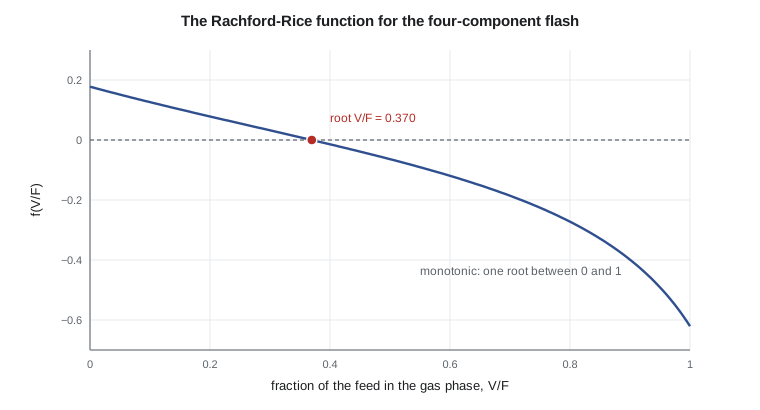
The function \(f\) decreases steadily with \(\beta\), so if \(f(0) > 0\) and \(f(1) < 0\) the feed is two-phase and there is exactly one root between 0 and 1. If \(f(0) < 0\) the feed is a subcooled liquid; if \(f(1) > 0\) it is a superheated vapour. Checking the signs first, and then solving by Newton's method or by bisection, makes the calculation robust. In a real simulator the K-values depend on the compositions through the activity coefficients, so the Rachford-Rice solution is nested inside an outer loop that updates the K-values until they stop changing.
# Unit models: Rachford-Rice flash with Newton's method, and a condenser rated with one LMTD versus zones
import math
comp = ["ester", "ethanol", "water", "acid"]
z = [0.31, 0.22, 0.33, 0.14]          # feed mole fractions (illustrative)
K = [2.10, 1.35, 0.62, 0.18]          # K-values at the drum T and P (illustrative)
def rr(beta): return sum(zi * (Ki - 1) / (1 + beta * (Ki - 1)) for zi, Ki in zip(z, K))
def drr(beta): return -sum(zi * (Ki - 1) ** 2 / (1 + beta * (Ki - 1)) ** 2 for zi, Ki in zip(z, K))
print(f"check: f(0) = {rr(0):+.4f} (positive) and f(1) = {rr(1):+.4f} (negative), so the feed is two-phase")
beta = 0.5
for it in range(1, 20):
    step = rr(beta) / drr(beta); beta -= step
    print(f"Newton iteration {it}: V/F = {beta:.6f}, f = {rr(beta):+.2e}")
    if abs(step) < 1e-9: break
x = [zi / (1 + beta * (Ki - 1)) for zi, Ki in zip(z, K)]
y = [Ki * xi for Ki, xi in zip(K, x)]
for c, xi, yi in zip(comp, x, y): print(f"{c:8s} x = {xi:.4f}  y = {yi:.4f}")
print(f"sum x = {sum(x):.4f}, sum y = {sum(y):.4f}")
print()
# Condenser: overhead vapour enters superheated, condenses, leaves subcooled; cooling water 25 -> 35 C
zones = [("desuperheat", 86.0, 72.0, 40.0), ("condense", 72.0, 71.0, 905.0), ("subcool", 71.0, 50.0, 55.0)]  # Thot in, out (C), duty kW
U = {"desuperheat": 0.12, "condense": 0.85, "subcool": 0.40}   # kW/m2K, illustrative
Q = sum(q for *_, q in zones); mcp_w = Q / 10.0                 # water 10 K rise
Tw_out = 35.0; area = 0.0
print(f"total duty {Q:.0f} kW; water flow {mcp_w / 4.18:.1f} kg/s")
for name, th_in, th_out, q in zones:
    tw_in = Tw_out - q / mcp_w
    d1, d2 = th_in - Tw_out, th_out - tw_in
    lm = (d1 - d2) / math.log(d1 / d2)
    a = q / (U[name] * lm); area += a
    print(f"{name:12s} duty {q:5.0f} kW  LMTD {lm:5.1f} K  U {U[name]:.2f}  area {a:6.1f} m2")
    Tw_out = tw_in
d1, d2 = 86.0 - 35.0, 50.0 - 25.0
lm = (d1 - d2) / math.log(d1 / d2)
Uavg = 0.85
print(f"zone total area {area:.1f} m2")
print(f"single LMTD {lm:.1f} K with U = {Uavg} gives {Q / (Uavg * lm):.1f} m2 (undersized by {100 * (1 - Q / (Uavg * lm) / area):.0f} %)")check: f(0) = +0.1778 (positive) and f(1) = -0.6206 (negative), so the feed is two-phase Newton iteration 1: V/F = 0.376888, f = -3.42e-03 Newton iteration 2: V/F = 0.369618, f = -5.69e-06 Newton iteration 3: V/F = 0.369606, f = -1.50e-11 Newton iteration 4: V/F = 0.369606, f = +0.00e+00 ester x = 0.2204 y = 0.4628 ethanol x = 0.1948 y = 0.2630 water x = 0.3839 y = 0.2380 acid x = 0.2009 y = 0.0362 sum x = 1.0000, sum y = 1.0000 total duty 1000 kW; water flow 23.9 kg/s desuperheat duty 40 kW LMTD 43.8 K U 0.12 area 7.6 m2 condense duty 905 kW LMTD 41.3 K U 0.85 area 25.8 m2 subcool duty 55 kW LMTD 34.2 K U 0.40 area 4.0 m2 zone total area 37.4 m2 single LMTD 36.5 K with U = 0.85 gives 32.3 m2 (undersized by 14 %)
For the four-component feed in the code, which resembles the overhead vapour of the reactive column partly condensed, \(f(0) = +0.178\) and \(f(1) = -0.621\), so the feed is two-phase. Newton's method from a starting value of 0.5 converges in four iterations to \(V/F = 0.3696\). The vapour is enriched in ester and ethanol and depleted in acid, as the K-values suggest. Both sets of mole fractions add to one, which is the first check on any flash result.
Worked problem
A two-component flash by hand
A feed of 50 % A (\(K = 2.0\)) and 50 % B (\(K = 0.5\)) flashes at fixed temperature and pressure. Find the vapour fraction and the phase compositions.
Show solution
- \(f(\beta) = \frac{0.5(1.0)}{1 + \beta} + \frac{0.5(-0.5)}{1 - 0.5\beta} = 0\).
- So \(0.5(1 - 0.5\beta) = 0.25(1 + \beta)\), giving \(0.5 - 0.25\beta = 0.25 + 0.25\beta\) and \(\beta = 0.5\).
- \(x_{A} = 0.5 / (1 + 0.5) = 0.333\); \(y_{A} = 2.0 \times 0.333 = 0.667\).
- \(x_{B} = 0.667\) and \(y_{B} = 0.333\); both sets add to one.
Answer: Half the feed vaporizes. The vapour is 66.7 % A and the liquid 33.3 % A.
Other flash specifications change the problem. An adiabatic flash, with zero duty and a specified pressure, must find the temperature at which the energy balance closes, so the Rachford-Rice solution is nested inside a temperature search. A flash at specified vapour fraction finds the temperature or pressure at which that fraction vaporizes: a vapour fraction of zero gives the bubble point and one gives the dew point. Three-phase flashes, vapour plus two liquids, are needed for the decanter and for any column where water may separate; they add a second Rachford-Rice equation and a stability test to decide whether the second liquid exists at all.
Heat exchangers
Simulators offer heat exchanger models of increasing detail. The simplest is a heater or cooler, a single stream with a specified outlet temperature or duty, which calculates the other. A two-stream exchanger model balances the duty between hot and cold sides, and the user specifies one outlet temperature, a duty, or an approach temperature. These are design models: they say how much heat is transferred, not how big the exchanger must be. A rating model, given the geometry and the heat transfer coefficients, calculates the outlet temperatures. Detailed rating, with tube counts, baffles, pressure drops and fouling, is usually done in specialized exchanger design software linked to the simulator.
The log mean temperature difference assumes that the heat capacity of each stream is constant along the exchanger. That is false for a stream that changes phase. A condenser receiving a superheated vapour first cools the vapour, then condenses it at a nearly constant temperature, then subcools the liquid. Each zone has a very different coefficient: gas-side cooling is poor, condensation excellent, and liquid subcooling moderate. A single log mean temperature difference across the whole exchanger, with a single coefficient, can badly misjudge the area. Simulators handle this by dividing the exchanger into zones or increments and calculating each separately, which they report as a heat release curve.
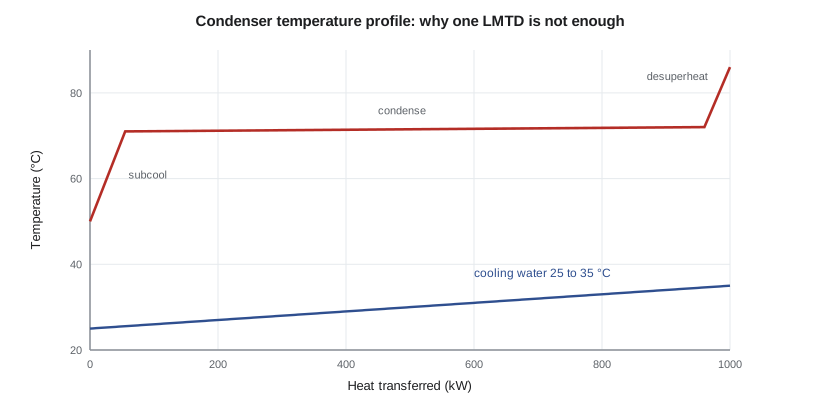
The second part of the code applies this to the condenser above the decanter, with a duty of 1,000 kW and cooling water at 23.9 kg/s. The three zones need 7.6, 25.8 and 4.0 square metres, a total of 37.4. A single log mean temperature difference of 36.5 K with the condensing coefficient would give 32.3 square metres, 14 % too small. The desuperheating zone is a small duty but needs a fifth of the area, because the gas-side coefficient is low. An exchanger specified from the single calculation would fail to condense all the vapour.
| Block | Solves | User specifies | Main pitfall |
|---|---|---|---|
| Mixer | Component and energy balances | Outlet pressure | Hidden flashing at the tee |
| Splitter | Flow division at fixed composition | Split fractions | Used as a separator |
| Component splitter | Fixed fractions of each component | Fractions by component | No thermodynamics |
| Flash | Phase equilibrium and balances | Two of T, P, duty, vapour fraction | Missing second liquid phase |
| Heater or cooler | Energy balance on one stream | Outlet temperature or duty | Says nothing about area |
| Two-stream exchanger | Energy balance on both sides | Outlet temperature, duty or approach | Temperature cross; phase change zones |
Temperature crosses and approach temperatures
A two-stream exchanger model will report a converged result even if the temperatures are impossible for a real exchanger. If the cold outlet is hotter than the hot outlet in a single-pass counter-current exchanger, that is fine, but in a shell with two tube passes it may not be achievable, and if the cold stream at any point is hotter than the hot stream at the same point, heat would have to flow uphill. Simulators flag a temperature cross, and Theo checks the minimum approach of every exchanger. For the feed-effluent exchanger on the ester column he finds an approach of 4 K at one end, below the 10 K minimum in Kingfisher Bioenergy's design guide. He changes the specification so that the approach is 10 K and lets the trim heater take the extra duty.
Pressure drop is the other number that simple exchanger models leave to the user. A default of zero is common, and harmless at first. Once the exchanger is sized, the pressure drop on each side should be entered, because it changes the boiling point of a vaporizing stream and the pump head needed. Ingrid's rule is that every exchanger in the issued model has a pressure drop from its data sheet, not a default.
Common mistakes
MistakeUsing a splitter where the outlets differ in composition.
InsteadA change of composition needs a flash or separation model.
MistakeSolving a flash without checking for two phases.
InsteadCheck the signs of the Rachford-Rice function at 0 and 1 first.
MistakeUsing a single LMTD for a condenser with desuperheating.
InsteadDivide the exchanger into zones and use a coefficient for each.
MistakeLeaving exchanger pressure drops at zero in the issued model.
InsteadEnter pressure drops from the data sheets once equipment is sized.
Summary and key terms
- Mixers and splitters do balances only; a splitter cannot change composition.
- The Rachford-Rice equation reduces an isothermal flash to one equation in the vapour fraction, with a unique root when the feed is two-phase.
- Adiabatic and vapour-fraction flashes nest the Rachford-Rice solution inside a temperature or pressure search.
- Heat exchanger design models give duty; rating models need geometry and coefficients.
- Exchangers with phase change must be analysed in zones; always check temperature crosses and approach.
- Rachford-Rice equation
- The equation in the vapour fraction that combines balances and equilibrium for a flash.
- Isothermal flash
- A flash at specified temperature and pressure.
- Adiabatic flash
- A flash at specified pressure with no heat added or removed.
- Heat release curve
- A plot of temperature against cumulative duty along an exchanger.
- Temperature cross
- A condition where the cold stream would need to be hotter than the hot stream.
- Approach temperature
- The smallest temperature difference between hot and cold streams in an exchanger.
Practice problems
Work each problem on paper first, then reveal the answer to check.
What does it mean if f(0) of the Rachford-Rice function is negative?
Show answer
The feed is a subcooled liquid at those conditions.
What vapour fraction did the example flash reach?
Show answer
0.3696, in four Newton iterations.
Why did the single-LMTD condenser estimate come out small?
Show answer
It ignored the low coefficient in the desuperheating zone.
What is a bubble point flash?
Show answer
A flash at vapour fraction zero, finding the temperature or pressure where the liquid starts to boil.
Why is a component splitter only a placeholder?
Show answer
It does no thermodynamics, so it cannot respond to changes in conditions.
What did Theo do about the 4 K approach?
Show answer
Respecified the exchanger to a 10 K approach and moved duty to the trim heater.
Lesson quiz · 5 questions
Score 60% or more to complete this lesson.
Create a free account to save your progress, take quizzes and earn a certificate.