
BLR-310 · Lesson 6 of 12 · 20 min
Cylinder intersections: tees and laterals
Northgate's maintenance planners have sent over a list of fabricated branches for the spring turnaround: two equal tees in NPS 12 pipe for a low-pressure drain header, a 600 mm (24 in) duct branch on a 1,200 mm (48 in) duct for the flare knockout area's purge air, and a 45 degree lateral in NPS 8 on an NPS 12 header for a tank farm transfer line. All three are cylinders meeting cylinders, the most common intersection in boilermaker and pipe work, and all three are developed by the parallel-line method that Kiera used for the elbow. "An elbow is a cylinder cut by a plane," Joanne says. "A tee is a cylinder cut by another cylinder. The method's the same; the cut's a curve instead of a straight line in the side view." This lesson covers the line of intersection between two cylinders, the branch pattern and the hole in the header for tees and laterals, and how the parts are cut, fitted and checked.
The line of intersection
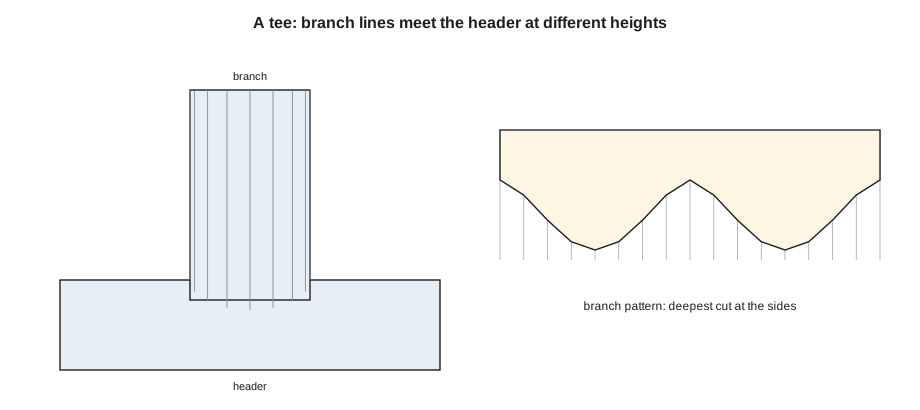
When two cylinders meet, the curve where their surfaces cross is the line of intersection. It is the cut line on the branch and the edge of the hole in the header. In a side view looking along the header, the header appears as a circle and the branch as a rectangle standing on it; each line on the branch runs down until it touches the header circle. The lengths of those lines, measured from a square end of the branch, are the ordinates of the branch pattern. In the front view, the line of intersection appears as a curve: for an equal tee, two straight lines meeting in a V at the centre; for an unequal tee, a smooth curve that dips less than the header's radius.
The branch lines meet the header at different heights because each line is at a different sideways distance from the header's axis. The line directly over the header's top, on the plane through both axes, meets the header highest; the lines at the sides of the branch, farthest out to the sides, meet it lowest. The difference in height, the depth of the saddle, depends only on the branch radius and the header radius. For a branch line at a sideways distance y from the header axis, the line meets the header at a height equal to the square root of the header radius squared minus y squared.
Here θ is the angle around the branch measured from the plane through both axes, R is the header radius and r is the branch radius. For an equal tee, the deepest lines, at the sides, meet the header at its horizontal centre line, a full header radius below the top, so the saddle is as deep as the branch radius. For a small branch on a large header, the saddle is shallow, and for a very small branch it is almost flat.
Developing the branch
The branch is developed exactly like the pipe cut in lesson 2. Its circumference, on the outside diameter for a wrap-around template or on the mean diameter for a branch rolled from plate, is the stretchout, divided into 16 equal spaces starting on the plane through both axes. At each line, the ordinate is the length of that branch line, measured from a square cut-off line, down to the header. Joining the tops gives a scalloped curve with two low points and two high points, one of each for every half of the branch.
The template for an equal tee is easy to recognise: its curve touches the stretchout line at four points and rises to the full branch radius between them. The duct branch, at half the header's diameter, gives a much gentler curve. Kiera's code uses the general formula for any branch angle, which she will need for the lateral; for a tee, the angle is 90 degrees.
The lateral
A lateral is a branch that meets the header at an angle other than 90 degrees, usually 45 degrees, so that flow enters or leaves the header more smoothly. Its line of intersection is not symmetrical front to back. The side of the branch that leans toward the header, the heel, meets the header close to the branch's root; the side that leans away, the toe, runs much farther along the header. The branch lines must now be measured along the branch at its slope, and each one's length depends both on its sideways distance from the header axis and on its position in the plane through both axes.
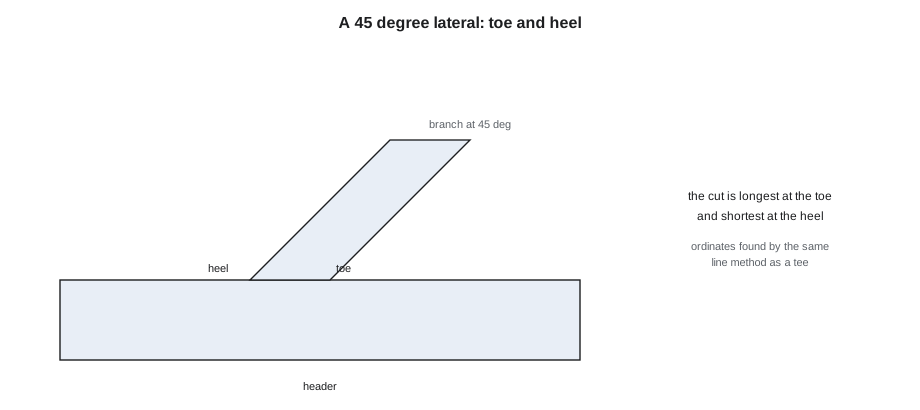
For a branch line at angle θ around the branch, with branch angle β to the header, the distance along the line from a reference plane square to the branch axis down to the header surface is the header height at that line's sideways offset, less the line's in-plane offset times the cosine of β, all divided by the sine of β. That sounds complicated, but it is only the tee formula with the branch tipped over. Kiera's code applies it at each of the 16 lines and gives the ordinates measured back from the longest line, which is the heel line.
| Fitting | Line of intersection in front view | Pattern shape |
|---|---|---|
| Equal tee | Two straight lines in a V | Four touching points, deep scallops |
| Unequal tee | Smooth shallow curve | Gentle scallops |
| 45 degree lateral | Long curve from heel to toe | Lopsided: short heel, long toe |
| Offset tee (branch off centre) | Unsymmetrical curve | Unsymmetrical scallops; every line found separately |
Kiera's ordinates
Kiera runs all three branches through the code. The tees and the duct branch use the pipe and duct outside or mean diameters; the lateral uses NPS 8 on NPS 12 at 45 degrees.
# Tee and lateral intersections: ordinate tables for the branch cut (metric)
import math
from math import gcd
MODE = "mm"

def frac(x, den=16):
    sign = "-" if x < 0 else ""
    n = round(abs(x) * den); whole, rem = divmod(n, den)
    if rem == 0:
        return f"{sign}{whole} in"
    g = gcd(rem, den)
    return f"{sign}{whole} {rem // g}/{den // g} in" if whole else f"{sign}{rem // g}/{den // g} in"

def show(x):
    x = 0.0 if abs(x) < 1e-6 else x
    return f"{x:,.0f} mm" if MODE == "mm" else frac(x)
def branch(Rh, rb, beta_deg, n=16):
    """Length of each branch line from a square cut-off plane to the header surface.
    beta = angle between branch and header axes (90 for a tee). Ordinates are returned
    measured back from the longest line, which gets 0."""
    b = math.radians(beta_deg)
    s = []
    for k in range(n // 2 + 1):
        th = 2 * math.pi * k / n
        y, u = rb * math.sin(th), rb * math.cos(th)
        s.append((math.sqrt(Rh * Rh - y * y) - u * math.cos(b)) / math.sin(b))
    top = max(s)
    return [top - v for v in s]

cases = [("equal tee, NPS 12 on NPS 12", 323.8, 323.8, 90), ("duct branch, 600 on 1,200", 1206, 606, 90), ("45 deg lateral, NPS 8 on NPS 12", 323.8, 219.1, 45)]
for name, Dh, db, beta in cases:
    ords = branch(Dh / 2, db / 2, beta)
    print(f"{name}: stretchout {show(math.pi * db)}, 16 lines")
print(" " + " ".join(f"{k}:{show(v)}" for k, v in enumerate(ords)))equal tee, NPS 12 on NPS 12: stretchout 1,017 mm, 16 lines 0:0 mm 1:12 mm 2:47 mm 3:100 mm 4:162 mm 5:100 mm 6:47 mm 7:12 mm 8:0 mm duct branch, 600 on 1,200: stretchout 1,904 mm, 16 lines 0:0 mm 1:11 mm 2:39 mm 3:69 mm 4:82 mm 5:69 mm 6:39 mm 7:11 mm 8:0 mm 45 deg lateral, NPS 8 on NPS 12: stretchout 688 mm, 16 lines 0:219 mm 1:219 mm 2:215 mm 3:202 mm 4:170 mm 5:118 mm 6:60 mm 7:16 mm 8:0 mm
For the equal tee, the ordinates rise from zero at lines 0 and 8, on the plane through both axes, to the full branch radius at line 4, the side of the branch. The duct branch's deepest ordinate is less than a seventh of its diameter: a shallow saddle. The lateral's ordinates run from the heel, line 8 at zero, to the toe, line 0, at about the branch's outside diameter divided by the sine of 45 degrees, less a little for the header's curve. The lateral's template is nearly 690 mm (27 1/8 in) long around and more than 215 mm (8 1/2 in) from heel to toe: a long cut that must be smooth to fit.
Worked problem
Depth of a saddle
An NPS 4 branch, outside diameter 114.3 mm (4 1/2 in), goes on an NPS 12 header, outside diameter 323.8 mm (12 3/4 in). How deep is the saddle?
Show solution
- Header radius 161.9 mm (6 3/8 in); branch radius 57.15 mm (2 1/4 in).
- Height of the side lines: √(161.9² − 57.15² (6.375² − 2.25²)) = 151.5 mm (5 31/32 in).
- Saddle depth = header radius − that height = 10.4 mm (13/32 in).
Answer: The saddle is about 10 mm (13/32 in) deep: small enough that a quick template from the general formula, or even a fitted grind, will do.
The hole in the header
The header needs a hole where the branch fits. For a set-on branch, which sits on top of the header and is welded around its outside, the hole is the branch's inside diameter traced onto the header; the branch's cut end sits on the header's outside surface. For a set-in branch, which passes through the header wall, the hole is the branch's outside diameter and the branch is cut to the header's inside surface. The drawing, and the weld detail, decide which. The pulp and refinery piping codes and the owner's specifications set the weld details for branch connections, and many owners require a reinforcing pad around a fabricated branch on a pressure line.
The hole's outline is found by the same intersection. On a straight header, it can be marked by holding the cut branch in place and scribing around it, which is how Joanne does small branches. For large branches, or headers rolled from plate, the hole is developed onto the header's stretchout so that it can be cut flat before rolling. That development is the subject of lesson 8, where Kiera lays out nozzle openings on V-414's shell.
Cutting, fitting and checking
The branch is cut along the template line with a torch or a pipe-cutting machine. On the equal tee, the bevel changes all the way around: at the crotch, where the branch meets the header's sides, the joint is a groove; at the top, where it sits on the header's crown, it is closer to a fillet. A good fitter dresses the bevel by hand as the angle changes, checking with a gauge. The branch is held in position with clamps or a fixture, checked for square to the header with a square in two directions, tacked at four points, and checked again before welding. For a lateral, the angle is checked with a protractor or a cut template of the angle.
The common faults are a branch that leans because its template was wrapped crooked, a gap at the heel or toe of a lateral because the curve was not smooth, and a hole in the header cut to the wrong diameter for the branch type. All three are caught at the fit-up hold point, which Harjit keeps on every fabricated branch for pressure service.
Reinforcing pads
A hole in a header removes metal that was carrying load, and on a pressure line the code requires that the lost area be replaced, either by extra thickness in the header and branch near the opening or by a reinforcing pad, a ring of plate welded around the branch on the header's outside. The size of the pad is set by the designer's reinforcement calculation; the boilermaker's job is to make it fit. A pad is a saddle-shaped ring: flat in plan, but curved to sit tight on the header. It is laid out by the same intersection method as the branch, developed onto the header's surface, cut from plate and rolled to the header's outside radius. Every pad has a small threaded telltale hole, drilled through it before fitting, which lets the space between the pad and the header be tested with air and soapy water after welding, and lets any leak through the header show in service.
Common mistakes
MistakeMeasuring branch ordinates from the wrong starting line.
InsteadStart the divisions on the plane through both axes, so the key points fall on division lines.
MistakeCutting the header hole to the outside diameter for a set-on branch.
InsteadA set-on branch needs a hole to its inside diameter; a set-in branch needs its outside diameter.
MistakeTreating a lateral as a tee with a tilted template.
InsteadCalculate each line's length along the sloping branch; heel and toe are different.
MistakeLeaving a constant bevel around an equal tee.
InsteadDress the bevel as the joint changes from groove at the crotch to near-fillet at the crown.
MistakeChecking square in only one direction.
InsteadCheck the branch for square in two directions before and after tacking.
Summary and key terms
- The line of intersection is the cut on the branch and the edge of the hole in the header.
- Each branch line meets the header at a height of √(Rh² − y²), where y is its sideways offset.
- Branch patterns are developed by the parallel-line method, starting on the plane through both axes.
- An equal tee's saddle is as deep as the branch radius; small branches on large headers have shallow saddles.
- A lateral's lines are measured along the sloping branch; the heel is short and the toe long.
- Set-on branches need a hole to the branch inside diameter; set-in branches need the outside diameter.
- Line of intersection
- The curve where two surfaces cross.
- Header
- The main pipe or duct that a branch joins.
- Lateral
- A branch that meets the header at an angle other than 90 degrees.
- Saddle
- The curved cut at the end of a branch that fits over a header.
- Set-on branch
- A branch that sits on the outside of the header.
- Set-in branch
- A branch that passes through the header wall.
Practice problems
Work each problem on paper first, then reveal the answer to check.
How deep is the saddle on an equal tee?
Show answer
As deep as the branch radius, because the side lines meet the header at its horizontal centre line.
Why are lateral ordinates not symmetrical front to back?
Show answer
The branch leans, so lines on the heel side meet the header sooner than lines on the toe side.
A branch on a large header has a very shallow saddle. Why?
Show answer
Its lines are all close to the header's top, where the header surface is nearly flat across the branch.
What decides whether the header hole is the branch's inside or outside diameter?
Show answer
Whether the branch is set on or set in, as the drawing and weld detail show.
Lesson quiz · 5 questions
Score 60% or more to complete this lesson.
Create a free account to save your progress, take quizzes and earn a certificate.