
BLR-110 · Lesson 6 of 12 · 20 min
Atmospheric testing and ventilation
Before anyone enters the Unit 2 steam drum, someone has to prove that the air inside it is safe to breathe and will stay that way. At Riverbend that someone is a qualified gas tester from the station's safety group, but every Ironbridge worker who enters a confined space also wears a personal four-gas monitor and is trained to read it, bump test it and act on its alarms. Kiera's monitor is clipped to her harness at chest height on the first morning, and Imran spends an hour teaching her what it can and cannot tell her. This lesson covers how atmospheres are tested, what the limits are and how ventilation keeps a space safe once it is open.
What a gas monitor measures
A four-gas monitor has four sensors. The oxygen sensor reads the percentage of oxygen by volume; fresh air is 20.9 %. The combustible gas sensor reads the concentration of flammable gas as a percentage of its lower explosive limit, the LEL, the lowest concentration in air at which the gas can ignite. A reading of 10 % LEL for methane means the air contains one tenth of the 5 % methane needed to burn. The two toxic sensors are usually hydrogen sulphide and carbon monoxide, reading in parts per million. Some monitors add sensors for sulphur dioxide, ammonia or other gases expected on a site, and a photoionization detector, a PID, is used where volatile organic compounds such as benzene might be present.
Each sensor has limits that the user has to understand. The most common combustible sensor, the catalytic bead, burns a tiny sample of gas on a heated bead and measures the heat. It needs oxygen to work, so it reads low or zero in an atmosphere with too little oxygen, which is exactly the atmosphere a nitrogen-purged vessel might hold. It is calibrated for one gas, usually methane or pentane, and reads other gases with a different sensitivity. Silicones, lead compounds and high levels of hydrogen sulphide can poison it. Infrared combustible sensors avoid some of these problems but cannot detect hydrogen. Electrochemical toxic sensors can respond to other gases than the one they are meant for, and all sensors drift with age.
For that reason a monitor is bump tested before each day's use, by exposing it to a known concentration of test gas and checking that every sensor responds and every alarm sounds, and it is calibrated at the interval the manufacturer and the site require. A monitor that fails a bump test does not go into a space. Kiera's first entry is delayed by ten minutes because her monitor's hydrogen sulphide sensor responds too slowly in the bump test; she swaps it at the tool crib for one that passes.
Acceptable atmospheres
The limits for entry come from the regulations, the site's rules and the exposure limits for each substance. Alberta's Code treats oxygen below 19.5 % or above 23.0 % by volume as hazardous, and a toxic substance above its occupational exposure limit as hazardous. Riverbend and Northgate add their own limits for flammable gas, typical of the industry: entry is allowed only below 10 % of the LEL, and hot work only where the reading is zero. The toxic limits come from the Code's exposure limits; for hydrogen sulphide Alberta sets an 8-hour limit of 10 ppm and a ceiling of 15 ppm that must never be exceeded.
| Gas | Fresh air | Entry limit at Riverbend and Northgate | Monitor alarm (typical) |
|---|---|---|---|
| Oxygen | 20.9 % | 19.5 to 23.0 % | 19.5 % low, 23.0 % high |
| Flammable gas | 0 % LEL | Below 10 % LEL; zero for hot work | 10 % LEL |
| Hydrogen sulphide | 0 ppm | Below 10 ppm (8 h); never above 15 ppm | 10 ppm |
| Carbon monoxide | 0 ppm | Below 25 ppm (8 h) | 25 to 35 ppm |
High oxygen is as dangerous as low oxygen. An enriched atmosphere makes clothing and hair burn fiercely, and turns a small spark into a flash fire. Oxygen enrichment in a vessel usually comes from a leaking oxyfuel hose or torch, or from someone using oxygen to cool off or to blow out dust. Oxygen is never used to ventilate a space.
How and where to test
Testing follows an order: oxygen first, because the combustible reading depends on it; then flammable gases; then toxic gases. Before entry, the tester samples the space from outside, using a pump and a sampling hose or probe pushed through the manway, so that nobody breathes the air until it has been tested. The pump needs time to draw the sample through the hose, so the tester waits for the reading to settle, allowing more time for longer hoses, as the monitor's manual specifies.
Gases do not always mix evenly. Hydrogen sulphide and many hydrocarbon vapours are heavier than air and collect in the bottom of a vessel. Methane and hydrogen are lighter and collect at the top. Carbon monoxide and nitrogen are close to the density of air and can be anywhere. In a still vessel the atmosphere can be layered, so the tester samples at the top, middle and bottom of the space, and at the far end of a long space as well as near the opening. In the steam drum, Riverbend's gas tester samples at both manways, then sends the probe in along the floor of the drum and up into the space above the separators.
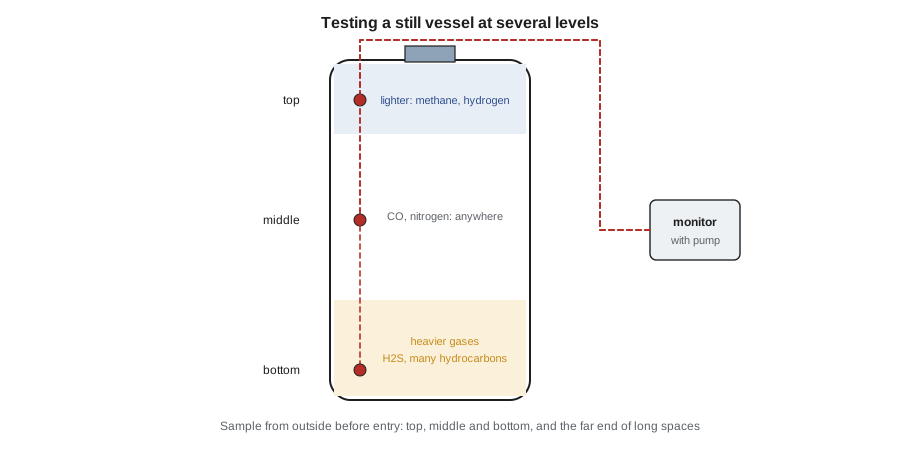
Testing is repeated. A space that was safe at 06:30 may not be safe at 10:00: work inside can create hazards, such as welding fume, solvent vapour or carbon monoxide from an engine-driven compressor parked too close to the ventilation intake; deposits can release gas as they are disturbed; an isolation can leak. The entry permit sets the retest interval, often every two hours or at each re-entry after a break, and requires continuous monitoring when conditions could change without warning. Entrants wear their own monitors throughout, and the attendant may have one at the opening.
# Checking pre-entry readings against the site limits (Alberta)
limits = {"O2_low": 19.5, "O2_high": 23.0, "LEL": 10.0, "H2S": 10.0, "CO": 25.0}
readings = [  # location, O2 %, LEL %, H2S ppm, CO ppm
    ("north manway",          20.9, 0, 0, 0),
    ("south manway",          20.8, 0, 0, 2),
    ("drum floor, mid-length", 20.6, 0, 1, 3),
    ("under separators",      19.2, 0, 0, 1),
]
ok = True
for loc, o2, lel, h2s, co in readings:
    problems = []
    if o2 < limits["O2_low"]: problems.append("low O2")
    if o2 > limits["O2_high"]: problems.append("high O2")
    if lel >= limits["LEL"]: problems.append("flammable")
    if h2s >= limits["H2S"]: problems.append("H2S")
    if co >= limits["CO"]: problems.append("CO")
    ok = ok and not problems
    print(f"{loc:<24} O2 {o2:4.1f} %  LEL {lel:2d} %  H2S {h2s:2d}  CO {co:2d}  {', '.join(problems) or 'acceptable'}")
print("ENTRY ALLOWED" if ok else "NO ENTRY: ventilate, find the cause and retest")north manway O2 20.9 % LEL 0 % H2S 0 CO 0 acceptable south manway O2 20.8 % LEL 0 % H2S 0 CO 2 acceptable drum floor, mid-length O2 20.6 % LEL 0 % H2S 1 CO 3 acceptable under separators O2 19.2 % LEL 0 % H2S 0 CO 1 low O2 NO ENTRY: ventilate, find the cause and retest
The low oxygen reading under the separators stops the entry. The rest of the drum is fine, but one pocket of stale air, perhaps where rust has consumed oxygen in a corner the ventilation is not reaching, is enough. The crew moves the ventilation duct to reach that area and the tester samples again.
Ventilation
Ventilation removes contaminants and replaces the air in a space. Alberta's Code requires a space that has or is likely to have a hazardous atmosphere to be ventilated, purged or both before entry, and personal protective equipment to be used if ventilation alone cannot make it safe. PPE is not an acceptable control for a flammable or explosive atmosphere. If mechanical ventilation is used, it must have a way to warn the workers inside if it fails, and they must know how to get out.
Air can be blown into a space, called supply or positive ventilation, or drawn out of it, called exhaust or negative ventilation. Supply ventilation pushes fresh air to where the duct ends, which is useful for cooling and for diluting contaminants around a worker. Exhaust ventilation captures contaminants close to where they are made, such as welding fume at the arc, and draws fresh air in through the other openings. On the steam drum, the crew blows air into the north manway through a duct that reaches the far end of the drum and draws it out of the south manway with an exhaust fan, so that the air sweeps the whole length of the drum.
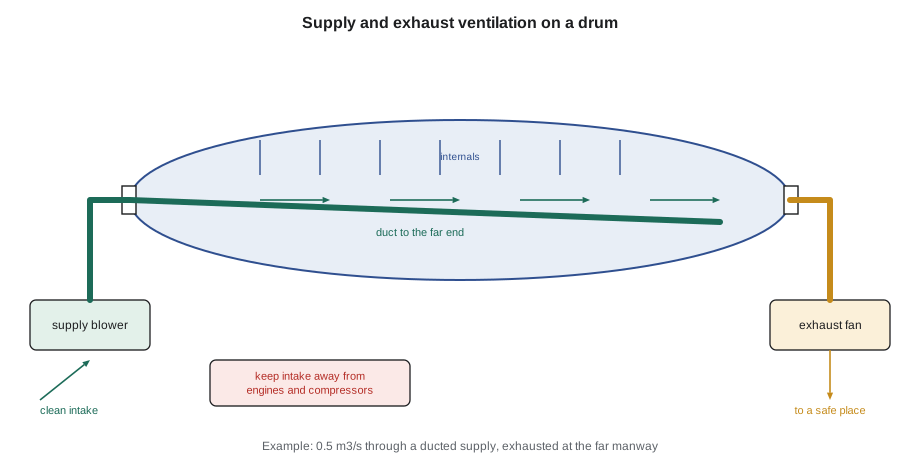
Bad ventilation is common and dangerous. A blower that only blows air into the manway without a duct may just stir the air near the opening and leave the far end stagnant. Supply and exhaust placed at the same opening can short-circuit, recirculating the same air. A blower intake next to a running diesel compressor or truck pumps carbon monoxide into the space. Electric blowers in an area that could have flammable vapours must be rated for the hazardous location, or replaced with air-driven blowers. Ducts get crushed under scaffold planks or kinked around corners. Kiera's job on the second morning is to walk the duct from the blower to the drum and back, checking for exactly these faults.
How long to ventilate
Ventilation dilutes a contaminant gradually rather than replacing the air all at once. If the incoming air mixes with the air in the space, the concentration falls exponentially. The time to bring a concentration down from its starting value to a target is
where V is the volume of the space, Q is the airflow, C0 and C are the starting and target concentrations, and k is a mixing factor between 0 and 1 that allows for air that short-circuits rather than sweeping the space. A well-arranged duct might have k near 0.5; a blower pointed into a manway, much less. Ironbridge's procedure also asks for a minimum number of air changes, the volume of the space divided by the airflow, before the pre-entry test, and continuous ventilation during entry. The code below works it out for the steam drum, which has a volume of about 21 m³.
# Ventilation time for the Unit 2 steam drum (illustrative)
import math
V = 21.2          # drum volume, m3
Q = 0.5         # blower airflow, m3/s
k = 0.5          # mixing factor for a ducted supply with exhaust at the far manway
C0, C = 50.0, 2.0    # starting and target CO concentration, ppm (e.g. from a nearby engine)
t = V / (k * Q) * math.log(C0 / C)
changes = Q * t / V
print(f"one air change takes {V / Q:.1f} s")
print(f"time to dilute {C0:.0f} ppm to {C:.0f} ppm: {t:.0f} s ({changes:.1f} air changes)")
for k_ in (0.5, 0.2, 0.1):
    print(f"  with mixing factor {k_}: {V / (k_ * Q) * math.log(C0 / C) / 60:.1f} min")
print("minimum before testing by Ironbridge procedure: 10 air changes =", f"{10 * V / Q / 60:.1f} min")one air change takes 42.4 s time to dilute 50 ppm to 2 ppm: 273 s (6.4 air changes) with mixing factor 0.5: 4.5 min with mixing factor 0.2: 11.4 min with mixing factor 0.1: 22.7 min minimum before testing by Ironbridge procedure: 10 air changes = 7.1 min
The numbers show two things. A drum this size clears quickly if the ventilation is well arranged, and much more slowly if it is not; the mixing factor matters as much as the blower size. And dilution never gets to zero: ventilation reduces a contaminant, so the source must be found and stopped. If carbon monoxide keeps appearing in the drum, the answer is to move the compressor, not to run a bigger fan.
Worked problem
A rising reading during work
Two hours into the drum work, Kiera's monitor shows carbon monoxide climbing from 0 to 18 ppm, and the attendant's monitor at the manway shows 12 ppm. The site limit is 25 ppm. What should the crew do?
Show solution
- Stop work and leave the drum. A rising reading means the conditions have changed, and the cause is not yet known.
- The attendant reports to the foreman and the permit issuer, and the permit is suspended.
- The crew checks the ventilation and finds that a rental generator has been parked a few metres from the supply blower's intake, so the blower is drawing exhaust into the drum.
- The generator is moved downwind, the intake is relocated, the drum is ventilated and retested at all levels, and the permit is revalidated before re-entry.
Answer: Readings below the limit but rising are a warning. Leave, find the source, fix it and retest.
Common mistakes
MistakeEntering on the strength of a single reading at the manway.
InsteadTest at the top, middle and bottom, and at the far end, from outside.
MistakeSkipping the bump test because the monitor was fine yesterday.
InsteadBump test every day before use; sensors fail without warning.
MistakeTrusting the LEL sensor in a low-oxygen space.
InsteadCatalytic sensors need oxygen; read oxygen first.
MistakeVentilating with oxygen or compressed oxygen.
InsteadNever; it creates an enriched, highly flammable atmosphere.
MistakePlacing the blower intake near engines.
InsteadTake supply air from a clean source, upwind and away from exhausts.
Summary and key terms
- A four-gas monitor reads oxygen, flammable gas as % LEL, and usually hydrogen sulphide and carbon monoxide.
- Monitors are bump tested daily and calibrated on schedule; catalytic sensors need oxygen and can be poisoned.
- Oxygen must be 19.5 to 23.0 %; site rules require flammables below 10 % LEL for entry and zero for hot work, and toxics below their exposure limits.
- Test oxygen, then flammables, then toxics, from outside, at several levels; retest during work and monitor continuously when conditions can change.
- Ventilation must sweep the whole space from a clean air source; the mixing factor matters as much as the airflow.
- Dilution never reaches zero: find and stop the source.
- LEL
- Lower explosive limit: the lowest concentration of a gas in air that can ignite.
- Bump test
- A brief exposure of a monitor to test gas to confirm the sensors and alarms respond.
- Calibration
- Adjusting a monitor so that its readings match a known concentration.
- Stratification
- Layering of gases by density in a still space.
- Supply ventilation
- Blowing fresh air into a space.
- Exhaust ventilation
- Drawing contaminated air out of a space, often at the source.
- Air change
- Moving a volume of air equal to the volume of the space.
Practice problems
Work each problem on paper first, then reveal the answer to check.
A drum of 9.4 m³ is ventilated with 0.25 m³/s. How long is one air change?
Show answer
9.4 / 0.25 = about 38 s.
Why is oxygen tested first?
Show answer
The combustible sensor needs oxygen to read correctly, and low or high oxygen is itself a hazard.
Where would you expect hydrogen sulphide to collect in a still vessel?
Show answer
Near the bottom; it is heavier than air.
A monitor reads 6 % LEL in a vessel. May the crew enter? May they weld?
Show answer
Entry may be allowed under the site's 10 % rule if all other readings are acceptable, but no hot work, which needs a zero reading.
Lesson quiz · 5 questions
Score 60% or more to complete this lesson.
Create a free account to save your progress, take quizzes and earn a certificate.