
BLR-110 · Lesson 1 of 12 · 20 min
The boilermaker trade
Kiera Lafontaine starts her first morning as a boilermaker apprentice in a gravel yard in Nisku, just south of Edmonton. The yard belongs to Ironbridge Industrial, a contractor that supplies boilermaker crews to power stations, refineries, pulp mills and tank farms. Its shop has a plate roll, a press brake and a row of welding booths, but most of its people are not in the shop. They are on outage and turnaround jobs at the plants, sometimes a few kilometres away and sometimes a day's drive north. Kiera was dispatched through the union hall on a Friday, and on Monday she meets the people she will work with for the next few years: Dale Whitford, the journeyperson who will mentor her; Rosa Delgado, the general foreman who runs Ironbridge's field crews; and Imran Qureshi, the safety advisor who will sign her orientation papers before she sets foot on a site.
Dale has spent thirty years in the trade. He has rolled tubes in power boilers, changed out coker drum heads in upgraders, hung new sections of recovery boiler wall in pulp mills and erected storage tanks across the prairies. He tells Kiera on the first morning that the trade is about heavy steel under pressure, in places that are hot, cramped and high, and that the people who last in it are the ones who take the safety side seriously from the first day. This course is that safety side. It covers what boilermakers do and where they do it, how industrial sites control work with permits and hazard assessments, and the four hazards that define the trade's injuries: confined spaces, atmospheres, heights and hot work.
What boilermakers build and maintain
A boilermaker builds, erects, maintains and repairs boilers, pressure vessels, heat exchangers, storage tanks, stacks, ducts and other large plate and tube structures. The name comes from the steam boilers of the nineteenth century, when riveted plate shells were laid out, rolled, punched and assembled by hand. The work has changed, with welding replacing riveting and cranes replacing gin poles, but the core is the same: heavy plate and tube, fitted to tight tolerances, made to hold pressure or contain a product, and inspected before it goes into service.
Most boilermakers work in the field rather than in a fabrication shop. A new power boiler arrives at site in hundreds of pieces: drums, headers, panels of waterwall tube, superheater and reheater sections, structural steel and casing. Boilermakers rig and set each piece, fit and weld the tube joints, roll tubes into drums where the design calls for it, and pressure-test the finished boiler. On an existing plant, the same crews return every year or two for an outage, when the plant shuts down so that worn parts can be replaced, tubes repaired and vessels inspected. Outages and turnarounds are where most of the trade's hours are worked, and where most of its injuries happen.
| Work | Typical tasks |
|---|---|
| Power boilers | Waterwall and superheater tube replacement, drum internals, burner and air heater work, pressure tests |
| Pressure vessels and exchangers | Opening and closing manways, pulling and setting tube bundles, nozzle repairs, internal inspection support |
| Storage tanks | Field erection of shell, bottom and roof plates, floating roofs, repairs, tank cleaning support |
| Stacks, ducts and precipitators | Erecting and repairing flue ducts, expansion joints, stacks and dust collection equipment |
| Specialty | Coker drum head and skirt work, recovery boiler floor and wall repairs, refractory anchoring, shipbuilding in some regions |
The trade overlaps with others. Welders join metal, but a boilermaker also lays out, fits, rigs and erects. Pipefitters install piping systems, and the line between a boiler's tubes, which belong to the boilermaker, and the plant's steam piping, which belongs to the pipefitter, is set by the boiler code and by trade jurisdiction agreements on each job. Ironworkers erect structural steel, while boilermakers erect the pressure parts and the plate structures hung from it. On a busy outage Kiera will work beside all three trades, and much of the coordination on site is about who does which piece of work and in what order.
Becoming a boilermaker
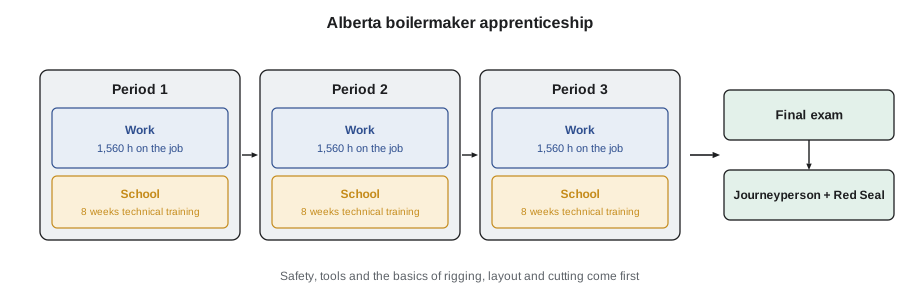
In Alberta, boilermaker is a designated trade with a three-period apprenticeship. Each period is about a year long and combines roughly 1,560 hours of paid work on the job with eight weeks of technical training at a college. A person must be a registered apprentice or a certified journeyperson to do the trade's work on boilers, tanks and pressure vessels in the province. After the third period an apprentice writes the provincial exam, and boilermaker is a Red Seal trade, so the journeyperson certificate can carry the Red Seal endorsement that other provinces recognize.
Kiera's first period covers exactly what this course covers: safety, the trade's tools and terms, and an introduction to rigging, layout and cutting. Later courses in the program take her through rigging and lifting, layout and fitting, welding and cutting, boilers and pressure vessels, tanks and field erection, pressure equipment codes, and industrial maintenance and turnarounds. The code below tracks progress through the apprenticeship from the hours in a logbook.
# Apprenticeship progress from logged hours (Alberta, three periods)
periods = 3          # number of periods or years
hours_per_period = 1560   # on-the-job hours expected per period
logged = [620, 410, 880, 290]   # hours logged on each job so far
total = sum(logged)
done = total // hours_per_period
into = total - done * hours_per_period
print(f"hours logged: {total:,} of {periods * hours_per_period:,}")
print(f"periods completed: {done} of {periods}; {into:,} h into the next")
print(f"overall progress: {100 * total / (periods * hours_per_period):.0f} %")
for job, h in zip(["Riverbend Unit 2 outage", "Northgate turnaround", "Prairie Junction Tank 14", "Ironbridge shop"], logged):
print(f" {job:<28}{h:>6,} h")hours logged: 2,200 of 4,680 periods completed: 1 of 3; 640 h into the next overall progress: 47 % Riverbend Unit 2 outage 620 h Northgate turnaround 410 h Prairie Junction Tank 14 880 h Ironbridge shop 290 h
How the work is organized
Much of the boilermaker trade in Alberta is unionized. Contractors such as Ironbridge sign agreements with the union and call workers from its hall when they win a job. The hall dispatches qualified members, often in large numbers for a few weeks, and those members move on to the next contractor when the job ends. A boilermaker can work for five or six employers in a year without changing trades or cities. Non-union contractors also do boilermaker work, especially in maintenance and shop fabrication, and the safety rules apply equally to both.
On a job, the crew structure is simple. The general foreman, Rosa on Ironbridge's jobs, runs all the boilermaker work for the contractor. Under her are foremen, each with a crew of five to ten journeypersons and apprentices, and each crew has a defined scope: one crew on the steam drum, another on the waterwalls, a third on the air heater. Apprentices work under the direction of a journeyperson, who is responsible for showing them how to do the work safely and for checking it. The ratio of apprentices to journeypersons is limited by the apprenticeship rules and by the union agreement, so that apprentices are supervised rather than used as cheap labour.
Above the contractor is the plant owner. A power station, refinery or mill hires several contractors for an outage and keeps control of the site. The owner issues the permits, owns the isolations, runs the gas testing program in many plants and has the final say on whether work may proceed. The owner also employs or contracts the pressure equipment inspectors who decide what needs to be repaired and accept the repairs. At Riverbend Generating Station that person is Peg Lindqvist, the plant's owner's inspector, whom Kiera will meet many times in later courses.
Where the injuries come from
Imran starts every orientation with the same list. Boilermakers are hurt and killed most often by falls from height, by being struck by or caught between heavy loads during rigging, by hazardous atmospheres inside vessels and boilers, by fires and burns during hot work, and by the cumulative effects of noise, heat, dust and fume. The trade also has a long tail of injuries that do not make the news: back and shoulder strains from handling plate and tools, hand injuries, eye injuries from grinding, and cuts. Each lesson in this course takes one of these hazards and the controls that keep it in check.
| Hazard | Where it shows up | Lesson |
|---|---|---|
| Permit and isolation failures | Work on equipment that has not been properly isolated or released | 3 |
| Unassessed hazards | Changed conditions, simultaneous work, new tasks | 4 |
| Confined spaces | Drums, vessels, furnaces, tanks, ducts | 5 to 7 |
| Falls | Boiler structure, scaffolds, tank shells, open floors | 8 and 9 |
| Fire and burns | Cutting, welding and gouging near combustibles or flammable vapours | 10 |
| Health hazards | Asbestos, refractory fibres, silica, fume, chemicals, noise, heat | 11 |
Dale adds a point Imran does not put on a slide. Most serious incidents in the trade happen when something has changed: a job that was planned for a cold boiler now has steam leaking back through a valve, a crew from another trade starts work overhead, a scaffold is modified, a permit runs past the end of a shift. The habits this course teaches, from the hazard assessment before each task to the gas test before each entry, are ways of noticing change before it hurts someone.
The tools of the trade
Kiera's first purchase is a set of hand tools: a tape measure, a combination square, soapstone and a scribe, a centre punch, a ball-peen hammer and a sledge, a set of wrenches, a spud wrench, drift pins, a level and a plumb bob. The contractor supplies the larger equipment: chain falls and come-alongs, porta-powers and hydraulic jacks, tube expanders, grinders, oxyfuel and plasma cutting rigs, gouging torches, welding machines, and the rigging gear for heavy lifts. She also receives her personal protective equipment: a hard hat, safety glasses and a face shield, hearing protection, steel-toed boots, flame-resistant coveralls, leather and cut-resistant gloves, and a full-body harness. The harness is fitted to her by Imran before she leaves the orientation room.
Personal protective equipment is the last line of defence, not the first. The plant's systems of permits, isolations, gas testing, guardrails and scaffolds keep hazards away from workers, and PPE protects against what remains. Imran makes the point by asking Kiera what her hard hat would do if a 500 kg tube panel fell on it. The answer, nothing useful, is why the rigging and barricades matter more.
Worked problem
Kiera's first week
Kiera's first week is planned by Rosa: two days of contractor and site orientation, one day in the Ironbridge shop learning to use the tools under Dale, and two days on the Riverbend Unit 2 outage as a helper on the steam drum crew. What must happen before she starts work at the station?
Show solution
- She completes Ironbridge's orientation, including the contractor's safety program, the right to refuse unsafe work, how to report hazards and incidents, and the fitting of her PPE and harness.
- She completes the plant's site orientation, which covers the station's emergency alarms, muster points, permit system and rules, and she receives a site badge. Many large industrial owners in Alberta also require an industry-standard orientation from Energy Safety Canada before contractors arrive.
- Her training records are checked for the tasks she will do: confined space entry training before she enters the drum, fall protection training before she works at height, and the gas detector training the plant requires.
- On the first morning at Riverbend she attends the crew's toolbox meeting and signs onto the crew's hazard assessment for the day's task before work begins.
Answer: Orientation, training records and the day's hazard assessment come first; the tools come second.
Common mistakes
MistakeThinking that safety rules are the plant's job and not the worker's.
InsteadEvery worker has duties: follow the procedures, use the protection, report hazards and refuse work that is unsafe.
MistakeStarting work before the crew's hazard assessment is signed.
InsteadSign on to the hazard assessment for the task before picking up a tool.
MistakeTreating PPE as the main protection.
InsteadPPE protects against what is left after the job has been made safe by permits, isolations, guarding and access.
MistakeAssuming the same job will go the same way as last year.
InsteadConditions change from outage to outage; reassess every time.
MistakeKeeping quiet as a new apprentice.
InsteadApprentices are expected to ask; a question costs less than an injury.
Summary and key terms
- Boilermakers build, erect, maintain and repair boilers, pressure vessels, exchangers, tanks, stacks and ducts, mostly in the field.
- Much of the work happens during plant outages and turnarounds, when many contractors work at once.
- In Alberta the apprenticeship is three periods of about 1,560 hours each, with eight weeks of technical training per period, and it is a Red Seal trade.
- The general foreman, foremen and journeypersons run the work; the plant owner controls the site, the permits and the inspections.
- The trade's major hazards are falls, rigging, hazardous atmospheres in confined spaces, hot work and health hazards such as fibres, dust, noise and heat.
- PPE is the last line of defence after the hazards have been controlled by the work system.
- Boilermaker
- A tradesperson who builds, erects, maintains and repairs boilers, pressure vessels, tanks and other plate and tube structures.
- Outage
- A planned shutdown of a power plant unit for maintenance, repair and inspection.
- Turnaround
- A planned shutdown of a refinery or process unit for maintenance and inspection, often called a TAR.
- General foreman
- The contractor's supervisor in charge of all of a trade's work on a job.
- Owner's inspector
- The pressure equipment inspector working for the plant owner who decides on repairs and accepts them.
- Dispatch
- The union hall's process for sending qualified members to a contractor's job.
Practice problems
Work each problem on paper first, then reveal the answer to check.
Kiera has logged 2,100 hours. How many periods has she completed in a three-period program of 1,560 hours each?
Show answer
One period, with 540 hours into the second.
Name three kinds of equipment a boilermaker works on besides boilers.
Show answer
Pressure vessels, heat exchangers and storage tanks; also stacks, ducts and precipitators.
Who controls the permits on a plant outage?
Show answer
The plant owner, through its permit issuers.
Why is PPE called the last line of defence?
Show answer
It only protects against hazards that the work system has failed to eliminate or control.
Lesson quiz · 5 questions
Score 60% or more to complete this lesson.
Create a free account to save your progress, take quizzes and earn a certificate.