
BLR-110 · Lesson 2 of 12 · 20 min
Where boilermakers work: power, refining, pulp and mining
In her first month Kiera works on four sites. Ironbridge has crews on the spring outage of Unit 2 at Riverbend Generating Station, a turnaround at the Northgate Upgrader, the field erection of Tank 14 at Prairie Junction Terminal, and a repair contract on the recovery boiler at Tamarack Pulp. Rosa sends her to each of them for a few days, partly because the crews need helpers and partly because she wants Kiera to see the range of the trade before she settles on one crew. Every site has its own owner, its own rules and its own mix of hazards. This lesson is a tour of those workplaces and what makes each of them dangerous.
Power stations
A thermal power station turns fuel into steam and steam into electricity. The boiler is the boilermaker's part of the plant. Riverbend Unit 2 is a drum-type boiler built in the 1970s and converted from coal to natural gas, producing about 180 tonnes of steam an hour. Water enters through the economizer, where it picks up heat from the flue gas, and flows into the steam drum, a thick cylindrical vessel running across the top of the boiler. From the drum, water flows down through large unheated pipes called downcomers to the lower headers and the mud drum, then rises through the tubes that line the furnace walls, the waterwalls, where it partly boils. The steam and water mixture returns to the steam drum, where separators remove the water, and the dry steam passes on to the superheater, which raises its temperature before it goes to the turbine.
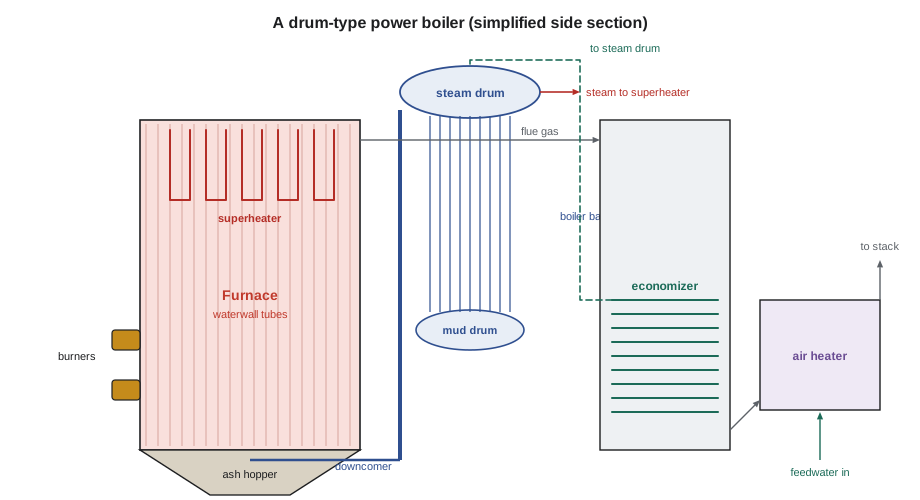
During an outage the boiler is cooled, drained and opened. Boilermakers enter the steam drum through its manways to inspect and repair the drum internals, enter the furnace on scaffolds to replace damaged waterwall tubes, crawl through the back pass to repair economizer tubes, and work on the burners, windbox and air heater. Every one of these spaces is a confined space, many of them are high above the ground, and almost every repair involves cutting and welding. The furnace of a boiler like Unit 2 is about 30 m tall, and the scaffold inside it is one of the largest temporary structures the crews will work on all year.
Newer gas-fired plants use heat recovery steam generators, or HRSGs, which capture the heat in a gas turbine's exhaust. An HRSG is a tall box of tube bundles and drums with narrow access lanes between the modules, and its outages bring the same hazards in tighter spaces. Nuclear stations also use boilermakers, for the steam generators and other large components, under the additional controls of radiation protection programs that are outside the scope of this course.
Refineries and upgraders
A refinery separates and converts crude oil into fuels and other products. An upgrader, found in Alberta's oil sands, converts bitumen into synthetic crude oil before it is shipped. Both are full of pressure equipment: distillation columns, reactors, fired heaters, hundreds of heat exchangers and, at Northgate, two pairs of delayed coker drums. A coker drum is a tall vessel, about 8 to 9 m in diameter, that is filled with hot residue, allowed to crack into lighter products and solid coke, then steamed, cooled with water and cut out with high-pressure water jets. The drums cycle between hot and cold every day or so, and the repeated thermal stress cracks their shells and skirts. Repairing them is classic boilermaker work.
A refinery turnaround shuts down a process unit, or the whole plant, for weeks. Thousands of contractor workers arrive at once. The process equipment has held hydrocarbons, hydrogen sulphide, acids and catalysts, and before boilermakers can open it the owner's operators must drain it, purge it, isolate it with blinds and steam or wash it out. Even then, deposits can release gases when disturbed, iron sulphide scale can heat up and ignite when it dries in air, and a neighbouring unit may still be running. The hazards of a refinery are less about heat and height than about what the equipment contained.
Turnarounds are run under the owner's process safety program. The owner manages the isolation of the unit from the rest of the plant, the opening of equipment, and the control of contractors working on it. Contractors are expected to follow those rules, train their workers in them and report hazards they find.
Pulp and paper mills
A kraft pulp mill cooks wood chips in chemicals to free the fibre, then recovers the chemicals by burning the spent cooking liquor, called black liquor, in a recovery boiler. The recovery boiler is one of the largest and most hazardous boilers in industry. The black liquor burns in the lower furnace and leaves a pool of molten salts, called smelt, on the furnace floor, which drains out through smelt spouts into a dissolving tank. If water reaches the smelt bed, from a leaking tube or a wash-down, the result can be a smelt-water explosion powerful enough to wreck the boiler. Recovery boiler operators and the contractors who repair them follow strict rules, developed by the industry over decades, for tube leak detection, emergency shutdown and the quality of tube repairs.
For boilermakers, the recovery boiler means tube welding to very high quality standards, work in the hot, dusty lower furnace after the smelt bed has been cooled and removed, and confined space entry into areas full of caustic deposits. At Tamarack Pulp, Ironbridge's crew is replacing a section of floor tubes, and every weld they make will be inspected by radiography before the boiler is refilled.
Mining, tanks and other industries
Boilermakers also work in mines and mineral processing. In Alberta's oil sands that means the boilers that make steam for in-situ production, the large vessels of the extraction plants, and the cyclones, chutes and hoppers that handle abrasive sand, which wear through steel and need frequent replacement. Smelters and refineries for metals use boilermakers on furnaces, roasters, flues and precipitators. Field-erected storage tanks for crude oil, fuels and water are built by boilermaker crews at terminals and plants across the province.
Tank erection is different from outage work. At Prairie Junction, Tank 14 will be 60 m in diameter and 15 m high. The crew lays the bottom plates on a prepared foundation, then erects the shell course by course, either from the bottom up on scaffolds or by jacking the shell up as each course is added beneath it. The hazards are falls from the shell and roof, rigging of large plates in wind, and confined space entry once the roof is on. Later in the program a whole course covers tanks and field erection.
| Site | Typical boilermaker work | Distinctive hazards |
|---|---|---|
| Power station | Waterwall, superheater and economizer tubes, drum internals, air heaters | Furnace scaffolds, heat, ash and dust, hot work in tight spaces |
| Refinery or upgrader | Exchangers, columns, coker drums, fired heaters | Hydrocarbons and hydrogen sulphide, pyrophoric scale, nitrogen purges, neighbouring live units |
| Pulp mill | Recovery boiler tubes, digesters, tanks | Smelt-water explosion risk, caustic deposits, high weld quality demands |
| Mining and oil sands | Steam boilers, wear liners, chutes, hoppers | Abrasive wear, remote camps, cold weather |
| Tank farm | Field-erected tanks, floating roofs, repairs | Falls from shell and roof, wind on plates, residues in old tanks |
Working on someone else's site
On every one of these sites Ironbridge is a guest. The owner sets the site rules, controls access, runs the emergency response and issues the permits. Rules differ between sites: one plant requires a gas monitor on every worker inside the fence, another only for confined space entry; one bans phones in process areas, another allows them in the change rooms only. Kiera learns to read each site's rules in the orientation and to ask Dale when something is different from the last site. The hardest rule to keep is the one about staying in the work area. A boilermaker who wanders onto a running unit to find a washroom or a shortcut is outside every control the permit system provides.
Outages and turnarounds also bring scale. Riverbend's spring outage has about 400 contractor workers from a dozen companies, working around the clock in two twelve-hour shifts for five weeks. The schedule is tight because every day the unit is down costs the owner money in lost generation. Rosa's job is to plan her crews so that the work gets done without pushing people into long hours that make them careless. The code below is the kind of rough estimate she makes when a scope is added in the middle of an outage.
# Rough crew planning for an added outage scope (illustrative)
scope_hours = 480          # estimated crew-hours for the added tube repairs
shift_hours = 12             # hours per shift
productive = 0.70            # fraction of a shift spent on the task (permits, gas tests, breaks, travel)
days_left = 9                # days left in the outage window
for crew in (4, 6, 8):
    hours_per_day = crew * shift_hours * productive
    days = scope_hours / hours_per_day
    status = "fits" if days <= days_left else "does not fit"
    print(f"crew of {crew}: {days:4.1f} days on one shift, {days / 2:4.1f} days on two shifts ({status} on one shift)")
print("consecutive 12-hour shifts are limited by the site's fatigue rules; check before adding days")crew of 4: 14.3 days on one shift, 7.1 days on two shifts (does not fit on one shift) crew of 6: 9.5 days on one shift, 4.8 days on two shifts (does not fit on one shift) crew of 8: 7.1 days on one shift, 3.6 days on two shifts (fits on one shift) consecutive 12-hour shifts are limited by the site's fatigue rules; check before adding days
The productive fraction is the part people forget. On a large outage, a crew spends a real share of each shift on things other than the task: receiving the permit, waiting for a gas test, walking to the work face, getting tools through a manway, taking breaks in the heat. Planning a job as if every hour is spent welding is how schedules slip and how crews end up rushing at the end.
Worked problem
Which hazards come with the job?
Rosa asks Kiera to list the main hazards she should expect on her first days at each of the four sites, before reading the site orientations.
Show solution
- Riverbend Unit 2: entry into the steam drum and mud drum, work at height on the furnace scaffold, heat and ash in the back pass, and hot work on tube repairs.
- Northgate: residual hydrocarbons and hydrogen sulphide in opened equipment, pyrophoric iron sulphide, nitrogen used for purging nearby, and running units next to the turnaround area.
- Tamarack Pulp: caustic deposits and dust in the recovery boiler, the strict controls on water near the furnace, and confined space entry into the lower furnace.
- Tank 14: falls from the shell and roof edges, wind loading on plates being rigged, and later confined space entry inside the tank.
Answer: Each site's orientation then adds its own rules, alarms and emergency procedures to the list.
Outage seasons and travel
Outage work follows the seasons. Power stations schedule their outages in spring and fall, when demand for electricity is lowest, and refineries plan turnarounds years in advance on a cycle set by inspection intervals and catalyst life. The result is that boilermakers are very busy for a few months and quieter in between, and many travel to follow the work. In Alberta that often means camp jobs in the oil sands, with rotations such as two weeks in and one week out, flying or driving north from Edmonton. Camp life brings its own safety issues: long shifts, fatigue from travel, driving tired on northern highways at the end of a rotation, and weeks away from family.
Rosa watches for fatigue as closely as for any other hazard. A boilermaker who has worked fourteen twelve-hour shifts in a row is slower, makes more mistakes and notices less, and the site's fatigue rules limit how many consecutive shifts a worker may do. Kiera is told to say so if she is too tired to work safely; it is treated like any other hazard report.
Common mistakes
MistakeTreating every plant the same.
InsteadRead each site's rules; alarms, permits and PPE requirements differ.
MistakeWalking through running units as a shortcut.
InsteadStay inside the work area and the routes the site allows.
MistakeAssuming opened process equipment is clean.
InsteadDeposits can release gas and pyrophoric scale can ignite; treat it as hazardous until tested.
MistakeSpraying water in a recovery boiler without authorization.
InsteadWater near the smelt bed can cause an explosion; follow the mill's wash-down rules.
MistakePlanning crew hours as if every hour is productive.
InsteadAllow for permits, gas tests, access and breaks.
Summary and key terms
- A drum-type power boiler has an economizer, steam and mud drums, downcomers, waterwalls, superheaters and an air heater; each is opened during an outage.
- Refinery and upgrader turnarounds bring hazards from the process: hydrocarbons, hydrogen sulphide, pyrophoric scale and inert gas purges.
- Recovery boilers in pulp mills carry the risk of smelt-water explosions, so mills tightly control water and repair quality.
- Boilermakers also work in the oil sands, mines and smelters, and erect field tanks.
- The owner controls each site; contractors follow its rules, stay in their work areas and plan for the real productive time in a shift.
- Steam drum
- The large vessel at the top of a boiler where steam separates from water.
- Mud drum
- The lower drum of a boiler, connected to the steam drum by banks of tubes.
- Waterwall
- The tubes that line a boiler furnace and carry water and steam.
- HRSG
- A heat recovery steam generator, which makes steam from a gas turbine exhaust.
- Coker drum
- A large vessel in which heavy residue is thermally cracked into lighter products and solid coke.
- Recovery boiler
- The boiler in a kraft pulp mill that burns black liquor to recover cooking chemicals.
- Smelt
- Molten inorganic salts that collect on the floor of a recovery boiler.
Practice problems
Work each problem on paper first, then reveal the answer to check.
Name the path of water and steam through a drum boiler from the economizer to the superheater.
Show answer
Economizer, steam drum, downcomers, lower headers and mud drum, waterwalls, back to the steam drum, then superheater.
Why is water near the smelt bed so dangerous?
Show answer
It can flash to steam in contact with molten smelt and cause an explosion.
What is pyrophoric iron sulphide?
Show answer
A scale that can heat up and ignite when it dries out in air after equipment is opened.
A scope of 300 crew-hours is given to a crew of five on 12-hour shifts at 70 % productive time. How many shifts?
Show answer
5 × 12 × 0.7 = 42 h per shift; 300 / 42 = about 7 shifts.
Lesson quiz · 5 questions
Score 60% or more to complete this lesson.
Create a free account to save your progress, take quizzes and earn a certificate.