
AI-101 · Lesson 4 of 12 · 31 min
Knowledge, logic and reasoning under uncertainty
Intelligent behaviour depends on knowledge: facts about the world, rules about how things work, and the ability to combine them to reach new conclusions. For decades, much of AI research focused on representing knowledge explicitly, in forms a computer can manipulate, and on reasoning with it. This approach produced expert systems, knowledge graphs, planning systems and formal verification tools that are still in use. It also ran into a fundamental difficulty: real knowledge is uncertain, incomplete and full of exceptions. This lesson covers logic and rule-based reasoning, knowledge graphs, and probabilistic reasoning with Bayes' rule, which together underpin how AI systems handle uncertainty, and explains how these ideas relate to modern learned systems.
Logic and inference
Logic is a precise language for stating facts and deriving conclusions. In propositional logic, statements are true or false and are combined with AND, OR, NOT and IF-THEN. Inference rules derive new true statements from old ones. The most famous is modus ponens: from "if P then Q" and "P", conclude "Q". For example, from "if the server room temperature exceeds 35 °C, then an alarm sounds" and "the temperature is 37 °C", a system concludes that an alarm sounds.
First-order logic adds objects, properties and relationships with variables and quantifiers ("for all" and "there exists"), so it can state general rules such as "every server in a rack shares that rack's power feed". Logic is sound (it never derives false conclusions from true premises) and transparent (every conclusion can be traced to its premises), which is why it remains essential in safety-critical software, hardware verification, databases and legal and regulatory reasoning.
Worked problem
Chaining rules
A diagnostic system knows: (1) if a UPS is on battery and the generator has not started, then the load is at risk; (2) if utility power is lost, then the UPS is on battery; (3) if the fuel valve is closed, then the generator has not started. Facts: utility power is lost; the fuel valve is closed. What can it conclude?
Show solution
- From (2) and "utility power is lost": the UPS is on battery.
- From (3) and "the fuel valve is closed": the generator has not started.
- From (1) and both conclusions: the load is at risk.
Answer: The load is at risk, and the system can explain exactly why, citing the facts and rules used. Chaining rules forward from facts like this is called forward chaining; working backward from a goal to see which facts would prove it is backward chaining.
Expert systems and their limits
Expert systems of the 1970s and 1980s encoded the knowledge of human specialists as hundreds or thousands of if-then rules, with an inference engine to apply them. MYCIN, developed at Stanford in the 1970s, recommended antibiotics for blood infections and performed comparably to specialists in tests; XCON configured computer orders for Digital Equipment Corporation and saved the company millions of dollars a year. Expert systems were a commercial boom in the 1980s (Lesson 2).
They also revealed hard problems:
- Knowledge acquisition bottleneck: experts struggle to state their knowledge as rules, and extracting it is slow and expensive.
- Brittleness: systems fail badly on situations their rules did not anticipate.
- Maintenance: large rule bases become inconsistent and hard to update.
- Common sense: people rely on vast amounts of unstated everyday knowledge ("water is wet", "people do not like to wait"), which proved extremely difficult to write down. The Cyc project, begun in 1984, spent decades encoding millions of common-sense facts.
- Uncertainty: real rules have exceptions and degrees of confidence.
Rule-based systems survive wherever rules are clear and explanations are required: tax software, eligibility checks, building control sequences, fraud rules, and business process automation. Many modern AI products combine learned models with rules for policy, safety and compliance.
Knowledge graphs
A knowledge graph represents knowledge as a network of entities (nodes) connected by relationships (edges), such as "Toronto — is located in — Ontario" or "GPU H100 — manufactured by — NVIDIA". Large knowledge graphs, such as Wikidata, with over 100 million items, and those built by search engines, power the information panels in search results, question answering, product recommendations and data integration in large organizations.
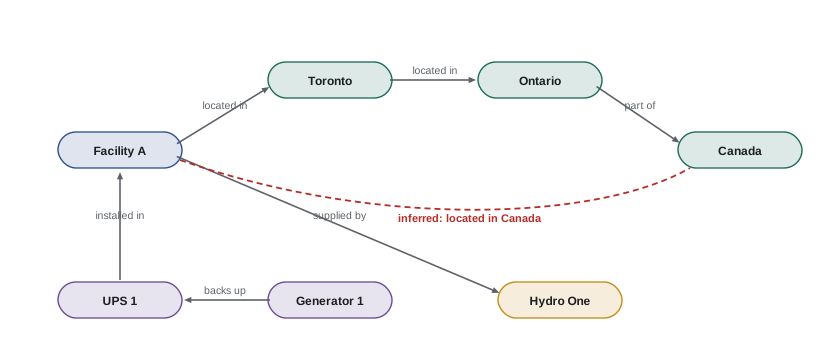
Graphs support inference: if A is located in B and B is located in C, then A is located in C. Today, knowledge graphs are often combined with language models, which can extract facts from text to build graphs and use graphs to ground their answers in verified facts (Lesson 9).
Planning
Knowledge about actions lets a system plan: find a sequence of actions that achieves a goal. Classical planning describes each action by its preconditions (what must be true before it) and effects (what becomes true or false after it), an approach introduced with the STRIPS planner developed for Shakey, a mobile robot built at the Stanford Research Institute between 1966 and 1972 that could plan routes and push boxes between rooms. A planner searches through possible sequences of actions (Lesson 3), using the action descriptions to reason about which actions are useful.
Planning is used in logistics, manufacturing schedules, space missions (NASA used automated planners to operate spacecraft), video game characters and robotics. A data centre maintenance procedure is a kind of plan: to replace a UPS module safely, the system must first be transferred to bypass, which requires the bypass to be available, and so on. Planning systems can check such procedures for missing steps or unsafe orderings.
Worked problem
Preconditions and effects
Action "open breaker B1" has precondition "load on B1 transferred to B2" and effect "B1 open". Action "transfer load to B2" has precondition "B2 available" and effect "load on B1 transferred to B2". The goal is "B1 open"; B2 is available. What plan achieves the goal?
Show solution
- The goal "B1 open" is an effect of "open breaker B1", which needs "load transferred to B2".
- "Transfer load to B2" achieves that and needs "B2 available", which is true.
Answer: The plan is: transfer load to B2, then open breaker B1. Working backward from the goal through preconditions like this is how planners find valid orderings, and it is exactly the reasoning that well-written maintenance procedures encode.
Why uncertainty matters
Most real-world reasoning is uncertain. A medical test can be wrong; a sensor can fail; a rule like "birds fly" has exceptions; and evidence is incomplete. Early AI systems handled uncertainty with ad hoc "certainty factors", which could produce inconsistent results. From the 1980s, researchers such as Judea Pearl showed how probability theory provides a principled foundation for reasoning with uncertainty, an idea that transformed AI.
Probability measures degrees of belief between 0 (impossible) and 1 (certain). The key tool for updating beliefs with evidence is Bayes' rule:
where \(P(H)\) is the prior probability of a hypothesis \(H\) before seeing evidence, \(P(E \mid H)\) is the likelihood of the evidence if the hypothesis is true, and \(P(H \mid E)\) is the posterior probability after seeing the evidence.
p_disease = 0.01
sensitivity = 0.95
false_positive = 0.05

p_pos = sensitivity * p_disease + false_positive * (1 - p_disease)
posterior = sensitivity * p_disease / p_pos
print(f"P(positive test) = {p_pos:.4f}")
print(f"P(disease | positive) = {posterior:.3f}")

prior = p_disease
for test in range(1, 4):
    p_pos = sensitivity * prior + false_positive * (1 - prior)
    prior = sensitivity * prior / p_pos
    print(f"after {test} independent positive test(s): {prior:.3f}")

for base in [0.001, 0.01, 0.1, 0.3]:
    post = sensitivity * base / (sensitivity * base + false_positive * (1 - base))
print(f"prevalence {base:>5}: P(disease | positive) = {post:.3f}")P(positive test) = 0.0590 P(disease | positive) = 0.161 after 1 independent positive test(s): 0.161 after 2 independent positive test(s): 0.785 after 3 independent positive test(s): 0.986 prevalence 0.001: P(disease | positive) = 0.019 prevalence 0.01: P(disease | positive) = 0.161 prevalence 0.1: P(disease | positive) = 0.679 prevalence 0.3: P(disease | positive) = 0.891
The result surprises most people: with a disease affecting 1% of the population, a positive result from a test that is 95% accurate means only about a 16% chance of disease, because the few true positives are outnumbered by false positives from the much larger healthy population. Ignoring the prior (the base rate) is one of the most common reasoning errors, made by people and by poorly designed systems. A second independent positive test raises the probability to about 79%.
Worked problem
Base rates in fraud detection
A fraud detector flags 2% of legitimate transactions and catches 90% of fraudulent ones. If 0.1% of transactions are fraudulent, what fraction of flagged transactions are actually fraud?
Show solution
- Out of 1,000,000 transactions: 1,000 fraud, 999,000 legitimate.
- Flagged fraud: \(0.9 \times 1000 = 900\). Flagged legitimate: \(0.02 \times 999000 = 19{,}980\).
- Fraction of flags that are fraud: \(900/(900 + 19980) = 4.3\%\).
Answer: Only about 4% of flagged transactions are fraud; 96% are false alarms. Systems for rare events therefore need very low false positive rates, follow-up checks, or human review, and their designers must report precision, not just accuracy (Lesson 5).
Bayesian networks
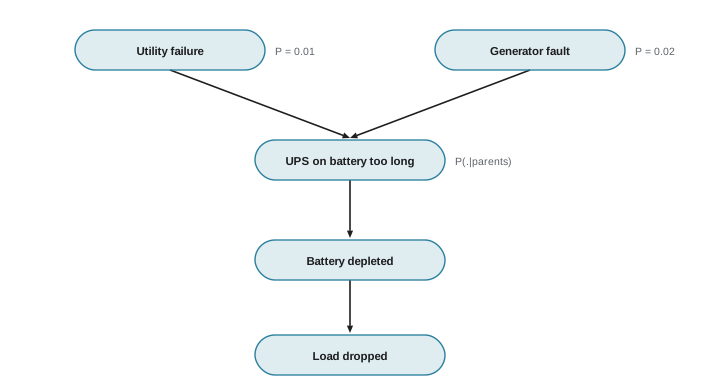
Real problems involve many uncertain variables that influence each other. A Bayesian network represents them as a graph in which arrows show direct influence, and each variable has a table of probabilities given its parents. For example, a network for diagnosing a data centre outage might link "utility failure" and "generator fault" to "UPS on battery", and that to "battery depleted" and "load dropped". Given evidence (the load dropped and the utility was normal), the network computes the most likely causes. Bayesian networks are used in medical diagnosis, fault detection, risk assessment and spam filtering, and they make reasoning transparent because the structure and probabilities can be inspected.
Decisions under uncertainty
Knowing probabilities is not enough; an intelligent agent must act. Decision theory combines probabilities with utilities (values of outcomes) and chooses the action with the highest expected utility:
Worked problem
Should we replace the battery string?
A battery string has a 4% chance of failing in the next year. A failure during an outage would cost $2 million. Replacing it now costs $60,000 and reduces the failure chance to 0.5%. Which choice has the lower expected cost?
Show solution
- Keep: \(0.04 \times 2{,}000{,}000 = \$80{,}000\) expected loss.
- Replace: \(60{,}000 + 0.005 \times 2{,}000{,}000 = \$70{,}000\).
Answer: Replacing has the lower expected cost ($70,000 versus $80,000), though the margin is small and depends on the estimates. Expected-value reasoning underlies maintenance planning, insurance, medical decisions and the reward signals used in reinforcement learning (Lesson 7).
Logic, probability and learning today
Modern machine learning systems are, in a sense, probabilistic reasoners whose knowledge is learned from data rather than written by hand: a classifier outputs probabilities, and a language model is a probability distribution over text. But they lack some strengths of explicit knowledge: guaranteed consistency, easy updating of individual facts, and transparent explanations. Researchers in neurosymbolic AI combine the two, for example by letting language models call logic engines, calculators and databases (tool use), or by constraining learned systems with rules. When reliability and explanation matter, as in medicine, law, engineering and finance, explicit knowledge and well-calibrated probabilities remain essential.
Common mistakes
MistakeIgnoring base rates when interpreting a positive test or alarm.
InsteadCombine the likelihood with the prior using Bayes' rule.
MistakeAssuming rule-based systems handle situations no one anticipated.
InsteadThey are brittle outside their rules; test unusual cases.
MistakeTreating a confident output as certain.
InsteadAsk for calibrated probabilities and evidence.
MistakeChoosing actions by probability alone.
InsteadWeigh probabilities by the value of outcomes (expected utility).
MistakeAssuming learned and rule-based approaches cannot be combined.
InsteadMany practical systems use both.
Summary and key terms
- Logic states facts and rules precisely and derives conclusions soundly and transparently.
- Expert systems encoded specialist rules but were brittle and hard to build and maintain.
- Knowledge graphs link entities through relationships and support inference and search.
- Bayes' rule updates beliefs with evidence: posterior ∝ likelihood × prior.
- Base rates matter: rare conditions produce many false positives.
- Bayesian networks model many uncertain variables; decision theory chooses actions by expected utility.
- Modern AI increasingly combines learned models with explicit knowledge and tools.
- Knowledge representation
- Encoding knowledge in a form a computer can reason with.
- Inference
- Deriving new conclusions from known facts and rules.
- Modus ponens
- From "if P then Q" and P, conclude Q.
- Expert system
- A rule-based system encoding specialist knowledge.
- Knowledge graph
- A network of entities connected by labeled relationships.
- Prior probability
- Belief in a hypothesis before seeing evidence.
- Posterior probability
- Belief after taking evidence into account.
- Bayes' rule
- P(H|E) = P(E|H) P(H) / P(E).
- Bayesian network
- A graph of variables with conditional probability tables.
- Expected utility
- The probability-weighted value of an action's outcomes.
Practice problems
Work each problem on paper first, then reveal the answer to check.
From "if it rains, the ground is wet" and "it rains", what follows, and by which rule?
Show answer
The ground is wet, by modus ponens.
Name three limitations of expert systems.
Show answer
Knowledge acquisition bottleneck, brittleness, maintenance, common sense, uncertainty.
Give an example of inference in a knowledge graph.
Show answer
A in B and B in C implies A in C.
Prevalence 2%, sensitivity 90%, false positive rate 10%. P(disease | positive)?
Show answer
0.018/(0.018 + 0.098) = 0.155.
Why does a second positive test raise the probability so much?
Show answer
The first positive raised the prior from 1% to 16%, so the second starts from a much higher base.
Detector flags 1% of normal and 95% of attacks; attacks are 0.5%. Precision of flags?
Show answer
0.00475/(0.00475 + 0.00995) = 32%.
What does an arrow in a Bayesian network mean?
Show answer
Direct probabilistic influence of one variable on another.
Action A: 10% chance of $50,000 loss. Action B: $3,000 cost and 2% chance. Expected costs?
Show answer
A: $5,000; B: $4,000.
Why are explicit rules still used alongside machine learning?
Show answer
For guaranteed policies, transparency, compliance and easy updates.
What is neurosymbolic AI?
Show answer
Combining neural learning with symbolic logic or knowledge.
Lesson quiz · 5 questions
Score 60% or more to complete this lesson.
Create a free account to save your progress, take quizzes and earn a certificate.