
ACCT-321 · Lesson 11 of 12 · 26 min
Incentives, compensation and agency
Performance measures matter most when something depends on them. Lessons 4 to 10 developed measures of divisional performance; this lesson asks how those measures should be tied to managers' rewards. It starts with agency theory, the main economic framework for thinking about incentives, then turns to the design of annual bonus plans, long-term incentives, bonus banks and clawbacks, and finally to the behavioural problems that incentive plans create. Executive pay governance, including say-on-pay votes and board compensation committees, is covered in BUS-310, and the accounting for share-based payment in ACCT-212; here the focus is on incentive design as part of the management control system. Regulatory facts are stated as of October 2026.
Agency theory
Agency theory models the relationship between a principal, such as shareholders or head office, and an agent, such as a divisional manager, who acts on the principal's behalf. Two problems arise because the agent's interests differ from the principal's and the principal cannot observe everything the agent does or knows. Moral hazard is the risk that the agent, whose effort and choices are hidden, will act in his or her own interest: working less hard, consuming perquisites, avoiding risky but valuable projects, or managing reported results. Adverse selection arises from hidden information: the agent knows more about the division's prospects or costs than the principal, as in the budget slack problem of lesson 3.
The principal can reduce these problems by monitoring the agent, which is costly and incomplete, or by tying the agent's pay to outcomes that reflect effort and decisions. But outcomes also depend on factors outside the agent's control, such as the economy, competitors and weather. Pay that depends heavily on outcomes therefore loads risk onto the agent, who is usually more risk averse than diversified shareholders and must be paid a risk premium to accept it. The design problem is to balance incentives against risk.
A standard result from the linear agency model developed by Bengt Holmström and Paul Milgrom shows the trade-off. If the agent's pay is a fixed salary plus a share \(b\) of a measured outcome, the best share falls as the agent's risk aversion \(r\), the cost of effort \(c\) and the noise in the measure \(\sigma^2\) increase.
The practical implications are important. Noisy measures should carry weaker incentives. Measures should be chosen for their informativeness about the agent's actions: Holmström's informativeness principle says that any measure that adds information about the agent's effort, even a non-financial or relative one, should be included in the contract. This is the formal case for the controllability principle of lesson 2, for relative performance evaluation, which filters out common shocks, and for the balanced scorecard's mix of measures.
Forms of compensation
Managers' pay at Cormorant, as at most companies, has three main parts. Base salary rewards the job and the person's experience and is not at risk. The annual bonus, or short-term incentive, rewards performance against one-year targets, typically in cash. Long-term incentives reward performance over three or more years, usually in shares: restricted share units that vest over time, performance share units whose number depends on measures such as relative total shareholder return or cumulative EVA, and sometimes share options. Long-term awards align managers with shareholders and encourage retention, but share prices depend heavily on market-wide factors, and divisional managers have limited influence on the company's share price, so their line of sight from action to reward is weak.
| Component | Measure at Cormorant | Horizon | Main purpose |
|---|---|---|---|
| Base salary | Market data for the role | Ongoing | Attract and retain |
| Annual bonus | Divisional controllable margin (60%) and scorecard objectives (40%) | One year | Reward annual performance against plan |
| Performance share units | Three-year cumulative EVA and relative total shareholder return | Three years | Align with shareholders and long-term value |
| Restricted share units | Continued service | Three-year vesting | Retention |
| Benefits and pension | Service | Long term | Security and retention |
Designing the annual bonus
The annual bonus is where management accounting and compensation meet most directly. A typical plan specifies a target bonus as a percentage of salary, a performance measure, a target level of performance, a threshold below which nothing is paid, and a cap above which the bonus does not increase. Cormorant's plan for the Appliances general manager, whose salary is $250,000, sets a target bonus of 40 per cent of salary. For the financial part, the target is the budgeted controllable margin of $5,500,000 from lesson 3, the threshold is 80 per cent of target, paying half the target bonus, and the cap is 120 per cent of target, paying 150 per cent.
# Appliances general manager's 2027 annual bonus plan (illustrative; $000)
salary, target_pct = 250, 0.40
target = 5_500                      # budgeted controllable margin (lesson 3)
threshold, cap = 0.80 * target, 1.20 * target
def payout(margin):
    if margin < threshold: return 0.0
    if margin <= target: share = 0.50 + 0.50 * (margin - threshold) / (target - threshold)
    else: share = 1.00 + 0.50 * (min(margin, cap) - target) / (cap - target)
    return salary * target_pct * share
for m in (4_000, 4_400, 5_000, 5_500, 6_000, 6_600, 7_000):
    print(f"Controllable margin {m:>5,}: bonus {payout(m):6.1f}")
# Gaming at the kinks
print(f"Pull 300 forward from 2028 when at 4,200: bonus {payout(4_200):.1f} -> {payout(4_500):.1f}")
print(f"Defer 400 to 2028 when at 7,000: bonus {payout(7_000):.1f} -> {payout(6_600):.1f}")Controllable margin 4,000: bonus 0.0 Controllable margin 4,400: bonus 50.0 Controllable margin 5,000: bonus 77.3 Controllable margin 5,500: bonus 100.0 Controllable margin 6,000: bonus 122.7 Controllable margin 6,600: bonus 150.0 Controllable margin 7,000: bonus 150.0 Pull 300 forward from 2028 when at 4,200: bonus 0.0 -> 54.5 Defer 400 to 2028 when at 7,000: bonus 150.0 -> 150.0
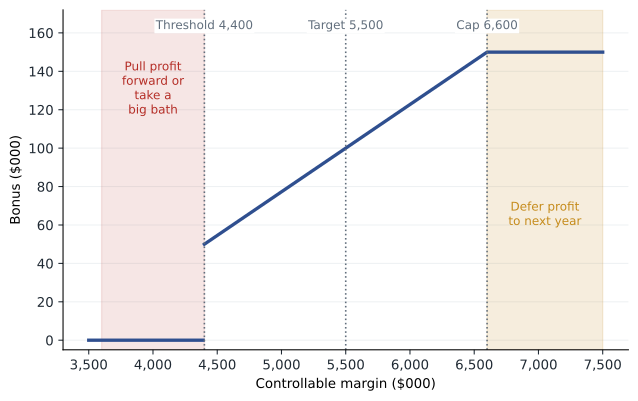
The plan's kinks create incentives that have been documented in research since Paul Healy's 1985 study of bonus schemes. A manager who expects to finish just below the threshold, at $4,200,000, gains $54,500 by pulling $300,000 of profit forward from next year, by accelerating shipments, delaying discretionary spending or adjusting estimates. A manager who expects to finish far below the threshold may do the opposite, taking a big bath: pushing costs into the current year, when the bonus is lost anyway, to make next year's target easier. And a manager above the cap, at $7,000,000, loses nothing by deferring $400,000 of profit to the next year, where it may help earn a bonus. None of these actions creates value; some, such as cutting maintenance or training, destroy it.
Plan designers reduce these problems in several ways. Wider ranges between threshold and cap, or no cap at all, reduce the zones where gaming pays. Linear plans without thresholds or caps remove kinks entirely but can pay large bonuses for luck and impose large losses for bad luck. Targets set from external benchmarks or prior-year results rather than negotiated budgets reduce the incentive to sandbag, as lesson 3 discussed. Multi-year measurement, deferral and bonus banks spread the consequences of income shifting over time. Discretionary adjustments by the compensation committee can correct for obvious manipulation or uncontrollable events, at the cost of subjectivity.
Bonus banks
A bonus bank, promoted by Stern Stewart alongside EVA (lesson 5), removes thresholds and caps but defers payment. Each year a bonus is declared from the change in EVA or another measure, without a cap, and can be negative. The declared bonus is added to the manager's bank, and only a fraction of a positive balance, often a third, is paid out each year. A negative balance carries forward and must be earned back before anything more is paid.
# A bonus bank: declared bonuses are banked; one-third of a positive balance is paid each year ($000)
declared = {2027: 180, 2028: -60, 2029: 120, 2030: -150, 2031: 90}
balance = 0.0
for year, bonus in declared.items():
    balance += bonus
    paid = balance / 3 if balance > 0 else 0.0
    balance -= paid
print(f"{year}: declared {bonus:>5} paid {paid:6.1f} carried forward {balance:7.1f}")2027: declared 180 paid 60.0 carried forward 120.0 2028: declared -60 paid 20.0 carried forward 40.0 2029: declared 120 paid 53.3 carried forward 106.7 2030: declared -150 paid 0.0 carried forward -43.3 2031: declared 90 paid 15.6 carried forward 31.1
The bank pays $60,000 in 2027 on a declared bonus of $180,000, then recovers part of the overpayment risk when 2028's declared bonus is negative. By 2030, a large negative year drives the balance below zero and nothing is paid; the manager must earn back $43,300 before receiving more. Because there is no threshold and no cap, the manager has no reason to shift income between years at the margin, and because payouts are deferred, a manager who boosts short-term results at the expense of later years will find the bank depleted. The main disadvantages are complexity and the risk that managers with large negative balances will leave rather than work them off, which is why some plans forgive part of a negative balance or start new managers with a positive one.
Worked problem
Choosing between a capped plan and a bonus bank
Appliances' controllable margin turns out to be $7,000,000 in 2027, $4,200,000 in 2028 and $5,500,000 in 2029. Under the 80/120 plan, what total bonus is paid, and what income shifting might a manager try?
Show solution
- 2027: above the cap; bonus $150,000. The manager could defer up to $400,000 to 2028 at no cost.
- 2028: below the threshold; bonus $0, unless profit can be pulled forward. If $400,000 had been deferred from 2027, 2028 margin of $4,600,000 would pay about $59,100.
- 2029: at target; bonus $100,000.
- Total without shifting: $250,000; with the deferral: about $309,100, with no change in underlying performance.
Answer: The capped plan pays $250,000 but rewards about $59,100 for timing alone; a bonus bank or wider range would reduce that incentive.
Clawbacks and deferral
A clawback provision allows a company to recover incentive pay that was based on results later found to be misstated. Canada has no general securities rule requiring clawbacks, but many TSX-listed companies have adopted policies voluntarily, often triggered by a restatement combined with misconduct, and Canadian companies also listed on a US exchange must comply with the US rule. Canadian reporting issuers disclose executive pay, including any clawback policy, under Form 51-102F6.
Clawbacks are only as effective as their enforcement; recovering paid cash from former executives can be slow and costly. Deferral, holding back part of each bonus for several years and paying it only if results hold up, achieves a similar effect with less friction, which is one reason financial regulators have required deferral for senior bankers in many countries.
Behavioural problems and remedies
Incentive plans focus attention, which is their purpose, but they can focus it too narrowly. Managers pursue what is measured and rewarded at the expense of what is not, a problem described in Steven Kerr's classic 1975 article on rewarding A while hoping for B. Financial targets can crowd out intrinsic motivation and ethical restraint, especially when targets are very difficult: several well-known corporate scandals, including fraudulent sales practices at banks, have been linked to aggressive targets combined with weak controls. Team-based bonuses encourage cooperation, as in the transfer pricing disputes of lessons 6 and 7, but invite free riding. Subjective evaluations allow judgement about what really happened but are vulnerable to personal bias and to systematic errors in judgement, such as the common-measures bias of lesson 9.
ESG-linked pay, now included in the incentive plans of many large companies, illustrates the trade-offs. Linking part of the bonus to Cormorant's emissions and heat pump targets (lesson 10) can signal priorities and focus effort. But if the targets are vague, easy or assessed by the managers themselves, the link rewards managers without changing outcomes. Good practice uses a small number of measurable, audited targets that are material to the strategy, sets them with the same rigour as financial targets, and discloses how they were met.
Ethics codes add a professional dimension. CPA Canada's codes of professional conduct require management accountants to act with integrity and objectivity, which includes refusing to manipulate reported results to trigger bonuses, their own or their managers'. The management accountant who designs or calculates a bonus plan has a particular duty to ensure that its measures are reliable and that adjustments are disclosed and justified.
Common mistakes
MistakeTying pay to a measure without considering its noise.
InsteadNoisy measures warrant weaker incentives; add informative measures that filter out noise.
MistakeIgnoring the incentives created by thresholds and caps.
InsteadKinks invite income shifting and big baths; widen ranges, use banks or deferral.
MistakeRelying only on share-based awards for divisional managers.
InsteadDivisional managers have weak line of sight to the share price; include divisional measures.
MistakeAssuming clawbacks solve manipulation.
InsteadRecovery is slow and costly; combine with deferral and strong controls.
MistakeAdding ESG targets that are vague or self-assessed.
InsteadUse a few measurable, audited, material targets set with financial rigour.
Summary and key terms
- Agency theory identifies moral hazard (hidden action) and adverse selection (hidden information).
- Incentives must be balanced against risk: noisier measures and more risk-averse agents call for weaker incentives.
- The informativeness principle supports adding any measure that reveals information about the agent's actions.
- Pay typically combines base salary, an annual bonus and long-term share-based awards.
- Thresholds and caps in bonus plans create incentives to shift income and take big baths.
- Bonus banks remove thresholds and caps and defer payment, reducing short-term gaming.
- Canada has no general mandatory clawback rule; US-listed Canadian companies follow US rules.
- Agency theory
- A framework analysing contracts between a principal and an agent who acts on the principal's behalf.
- Moral hazard
- The risk that an agent whose actions are hidden will act in his or her own interest.
- Adverse selection
- Problems arising from an agent's private information.
- Informativeness principle
- Any measure that adds information about an agent's actions should be used in the contract.
- Risk premium
- Additional pay required for a risk-averse agent to accept uncertain compensation.
- Threshold
- The performance level below which no bonus is paid.
- Cap
- The performance level above which the bonus does not increase.
- Big bath
- Pushing costs into a year in which the bonus is lost anyway, to make future targets easier.
- Bonus bank
- A plan in which uncapped bonuses, positive or negative, are banked and paid out gradually.
- Clawback
- Recovery of incentive pay based on results later found to be misstated.
Practice problems
Work each problem on paper first, then reveal the answer to check.
Rerun the bonus program with a cap of 130 per cent of target. Bonus at a controllable margin of $7,000,000?
Show answer
About $145,500, because the payout now reaches 150 per cent only at $7,150,000.
Under the original plan, what is the bonus at $4,900,000?
Show answer
About $72,700.
A manager expects $3,800,000. Why might he or she take a big bath?
Show answer
No bonus is possible this year, so pushing costs into it makes next year's target easier.
Rerun the bank program with a 2030 declared bonus of −30. Amount paid in 2030 and balance carried?
Show answer
Paid about $25.6 thousand; balance about $51.1 thousand.
Using the formula for the optimal share, what happens to b* if measurement noise doubles?
Show answer
It falls, because the denominator rises.
Give two reasons share-based awards are a weak incentive for divisional managers.
Show answer
Share prices depend on market-wide factors, and one division has limited influence on the share price.
What does Kerr's "rewarding A while hoping for B" describe?
Show answer
Incentive systems that reward behaviour different from what the organization actually wants.
Why might an evaluator prefer relative performance evaluation for Components?
Show answer
It filters out industry-wide shocks, making the measure more informative about the manager's actions.
Name two features of good ESG-linked pay.
Show answer
Measurable, audited targets that are material to the strategy (also rigorous target setting, disclosure).
How does deferral achieve a similar effect to a clawback?
Show answer
Pay is withheld until results hold up, so recovery is not needed.
Lesson quiz · 5 questions
Score 60% or more to complete this lesson.
Create a free account to save your progress, take quizzes and earn a certificate.