
WLD-230 · Lesson 9 of 12 · 16 min
Overhead groove welds (4G)
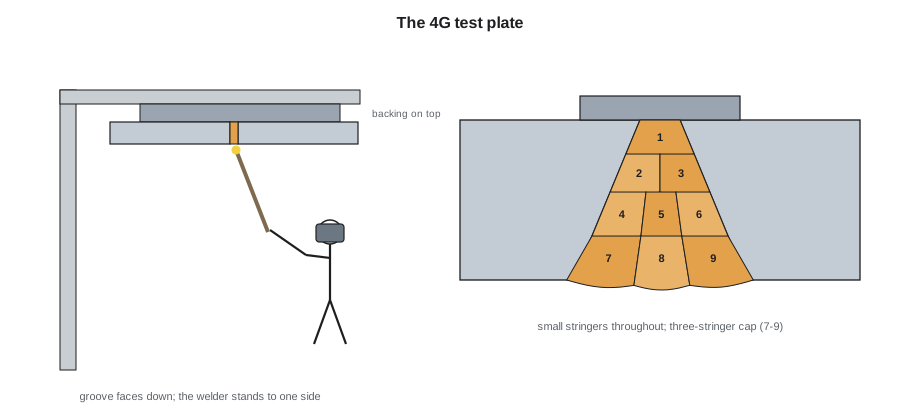
The overhead groove, 4G, is the last position in Devon's training. The test plate is held above the welder's head with the groove facing down and the backing bar on top, and every pass is welded from underneath. It combines the hardest parts of everything so far: a root that must fuse its corners into a backing above it, fill passes that must fuse sidewalls while hanging upside down, and a cap that must lie flat across a groove where gravity pulls the middle of every bead down. A passed 4G plate qualifies the welder for flat and overhead groove welds, and together with a 3G plate, for groove welds in all positions on plate.
Setting up the 4G plate
The plate is clamped in the overhead arm of the welding stand, groove down, so that the bottom face of the plate is at about forehead height. Devon checks that he can reach the whole length of the groove from where he will stand without stretching, that the lead is hung over the arm of the stand so the stinger hangs free, and that the fume arm is close. The plate cannot be moved once welding starts, so he takes a full minute to walk along under it with an unlit electrode in the holder, checking his reach and angles from one end to the other.
The protection is the same as for overhead fillets: cap, closed collar, earplugs, gauntlets. A groove plate puts more spatter into the air than a fillet because there are more passes, and a hot slag chip falling from a groove is the size of a fingernail. Devon chips with a clear face shield down and steps to the side of the plate when chipping.
The overhead root
The root on backing overhead is run with the 1/8 in E7018 at about 105 to 120 A, slightly higher than vertical because the arc must push the pool up into the groove against the backing. The electrode is held square across the groove, with a slight push in the direction of travel, and the arc is held very short, with the coating almost resting on the bevel edges.
The key to the overhead root is to push the electrode up into the groove. Beginners tend to hold the electrode back at the mouth of the groove, afraid of the pool, and the arc then melts the bevel edges near the face without reaching the backing. The root sits low in the groove, fused to the bevels but not to the backing, and the bend test opens along the backing line. Marta has Devon feel the electrode coating touching both bevel edges as he travels, which guarantees that the arc is at the root. The motion is a small side-to-side movement within the root opening, with a brief pause at each corner.
The overhead root is often convex, because the pool sags slightly toward the welder before it freezes. A convex root leaves valleys at the sidewalls, and the valleys must be ground before the next pass. Devon grinds every overhead root, which takes about a minute with a thin disc.
Fill passes overhead
Overhead fill passes are small stringers, smaller than in any other position. Each pass should be no wider than about two to two and a half times the electrode diameter, and no thicker than about 1/8 in. A larger pass sags and traps slag at its edges. The layers are built the same way as in the flat position, sidewall passes first, then the middle, but with more passes per layer: on the 3/8 in test plate, Devon runs the root, a second layer of two passes, a third layer of two or three passes and a cap of three passes.
The aim on each overhead stringer is a flat or slightly concave bead that fuses smoothly into the sidewall and the bead beside it. The electrode is pointed slightly toward the sidewall for a sidewall pass, and square for a middle pass. Travel is steady, and the arc stays short. Each pass is chipped, brushed and checked, and any convex pass is ground before the next.
Overhead welding is tiring, and a tired welder makes defects. On the 4G plate, Devon welds one pass, steps out from under the plate to chip and rest his arm while the plate cools toward the interpass limit, and then welds the next. The plate cools a little between passes this way, which also keeps the interpass temperature under control.
The overhead cap
The overhead cap is made with stringers, not a weave. Three overlapping passes cover the groove on the test plate: one along each bevel edge and one in the middle. Each edge pass fuses into the bevel edge and about 1/16 in onto the plate surface, and the middle pass overlaps both. The middle pass must be run a little faster than the edge passes, so that it does not sag below the line of the edges. Done well, the overhead cap is flat, with the three passes blending into one surface. Done poorly, it has a sag in the middle, undercut at the edges, or both.
The most common overhead cap fault is undercut at the edges, from too much current or from the edge passes being aimed too far onto the plate. The second is convexity in the middle, from a slow middle pass. Lucia measures the cap reinforcement on overhead plates carefully, because a sagging overhead cap can exceed the 1/8 in limit in the middle even when it looks right.
Comparing the positions
| Flat (1G) | Vertical (3G) | Overhead (4G) | |
|---|---|---|---|
| Current, 1/8 in E7018 | 115-135 A | 95-115 A | 105-120 A |
| Root motion | Slight side to side | Small triangle, upward | Small side to side, pushed up into the groove |
| Fill | Stringers | Stringers, up each sidewall | Small stringers, more of them |
| Cap | Stringers | One weave, edge to edge | Three stringers |
| Main risk | Cold corners on backing | Sagging, undercut, sidewall fusion | Root not reaching backing, sag, slag at toes |
| Passes on 3/8 in plate | 5-6 | 6-7 | 8-9 |
Tracking progress
Devon has been keeping his practice log since week one: the date, position, plate number, current, the result of the visual check and the result of the bend or break test. By week eight, Lucia sits down with him to look at the numbers, because the test is two weeks away and the log shows where his weak spots are.
# Practice log summary: pass rate by position and the most common reason for failure
from collections import Counter, defaultdict
log = [
    # (week, position, passed, reason)
    (3, "1G", False, "cold corner"), (3, "1G", True, ""), (3, "1G", True, ""), (4, "1G", True, ""), (4, "1G", True, ""),
    (4, "2G", False, "undercut"), (4, "2G", True, ""), (4, "2G", True, ""), (5, "2G", True, ""),
    (5, "3G", False, "cold corner"), (5, "3G", False, "slag at restart"), (6, "3G", False, "sidewall fusion"), (6, "3G", True, ""),
    (6, "3G", True, ""), (7, "3G", True, ""), (8, "3G", True, ""),
    (7, "4G", False, "root not on backing"), (7, "4G", False, "slag at toe"), (7, "4G", True, ""), (8, "4G", False, "root not on backing"),
    (8, "4G", True, ""), (8, "4G", False, "root not on backing"), (8, "4G", True, ""), (8, "4G", True, ""),
]
by_pos = defaultdict(list)
for week, pos, ok, why in log:
    by_pos[pos].append((week, ok, why))
for pos in sorted(by_pos):
    rows = by_pos[pos]
    rate = 100 * sum(ok for _, ok, _ in rows) / len(rows)
    last3 = rows[-3:]
    recent = 100 * sum(ok for _, ok, _ in last3) / len(last3)
    reasons = Counter(why for _, ok, why in rows if not ok).most_common(1)
    top = reasons[0][0] if reasons else "none"
print(f"{pos}: {len(rows):2d} plates, {rate:3.0f}% passed overall, {recent:3.0f}% of the last {len(last3)}; most common failure: {top}")1G: 5 plates, 80% passed overall, 100% of the last 3; most common failure: cold corner 2G: 4 plates, 75% passed overall, 100% of the last 3; most common failure: undercut 3G: 7 plates, 57% passed overall, 100% of the last 3; most common failure: cold corner 4G: 8 plates, 50% passed overall, 67% of the last 3; most common failure: root not on backing
The summary tells a clear story. His flat and horizontal plates are reliable. His vertical plates were weak at first and are now passing consistently. His overhead plates are improving, two of his last three passed, but the most common failure is a root that did not reach the backing, the beginner's overhead fault of holding the electrode back at the mouth of the groove. For the next two weeks, Lucia has him weld overhead roots only, on short scrap plates with the backing knocked off after each one so he can see the fusion, until ten in a row are fused right across.
Overhead groove welds in production
Real overhead groove welds are less common than overhead fillets, because good design and fabrication practice avoid them: a beam can usually be turned over, and a joint can usually be welded from above. They do occur in the field, in repairs and on structures that cannot be moved. During Devon's overhead weeks, the Unit 4 pipe rack needs a short extension: a new beam spliced to an existing one with complete joint penetration welds in the flanges, and the bottom flange can only be welded from underneath. Marta makes the bottom flange weld, overhead, from a lift, and Devon assists and watches. The flange is 1/2 in thick, welded on backing, and takes eleven passes.
Watching an experienced welder do it for real teaches Devon two things the practice booth had not. Marta takes longer between passes than he expected, cleaning each pass meticulously and checking it with a light before the next. And she grinds more: every pass that is even slightly convex gets a touch with the disc. She tells him that an overhead joint that will be ultrasonically tested is not the place to save a minute.
Common 4G defects
| Defect | Cause | Correction |
|---|---|---|
| Root not fused to the backing | Electrode held back at the mouth of the groove | Push the electrode up so the coating touches both bevels |
| Convex root with valleys | Pool sagging before it freezes | Grind the root; lower current slightly |
| Slag at the toes of fill passes | Passes too large and convex | Smaller passes; grind convex beads |
| Sag in the middle of the cap | Middle cap pass too slow or too hot | Run the middle pass faster |
| Undercut at the cap edges | Current too high, edge passes aimed onto the plate | Lower current; aim at the bevel edge |
| Porosity | Long arc, damp electrode | Short arc, electrodes from the oven |
Avoiding overhead welding in production
In the shop, overhead welding is avoided wherever possible, because it is slow, tiring and more likely to have defects. Hartwell's fabrication sequence is planned so that assemblies can be turned: a beam is welded on one side, rolled over with the crane and the rolling fixture, and welded on the other side in the flat or horizontal position. The Coldwater skid base frame was welded on stands that let it be rolled. Raj, the detailer, marks on the shop drawings which welds are expected to be made in position because the assembly cannot be turned, so that Glen can assign qualified welders to them.
Overhead groove welds remain where the structure cannot be turned: field connections, repairs on structures in service, the underside of a tank roof or a vessel saddle, and pipe joints in fixed positions, where the bottom of every joint is welded overhead. That is the real reason for the 4G test. A welder who can make a sound overhead groove on a plate in the booth can make the bottom of a pipe joint on a rack, which is where the next course is going.
Pacing the 4G test plate
On the test day, Devon will have a time limit for each plate, set by the examiner, and the overhead plate is the one where pacing matters most. In his last week of practice, he times each step of his 4G plates: setting up and checking reach, root, grinding the root, each fill pass with its chipping and cooling, and the three cap passes. His plates take about thirty-five minutes, of which only about eight are arc time. The rest is cleaning, grinding, checking temperature and resting the arm, and Marta tells him not to try to save time there. The time to save is the time spent hesitating before each pass, which he cuts by planning the order of the passes on the plate before he starts.
Common mistakes
MistakeHolding the electrode back at the mouth of the groove.
InsteadPush it up into the groove so the arc reaches the backing.
MistakeRunning large overhead fill passes to save time.
InsteadKeep passes small, about two to two and a half electrode diameters wide.
MistakeWeaving the overhead cap.
InsteadMake the cap with three stringers, running the middle one faster.
MistakeSkipping the grinder on convex passes.
InsteadGrind every convex root or fill pass overhead.
MistakeWelding pass after pass without a break.
InsteadStep out between passes to chip, rest and let the plate cool.
Summary and key terms
- A 4G plate is a groove welded overhead with the backing on top.
- Push the root electrode up into the groove until the coating touches both bevels.
- Fill with small stringers; grind any convex pass.
- Make the cap with three stringers, the middle one run faster.
- Rest between passes; overhead fatigue causes defects.
- A practice log shows which positions and faults need more work.
- 4G
- A groove weld in plate in the overhead position.
- Practice log
- A record of each practice weld, its settings and its test result.
- Convexity
- The amount by which a weld face stands above a straight line between its toes.
Practice problems
Work each problem on paper first, then reveal the answer to check.
A 4G root bend opens along the line of the backing. What is the usual cause?
Show answer
The root did not reach the backing because the electrode was held back.
How wide should an overhead fill stringer be with a 1/8 in electrode?
Show answer
About 1/4 to 5/16 in, two to two and a half times the electrode diameter.
How is the 4G cap made on the test plate?
Show answer
As three overlapping stringers, one on each edge and one in the middle.
Lesson quiz · 5 questions
Score 60% or more to complete this lesson.
Create a free account to save your progress, take quizzes and earn a certificate.