
WLD-230 · Lesson 1 of 12 · 16 min
From fillets to groove welds
Devon Okafor has spent most of his first two years at Hartwell Fabrication putting down fillet welds: gussets on the Coldwater skid base frame, stiffeners on the Riverside bridge girders, clips, brackets and farm repairs. He can run a flat or horizontal fillet with E7018 that Lucia Ferreira, the shop's welding inspector, passes without comment, and in the last course he qualified with flux-cored wire in the vertical and overhead positions. What he cannot yet do is the thing every structural welder is eventually judged on: a groove weld in plate, in any position, made with a stick electrode, that bends around a mandrel without opening up. This course takes him there. It starts on the bench with groove preparation and root passes in the flat position, moves the plate up the wall to vertical and then over his head, and ends with the AWS D1.1 3G and 4G plate tests that will let him weld groove joints on code work.
This first lesson looks at what changes when a welder moves from fillet welds to groove welds, why groove welds matter so much in structural and pressure work, and what the plan for the next eleven lessons looks like.
What a groove weld does that a fillet cannot
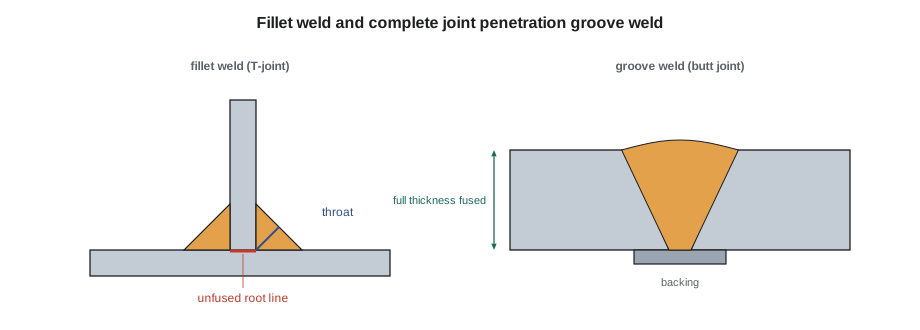
A fillet weld joins two members that meet at an angle, usually in a T-joint, lap joint or corner joint, and it carries load through its throat, the short distance from the root of the joint to the face of the weld. A fillet weld is cheap, easy to fit and forgiving of small gaps, which is why most welds on most drawings are fillets. But a fillet has limits. It cannot join two plates edge to edge in a butt joint, it cannot carry the full strength of a thick plate in tension without becoming enormous, and its root, the unfused line where the two members touch, is a built-in notch that matters under fatigue loading.
A groove weld fills a prepared space between the members. In a complete joint penetration weld, the weld metal runs through the full thickness of the joint, so the welded joint behaves like one solid piece of steel. That is what the flange splices on the Riverside girders need, what a column splice needs, what a lifting lug that takes a crane load needs, and what every pressure-containing seam in a vessel or pipe needs. When Glen Teskey, the shop foreman, schedules the bridge flange splices or the Coldwater skid's lifting lugs, he can only give them to welders who are qualified for groove welds in the position the joint will be welded in.
The parts of a groove weld
The last course went through the groove weld symbol and the names of the parts of a groove, and this course uses those names constantly. For a single-V groove between two plates of the same thickness, the parts are:
- The bevel angle: the angle cut on the edge of each plate, measured from a line square to the plate surface.
- The groove angle: the total included angle between the two bevels. Two 22.5 degree bevels make a 45 degree groove.
- The root face, or land: a short flat on the bottom of the bevel. Many joints welded on backing have no root face at all, a feather edge.
- The root opening: the gap between the members at the root of the joint.
- The backing: a strip of steel, or sometimes a ceramic or copper bar, under the root opening that supports the first pass.
Every one of these is set by the welding procedure, and every one changes how much weld metal the joint needs and how easy the root is to weld. A bigger root opening makes the root easier to fuse on backing but takes more filler. A bigger groove angle gives the electrode better access to the sidewalls but takes much more filler, because the width of the groove grows with depth.
How much more metal a groove takes
A beginner moving from fillets to grooves is usually surprised by how many passes a groove weld takes. The cross-section of a single-V groove with backing and no root face is a rectangle, the root opening times the thickness, plus two triangles, one for each bevel:
where g is the root opening, t is the plate thickness and θ is the bevel angle of each plate. The weld reinforcement, the metal that stands above the plate surface, adds a little more. The second term grows with the square of the thickness, so doubling the thickness of a groove weld more than doubles the weld metal it needs.
# Cross-section of a single-V groove on backing compared with an equal-strength pair of fillets
import math
def groove_area(t, gap, bevel_deg, reinf):
    width = gap + 2 * t * math.tan(math.radians(bevel_deg))
    return gap * t + t * t * math.tan(math.radians(bevel_deg)) + (2 / 3) * width * reinf, width
for t in [0.375, 0.625, 1.0]:
    a, w = groove_area(t, 0.25, 22.5, 0.0625)
    leg = t * 0.75                     # a pair of fillets sized to roughly match, both sides
    fillets = 2 * 0.5 * leg * leg
print(f"plate {t} in: groove area {a:.3f} in2, cap width {w:.2f} in; two fillets of leg {leg:.2f} in use {fillets:.3f} in2")plate 0.375 in: groove area 0.175 in2, cap width 0.56 in; two fillets of leg 0.28 in use 0.079 in2 plate 0.625 in: groove area 0.350 in2, cap width 0.77 in; two fillets of leg 0.47 in use 0.220 in2 plate 1.0 in: groove area 0.709 in2, cap width 1.08 in; two fillets of leg 0.75 in use 0.562 in2
The numbers show the problem in plain terms. Going from 3/8 in to 1 in plate multiplies the groove area by about four. On thick plate, the groove weld is mostly the triangular part, which is why welding engineers like Elena Marchetti choose double-V grooves, smaller angles or other groove shapes when the joint is thick enough to make the metal worth saving.
Positions
In the first SMAW course Devon welded fillets in the flat and horizontal positions, 1F and 2F. The position of a weld is described by a number and a letter. The number gives the position: 1 is flat, 2 horizontal, 3 vertical and 4 overhead. The letter gives the type of weld: F for fillet and G for groove. Plate tests are named the same way, so a 3G test is a groove weld in a plate standing vertically with the weld axis running up and down, and a 4G test is a groove weld in a plate held overhead, welded from underneath.
Canadian practice, including the CWB's welder tests, often uses the letters F, H, V and O for flat, horizontal, vertical and overhead instead of the numbers, and a welder's card lists the positions in which the welder is qualified. Pipe positions have their own numbers, 1G, 2G, 5G and 6G, and come in the pipe welding course.
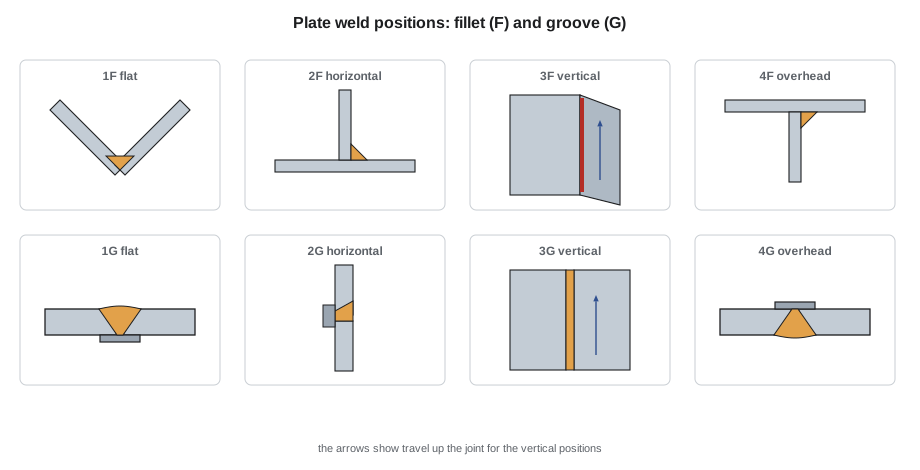
Each position changes what gravity does to the molten weld pool. In the flat position, gravity holds the pool in the joint and helps the welder. In the vertical position, gravity pulls the pool down out of the joint, and the welder controls it with lower current, a shorter arc, the right electrode angle and a technique that lets each part of the pool freeze before the next is added. Overhead, gravity pulls the pool away from the joint and toward the welder, and the welder relies on surface tension and arc force to keep it in place. Most of this course is about learning to work with those forces.
Why stick welding is still the all-position test
Devon already holds flux-cored qualifications, and on the shop floor most production welding at Hartwell is done with wire. So why spend a whole course on stick welding in all positions? Marta Kowalchuk, his mentor, has three answers.
- Field and repair work. Stick welding needs only a power source and a pair of leads. On the Riverside erection, on a farm yard, inside a tank or on the Unit 4 pipe rack, it is often the only practical process, and wind does not blow its shielding away.
- Low-hydrogen electrodes on critical joints. Many repair procedures on thick or high-strength steel call for low-hydrogen stick electrodes, because their hydrogen level is controlled and they can be used in any position.
- Skill transfer. A welder who can run an overhead groove weld with a stick electrode can learn to do it with any other process. The reverse is not always true, because wire processes hide poor technique more easily.
Hartwell's welders all hold SMAW qualifications in all positions to AWS D1.1, and Glen will not send anyone to the field without one.
Groove welds and qualification
A welder is qualified by a test weld made under watch, cut into specimens and tested. For groove welds in plate, the usual test is a single-V groove with a backing bar, welded in the position being qualified, then cut into strips and bent around a mandrel until the surface stretches about a fifth of its length. Any discontinuity in the weld opens up and shows. Lessons 10 and 12 cover the test in detail.
In the United States, structural welders are usually qualified to AWS D1.1, the Structural Welding Code. A welder makes a test weld that is examined visually and then bend tested or radiographed, and the results are recorded on a welder qualification record kept by the employer. The qualification stays in effect as long as the welder keeps using the process; a gap of more than six months without using it ends the qualification. Hartwell's shop test for groove welds uses a 3/8 in plate test on a backing bar, which qualifies a welder for groove welds in a range of thicknesses, and Lucia witnesses the test.
Positions are qualified in a specific way. A test in the vertical position qualifies the flat and horizontal positions as well as vertical, and a test in the overhead position qualifies flat and overhead. A welder who passes both the vertical and overhead groove tests is qualified for groove welds in all positions on plate, and groove qualifications also cover fillet welds in the same positions. That is why the vertical and overhead groove tests are the goal of this course.
Devon's plan
Marta lays out a plan on the whiteboard in the training bay:
| Weeks | Work | Lesson |
|---|---|---|
| 1-2 | Groove preparation, backing, tacking and flat root passes | 2, 3 |
| 3 | Open-root practice with E6010 on scrap plate | 4 |
| 4 | Fill and cap passes in the flat and horizontal positions | 5 |
| 5-6 | Vertical-up fillets, then vertical grooves | 6, 7 |
| 7-8 | Overhead fillets, then overhead grooves | 8, 9 |
| 9 | Cutting and bending practice coupons, defect repairs | 10, 11 |
| 10 | Test plates | 12 |
Between the practice sessions, Devon will use what he learns on real work: vertical groove welds on the Coldwater skid's column splices, overhead fillets under the skid deck, an overhead repair on Wes Brandvold's loader frame and, under Marta's watch, the bearing stiffeners on the Riverside girders.
What the practice plates teach
Each practice plate is a short test of one thing. Devon will weld root passes until the backing is fused along its whole length with no gaps, open roots until the keyhole stays the same size from start to finish, and fill passes until each layer lies flat with no deep valleys at the sidewalls. Every plate is marked with the date, position, electrode and settings, and either broken, bent or cut and etched, so that he knows what was inside it. Lucia's rule is simple: a plate that looks good on top is not a good plate until you have seen inside it.
Common mistakes
MistakeTreating a groove weld as a large fillet.
InsteadA groove weld fills a prepared joint through its thickness; the root, sidewalls and passes all need their own technique.
MistakeAssuming flat technique works in other positions.
InsteadCurrent, arc length, angles and travel all change when the plate goes vertical or overhead.
MistakeJudging a practice plate by its cap.
InsteadBreak, bend or etch practice plates to see the root and sidewall fusion.
MistakeUnderestimating filler for thick grooves.
InsteadGroove area grows with the square of the thickness; plan electrodes and time accordingly.
MistakeThinking a fillet qualification covers groove welds.
InsteadGroove tests qualify fillets, but fillet tests do not qualify groove welds.
Summary and key terms
- Groove welds fill a prepared joint and can fuse the full thickness, which fillets cannot.
- The bevel angle, groove angle, root face, root opening and backing define a groove.
- Single-V groove area is the root opening times thickness plus the bevel triangles, which grow with the square of thickness.
- Positions are numbered 1 to 4 for flat, horizontal, vertical and overhead, with F for fillet and G for groove.
- Vertical and overhead groove tests together qualify a welder for groove welds in all plate positions.
- Stick welding remains the standard field, repair and all-position process.
- Groove weld
- A weld made in a prepared groove between the members.
- Complete joint penetration
- A groove weld that fuses through the full thickness of the joint.
- Groove angle
- The included angle between the bevels of a groove.
- Root opening
- The gap between the members at the root of the joint.
- Backing
- Material placed under the root of a groove weld to support the first pass.
- 3G
- A groove weld in plate in the vertical position.
- 4G
- A groove weld in plate in the overhead position.
Practice problems
Work each problem on paper first, then reveal the answer to check.
What is the groove angle of a single-V joint made from two 30 degree bevels?
Show answer
60 degrees.
What is the area of a single-V groove in 3/8 in plate with a 1/4 in root opening and 22.5 degree bevels, without reinforcement?
Show answer
0.25 x 0.375 + 0.1406 x 0.414 = about 0.152 in2.
Which two plate groove tests qualify a welder for all plate positions?
Show answer
The vertical (3G) and overhead (4G) tests.
Lesson quiz · 5 questions
Score 60% or more to complete this lesson.
Create a free account to save your progress, take quizzes and earn a certificate.