
WLD-210 · Lesson 9 of 12 · 17 min
Flux-cored arc welding: gas-shielded and self-shielded
If one process carries Hartwell's structural work, it is flux-cored arc welding. The Riverside girders' web splices, flange butt welds and stiffener fillets, the skid's heavy lug welds and most of the out-of-position plate welding in the structural bay are made with gas-shielded flux-cored wire, and when the bridge goes up in the field, the erection welds will be made with self-shielded wire. Flux-cored wire combines the high current and continuous feed of a wire process with a slag that does for the weld what the coating of a stick electrode does: protects it, shapes it, alloys it and, above all, holds the pool in place out of position. This lesson covers both families, what their cores do, how to run them, and where each is the right choice and the wrong one.
What the core does
The core of a flux-cored wire is a carefully designed powder. Its ingredients do several jobs at once:
- Slag formers, such as titanium dioxide (rutile), silica, lime and fluorides, melt into a slag that floats to the top of the pool, protects it from the air as it freezes, and shapes the bead.
- Arc stabilizers, such as potassium and sodium compounds, make the arc start easily and burn smoothly.
- Deoxidizers, such as manganese and silicon, clean the pool of oxygen.
- Alloying elements, such as nickel, molybdenum or chromium, adjust the strength and toughness of the weld metal.
- Iron powder adds metal and raises the deposition rate.
- In self-shielded wires, gas formers such as carbonates break down in the arc to make a protective gas, and strong deoxidizers and denitriders such as aluminum and titanium tie up oxygen and nitrogen that reach the pool.
The proportions decide the wire's personality. Rutile-based cores make a fast-freezing slag that freezes before the weld metal, forming a shelf that holds up the pool in vertical-up and overhead welding, and they run with a smooth, spray-like arc and an easily removed slag. Basic cores, rich in lime and fluorides, make weld metal with lower hydrogen and better toughness, with a more globular arc and a slag that freezes more slowly, so they are best in the flat and horizontal positions.
Gas-shielded flux-cored wire
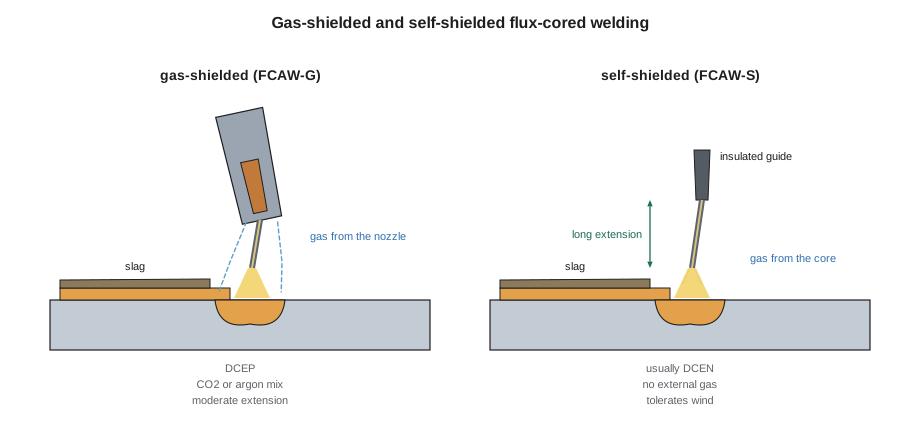
Gas-shielded wires, FCAW-G, use carbon dioxide or an argon and carbon dioxide mix in addition to the core. The all-position rutile type, usability T1, is the most widely used flux-cored wire in structural fabrication. A 0.045 in T1 wire runs at about 150 to 300 A, with the arc in a fine globular to spray-like mode, and can be welded vertical up at well over 200 A, far more current than any stick electrode or solid wire can carry in that position. That is the key to its productivity on plate: high current, deep fusion and fast fill, in any position.
Each T1 wire is classified for a particular gas. With carbon dioxide, the arc is a little harsher with more spatter but deep penetration and lower cost. With a mix of 75 to 80 percent argon and the rest carbon dioxide, the arc is smoother, the spatter lower and the bead flatter, and the voltage is usually set about 1 to 2 volts lower than with carbon dioxide for the same wire speed. The argon mix also keeps more manganese and silicon in the weld, raising strength slightly. Some wires are dual-classified for both gases; others are not, and using the wrong gas with them changes the weld metal. On the Riverside girders, the procedure calls for a T1 wire with an H8 hydrogen limit and a low-temperature toughness rating, in a 75 and 25 mix.
Running gas-shielded flux-cored wire
Devon's flux-cored technique notes:
- Use DCEP, knurled drive rolls with light tension, and a nozzle and tip suited to the current.
- Hold a CTWD of about 5/8 to 1 in, as the wire's data sheet recommends; too short and the tip overheats and spatter builds up, too long and the arc becomes erratic and porosity appears.
- Drag the gun about 5 to 15 degrees in the flat and horizontal positions so the slag stays behind the pool; in vertical up, point the gun up slightly, 0 to 10 degrees, and let the slag shelf hold the pool.
- Keep the arc on the leading edge of the pool. If the slag runs ahead of the arc, slag inclusions and lack of fusion follow.
- Remove all slag between passes, with a chipping hammer and wire brush or a needle scaler, and pay particular attention to the toes and to the corners of grooves where slag lodges.
- Store wire dry. Gas tracks, small worm-like grooves on the bead surface under the slag, are a sign of moisture in the wire, voltage too high for the wire speed, or a stickout outside the range.
In the vertical-up position, Marta teaches Devon a triangular weave or a slight side-to-side motion with a pause at each toe for fillets, and a straight stringer or narrow weave for the root of a groove. The slag shelf lets him run 0.045 in wire at 180 to 210 A and around 24 to 25 V vertical up, and his fillets come out flat with smooth toes. Overhead, he uses stringers with a slight drag and keeps the pool small.
Self-shielded flux-cored wire
Self-shielded wires, FCAW-S, carry their shielding in the core. They need no gas cylinder, regulator or nozzle, and they work in winds that would blow a gas shield away. That makes them the natural choice for field erection, offshore and pipeline work and anywhere a gas cylinder is a nuisance. Their design is different from gas-shielded wires in several ways:
- Most run on DCEN, with the gun negative, which puts more heat into the wire and helps the core chemistry work.
- Many need a longer electrode extension, often 3/4 to 1-1/2 in or more, set by an insulated guide at the end of the gun instead of a gas nozzle. The extension preheats the wire so that the gas formers and deoxidizers react correctly before the metal reaches the arc. Running a self-shielded wire with a short, gas-shielded-style stickout often causes porosity.
- They depend on a short arc. Too high a voltage makes a long arc that lets nitrogen from the air into the pool, faster than the core can tie it up. The result is porosity and, worse, nitrogen in the weld metal that lowers toughness.
- Their weld metal is alloyed with aluminum and other strong deoxidizers. That is why mixing self-shielded welds with welds made by other processes in the same joint can lower toughness: the diluted chemistry is not what either was designed for. Structural specifications for seismic and other demand-critical connections require testing when processes are intermixed.
The common self-shielded types:
| Usability | Positions | Character | Typical use |
|---|---|---|---|
| T8 | All | Basic slag, good low-temperature toughness, DCEN | Field structural, seismic and bridge erection welds |
| T11 | All | General purpose, easy to run, DCEN | Light structural and repair; many are limited in plate thickness or number of passes |
| T4 | Flat and horizontal | High deposition, shallow penetration, DCEP | Heavy fillets and fill on well-fitted joints |
| T7 | Flat and horizontal (some all) | High deposition, DCEN | Heavy fill in the flat position |
The limits on some self-shielded wires matter. Wires of the general-purpose type are often restricted by their makers to a maximum plate thickness or to single-pass welds, because their weld metal becomes brittle when many passes build up. Lucia makes Devon read the data sheet for every self-shielded wire on the field truck, and the bridge erection procedure names a T8 wire with a toughness rating and a hydrogen limit, not a general-purpose one.
Fume
Flux-cored wires make more fume than solid wire, and self-shielded wires make the most of all, because the core's minerals, alloys and gas formers vaporize in the arc. Fume generation rates for self-shielded wires can be several times those of solid wire at the same current. The fume contains manganese and, from some cores, fluorides, and it is the main health hazard for a welder running flux-cored wire all day. Hartwell uses fume extraction guns, which pull fume from just behind the nozzle, on the gas-shielded stations in the structural bay, and portable extractors and position control in the field: the welder keeps their head out of the plume and works upwind where possible.
# Fume exposure estimate: how much fresh air keeps a welder's area below a target? (illustrative)
fgr = {  # fume generation rate, grams per minute of arc time, typical ranges
    "solid wire, spray": 0.3,
    "flux-cored, gas-shielded": 0.6,
    "flux-cored, self-shielded": 1.2,
}
target = 2.0          # target fume concentration in the breathing zone, mg/m3 (illustrative)
capture = 0.7       # fraction removed at source by local extraction
arc_fraction = 0.4    # arc on 40 percent of the time
for name, rate in fgr.items():
    escaping = rate * 1000 * arc_fraction * (1 - capture)       # mg per minute into the room air
    airflow = escaping / target                                 # m3 per minute of dilution air
print(f"{name:27} needs about {airflow * 35.31:7.0f} cfm of dilution air")solid wire, spray needs about 636 cfm of dilution air flux-cored, gas-shielded needs about 1271 cfm of dilution air flux-cored, self-shielded needs about 2542 cfm of dilution air
The point of the illustration is the comparison, not the numbers: removing most of the fume at the source with an extraction gun or arm reduces the dilution air needed many times over, and self-shielded wire needs the most care. Exposure monitoring in the breathing zone, as covered in the safety course, is the only way to know the real exposure.
Choosing gas-shielded or self-shielded
| Factor | Gas-shielded (FCAW-G) | Self-shielded (FCAW-S) |
|---|---|---|
| Wind | Needs shelter above about 8 km/h or 5 mph | Tolerates wind |
| Equipment | Cylinder or bulk gas, nozzle | No gas; light portable feeders |
| Arc and spatter | Smoother, lower spatter | Harsher, more spatter |
| Polarity | DCEP | Usually DCEN |
| Electrode extension | Moderate | Often long, set by guide |
| Fume | Moderate | Highest of the wire processes |
| Toughness and restrictions | Good; wide choice | T8 types good; some general types limited |
| Typical place at Hartwell | Shop structural and girder welding | Field erection and windy repair work |
Devon notices that one of the field welders' trucks has a gas-shielded setup with a tarp enclosure as well as the self-shielded feeder. Marta explains that the bridge erection procedure allows either: gas-shielded where the splice can be enclosed, self-shielded where it cannot. Each has its own qualified procedure, and the welders are qualified for both.
Defects to watch for
Flux-cored welds have their own common defects:
- Slag inclusions, from slag left between passes or a pool that ran ahead of the arc, especially at the toes and in narrow grooves.
- Porosity and gas tracks, from damp wire, wrong stickout, too high a voltage or, with gas-shielded wire, poor gas coverage.
- Incomplete fusion at the toes or sidewalls, from travel speed too fast or an arc that is not directed at the sidewall.
- Wagon tracks, lines of slag inclusion along the two toes of a root pass in a groove, where the slag was trapped and not removed before the next pass.
- Low toughness from mixing self-shielded and other processes, or from running general-purpose self-shielded wire beyond its limits.
Running self-shielded wire in the field
On a breezy morning, Marta takes Devon to the river crossing, where the Riverside bridge abutments have embedded steel bearing plates waiting for small erection clips. The self-shielded feeder runs from the generator welder on the truck, with the feeder set beside the work and the work lead clamped to the bearing plate itself. Marta sets DCEN on the reversing lead, fits the insulated guide to the gun, checks the extension with a gauge, and runs a test bead on a scrap plate before welding the clips. She keeps the arc short and the travel steady, drags the gun, and stands upwind so the plume blows away from her. After each weld she chips the slag, checks the bead for porosity and fusion at the toes, and marks the clip with her stamp. Devon notices how much more slag and fume the self-shielded wire makes than the gas-shielded wire in the shop, and how little the wind bothers the weld. Back in the truck, the wire spool goes into a sealed bag before the drive back, because the cold morning air is damp.
Common mistakes
MistakeRunning self-shielded wire with a short stickout like a gas-shielded wire.
InsteadUse the extension the wire's data sheet calls for, often much longer.
MistakeTurning up the voltage on self-shielded wire.
InsteadA long arc lets nitrogen in; keep the arc short.
MistakeLeaving slag in the corners of a groove before the next pass.
InsteadClean every pass, especially toes and sidewalls.
MistakeUsing a general-purpose self-shielded wire on thick multipass work.
InsteadCheck the maker's thickness and pass limits.
MistakeWelding self-shielded wire all day without fume control.
InsteadUse extraction, keep out of the plume and monitor exposure.
Summary and key terms
- Flux-cored wire cores contain slag formers, arc stabilizers, deoxidizers, alloys and iron powder; self-shielded cores add gas formers and denitriders.
- Rutile-based T1 gas-shielded wires make a fast-freezing slag that allows high-current all-position welding.
- Gas-shielded wire runs DCEP with carbon dioxide or an argon mix and is dragged so the slag stays behind the pool.
- Self-shielded wire needs no gas and tolerates wind, usually runs DCEN with a long extension and a short arc.
- Some self-shielded wires are limited in thickness or passes; intermixing processes can lower toughness.
- Flux-cored wires make more fume than solid wire, and self-shielded wires the most.
- FCAW-G
- Gas-shielded flux-cored arc welding.
- Rutile
- Titanium dioxide, the main slag former in fast-freezing all-position flux-cored wires.
- Fast-freezing slag
- Slag that freezes before the weld metal and supports the pool out of position.
- Denitrider
- An element such as aluminum that ties up nitrogen in the weld pool.
- Gas tracks
- Worm-like grooves on the bead surface under the slag, caused by gas escaping.
- Wagon tracks
- Lines of slag inclusion along both toes of a groove root pass.
- Intermixing
- Combining welds made by different processes or filler metals in the same joint.
Practice problems
Work each problem on paper first, then reveal the answer to check.
Why does a T1 flux-cored wire weld vertical up at more than 200 A?
Show answer
Its fast-freezing rutile slag supports the pool.
What polarity do most self-shielded wires use?
Show answer
DCEN.
Self-shielded welds show porosity after the welder raised the voltage. What is the likely cause?
Show answer
The longer arc let nitrogen into the pool.
Lesson quiz · 5 questions
Score 60% or more to complete this lesson.
Create a free account to save your progress, take quizzes and earn a certificate.