
WLD-210 · Lesson 7 of 12 · 16 min
Pulsed spray and advanced waveforms
Spray transfer gives clean, well-fused welds but only in the flat and horizontal positions; short-circuit transfer goes anywhere but risks cold lap on plate. For decades welders filled the gap with flux-cored wire. Then inverter power sources made it possible to switch the current between high and low values hundreds of times a second, under precise electronic control, and a new mode was born: pulsed spray transfer. Today most new multiprocess machines in Hartwell's shop can pulse, and many also offer controlled short-circuit programs that tame the short-circuit arc. This lesson explains how pulsing works, what synergic and adaptive controls do, how controlled short-circuit processes differ, and how heat input is measured when the current is changing faster than a meter can follow. It also explains why Lucia Ferreira insists that the program number on the machine is as much a part of the procedure as the wire and gas.
How pulsed spray works
In pulsed spray transfer, GMAW-P in the code abbreviations, the power source alternates between two current levels. During the peak, the current rises above the spray transition current for a few milliseconds, long enough to pinch off one droplet, about the size of the wire, and fire it across the arc in spray fashion. Then the current drops to a low background level, just enough to keep the arc alight and the wire tip warm, while the next droplet forms. The ideal is one drop per pulse. Pulses repeat at somewhere between about 50 and 400 per second, set by the wire speed: more wire to melt means more pulses.
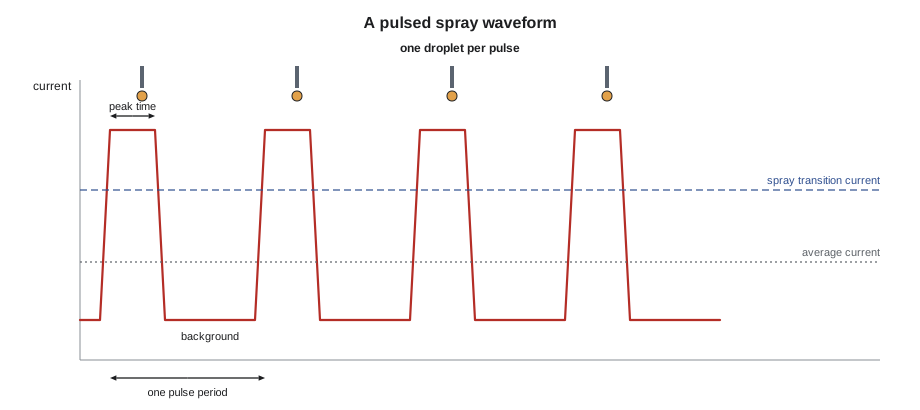
The result is spray-type metal transfer at an average current well below the transition current. The pool is smaller and cooler than a spray pool, so it can be held in vertical and overhead joints and on thinner material, but each droplet still flies across the arc with enough energy to fuse into the plate, and there are no short circuits to throw spatter. Pulsed spray gives good fusion out of position with solid wire, low spatter, and good control on thin stainless and aluminum. Its drawbacks are cost (the machines are more complex), more settings to understand, and a softer, wider arc that can be harder to steer into a tight root.
The pulse parameters
A pulse waveform has more variables than a constant-voltage arc:
- Peak current and peak time, which together set the energy that detaches each droplet.
- Background current, which keeps the arc stable and sets part of the heat.
- Pulse frequency, the number of pulses per second.
- Rise and fall rates, the shape of the edges of each pulse.
Setting all of these by hand for every wire speed would be impractical. Pulse machines therefore use synergic programs. A synergic program is a table, written by the machine maker after extensive testing, that links all of the pulse parameters to the wire feed speed for a particular wire material, diameter and gas. The welder selects the program for the wire and gas, sets the wire feed speed, and the machine chooses the peak, background and frequency to match. A single trim knob, often called arc length or trim, raises or lowers the arc length without the welder touching the individual pulse parameters.
Many machines are also adaptive: they measure the arc voltage on every pulse and adjust the waveform to hold the arc length constant as the stickout changes. When the welder's hand moves the gun closer, the machine shortens the pulses; farther away, it lengthens them. Adaptive pulse is forgiving of a changing stickout, which is common in vertical-up weaving and in tight joints.
# One drop per pulse? Compare droplet volume to wire diameter at a given pulse frequency
import math
d = 0.045                          # wire diameter, in
settings = [(200, 160), (315, 250), (315, 150)]    # wire speed in/min, pulses per second
for wfs, f in settings:
    melt_rate = math.pi * d ** 2 / 4 * wfs  / 60   # wire volume melted per second
    drop = melt_rate / f
    drop_d = (6 * drop / math.pi) ** (1 / 3)
    ratio = drop_d / d
    verdict = "about one drop per pulse" if 0.9 <= ratio <= 1.3 else ("drops too large" if ratio > 1.3 else "drops very small")
print(f"{wfs} in/min at {f} pulses/s: drop {drop_d:.2f} in = {ratio:.2f} x wire, {verdict}")200 in/min at 160 pulses/s: drop 0.04 in = 0.89 x wire, drops very small 315 in/min at 250 pulses/s: drop 0.04 in = 0.89 x wire, drops very small 315 in/min at 150 pulses/s: drop 0.05 in = 1.05 x wire, about one drop per pulse
The synergic program keeps the frequency in step with the wire speed so that each pulse carries a drop close to the wire diameter. If the frequency falls behind, drops grow and transfer becomes irregular and spattery, which is one sign of a wrong program for the wire.
Where Hartwell uses pulse
Marta uses pulsed spray for three jobs. On the Coldwater skid, the vertical fillets that attach the lifting lug plates and the vertical gussets are welded vertical up with 0.045 in ER70S-6 in a 90 and 10 mix on a pulse program, instead of changing over to a flux-cored wire. In the pressure bay, the stainless pipe supports are welded with pulsed stainless wire, which keeps the heat input low and the distortion small. And on aluminum, pulse is the normal mode: the soft wire and the high conductivity of aluminum make pulse the easiest way to get a stable spray-type arc on thin sections. Devon's first vertical-up pulse fillet is wider than he expects because the pool wets out well; Marta has him use a slight weave, pausing at each toe, and travel steadily upward.
Controlled short-circuit processes
Advanced power sources also control the short-circuit cycle itself. Instead of letting the current rise freely during each short and the bridge explode, the machine watches the voltage, detects when the molten bridge is about to break, and drops the current to a low level just before it does, so the droplet separates gently with almost no spatter. After the arc re-ignites, it raises the current again in a controlled pulse to melt the next droplet and push the pool. Makers sell these processes under trade names, but they work on the same principle. Some also move the wire mechanically back and forth, retracting it at each short.
Controlled short-circuit processes give the low heat input and gap-bridging ability of short-circuit transfer with better wetting and much less spatter, and they are especially good for open-root passes on pipe and plate, and for thin sheet. They are still a short-circuit process, though. For code purposes, many of them are treated like short-circuit transfer, with the same need for qualification, and the pipe welding course will look at their use for root passes on the Unit 4 spools.
Other waveform features
Modern machines offer more: double pulse, which switches between two pulse levels a few times a second to make a rippled bead like a gas tungsten arc weld, popular on aluminum; pulse-on-pulse; alternating current waveforms for aluminum; and programs that change the waveform automatically when the wire enters a tight root. Each program changes how heat and metal are delivered. Lucia's view is that every one of them is a tool, and every one of them must be written into the procedure with its program number and software version when it is used on code work.
Heat input with waveform-controlled processes
The usual heat input formula multiplies average voltage by average current. That works for a steady constant-voltage arc, but for pulsed and other waveform-controlled processes it can be badly wrong. Voltage and current change together within each pulse, and the average of their product, the true power, is not the same as the product of their averages. A meter that responds slowly may also show something different again.
For this reason, welding codes and the ASME qualification rules allow, and for waveform-controlled processes require, heat input to be determined from instantaneous power or energy: the power source or a fast data logger samples voltage and current thousands of times a second, multiplies each pair, and either averages the power or adds up the total energy for the weld. Heat input is then the energy divided by the weld length, or the average power divided by the travel speed. Many pulse machines display the total energy in kilojoules for each weld. Lucia records that number, the weld length and the time on the procedure qualification record and on production checks.
# Heat input for a pulsed weld: product of averages versus true average power
# one simplified pulse cycle sampled every 0.1 ms: (volts, amps)
import itertools
peak = [(34, 420)] * 20          # 2 ms peak
background = [(20, 60)] * 40     # 4 ms background
cycle = peak + background
samples = list(itertools.islice(itertools.cycle(cycle), 60 * 300))   # 1.8 s of welding
v_avg = sum(v for v, a in samples) / len(samples)
i_avg = sum(a for v, a in samples) / len(samples)
p_true = sum(v * a for v, a in samples) / len(samples)
speed = 10                    # travel speed, in/min
print(f"average voltage {v_avg:.1f} V, average current {i_avg:.0f} A")
print(f"product of averages {v_avg * i_avg:,.0f} W; true average power {p_true:,.0f} W")
print(f"heat input from averages: {60 * v_avg * i_avg / (1000 * speed):.2f} kJ/in")
print(f"heat input from true power: {60 * p_true / (1000 * speed):.2f} kJ/in")average voltage 24.7 V, average current 180 A product of averages 4,440 W; true average power 5,560 W heat input from averages: 26.64 kJ/in heat input from true power: 33.36 kJ/in
In this simplified waveform, the true power is about a quarter higher than the product of the averages. A procedure with a heat input limit could be qualified on one method and checked in production with the other, and the numbers would not match. The rule is to use the same method for qualification and production, and for waveform-controlled welding to use energy or instantaneous power.
Here E_arc is the arc energy reported by the power source for a weld of length L. If the specification uses a process efficiency, it is applied to the result in the same way as before.
Pulse and the codes
The 2025 edition of AWS D1.1 explicitly recognizes pulsed spray, GMAW-P, in prequalified WPSs, procedure qualification and welder qualification. Because pulse settings are set by the program rather than by voltage alone, Hartwell's WPSs for pulsed welding list the machine model, program, wire speed range and trim range, and heat input is recorded from the machine's energy display.
A welder qualified with spray or pulse is not automatically qualified for short-circuit transfer, and the reverse; the transfer mode is one of the variables that affects welder qualification on some codes, because the skills and the defects are different.
Practical setup of a pulse program
Devon writes down Marta's routine:
- Select the program for the exact wire material, diameter and gas in the cylinder. A program for a 90 and 10 mix will not behave the same with 75 and 25.
- Set the wire feed speed for the deposition and heat the joint needs.
- Run on scrap and adjust trim until the arc is short, quiet and tight without stubbing; a buzzing arc with a rapid, sharp sound usually means it is a little short, a soft, wide arc a little long.
- Keep the stickout steady; an adaptive program will correct small changes, but large changes still alter the heat.
- Record the program, wire speed, trim and the energy reading on the first weld for the inspector.
Recording a pulse program
Lucia keeps a one-page record for each pulse procedure in use: the machine model and software version, the program number and its description, the wire and gas it is for, the wire feed speed and trim ranges, and a photograph of the machine screen with the settings. When a machine's software is updated, the program behind a number can change, so updates on machines used for code work are scheduled with her and followed by a test bead and a check of the energy readings.
Common mistakes
MistakeSelecting a pulse program for the wrong gas because the wire matches.
InsteadThe program is tuned for a wire, diameter and gas together.
MistakeCalculating pulsed heat input from average meter readings for a code procedure.
InsteadUse energy or instantaneous power from the machine or a fast logger.
MistakeAssuming a controlled short-circuit process is prequalified like spray.
InsteadIt is a short-circuit process and is treated with the same caution on plate.
MistakeTreating the program number as a convenience setting.
InsteadIt is a procedure variable; record it.
MistakeExpecting pulse to fill large joints as fast as spray.
InsteadPulse runs at lower average current and deposits less.
Summary and key terms
- Pulsed spray alternates a peak above the transition current with a low background, aiming for one drop per pulse.
- It gives spray-type transfer at a lower average current, so solid wire can weld out of position and on thinner material.
- Synergic programs link all pulse parameters to wire feed speed; trim adjusts arc length; adaptive control corrects for stickout.
- Controlled short-circuit processes reduce spatter in short-circuit transfer but remain short-circuit processes.
- Heat input for waveform-controlled processes should be determined from energy or instantaneous power.
- Program and machine settings are part of the welding procedure.
- Pulsed spray transfer
- Spray-type transfer produced by pulsing the current above the transition level.
- Peak current
- The high current level in a pulse that detaches the droplet.
- Background current
- The low current between pulses that keeps the arc alight.
- Synergic program
- A stored table linking pulse parameters to wire feed speed for a wire and gas.
- Trim
- A single adjustment that raises or lowers arc length in a synergic program.
- Adaptive control
- Automatic correction of the waveform to hold arc length as stickout changes.
- Instantaneous power
- Power calculated from rapid samples of voltage and current multiplied together.
Practice problems
Work each problem on paper first, then reveal the answer to check.
A pulsed weld 12 in long reports 210 kJ of arc energy. What is the heat input?
Show answer
210 / 12 = 17.5 kJ/in.
Why does pulsed spray allow vertical welding with solid wire?
Show answer
The average current and pool are small, but each drop still transfers in spray fashion.
What is a synergic program?
Show answer
A table that sets pulse parameters from the wire speed for a given wire and gas.
Lesson quiz · 5 questions
Score 60% or more to complete this lesson.
Create a free account to save your progress, take quizzes and earn a certificate.