
WLD-210 · Lesson 6 of 12 · 16 min
Globular and spray transfer
Turn up the wire speed and voltage on a short-circuit arc and something changes. The crackle turns to an uneven sputter with large, slow drops wobbling on the end of the wire and falling into the pool, spatter everywhere, and an irregular bead. Keep going, with the right gas, and the arc suddenly goes quiet: a steady hiss, a cone of light, and a smooth stream of tiny droplets flying along the arc into a large, fluid pool. These are globular and spray transfer. One is mostly to be avoided and the other is the workhorse of heavy flat and horizontal GMAW. This lesson explains what happens in each, why argon makes the difference, where the change from one to the other occurs, and how Hartwell uses spray transfer on the Coldwater skid base frame and the carriage welds of the Riverside girders.
Globular transfer
Above the short-circuit range, the arc is long enough that the wire no longer touches the pool, but the current is not yet high enough to break the metal off in small drops. A large droplet, often bigger than the wire diameter, grows on the wire tip, held there by surface tension and pushed around by arc forces. When it is heavy enough it falls into the pool by gravity, or it bridges the arc and causes an irregular short. Because the drop is large and its path unpredictable, globular transfer spatters heavily, makes an irregular bead, and can only be used in the flat and horizontal positions, where gravity helps the drop into the pool.
With straight carbon dioxide, metal transfer is always globular above the short-circuit range, however high the current goes. The carbon dioxide arc constricts at the wire tip and its forces push the droplet upward rather than detaching it cleanly. Welders who use carbon dioxide at high current run a buried arc, pushing the wire tip down into the pool so that the arc is partly below the plate surface and the spatter is trapped in the crater. It gives deep penetration and is used for some heavy fillet work, but it is not a gentle process. At Hartwell, the old carbon dioxide machine is used for exactly that: heavy fillets on non-critical base plates, cleaned up afterward with an anti-spatter compound and a grinder.
With argon mixes, globular transfer occurs in a band between short-circuit and spray, and most welders treat it as a setting to get through, not to weld in. If an argon-mix arc is spitting large drops and spatter, either the voltage is too high for short-circuit or the current is too low for spray.
Spray transfer
When the shielding gas is rich in argon, roughly 80 percent or more, and the current rises above a level called the transition current, the transfer suddenly changes. The tip of the wire tapers to a point and the metal leaves it as a stream of fine droplets, smaller than the wire diameter, which fly along the axis of the arc into the pool. This is axial spray transfer. The droplets are driven by electromagnetic forces, not gravity, so they go where the wire points. There are almost no shorts, so the arc is quiet and steady and spatter is very low.
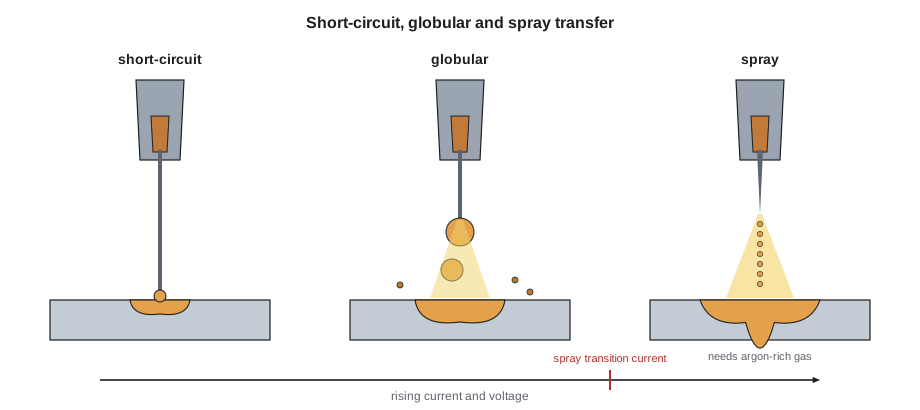
Spray transfer puts a lot of heat into the plate. The pool is large and fluid, deposition is high, and penetration is deep, with a characteristic finger shape in the middle of the weld from the concentrated argon arc. Those same features limit it: the large, fluid pool cannot be held in vertical or overhead positions, and on thin material it burns through. Spray transfer is a flat and horizontal process for plate, usually about 3/16 in thick and up.
The transition current
The current at which globular transfer changes to spray depends mainly on the wire diameter and the gas. A larger wire needs more current to make its droplets small. More carbon dioxide or more oxygen raises the transition current; at around 20 percent carbon dioxide or more, true spray cannot be reached at all. Longer stickout lowers the transition current slightly, because the wire is preheated. The values in the table are typical for carbon steel solid wire; wire makers publish their own figures.
| Wire diameter | 98 % argon, 2 % oxygen | 90 % argon, 10 % carbon dioxide |
|---|---|---|
| 0.035 in | about 155 A | about 170 A |
| 0.040 in | about 170 A | about 185 A |
| 0.045 in | about 220 A | about 235 A |
| 1/16 in | about 275 A | about 290 A |
Voltage must also be high enough: typically about 24 to 32 V, enough for a long arc in which droplets can form and detach freely. Too little voltage at spray current drives the wire into the pool and makes it short; too much makes a long, wandering arc and undercut.
# Predict the transfer mode (illustrative transition currents for carbon steel solid wire)
transition = {  # wire diameter (in): spray transition current with 90/10 argon-CO2, amps
    0.035: 170, 0.040: 185, 0.045: 235, 0.0625: 290,
}
def mode(d, amps, volts, argon_pct):
    t = transition[d]
    if argon_pct < 80:
        return "short-circuit" if volts < 22 and amps < 0.9 * t else "globular (argon too low for spray)"
    if amps >= t and volts >= 24:
        return "spray"
    if volts < 22:
        return "short-circuit"
    return "globular"
cases = [  # wire, amps, volts, percent argon
    (0.045, 180, 19, 75), (0.045, 210, 26, 90), (0.045, 270, 28, 90), (0.045, 270, 28, 75), (0.035, 190, 25, 90),
]
for d, a, v, ar in cases:
print(f"{d} in wire, {a} A, {v} V, {ar} % argon -> {mode(d, a, v, ar)}")0.045 in wire, 180 A, 19 V, 75 % argon -> short-circuit 0.045 in wire, 210 A, 26 V, 90 % argon -> globular 0.045 in wire, 270 A, 28 V, 90 % argon -> spray 0.045 in wire, 270 A, 28 V, 75 % argon -> globular (argon too low for spray) 0.035 in wire, 190 A, 25 V, 90 % argon -> spray
The prediction is deliberately simple; real arcs blur at the boundaries, and the best confirmation is the sound and look of the arc. But it shows the two conditions that must both be met for spray: an argon-rich gas and a current above the transition for that wire.
Streaming and rotating spray
Above the transition current, spray transfer becomes finer as current rises. At very high currents with long stickouts, the tapered wire tip can become so long and hot that it starts to whip around, flinging the metal out in a spiral: rotating spray transfer. It gives a wide, shallow bead and is used deliberately in some high-deposition mechanized welding with special gases, but in normal semi-automatic welding it is a sign that the current is too high for the wire and stickout.
Where Hartwell uses spray
The Coldwater skid base frame is built from wide-flange beams and channels, and the main fillets and the groove welds at the lifting lug plates are made in the flat and horizontal positions after the frame is set on rotating stands. Devon welds them with 0.045 in ER70S-6 wire in a 90 and 10 argon and carbon dioxide mix at around 260 to 280 A and 28 V: a spray arc. The beads are smooth and flat with almost no spatter, and the deep penetration gives reliable fusion at the root of the fillets. On the Riverside girders, the long flange-to-web fillets run on a carriage with metal-cored wire, which also runs in a spray-like mode; that comes later in the course.
Spray transfer has a cost in the booth. The arc is very bright and its ultraviolet output is much higher than a short-circuit or stick arc of the same current, enough to burn bare skin in minutes and to bounce off light-colored walls. Devon wears a jacket with a high collar, a darker lens than he used for stick welding, and Marta adjusts the booth curtains so the light does not reach the next bay. Spray arcs also make ozone from the ultraviolet light acting on the surrounding air, especially with argon-rich gases, so extraction matters even though the fume from solid wire is lower than from flux-cored wire.
Technique for spray transfer
- Use a nozzle with the contact tip recessed about 1/8 to 1/4 in inside it, which keeps spatter and heat off the tip at high current.
- Keep the contact tip to work distance at about 5/8 to 1 in; spray arcs use a longer stickout than short-circuit arcs.
- Use a push angle of about 5 to 10 degrees, or hold the gun nearly perpendicular, for good gas coverage and a flat bead.
- Travel at a steady speed fast enough to keep the arc on the leading edge of the large pool; letting the pool run ahead of the arc causes cold lap even in spray.
- Aim the wire at the root of a fillet, with the work angle split between the plates, adjusted toward the thicker plate.
- On horizontal fillets, keep the pool small enough to avoid undercut on the vertical plate and overlap on the horizontal one; very large single-pass horizontal fillets are split into several passes.
Spray transfer and the codes
AWS D1.1 prequalifies GMAW in spray, globular and pulsed spray transfer, but not short-circuit, provided the WPS stays within the code's limits. The 2025 edition puts the solid wire GMAW limits in their own table, with minimum currents by wire diameter, which helps keep a prequalified GMAW arc out of the short-circuit range, and explicitly recognizes pulsed spray. Because spray transfer needs an argon-rich gas, the gas is part of the WPS, and a cylinder with too much carbon dioxide would put the arc back into globular transfer.
# Check a spray-transfer setting against the wire's minimum current and a procedure range
wps = {"wire": "0.045 in ER70S-6", "amps": (250, 300), "volts": (26, 30), "gas_argon_min": 85}
min_spray_amps = 245         # transition current plus a margin for this wire and gas
readings = [(265, 28.0, 90), (232, 27.5, 90), (280, 29.5, 75), (295, 24.5, 90)]
for amps, volts, argon in readings:
    problems = []
    if not wps["amps"][0] <= amps <= wps["amps"][1]:
        problems.append("current outside WPS")
    if amps < min_spray_amps:
        problems.append("below spray transition")
    if not wps["volts"][0] <= volts <= wps["volts"][1]:
        problems.append("voltage outside WPS")
    if argon < wps["gas_argon_min"]:
        problems.append("gas too lean in argon for spray")
print(f"{amps} A {volts} V {argon} % Ar: " + ("OK" if not problems else "; ".join(problems)))265 A 28.0 V 90 % Ar: OK 232 A 27.5 V 90 % Ar: current outside WPS; below spray transition 280 A 29.5 V 75 % Ar: gas too lean in argon for spray 295 A 24.5 V 90 % Ar: voltage outside WPS
Choosing between the modes
| Mode | Heat and penetration | Positions | Spatter | Main uses | Main risks |
|---|---|---|---|---|---|
| Short-circuit | Low | All | Light to moderate | Sheet, roots, gaps | Lack of fusion on plate |
| Globular (argon mix) | Moderate | Flat, horizontal | Heavy | Rarely chosen | Spatter, irregular bead |
| Globular (carbon dioxide, buried arc) | High, deep | Flat, horizontal | Heavy unless buried | Heavy fillets on base plates | Spatter, rough bead |
| Spray | High, deep finger | Flat, horizontal | Very low | Plate fillets and grooves | Burn-through on thin plate; bright arc |
The gap in the table is obvious: no basic mode gives good fusion on plate in the vertical and overhead positions with solid wire. That gap is filled two ways: by pulsed spray, which the next lesson covers, and by flux-cored wire, whose slag holds up a hotter pool out of position.
Shielding gas checks for spray work
Because spray transfer depends on the gas, Hartwell's spray procedures include a check of the gas at each station. Before starting a shift on the skid frame, Devon confirms the cylinder or bulk outlet label against the procedure, sets the flow with the trigger pulled, and runs a short test bead to listen for the steady spray hiss. If the arc sputters at the procedure current, the first suspect is the gas, either the wrong cylinder or a mixer on the bulk system that has drifted, and the second is the voltage at the arc. A handheld gas analyzer, borrowed from the pressure bay, settles the question in a minute by reading the carbon dioxide content at the nozzle.
Common mistakes
MistakeCalling an argon-mix arc spray because the current is high.
InsteadSpray also needs the voltage and gas right; listen for the steady hiss.
MistakeUsing spray transfer on vertical or overhead joints.
InsteadThe pool is too large and fluid; use pulse or flux-cored wire.
MistakeRunning spray with a flush contact tip.
InsteadRecess the tip to protect it from heat and spatter.
MistakeExpecting spray with 75 percent argon.
InsteadTrue spray needs about 80 percent argon or more.
MistakeIgnoring ultraviolet exposure from a spray arc.
InsteadCover skin, use a suitable shade and screen nearby workers.
Summary and key terms
- In globular transfer, large drops fall from the wire by gravity with heavy spatter.
- Carbon dioxide shielding gives globular transfer at all currents above short-circuit; a buried arc reduces spatter.
- Spray transfer needs an argon-rich gas and a current above the transition current.
- The transition current rises with wire diameter and with more carbon dioxide or oxygen in the gas.
- Spray gives deep penetration, high deposition and low spatter, but only in flat and horizontal positions on plate.
- Spray arcs are very bright and need extra protection against ultraviolet radiation.
- Globular transfer
- Transfer of large drops, often bigger than the wire, mainly by gravity.
- Buried arc
- A carbon dioxide technique with the wire tip pushed below the plate surface to trap spatter.
- Spray transfer
- Transfer of a stream of fine drops along the arc axis above the transition current.
- Transition current
- The current above which globular transfer changes to spray for a given wire and gas.
- Rotating spray
- Spiral transfer from an overheated, whipping wire tip at very high current.
- Finger penetration
- The narrow, deep penetration in the middle of a spray weld in argon-rich gas.
Practice problems
Work each problem on paper first, then reveal the answer to check.
Can a 0.045 in wire in 100 percent carbon dioxide reach spray at 300 A?
Show answer
No; carbon dioxide gives globular transfer above the short-circuit range.
What is the typical transition current for 0.045 in solid wire in 90/10 argon and carbon dioxide?
Show answer
About 235 A.
Why is spray transfer limited to flat and horizontal positions?
Show answer
Its large, fluid pool would fall out of a vertical or overhead joint.
Lesson quiz · 5 questions
Score 60% or more to complete this lesson.
Create a free account to save your progress, take quizzes and earn a certificate.