
WLD-210 · Lesson 5 of 12 · 17 min
Short-circuit transfer
Metal crosses the arc in a wire process in one of several ways, called transfer modes, and the mode decides almost everything about the weld: how much heat goes in, how deep it penetrates, which positions it can be made in, how much spatter there is, and what kinds of defects to watch for. The mode is set by the wire diameter, the current, the voltage and the shielding gas. This lesson covers the lowest-energy mode, short-circuit transfer, in which the wire actually touches the pool many times a second. It is the mode most people picture when they think of a small MIG welder, and it is excellent for thin sheet, open roots and out-of-position work on light material. It is also the mode with the most famous weakness: on thick plate, it can lay metal on top of steel that never melted. On the Coldwater skid, Devon welds the sheet metal guards with it, and Lucia explains why the same settings are not allowed on the base frame beams.
How the metal crosses
In short-circuit transfer, also called short-arc or dip transfer, the arc is short and the voltage low, typically about 16 to 22 V for steel. The wire feeds forward until its molten tip touches the weld pool. At that instant the arc goes out, the wire is shorted to the work, and current rises quickly through the wire. The current heats the bridge of molten metal and its electromagnetic force, the pinch effect, squeezes the bridge until it necks down and breaks. The droplet is pulled into the pool by surface tension, the arc re-ignites across the gap, and the wire tip begins to melt again until the next short. This cycle repeats somewhere between about 20 and 200 times a second. Metal crosses only while the wire is touching the pool, never through the open arc.
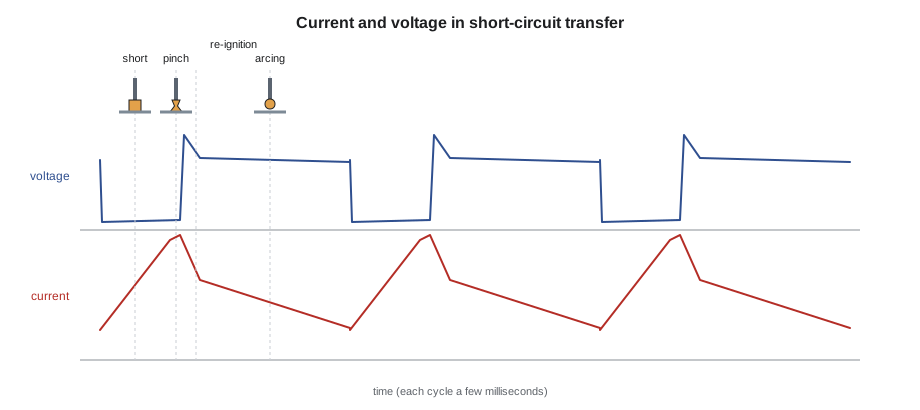
Because the arc is out for part of every cycle, the average heat put into the plate is low. That is the whole point of the mode: a welder can fuse thin sheet without burning through, bridge gaps, and weld in vertical and overhead positions because the small, cool pool freezes quickly. It is also the cause of its problems.
What the settings do
Short-circuit transfer uses small wires, usually 0.030, 0.035 or 0.040 in and sometimes 0.045 in at the low end of its current range, with currents from about 50 to 200 A depending on the wire size. Each setting has a clear effect:
- Wire feed speed sets the current and the amount of metal deposited.
- Voltage sets the arc length during the arcing period and so the short-circuit frequency. Too low, and the wire stubs into the pool and pushes the gun back. Too high, and the arc becomes long, the droplets grow large and fall globular-style, with heavy spatter. Between the two is a narrow window where the arc gives the steady crackle of a frying pan.
- Inductance, or arc control, sets how fast the current rises during each short. More inductance gives fewer, gentler shorts, a hotter, wetter pool and less spatter; less inductance gives more frequent, colder shorts and a stiffer pool.
- Contact tip to work distance changes the current at a set wire speed: a longer stickout preheats the wire by its own resistance, so less current is needed to melt it and the arc gets colder.
- Gas: carbon dioxide gives deeper penetration and more spatter; argon mixes with 15 to 25 percent carbon dioxide give a smoother arc and better bead shape. Mixes with more argon than about 85 percent make short-circuit welding colder and are mostly used for the spray modes.
| Wire diameter | Typical current | Typical voltage | Typical wire speed |
|---|---|---|---|
| 0.030 in | 50 to 130 A | 15 to 19 V | 100 to 350 in/min |
| 0.035 in | 70 to 160 A | 16 to 20 V | 100 to 350 in/min |
| 0.045 in | 120 to 200 A | 17 to 21 V | 100 to 200 in/min |
Watching and listening
A good short-circuit arc has a sound and a look. The sound is a steady, fine crackle with no pops or long silences. The pool is small and follows the arc closely. Spatter is light and fine. If the sound becomes a hiss with occasional loud pops and large spatter balls, the voltage is too high. If the gun pushes back and the wire stubs, the voltage is too low or the wire speed too high. Marta teaches Devon to set the wire speed first, for the amount of metal the joint needs, then bring the voltage up from low until the arc smooths out, then fine-tune with inductance.
Where short-circuit transfer is the right choice
Short-circuit transfer earns its place where low heat is the goal:
- Sheet metal and thin wall: guards, covers, enclosures and light brackets, where higher-energy modes would burn through.
- Open-root passes on pipe and plate, where the small pool can bridge a gap and form a root bead from one side. Controlled short-circuit processes, covered in the lesson on advanced waveforms, are especially good at this.
- Vertical and overhead welding on light material, where the small pool freezes before it can sag.
- Poor fit-up on light work, where gaps must be bridged without burning away the edges.
On the Coldwater skid, the sheet steel guards around the pump coupling and the instrument enclosure are welded with 0.035 in solid wire in short-circuit transfer. Devon runs short stitches, alternating sides, to keep the sheet flat.
The weakness: lack of fusion
The low heat that makes short-circuit transfer good on sheet makes it dangerous on thick plate. The small, cool pool can run ahead of the arc or roll over the cold edge of a groove or the toe of a fillet without melting it. The weld looks fine on the surface: a smooth bead with good shape. Underneath, the weld metal is lying on the plate, stuck to its surface but not fused into it. This is called cold lap or incomplete fusion, and it is very difficult to find by visual inspection. It shows up in break tests, bend tests and ultrasonic testing, and in service as cracking under load.
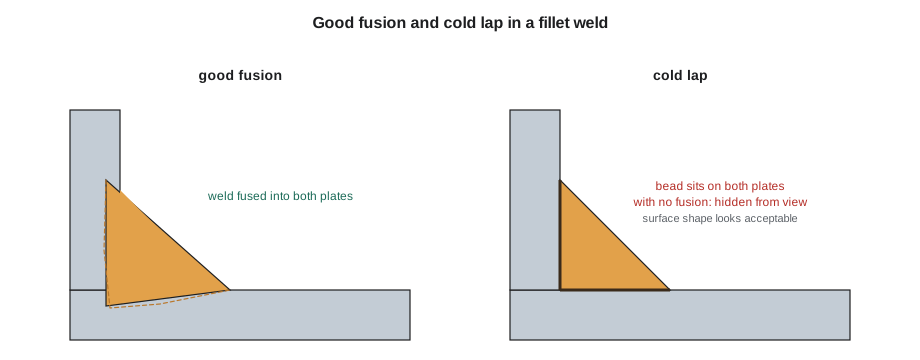
The risk rises with plate thickness, because thicker plate draws heat away faster, and in vertical-down welding, where the pool runs ahead of the arc. It also rises when the welder runs a large bead with a long stickout to fill the joint quickly.
What the codes say
Because of this weakness, the structural codes treat short-circuit transfer with caution.
AWS D1.1 does not allow short-circuiting transfer, GMAW-S, in prequalified welding procedure specifications. A fabricator who wants to use it on D1.1 work must qualify the procedure by testing and record a procedure qualification record, and welders who use it are qualified with bend tests rather than radiography. The code's companion for sheet steel, AWS D1.3, gives prequalified short-circuit procedures for thin material, and D1.1 points users of sheet below about 3/16 in to it.
Hartwell's rule follows the codes: short-circuit transfer for sheet, light non-structural attachments and qualified root passes; spray, pulsed spray or flux-cored wire for structural fillets and grooves on plate. The pump guard is light sheet; the skid's base frame beams are not.
Putting numbers on a short circuit
A short-circuit arc moves metal in tiny drops. Knowing the wire speed and the short-circuit frequency, Devon can work out how big each drop is. If the drops are much bigger than the wire diameter, the arc is closer to globular transfer and the voltage is probably too high.
# Droplet size in short-circuit transfer from wire speed and short frequency
import math
d = 0.035                    # wire diameter, in
for wfs, shorts in [(200, 120), (200, 60), (300, 140), (300, 30)]:            # wire speed in/min, shorts per second
    wire_per_sec = wfs  / 60       # wire melted per second, in
    vol_per_drop = math.pi * d ** 2 / 4 * wire_per_sec / shorts
    drop_d = (6 * vol_per_drop / math.pi) ** (1 / 3)
    note = "fine" if drop_d < 1.5 * d else "large: check voltage"
print(f"{wfs:5} in/min, {shorts:3} shorts/s -> drop diameter {drop_d:.2f} in ({drop_d / d:.1f} x wire) {note}")200 in/min, 120 shorts/s -> drop diameter 0.04 in (1.1 x wire) fine 200 in/min, 60 shorts/s -> drop diameter 0.05 in (1.3 x wire) fine 300 in/min, 140 shorts/s -> drop diameter 0.04 in (1.2 x wire) fine 300 in/min, 30 shorts/s -> drop diameter 0.07 in (1.9 x wire) large: check voltage
At high frequencies, each short carries a drop a little larger than the wire. When the frequency falls because the voltage has crept up, the drops grow to two or three times the wire diameter and the arc starts to spit large spatter. The welder hears the change before seeing it.
Heat input in short-circuit welding
A calculated heat input for short-circuit welding uses the average voltage and current from the meters. Because the current and voltage swing widely during each cycle, simple meters can mislead, and newer power sources calculate the true average power from rapid samples; some codes now ask for heat input to be calculated from instantaneous power or energy when waveform-controlled processes are used. For ordinary short-circuit welding, average meter readings give a reasonable estimate. Typical heat inputs are low, often a third to a half of those of a spray or flux-cored weld of similar size.
# Compare heat input: short-circuit on sheet versus flux-cored on plate (arc energy, no efficiency)
runs = [  # name, volts, amps, travel in/min
    ("short-circuit, sheet guard", 18, 120, 18),
    ("short-circuit, slow pass on plate", 19, 160, 12),
    ("flux-cored fillet on plate", 26, 240, 15),
]
for name, v, a, speed in runs:
    q = 60 * v * a / (1000 * speed)
print(f"{name:34} {q:5.2f} kJ/in")short-circuit, sheet guard 7.20 kJ/in short-circuit, slow pass on plate 15.20 kJ/in flux-cored fillet on plate 24.96 kJ/in
Low heat input on its own is not the problem; many good welds are made at low heat input. The problem is low heat input combined with a thick, cold plate and a pool that can get ahead of the arc.
Technique for short-circuit welding
Devon's notes from Marta's demonstration:
- Keep the contact tip about 1/4 to 1/2 in from the work, usually with the tip flush with the nozzle or slightly out.
- Use a slight push angle, about 5 to 15 degrees, for a flatter bead and better gas coverage on sheet; drag slightly for a little more penetration.
- Keep the arc on the leading edge of the pool, never letting the pool run ahead of the wire.
- On sheet, use short stitches and alternate locations to control heat and distortion.
- Vertical down is fast and common on sheet, but is not used on thick plate because it promotes cold lap; vertical up gives better fusion where heat is needed.
- Clean off oil, paint and heavy rust: the low heat cannot burn through contamination the way a hotter arc can.
Checking for fusion on a short-circuit weld
Because cold lap hides under a good surface, Hartwell checks short-circuit procedures with destructive tests before using them on anything structural. A fillet break test is the quickest: a short length of fillet on a T-joint is welded with the production settings, then the stem plate is hammered or pressed over until the weld breaks, and the broken surface is examined. A sound weld breaks through the throat and shows fusion to the root and to both legs; a cold-lapped weld peels off one plate with a smooth, shiny face where it never fused. A macro etch of a cut section shows the same thing at a glance after polishing and etching. When Devon set up the guard welds on the Coldwater skid, he welded three short test pieces at the settings he planned, broke one, and had Lucia etch another, before welding the real guards. Both showed full fusion into the 1/8 in sheet. The third test piece he kept on his bench as the reference for what the right sound and bead look like.
Common mistakes
MistakeUsing short-circuit settings for a structural fillet on thick plate because the bead looks good.
InsteadCold lap hides under a good surface; use spray, pulse or flux-cored on plate.
MistakeTurning up the voltage to get more heat.
InsteadHigh voltage moves toward globular transfer and spatter; add wire speed or change mode instead.
MistakeWelding vertical down on thick plate.
InsteadVertical down promotes lack of fusion; weld vertical up or use a different process.
MistakeLetting the pool run ahead of the arc.
InsteadKeep the arc on the leading edge of the pool.
MistakeAssuming the code allows short-circuit transfer because the wire and gas are listed.
InsteadShort-circuit procedures need qualification on structural plate work.
Summary and key terms
- In short-circuit transfer, the wire touches the pool 20 to 200 times a second and metal transfers only during the shorts.
- It uses small wires, low voltage and low current, and puts little heat into the work.
- Wire speed sets current, voltage sets arc length and frequency, and inductance sets how gently each short breaks.
- It is ideal for sheet, open roots, gaps and out-of-position work on light material.
- On thick plate it can cause hidden lack of fusion, or cold lap.
- Structural codes do not prequalify short-circuit transfer; it needs qualification by testing.
- Transfer mode
- The way molten metal crosses from the wire to the pool.
- Short-circuit transfer
- Transfer that occurs only when the wire touches the pool and the arc is momentarily out.
- Pinch effect
- The electromagnetic squeezing force that necks down and breaks a molten bridge.
- Cold lap
- Weld metal lying on the base metal without fusing to it.
- Incomplete fusion
- Failure of weld metal to fuse with the base metal or a previous pass.
- GMAW-S
- The code abbreviation for gas metal arc welding with short-circuiting transfer.
Practice problems
Work each problem on paper first, then reveal the answer to check.
A 0.035 in wire feeds at 240 in/min with 100 shorts a second. What length of wire melts per short?
Show answer
240 / 60 / 100 = 0.04 in of wire per short.
Why is short-circuit transfer good for vertical welding on light material?
Show answer
The small, cool pool freezes quickly and does not sag.
What defect is the main concern with short-circuit transfer on thick plate?
Show answer
Incomplete fusion, or cold lap.
Lesson quiz · 5 questions
Score 60% or more to complete this lesson.
Create a free account to save your progress, take quizzes and earn a certificate.