
WLD-120 · Lesson 2 of 12 · 20 min
Welding power sources and polarity
The welding power source is the box at the other end of the leads, and for stick welding it has one job: deliver a steady current at a voltage high enough to strike and hold the arc, adjustable over the range the electrodes need. How it does that, what kind of current it delivers, and which way the current flows through the arc all affect how an electrode runs. This lesson covers the types of SMAW power sources found in a shop and in the field, constant current output and why stick welding needs it, alternating and direct current, polarity, open-circuit voltage, duty cycle, and the arc blow that makes direct current difficult near the ends of a joint. Devon spends a morning with Marta going through every machine in the Hartwell booths and the two engine drives on the service trucks, reading nameplates and running the same electrode on each polarity.
Constant current output
A SMAW welder controls arc length by hand, and no hand is perfectly steady. As the arc gets longer, its voltage rises; as it gets shorter, its voltage falls. If the machine held voltage constant, as a wire-feed machine does, the current would swing wildly with every small movement and the arc would stutter or go out. SMAW machines are built instead to have a constant current output, also called a drooping characteristic: the current changes only a little as the arc voltage moves through the working range. The welder sets the current on the machine, and the machine holds it near that value whether the arc is a little long or a little short.
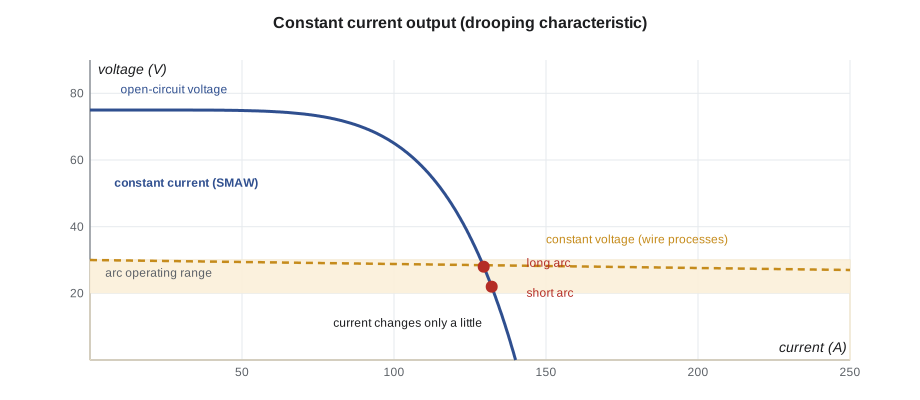
Many modern machines add adjustable arc force, sometimes called dig. When the arc gets very short and the voltage drops toward a short circuit, the machine briefly raises the current to keep the electrode from sticking. More arc force gives a crisper, more digging arc, useful for cellulosic pipe electrodes; less gives a softer arc. Hot start is a related feature that adds a short burst of extra current at the moment of striking to help the arc establish on cold metal. Both are set to suit the electrode and the welder.
Types of SMAW machines
- Transformer machines. A heavy transformer steps the supply voltage down to welding voltage, with taps or a moving core to set current. They give alternating current only, are rugged and cheap, and are found in farm shops and older school booths.
- Transformer-rectifier machines. A transformer followed by a rectifier gives direct current, often with an AC option. They have been the standard industrial stick machine for decades and many are still in service at Hartwell.
- Inverter machines. Electronics convert the supply to high-frequency current, transform it with a small, light transformer, and rectify it. Inverters are a fraction of the weight of older machines, use less power, and offer arc force, hot start and often multiprocess capability for GTAW and wire welding. Most new machines are inverters.
- Engine-driven machines. A gasoline or diesel engine drives a generator, giving welding current anywhere a truck can go, plus auxiliary power for grinders and lights. The service trucks carry these, and pipeline crews depend on them.
Every machine has a nameplate listing its input requirements, its rated output current and voltage at a stated duty cycle, its open-circuit voltage, and the processes it supports. Reading it before connecting or using a machine is part of setup.
Open-circuit voltage
When the machine is on but no arc is burning, the voltage between electrode and work is the open-circuit voltage, often abbreviated OCV. For SMAW it is typically about 50 to 80 V, higher than the arc voltage, because a higher voltage is needed to break down the gap and start the arc. Some electrodes, particularly certain AC electrodes and cellulosic types, need a higher OCV to strike and run well, which is one reason an electrode that runs beautifully on one machine can be hard to start on another. The first course covered the shock hazard of OCV; many machines used in wet or enclosed spaces have a voltage-reducing device that holds the OCV at a low value until the electrode touches the work.
Alternating and direct current
Direct current, DC, flows in one direction. Alternating current, AC, reverses direction many times a second, following the supply frequency of 60 Hz in North America on transformer machines. With AC the arc actually goes out and restrikes at every reversal, 120 times a second, which is why AC electrodes carry more arc-stabilizing compounds in their covering. DC gives a smoother, more stable arc, easier starts, less spatter and better control in vertical and overhead positions, and most structural and pipe welding is done on DC. AC is useful mainly because transformer machines are simple and cheap, and because AC largely avoids arc blow.
Polarity
With direct current, the direction of current flow is called polarity. Two terms are used, and both are in use on shop floors and in older books:
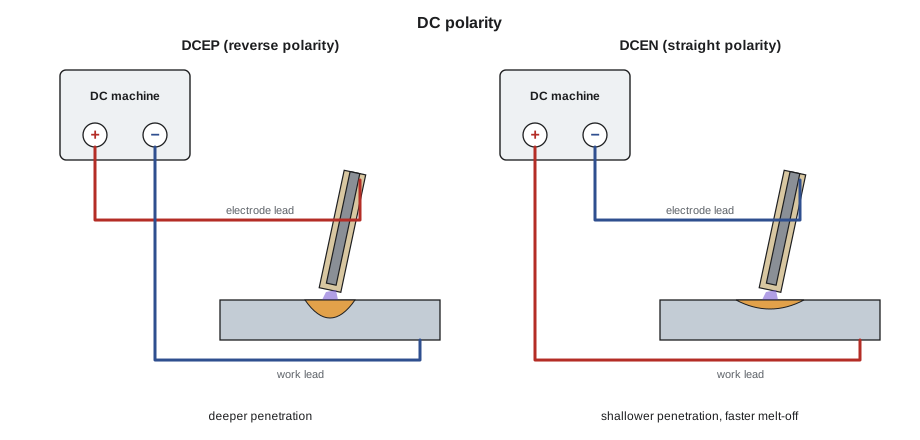
- Direct current electrode positive, DCEP, also called reverse polarity or DCRP. The electrode holder is connected to the positive terminal and the work lead to the negative terminal.
- Direct current electrode negative, DCEN, also called straight polarity or DCSP. The electrode holder is on the negative terminal and the work lead on the positive.
Polarity changes where the heat goes and how the arc behaves. For most covered electrodes, DCEP gives deeper penetration and a more forceful arc, and it is the polarity specified for low-hydrogen electrodes such as E7018 when run on DC and for cellulosic electrodes such as E6010. DCEN puts more heat into the electrode, melting it faster with shallower penetration, and suits some rutile electrodes such as E6013 on thin material. The electrode manufacturer's data and the electrode classification say which currents and polarities an electrode is designed for; the next lessons explain how to read them.
On many machines polarity is changed with a switch; on others the welder moves the cables between the output studs. Either way, the machine is switched off first. Devon's notebook gets a line Marta insists on: check polarity before the first arc of the day and every time a machine has been used by someone else. A low-hydrogen electrode run on the wrong polarity runs erratically, spatters, and can give porosity and poor fusion, and the welder may blame technique for a setup mistake.
Duty cycle
A power source heats up as it delivers current. Its duty cycle rating states the percentage of a ten-minute period it can deliver a stated current without overheating. A machine rated 300 A at 60 percent duty cycle can weld at 300 A for six minutes of every ten, resting for four. At lower currents the allowed duty cycle rises, approximately in inverse proportion to the square of the current, because heating goes with the square of current. At high enough reductions the machine can run continuously. Exceeding the duty cycle trips the thermal overload, which stops output until the machine cools, and repeated overheating shortens the life of the transformer, rectifier or electronics.
In practice, stick welding rarely reaches high duty cycles, because the welder stops to change electrodes and chip slag. Duty cycle matters most on long runs with large electrodes, with gouging, which draws high current, and when two welders share a multi-operator machine.
# Duty cycle at other currents, from the nameplate rating
rated_amps = 300      # nameplate current (A)
rated_duty = 60       # nameplate duty cycle (%)
print("current A   allowed duty %   arc-on min per 10 min")
for amps in (350, 300, 250, 200, 150, 125):
    duty = rated_duty * (rated_amps / amps) ** 2
    duty = min(duty, 100)
    print(f"{amps:9d}   {duty:14.0f}   {duty / 10:21.1f}")
# the highest current the machine can run continuously
cont = rated_amps * (rated_duty / 100) ** 0.5
print(f"continuous (100 %) rating about {cont:.0f} A")current A allowed duty % arc-on min per 10 min
350 44 4.4
300 60 6.0
250 86 8.6
200 100 10.0
150 100 10.0
125 100 10.0
continuous (100 %) rating about 232 AThe program shows that the machine in Devon's booth, rated 300 A at 60 percent, can run E7018 at 125 A all day without a thought, and could deliver about 230 A continuously. The rule is approximate; the manufacturer's duty cycle chart is the authority.
Worked problem
Checking a gouging job
A 400 A machine is rated at 60 percent duty cycle. A carbon arc gouging job needs 450 A. What duty cycle is allowed?
Show solution
- D2 = 60 × (400 / 450)² = 60 × 0.790 = 47 percent.
- So the machine can gouge for about 4.7 minutes in each 10-minute period.
Answer: About 47 percent; the operator must pause or the overload will trip.
Arc blow
Current flowing through the electrode, the arc and the work creates a magnetic field around each conductor. When the field around the arc is not symmetrical, it pushes the arc sideways, forward or back. The arc wanders, spatters, undercuts one side, and leaves porosity or poor fusion. This is arc blow, and it is mostly a direct current problem, because with AC the field reverses constantly and averages out. It is worst near the ends of a joint, in corners, near the work lead connection, on thick plate, on magnetized steel such as pipe that has been inspected with magnetic methods, and at the start of a weld where the steel ahead and behind the arc is unequal.
Welders control arc blow in several ways:
- Move the work clamp. Arc blow usually pushes the arc away from the work connection. Clamping at the other end of the joint, or using two clamps, can balance the field.
- Weld toward a heavy tack or toward the end that has been welded, and use run-on and run-off tabs so the arc is not near the free edge.
- Shorten the arc and angle the electrode against the direction of blow.
- Reduce the current, which weakens the magnetic field.
- Switch to AC with an electrode designed for it, if the procedure allows.
On the Coldwater skid, Devon tacks a gusset into a corner of the base frame and finds the arc pulling hard toward the open end. Marta moves the clamp from the far side of the frame to the gusset itself and has Devon weld toward the corner. The arc straightens.
Choosing and setting the machine
For each job, the welder checks: that the machine can deliver the current the electrode needs at the duty cycle the job requires; that it gives the current type and polarity the electrode classification allows; that its OCV suits the electrode; that arc force and hot start are set sensibly; and that the electrode and work leads are on the right terminals. The welding procedure, where there is one, specifies the current type and polarity and the current range, and the machine is set inside that range.
ANSI Z49.1 and the manufacturer's manual cover installation and grounding of machines; the National Electrical Code, Article 630, covers the supply circuit. At Hartwell, each booth machine has a tag showing its last inspection, and any machine with a damaged cable, a missing cover or a fault goes to the maintenance electrician.
Engine drives and multi-operator setups in the field
On a field job, the welding machine is usually an engine drive on a truck or skid. Its output is set like any other constant current machine, but a few habits are specific to it. The engine runs at a governed speed when welding and drops to idle when it is not; an automatic idle can make the first strike after a pause feel weak until the engine comes up to speed, so the welder pauses a moment after touching off. The machine's auxiliary outlets power grinders and portable rod ovens, and they share the engine's capacity with the welding output, so a big grinder and heavy welding together can pull the output down. Fuel, oil and coolant are checked at the start of the shift, the exhaust is pointed away from the work and any building openings, and the machine is never run in an enclosed space, because of carbon monoxide.
Large shops and construction sites sometimes use multi-operator systems, where one large power source feeds several welding stations through individual control boxes. Each station's welder sets their own current, but all share the duty cycle of the big machine, and polarity is common to all stations, which matters when two welders on the same work piece would otherwise be on opposite polarity.
Common mistakes
MistakeRunning E7018 on DCEN because the cables were left that way.
InsteadCheck polarity before the first arc; E7018 on DC runs electrode positive.
MistakeTreating the duty cycle as a percentage of the shift.
InsteadDuty cycle is minutes of welding in each ten-minute period at a stated current.
MistakeTurning the current up to fight arc blow.
InsteadHigher current makes arc blow worse; move the clamp, shorten the arc, angle the electrode or reduce current.
MistakeSwapping cables on a live machine.
InsteadSwitch the machine off before changing polarity at the studs.
Summary and key terms
- SMAW machines have a constant current (drooping) output so current stays steady as arc length changes.
- Transformer, transformer-rectifier, inverter and engine-driven machines all serve SMAW; inverters are now the most common new type.
- Open-circuit voltage of about 50 to 80 V starts the arc; some electrodes need higher OCV.
- DCEP (reverse) and DCEN (straight) change penetration and arc behavior; the electrode classification says which to use.
- Allowed duty cycle varies roughly with the inverse square of current.
- Arc blow is a DC problem near joint ends and magnetized steel; move the clamp, shorten the arc and angle the electrode.
- Constant current
- A power source output that holds current nearly steady as arc voltage changes.
- Open-circuit voltage (OCV)
- The voltage between electrode and work with the machine on but no arc.
- DCEP
- Direct current electrode positive, also called reverse polarity.
- DCEN
- Direct current electrode negative, also called straight polarity.
- Duty cycle
- Percentage of a ten-minute period a machine can deliver a stated current.
- Arc force (dig)
- A control that raises current briefly when the arc gets very short.
- Arc blow
- Deflection of the arc by unbalanced magnetic fields.
Practice problems
Work each problem on paper first, then reveal the answer to check.
A machine is rated 250 A at 30 percent. What duty cycle is allowed at 150 A?
Show answer
30 × (250 / 150)² = 83 percent.
Which polarity is reverse polarity?
Show answer
DCEP, electrode positive.
Why is AC less prone to arc blow?
Show answer
The magnetic field reverses with the current, so its push averages out.
Name two ways to reduce arc blow.
Show answer
Move the work clamp, weld toward a heavy tack, shorten the arc, angle the electrode, reduce current or use AC.
Lesson quiz · 5 questions
Score 60% or more to complete this lesson.
Create a free account to save your progress, take quizzes and earn a certificate.