
WLD-120 · Lesson 10 of 12 · 18 min
Fillet welds in the flat position
With pads behind Devon, Marta moves on to joints. The first is the easiest fillet weld to make well and the one every welder practices first: the fillet in the flat position, with the joint turned so the weld lies in a trough and the face of the finished weld is roughly level. Gravity helps rather than hinders, the puddle sits where it is put, and both plates heat evenly. This lesson covers welding positions and how they are named, setting up the flat fillet, electrode choice and settings, single-pass and multi-pass technique, common faults and their fixes, and how to estimate the electrodes, time and cost of a run of fillet welds. At the end of it, Devon welds the gusset plates on the Coldwater skid base frame under Marta's eye.
Welding positions
Welds are made in four basic positions: flat, horizontal, vertical and overhead. For test and procedure purposes, codes and standards give each a number and a letter: F for fillet and G for groove. So 1F is a fillet in the flat position, 2F horizontal, 3F vertical and 4F overhead; for groove welds, 1G to 4G, with extra designations for pipe. The position is defined by the angle of the weld axis and the angle of rotation of the weld face. For a flat fillet, the weld axis is horizontal and the joint is turned so the throat is vertical and the face of the weld horizontal, as if welding into the bottom of a V-shaped trough. For a horizontal fillet, the weld axis is horizontal, but one plate lies flat and the other stands up from it, so the weld is made in the corner from the side.
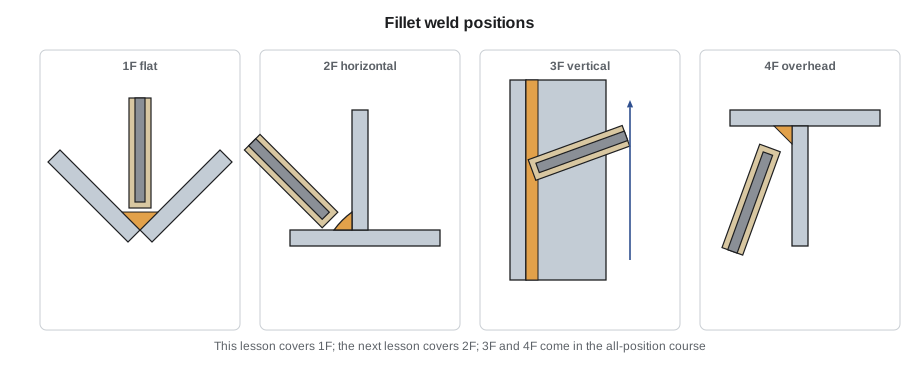
Positioning the work for flat welding whenever possible is good practice: it allows higher current and larger electrodes, deposits metal faster, and makes sound welds more easily. Shops use positioners, turning rolls and simple V-blocks to turn work into the flat position. In the field, the work goes where the structure is, and welders must be able to weld in whatever position the joint presents, which is why the qualification tests cover positions.
Setting up the flat fillet
For practice, Devon fits two pieces of 3/8 in plate as a T-joint, tight, square and tacked at each end on the back side of the joint, then sets the assembly in a V-block or on the corner of the table so the joint makes a trough with each plate at about 45 degrees to the horizontal. The work clamp goes on the assembly. The extraction hood is pulled close, because a flat fillet sends fume straight up into the welder's face.
Electrode choice for practice and for most structural flat fillets is E7018 in 1/8 in or 5/32 in. On production work where the procedure allows it, E7024 in 5/32 in or larger lays flat fillets much faster, with a smooth, slightly concave face and slag that often lifts off by itself, because it carries heavy iron powder in its covering. Hartwell's structural procedure for the base frame calls for E7018, so that is what Devon uses.
Settings: E7018 5/32 in at about 150 to 180 A on DCEP is a typical flat-fillet range, and E7018 1/8 in at 115 to 140 A. Flat welds tolerate the upper part of the electrode's range, but only so far: too much current undercuts the upper toe and makes a wide, runny puddle.
Technique for a single-pass flat fillet
- Work angle: 45 degrees, splitting the angle between the plates, so both legs get equal heat.
- Travel angle: a drag of about 10 to 20 degrees, pointing back toward the finished weld.
- Arc length: short, almost touching for E7018; E7024 can be dragged with the covering on the joint.
- Aim: the arc is pointed into the root, the bottom of the trough, so it melts into the root and both plates. A fillet that sits on the surfaces without reaching the root is the classic hidden flaw of fillet welds: incomplete fusion at the root.
- Travel speed: fast enough to keep the puddle the size of the intended weld, with the puddle wetting out evenly to both toes.
- Manipulation: for single-pass fillets up to about 5/16 in leg, a straight stringer or a very slight side-to-side motion at the face is enough.
Watch both toes. If one side wets out further than the other, the work angle is off or the arc is wandering; if the puddle looks as if it is sitting on top of the joint with a dark line at the edges, the current is low or the arc long. At each restart, follow the routine from the last lesson: chip the crater, strike ahead in the trough, come back and fill the crater, then travel on.
The size of a single-pass fillet is limited by what one puddle can hold without running or sagging. In the flat position, a single pass with a 5/32 in E7018 can lay a fillet of about 5/16 to 3/8 in; larger flat fillets need multiple passes. Codes and procedures state the maximum single-pass fillet size for each position, and the flat position allows the largest.
Multi-pass flat fillets
A larger fillet is built in layers of stringers or narrow weaves. For a three-pass fillet, the root pass goes into the root, the second pass is laid against the first along one plate, overlapping it by about half, and the third against the second along the other plate, so the finished face is flat and the legs equal. Each pass is chipped and brushed clean before the next. Larger fillets add layers in the same pattern, with each layer completing the face.
The sequence matters. A pass placed too high on one plate leaves a valley along the other that traps slag; a pass placed too low leaves the face uneven and the legs unequal. The welder aims each pass at the toe of the previous pass, as with pads, and checks the leg sizes with a fillet gauge as the weld grows.
Common faults in flat fillets
| Fault | What it looks like | Usual cause |
|---|---|---|
| Incomplete root fusion | Weld sits on the plates; a cut section shows an unfused root | Arc not aimed into the root; current too low; travel too fast |
| Undercut on the upper toe | Groove along one plate edge | Current too high; work angle favoring that plate; long arc |
| Overlap | Weld metal rolled onto a plate without fusing | Current too low; travel too slow; work angle off |
| Excessive convexity | Humped face, toes notched in | Current too low; travel too slow; too much metal per pass |
| Unequal legs | One leg longer than the other | Work angle off; pass sequence uneven |
| Slag inclusions | Dark lines on a cut section; pits on the surface | Slag not removed between passes; valleys between beads |
Estimating electrodes, time and cost
Before a job, Glen estimates how much electrode and welder time the fillets will take. The method uses the weld metal per unit length from the last lesson, a deposition rate for the electrode at its current, the deposition efficiency, which accounts for the metal lost in stubs, spatter and covering, and an operating factor for the share of time the arc is actually lit. Electrode manufacturers publish deposition rates and efficiencies; the figures below are typical values for planning.
# Estimate electrodes, welder time and cost for a run of fillet welds
weld_len = 138             # total length of fillet on the job (ft)
metal_per_len = 0.19       # weld metal for this fillet size (lb per ft)
dep_rate = 3.5             # deposition rate of the electrode (lb/h)
dep_eff = 0.65              # deposited metal / electrode weight used (stubs, spatter, covering)
op_factor = 0.30            # share of welder time with the arc lit
electrode_mass = 0.125       # mass of one electrode (lb)
labor_rate = 75          # welder cost per hour, with overhead (dollars)
electrode_price = 3.40      # electrode cost (dollars per lb)
metal = weld_len * metal_per_len
electrode_used = metal / dep_eff
arc_h = metal / dep_rate
welder_h = arc_h / op_factor
count = electrode_used / electrode_mass
cost = welder_h * labor_rate + electrode_used * electrode_price
print(f"weld metal {metal:.1f} lb, electrodes {electrode_used:.1f} lb (about {count:.0f} electrodes)")
print(f"arc time {arc_h:.1f} h, welder time {welder_h:.1f} h")
print(f"cost about {cost:,.0f} dollars, or {cost / weld_len:.1f} dollars per ft")weld metal 26.2 lb, electrodes 40.3 lb (about 323 electrodes) arc time 7.5 h, welder time 25.0 h cost about 2,010 dollars, or 14.6 dollars per ft
The Coldwater base frame has about 138 ft of 5/16 in fillet. The estimate, about 40 lb of 5/32 in E7018, roughly 320 electrodes and about 25 hours of welder time, is what Glen uses to book the welding bay and order electrode. Most of the cost is labor, not electrode, which is why shops care so much about operating factor, positioning and avoiding oversize fillets.
Worked problem
What positioning is worth
If the same fillets could be turned to the flat position and run with E7024 at twice the deposition rate, what happens to welder time, all else equal?
Show solution
- Arc time halves, because the same metal goes in at twice the rate.
- With the same operating factor, welder time also halves, from about 25 to about 12.5 hours.
- In practice the operating factor also improves, because E7024 slag peels more easily.
Answer: Welder time roughly halves, before counting the faster slag removal.
On the job: the Coldwater base frame
The Coldwater base frame is a rectangle of wide-flange beams with cross members, and gusset plates at each corner. The frame is small enough to turn, so Glen has it set on stands that let each corner be rolled into the flat position. Devon fits and tacks the gussets, Marta checks them, and Devon welds the first gusset fillets in two passes with 5/32 in E7018, checking the legs with a fillet gauge after each pass. Marta cuts nothing out of the real frame, of course; instead, Devon welds a test T-joint from the same plate at the start of the shift, and Marta breaks it in the press to look at the root, the subject of the capstone lesson.
Intermittent fillets and end returns
Not every fillet is continuous. Drawings sometimes call for intermittent fillets, short segments of a stated length at a stated pitch, center to center, either chain intermittent, with segments opposite each other on both sides of a joint, or staggered, with segments alternating. Intermittent fillets save weld metal and reduce distortion on lightly loaded joints, but every segment has a start and a crater, so each must be started cleanly and its crater filled to full size. Fillets at the ends of members are often returned, carried a short distance around the corner of the member, to avoid ending a weld at the edge where stress is high; the drawing shows when this is required.
Fume rises straight into the welder's breathing zone in flat welding, because the welder works directly above the joint. The extraction hood is placed close and to the side, slightly ahead of the arc, and the welder keeps the head out of the plume rather than leaning over the work. On long flat runs, Marta has Devon stop every few electrodes to move the hood along, which costs a few seconds and keeps the capture where it belongs.
Checking legs as the weld grows
On multi-pass flat fillets, the welder checks the leg sizes with a fillet gauge after each layer, not only at the end. A root pass that came out slightly long on one plate can be balanced by placing the next pass a little toward the other plate; discovered only after the cap, the same error leaves unequal legs that may have to be ground or built up. The check takes seconds with the slag off, and Marta counts it as part of the weld.
Common mistakes
MistakePointing the arc at the face of the trough instead of the root.
InsteadAim into the root so both plates and the root fuse.
MistakeTrying to make a 1/2 in flat fillet in one pass.
InsteadBuild large fillets in passes, each cleaned before the next.
MistakeLeaving the work in the horizontal position when it could be turned.
InsteadPosition for flat welding when possible; it is faster and sounder.
MistakeEstimating electrode only from weld metal weight.
InsteadDivide by deposition efficiency to include stubs, spatter and covering.
MistakeTurning the current up to the top of the range for speed.
InsteadToo much current undercuts the upper toe and makes a runny puddle.
Summary and key terms
- Positions are 1F flat, 2F horizontal, 3F vertical and 4F overhead for fillets, and 1G to 4G for grooves.
- Flat fillets use a 45 degree work angle, a 10 to 20 degree drag and an arc aimed into the root.
- Single flat passes reach about 5/16 to 3/8 in with a 5/32 in electrode; larger fillets take multiple passes.
- Root fusion is the hidden fault in fillets and is checked by breaking or sectioning test welds.
- Electrode quantity = weld metal ÷ deposition efficiency; welder time = arc time ÷ operating factor.
- 1F
- A fillet weld in the flat position.
- 2F
- A fillet weld in the horizontal position.
- Deposition rate
- Weld metal deposited per hour of arc time.
- Deposition efficiency
- Weld metal deposited as a share of electrode weight used.
- Positioner
- Equipment that turns work to a convenient welding position.
- Incomplete fusion
- Weld metal that has not fused to the base metal or the previous pass.
Practice problems
Work each problem on paper first, then reveal the answer to check.
A job has 65 ft of fillet needing 0.19 lb/ft. With 65 percent deposition efficiency, how much electrode is used?
Show answer
65 × 0.19 = 12.4 lb of weld metal; 12.4 / 0.65 = 19 lb of electrode.
Arc time is 4 h and the operating factor is 25 percent. What is the welder time?
Show answer
4 / 0.25 = 16 h.
What position is 1F?
Show answer
A fillet weld in the flat position.
Lesson quiz · 5 questions
Score 60% or more to complete this lesson.
Create a free account to save your progress, take quizzes and earn a certificate.