
TRD-105 · Lesson 4 of 12 · 21 min
Hitches, sling angles and load control
The same sling can lift very different loads depending on how it is attached. Used straight up and down, it carries its full vertical rating. Wrapped around a load and threaded through its own eye, it carries less. Passed under a load with both eyes on the hook, it can carry twice as much, but only if both legs hang straight. And the moment a sling's legs spread apart at an angle, the tension in each leg rises above its share of the load, sometimes far above it. This lesson explains the three basic hitches, the multi-leg bridle, the effect of sling angle and how riggers control a load once it is in the air.
Hector Ruiz, Stonebridge's lead rigger, spent an afternoon with the Kingsway Tower apprentices at the laydown yard with a bundle of pipe, two slings and a load cell. He lifted the same bundle with the slings close together and then spread far apart, and let them read the tension each time. "Same load, same slings," he said. "Look at the numbers. That is why you never guess an angle."
The three basic hitches
Vertical hitch
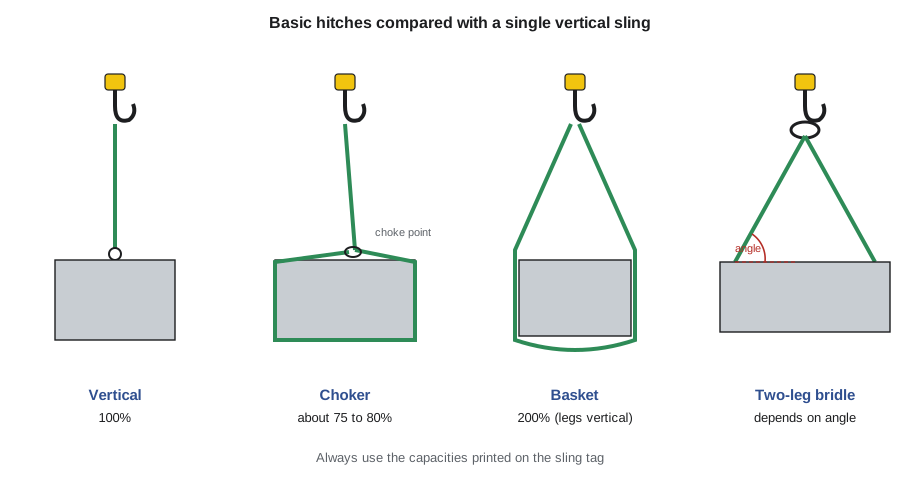
In a vertical hitch, the sling runs straight from the hook to a single attachment point on the load, such as a lifting lug or an eyebolt. The sling carries the full load and can be loaded up to its vertical rated capacity. A single vertical hitch gives no control over rotation: the load can spin, so it is used with a tag line and only on loads with a proper lifting point directly above the center of gravity.
Choker hitch
In a choker hitch, the sling is wrapped around the load and one eye is passed through the other eye (or through a shackle) so that the sling tightens around the load as it lifts. Chokers are useful for bundles of pipe, lumber and rebar because they grip. But the sharp bend where the sling passes through its own eye weakens it, and the tag shows a lower choker rating, usually about three quarters or a little more of the vertical rating. If the choke angle, the angle the sling makes as it passes through the eye, is tighter than about 120 degrees, the capacity must be reduced further according to the manufacturer's table. Never force the choke down by hammering the eye toward the load; let the sling draw tight as the load lifts.
A single choker does not hold a load well against slipping and does not control tilting. Long loads should be lifted with two chokers spread apart. A double-wrap choker, where the sling goes around the load twice before passing through the eye, grips much better than a single wrap.
Basket hitch
In a basket hitch, the sling passes under the load and both eyes go on the hook, cradling the load. With both legs hanging straight up, the two legs share the load, so the basket can carry twice the vertical rating. As soon as the legs spread apart, that advantage shrinks because of the sling angle. A single basket under a load's middle is unstable: the load can tip out. Baskets are normally used in pairs, spread apart, or with the load's shape keeping it from rolling out. Basket hitches must also respect the bend: the sling must not pass around a diameter so small that it is damaged.
Bridle hitches
A bridle uses two, three or four sling legs from a single master link or hook to attach at several points on the load. Bridles give good control of tilting and rotation and are standard for equipment with lifting lugs, for precast panels and for skids. A two-leg bridle shares the load between the two legs, adjusted for the angle.
Three- and four-leg bridles need care. Unless the legs are exactly the right lengths and the load is perfectly rigid, they will not share the load equally. A rigid load on four legs often rocks onto just two of them, like a four-legged table on an uneven floor. For that reason, a widely used rule is to assume that only two legs carry the whole load when sizing a three- or four-leg bridle, unless an engineer's lift plan shows otherwise or equalizing gear is used.
Sling angle: why spreading the legs matters
When a sling leg hangs at an angle, it must do two jobs at once: hold up its share of the load, and pull sideways against the other leg. The sideways pull does nothing useful, but it adds to the tension in the sling. The flatter the angle, the larger that sideways pull and the higher the tension.
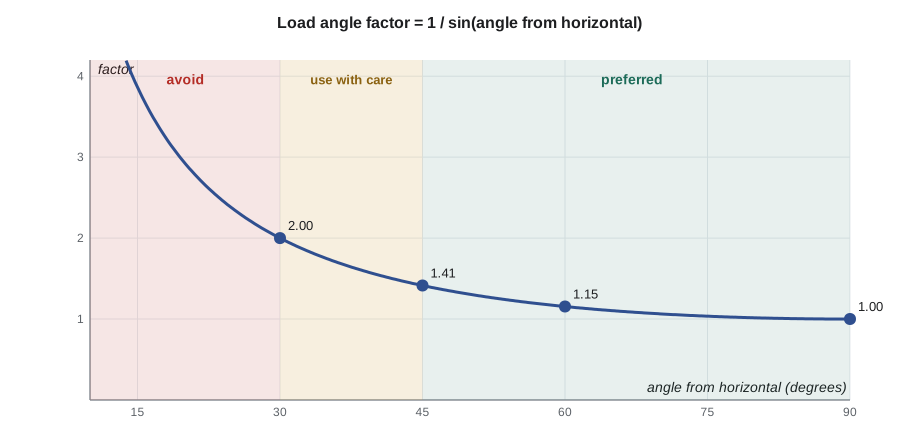
The sling angle is measured between the sling leg and the horizontal. For a two-leg bridle or basket with legs at angle theta from the horizontal, each leg carries:
where T is the tension in each leg, W is the load weight, n is the number of legs sharing the load and theta is the angle from horizontal. At 90 degrees (legs vertical), the sine is 1 and each leg carries exactly its share. At 60 degrees, each leg carries about 1.15 times its share. At 45 degrees, about 1.41 times. At 30 degrees, exactly twice its share. Below 30 degrees the tension climbs steeply toward infinity.
| Angle from horizontal | Load angle factor (1 / sin) | Tension in each of two legs, for a 1,000 unit load |
|---|---|---|
| 90° | 1.000 | 500 |
| 75° | 1.035 | 518 |
| 60° | 1.155 | 577 |
| 50° | 1.305 | 653 |
| 45° | 1.414 | 707 |
| 30° | 2.000 | 1,000 |
| 15° | 3.864 | 1,932 |
Many sites, including Kingsway Tower, do not allow sling angles below 30 degrees from horizontal for routine lifts, and riggers aim for 45 to 60 degrees or steeper whenever they can. Some charts and tags show capacities at 60, 45 and 30 degrees for exactly this reason.
There is a second effect. As the legs flatten, they also pull the attachment points toward each other. That horizontal force can bend a long thin load, pull lugs sideways that were designed only for a vertical pull, or crush a light crate. A spreader bar or lifting beam solves this, as Lesson 5 explains.
Measuring the angle without a protractor
On site, riggers work out the angle from the sling length and the distance between the pick points. For a two-leg bridle with equal legs of length L and pick points a distance S apart, the height of the hook above the pick points is H, and the angle from horizontal satisfies:
A simple field check: if the sling length is at least equal to the distance between the pick points, the angle is at least 60 degrees. If the sling is only about three quarters of that distance, the angle is near 45 degrees. If the sling is shorter than about 60 percent of the spacing, the angle is below 30 degrees and longer slings are needed.
Worked problem
Choosing sling length for a pipe bundle
A bundle of steel pipe weighing 2,600 lb is to be lifted by the tower crane with a two-leg bridle. The pick points are 10 ft apart. Compare the tension in each leg with 6 ft slings and with 10 ft slings.
Show solution
- Half the spacing is 5 ft. Each leg's share of the load is 1,300 lb.
- With 6 ft slings: H = √(6² − 5²) = √11 = 3.32 ft, so sin θ = 3.32 / 6 = 0.553 and θ ≈ 34°. Tension = 1,300 / 0.553 = 2,350 lb per leg.
- With 10 ft slings: H = √(10² − 5²) = √75 = 8.66 ft, so sin θ = 8.66 / 10 = 0.866 and θ = 60°. Tension = 1,300 / 0.866 = 1,500 lb per leg.
Answer: The longer slings reduce the tension in each leg from about 2,350 lb to about 1,500 lb. Choose slings rated for at least the tension at the actual angle.
The shorter slings would also put a strong inward squeeze on the bundle. Hector's rule for the apprentices: when in doubt, use longer slings.
Load control
Once a load is in the air, the crew controls it in four ways: by rigging it correctly so it hangs level and stable, by moving it slowly and smoothly, by using tag lines to stop it from spinning, and by keeping everyone out of its path.
- Tag lines: one or two non-conductive ropes tied to the load, long enough for handlers to stay well outside the area beneath it. A tag line guides rotation; it is not for holding the load against wind or pulling it into place. Never wrap a tag line around your hand or body, and let go rather than be pulled off balance or toward an edge.
- Smooth motion: sudden starts and stops make a load swing and can shock-load the rigging. A shock load can multiply the force in the slings well beyond the load's weight.
- Landing: prepare cribbing or blocking before the load arrives, so the slings can be pulled out without crushing hands. Keep fingers and feet out from under the load and away from pinch points between the load and anything solid. Lower the last few centimeters slowly, and do not remove the rigging until the load is stable.
- Wind: large flat loads such as formwork panels, sheets of plywood and glazing units catch the wind like sails. The lift director stops lifts when wind exceeds the crane manufacturer's limits or the site's limits, which are often lower for large panels.
Tag lines near overhead power lines must be dry, clean and non-conductive, and even then the load must stay outside the limits of approach covered in Lesson 8.
A sling tension calculator
The program below works out the angle and the tension in each leg of a two-leg bridle from the sling length, the pick-point spacing and the load. It flags any setup below 30 degrees and compares the tension with a sling's rated vertical capacity.
# two-leg bridle: angle and tension from sling length and pick-point spacing (lb, ft)
import math
load = 2600        # lb
spacing = 10.0     # ft between pick points
rated = 2400       # lb, vertical rating of each sling leg (example tag)
for L in (5.5, 6.0, 8.0, 10.0, 12.0):         # sling lengths to compare
    half = spacing / 2
    if L <= half:
        print(f"{L:.1f} ft slings: too short to reach"); continue
    H = math.sqrt(L**2 - half**2)
    angle = math.degrees(math.asin(H / L))
    T = (load / 2) / (H / L)
    flag = "AVOID (<30 deg)" if angle < 30 else ("over rating" if T > rated else "OK")
print(f"{L:4.1f} ft slings: angle {angle:4.1f} deg, tension {T:6.0f} lb per leg {flag}")5.5 ft slings: angle 24.6 deg, tension 3121 lb per leg AVOID (<30 deg) 6.0 ft slings: angle 33.6 deg, tension 2352 lb per leg OK 8.0 ft slings: angle 51.3 deg, tension 1665 lb per leg OK 10.0 ft slings: angle 60.0 deg, tension 1501 lb per leg OK 12.0 ft slings: angle 65.4 deg, tension 1430 lb per leg OK
See how quickly the tension drops as the slings get longer, and how the shortest slings fall below 30 degrees. The same bundle and the same slings can be safe or overloaded depending only on length.
Common mistakes
MistakeUsing the basket rating when the legs are spread at a flat angle.
InsteadReduce the capacity for the actual sling angle; the doubling only applies with vertical legs.
MistakeSizing a four-leg bridle as if all four legs share the load.
InsteadAssume two legs carry the load unless the lift plan or equalizing gear shows otherwise.
MistakeHammering a choker down tight against the load.
InsteadLet the choker draw tight as the load lifts; forcing it damages the sling.
MistakeUsing short slings that give a sling angle below 30 degrees.
InsteadUse longer slings or a spreader bar to keep the angle at 45 to 60 degrees or steeper.
MistakeWrapping a tag line around your hand for grip.
InsteadHold it so you can let go instantly, and stand clear of the load's path.
MistakeRemoving slings before the load is stable on its blocking.
InsteadLand on prepared cribbing and confirm the load is stable before unhooking.
Summary and key terms
- Vertical, choker and basket hitches have different capacities; read them from the tag.
- Chokers lose capacity at the choke point; baskets double capacity only when the legs are vertical.
- Tension per leg equals the leg's share of the load divided by the sine of the angle from horizontal.
- At 60 degrees the factor is about 1.15, at 45 degrees about 1.41, and at 30 degrees it is 2.
- Avoid sling angles below 30 degrees; aim for 45 to 60 degrees or steeper.
- Control loads with correct rigging, smooth motion, tag lines and prepared landings.
- Vertical hitch
- A single sling running straight from the hook to the load.
- Choker hitch
- A sling wrapped around the load and passed through its own eye so it tightens as it lifts.
- Basket hitch
- A sling passed under the load with both eyes on the hook.
- Bridle
- Two or more sling legs from one master link attached at separate points on the load.
- Sling angle
- The angle between a sling leg and the horizontal.
- Load angle factor
- The number by which a leg's share of the load is multiplied to get its tension at an angle.
- Shock load
- A sudden force from a jerk, drop or abrupt stop that can exceed the load's weight.
- Cribbing
- Blocks or timbers placed to land a load on, leaving room to remove slings.
Practice problems
Work each problem on paper first, then reveal the answer to check.
A 2,000 lb load hangs from a two-leg bridle at 45 degrees. What is the tension in each leg?
Show answer
1,000 / sin 45° = 1,000 / 0.707 = about 1,414 lb.
A sling is rated 2,400 lb vertical. What could it carry in a basket with vertical legs?
Show answer
About 4,800 lb, if the tag shows that basket rating.
Pick points are 6 ft apart and the slings are 6 ft long. What is the sling angle?
Show answer
60 degrees (the slings and spacing form an equilateral triangle).
Why is a single basket hitch under the middle of a long load unsafe?
Show answer
The load can tip and slide out because nothing controls its balance.
Why do many riggers size four-leg bridles as if only two legs carry the load?
Show answer
Rigid loads rarely share equally among four legs; two may end up carrying it all.
What is a tag line for, and what is it not for?
Show answer
It controls rotation from a distance; it is not for holding a load against wind or pulling it into place.
Lesson quiz · 5 questions
Score 60% or more to complete this lesson.
Create a free account to save your progress, take quizzes and earn a certificate.