
TRD-105 · Lesson 12 of 12 · 19 min
Choosing access equipment, rescue and putting it together
By the end of her second month at Kingsway Tower, Maya had worked from a stepladder, an extension ladder, a rolling scaffold, a frame scaffold in a stairwell and a scissor lift, and she had helped rig the hot water tank and watched the make-up air unit go up on the tower crane. Each job had needed a different piece of equipment, and each choice had been made for a reason. This final lesson pulls the course together. It shows how to choose the right access equipment for a task, how to plan for rescue and emergencies when people work at height or under loads, and how a whole week of Maya's work applies the skills from every lesson.
Start by asking whether work at height is needed
The safest fall is the one that cannot happen. Before choosing between a ladder, a scaffold and a lift, the crew asks whether the work could be done without going up at all. Safety professionals call this the hierarchy of controls for work at height:
- Eliminate the height: assemble on the ground and lift the assembly into place, use extension poles or remote tools, or change the sequence so work is done before the floor below is removed or after the floor above is in place.
- Use collective, passive protection: work from a platform with guardrails, such as a scaffold or a MEWP, so that every worker is protected without having to do anything.
- Use fall restraint: equipment that keeps a worker from reaching an edge.
- Use fall arrest: a harness, lanyard or lifeline and anchor that stops a fall after it starts. This needs training, inspection and a rescue plan.
- Use ladders for short, light tasks only, where other options are not reasonable.
Mechanical contractors use the first option more and more. On Kingsway Tower, Northbridge prefabricates pipe racks with valves and hangers in its shop, so that crews lift a finished section into place with a chain hoist instead of assembling dozens of joints overhead from a ladder. Fewer hours at height means fewer chances to fall.
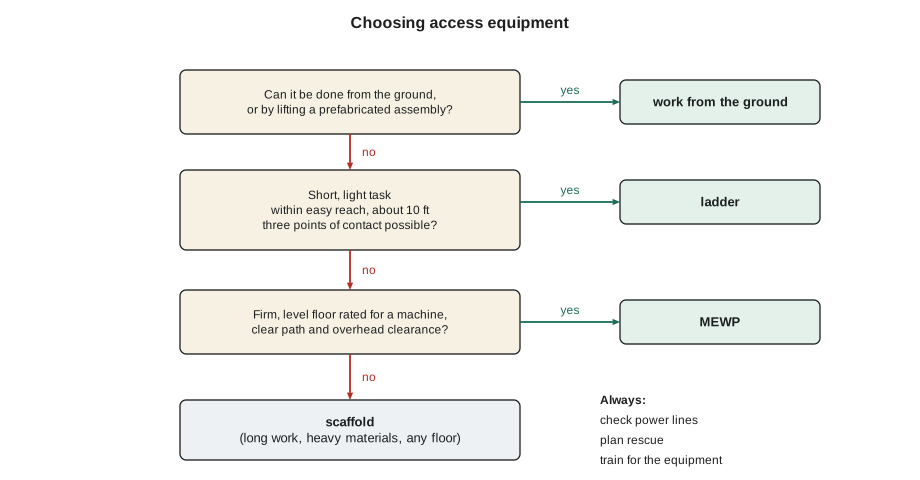
Choosing between a ladder, a scaffold and a MEWP
When work at height is needed, the choice depends on the task. Luis walks Maya through the factors for each job:
| Factor | Points toward a ladder | Points toward a scaffold | Points toward a MEWP |
|---|---|---|---|
| Duration | A few minutes at one spot | Days or weeks at the same area | Hours, moving between spots |
| Height and reach | Low, within easy reach | Any height, with engineering for tall scaffolds | Up to the machine's height and outreach |
| Hands and materials | One hand free, light tools only | Both hands, heavy materials, several workers | Both hands, tools and limited materials |
| Floor and access | Any firm footing | Room to erect and tie; sound footings | Firm, level floor rated for the machine; space to drive |
| Obstructions | Few | Can be built around obstructions | Clear path and overhead clearance |
| Repeated moves | Easy | Slow (rolling scaffold faster) | Very easy |
No single choice wins every time. In the parking levels, Maya's crew uses a rolling scaffold because the floor is level, the pipe runs are long and they need room for two people, a threading machine stand and fittings. In the retail space, a scissor lift wins because the ceiling is high and the crew moves every few minutes. In the stairwell, a frame scaffold built by the scaffold crew is the only option, because the floor steps down and nothing can drive in. For a single smoke detector check in a corridor, a stepladder is reasonable.
Ladders: still useful, with limits
Ladders were covered in TRD-101, but their limits bear repeating. Use them for short tasks that allow three points of contact. Choose the right type and duty rating, set extension ladders at about 4 to 1, extend them at least 3 feet above the landing and secure them against slipping. Never stand on the top rungs or the top cap of a stepladder, never carry materials up in your hands, and never use a metal ladder near electrical equipment. OSHA's Subpart X sets the details.
A good test: if you find yourself leaning out, reaching overhead with both hands or making many trips up and down to carry parts, you have outgrown the ladder.
Rescue planning
Every plan for work at height or work under loads must answer one question in advance: if something goes wrong, how do we get the person out, and how fast? Calling emergency services is part of the answer, but responders may take many minutes to arrive and may not be able to reach a worker suspended in a harness thirty meters up or trapped under a load. The site must be able to begin rescue itself.
- For fall arrest: a written rescue plan for each task, rescue equipment on hand (such as a rescue kit or a MEWP that can reach the worker), and trained people who can reach a suspended worker quickly. Suspension in a harness can become dangerous within minutes, as TRD-101 explained.
- For MEWPs: a trained person on the ground who can use the ground controls and the emergency lowering, nearby whenever the platform is raised.
- For scaffolds: a way to bring an injured worker down safely, which might be a stair tower, a MEWP or responders' equipment, and a clear route for responders to reach the scaffold.
- For rigging: first aid and a plan for crush injuries, and rules that nobody reaches under a load to help until it is secured. A dropped or shifting load must be stabilized before anyone approaches.
On Kingsway Tower, the emergency plan posted at the site office gives the street address, the nearest gate for ambulances, the site's emergency phone number and the location of first aid kits, AEDs and rescue equipment. Everyone learns it at orientation. When calling 911, give the address, the gate, the floor, and what happened, and send someone to the gate to meet responders.
After an incident
If a load drops, a sling breaks, a scaffold shifts or a MEWP tips or contacts a power line, the first job is to make the area safe and care for anyone hurt, without creating more victims: do not touch a machine or load that may be energized, and do not go under a load that has not been secured. Then report it. Serious incidents must be reported to the regulator and the scene preserved, as TRD-101 explained, and every incident and near miss is investigated so the crew learns what went wrong. Damaged rigging and equipment are tagged out and kept for the investigation.
Putting it together: Maya's week
To finish the course, here is one week of Maya's work at Kingsway Tower, with the lesson each decision comes from.
- Monday: the crew moves the hot water tank. Luis confirms the weight from the shipping papers (Lesson 2), chooses round slings in basket hitches (Lessons 3 and 4), checks the shackle and the beam trolley (Lessons 5 and 9), inspects everything before use (Lesson 6), names himself as the only person giving directions (Lessons 1 and 7) and has the area taped off (Lesson 8).
- Tuesday: drain piping in the P2 parking level. A rolling scaffold with a green tag, casters locked, guardrails in place and the platform load well within its rating (Lesson 10). Pipe is passed up one length at a time, not stacked on the platform.
- Wednesday: the make-up air unit goes up on the tower crane. Maya is not on the lift crew, but she knows to stay out of the exclusion zone and recognizes the signals as Hector's crew lands the unit (Lessons 7 and 8).
- Thursday: hangers and drains in the retail ceiling from a scissor lift. Familiarization on the new rental machine, pre-use inspection, function test and workplace inspection; she looks up before raising and keeps two pipe lengths at a time inside the guardrails (Lesson 11).
- Friday: a short task replacing a cleanout cover in a corridor. A stepladder is reasonable for a few minutes of light work, set on a firm floor, fully opened and locked (Lesson 12 and TRD-101).
None of these jobs was unusual. That is the point of the course: rigging, hoisting and access equipment are part of every working day in the trades, and safe habits are what make an ordinary day end the way it should.
Twelve habits to take with you
- Know the weight, including contents and rigging, before any lift.
- Find the center of gravity and lift from above it.
- Use only tagged, rated, inspected slings and hardware.
- Account for the hitch and the sling angle; avoid angles below 30 degrees.
- Load shackles, hooks and eyebolts the way they were designed.
- Inspect rigging before every use and take damaged gear out of service.
- One signaler directs; anyone can stop.
- Plan every lift, check capacity along the whole path and keep everyone out from under.
- Hang hoists only from rated anchors and never use cheater bars.
- Use scaffolds only when they are complete, tagged and inspected, and never modify them yourself.
- Use MEWPs only with training and familiarization, inspect them every shift and look up.
- Choose the right access equipment for the task, and have a rescue plan before anyone goes up.
A simple selection helper
The program below turns the selection table into a few rules. It is deliberately simple, and real decisions involve more factors and the site's rules, but it shows how the questions lead to an answer.
# suggest access equipment for a task from a few key questions
def suggest(task):
    if task["can_do_from_ground"]:
        return "work from the ground or lift a prefabricated assembly"
    if task["minutes"] <= 30 and task["height_ft"] <= 10 and task["light_tools"]:
        return "ladder (short, light task with three points of contact)"
    if task["floor_level_and_rated"] and task["overhead_clear"] and task["days"] <= 3:
        return "MEWP (with training, familiarization and a rescue plan)"
    return "scaffold (erected, tagged and inspected by the scaffold crew)"

week = {
    "P2 drain piping (long runs, level floor)": dict(can_do_from_ground=False, minutes=480, height_ft=10.5, light_tools=False, floor_level_and_rated=True, overhead_clear=False, days=4),
    "retail ceiling hangers": dict(can_do_from_ground=False, minutes=480, height_ft=18, light_tools=False, floor_level_and_rated=True, overhead_clear=True, days=2),
    "stairwell sleeves (stepped floor)": dict(can_do_from_ground=False, minutes=240, height_ft=13, light_tools=False, floor_level_and_rated=False, overhead_clear=True, days=3),
    "corridor cleanout cover": dict(can_do_from_ground=False, minutes=10, height_ft=8, light_tools=True, floor_level_and_rated=True, overhead_clear=True, days=1),
    "pipe rack section": dict(can_do_from_ground=True, minutes=0, height_ft=11.5, light_tools=False, floor_level_and_rated=True, overhead_clear=True, days=1),
}
for name, t in week.items():
print(f"{name:42} -> {suggest(t)}")P2 drain piping (long runs, level floor) -> scaffold (erected, tagged and inspected by the scaffold crew) retail ceiling hangers -> MEWP (with training, familiarization and a rescue plan) stairwell sleeves (stepped floor) -> scaffold (erected, tagged and inspected by the scaffold crew) corridor cleanout cover -> ladder (short, light task with three points of contact) pipe rack section -> work from the ground or lift a prefabricated assembly
The P2 drain piping comes out as a scaffold because the overhead space is crowded and the job runs for days, which matches the rolling scaffold the crew chose. The rules in the program are only a starting point; the crew's judgment, the site's rules and the equipment's limits decide.
Common mistakes
MistakeChoosing a ladder for a full day of overhead work because it is handy.
InsteadUse a scaffold or MEWP for long tasks and work that needs both hands.
MistakePlanning work at height without a rescue plan.
InsteadDecide before anyone goes up how they will be brought down if hurt or stuck.
MistakeRushing under a dropped or shifted load to help someone.
InsteadStabilize the load first, then help; do not create a second victim.
MistakeAssembling everything overhead when it could be prefabricated.
InsteadBuild on the ground and lift assemblies into place where possible.
MistakeTreating one week's equipment choice as the answer for every task.
InsteadRe-check the factors for each task: duration, height, floor, obstructions and materials.
MistakeForgetting to report a near miss because nobody was hurt.
InsteadReport it so the crew can fix the cause before someone is hurt.
Summary and key terms
- Eliminate work at height where possible, then prefer guarded platforms over personal fall protection and ladders.
- Choose ladders, scaffolds or MEWPs by duration, height, hands and materials, floor, obstructions and moves.
- Use ladders only for short, light tasks with three points of contact.
- Every task at height or under loads needs a rescue plan the site can start itself.
- After an incident, make the area safe without creating more victims, then report and investigate.
- Rigging, hoisting and access skills are part of every working day in the trades.
- Hierarchy of controls
- Ranking hazard controls from most to least effective, starting with eliminating the hazard.
- Passive protection
- Protection that works without the worker doing anything, such as guardrails.
- Fall restraint
- Equipment that keeps a worker from reaching a place where they could fall.
- Fall arrest
- Equipment that stops a fall after it starts.
- Prefabrication
- Assembling components off site or on the ground before installing them.
- Rescue plan
- A plan, with equipment and trained people, for bringing a worker down quickly after a fall or entrapment.
- Near miss
- An event that could have caused injury or damage but did not.
- Emergency plan
- The site's posted procedures, contacts and locations for responding to emergencies.
Practice problems
Work each problem on paper first, then reveal the answer to check.
What is the first step in the hierarchy of controls for work at height?
Show answer
Eliminate the height, for example by working from the ground or prefabricating.
Why is a guarded platform preferred over a harness?
Show answer
It protects every worker without anyone having to do anything; a harness only arrests a fall after it starts.
Give two signs you have outgrown a ladder for a task.
Show answer
Any two of: leaning out, working overhead with both hands, making many trips with parts, working for a long time.
Why must a site be able to start a rescue itself?
Show answer
Responders may take many minutes or be unable to reach a suspended or trapped worker quickly.
What should you do first if a load drops near a coworker?
Show answer
Make the area safe, stabilize the load and call for help; do not go under an unsecured load.
Which equipment suits long overhead pipe runs on a level parking floor with crowded overhead space?
Show answer
A rolling scaffold, used with casters locked and guardrails in place.
Lesson quiz · 5 questions
Score 60% or more to complete this lesson.
Create a free account to save your progress, take quizzes and earn a certificate.