
TRD-105 · Lesson 3 of 12 · 23 min
Sling types and rated capacity
A sling is the flexible link between a load and a hook. It looks simple: a loop of rope, chain or webbing. But each type of sling behaves differently, fails differently and has its own strengths and weaknesses. Choosing the right one is the rigger's first decision after working out the weight. On Kingsway Tower, Maya sees all of them in a single week: wire rope slings on the tower crane hook lifting bundles of steel, chain slings on a precast stair section, flat web slings around a stainless steel tank, and round slings on the domestic hot water tank her crew moved into the mechanical room.
This lesson describes the main sling types, how their capacity is rated, what the tag tells you and how to match a sling to a load. Lesson 4 then shows how the hitch and the sling angle change the capacity, and Lesson 6 covers inspection and when to take a sling out of service.
Rated capacity and the design factor
Every sling has a rated capacity, also called the working load limit or WLL. It is the most weight the sling may lift in a stated hitch, under normal conditions, when it is new or in good condition. The manufacturer sets it and marks it on the sling's tag.
The rated capacity is not the weight that breaks the sling. It is the breaking strength divided by a design factor, a safety margin built in to cover wear, small shock loads, uneven loading and the uncertainties of real work. Typical design factors under the ASME B30.9 sling standard used across North America are about 5 to 1 for wire rope and synthetic slings and 4 to 1 for alloy chain. A web sling rated at 1,000 kg in a vertical hitch might break at about 5,000 kg when new.
That margin is not spare capacity for you to use. It is already spoken for by things you cannot see: a little abrasion, a slight shock as the load lifts, a sling angle a few degrees flatter than you thought, a load weight that was estimated a bit low. Never load a sling beyond its rated capacity for the hitch and angle you are using.
Wire rope slings
Wire rope is made of steel wires twisted into strands, and strands twisted around a core. A common construction is described by two numbers, such as 6 × 19 or 6 × 36: six strands, each with roughly 19 or 36 wires. Fewer, larger wires resist abrasion better; more, smaller wires make the rope more flexible and better at bending around shackles and hooks. The core may be a fiber core or an independent wire rope core (IWRC), which is stronger and resists crushing.
Wire rope slings are strong for their size, resist cuts and abrasion better than synthetic slings, and tolerate heat that would destroy webbing. Their weaknesses are that they are stiff, they kink, and they can be permanently damaged by being bent sharply. A kinked, crushed or bird-caged wire rope sling must be removed from service, even if it looks strong. Broken wires stick out and cut hands, so wear gloves when handling wire rope.
The eyes at each end are made in one of several ways. A mechanically spliced eye, often called a Flemish eye with a pressed steel sleeve, is the most common on site and keeps most of the rope's strength. Hand-tucked splices have lower capacity and can unlay if the sling rotates. Wire rope clips are used for some temporary terminations, but slings made with clips are not used for general overhead lifting on most sites. The tag shows the capacity for each hitch.
Bending a wire rope sling around a small diameter reduces its strength. A rough rule is that the diameter of the pin, hook or edge the eye goes over should be at least as large as the rope's own diameter, and the body of the sling should wrap around something many times larger, or the capacity must be reduced. The manufacturer's D/d tables give the exact reduction, where D is the diameter of what the rope bends around and d is the rope's diameter.
Alloy chain slings
Chain slings are made of alloy steel chain, assembled with a master link at the top and hooks or other fittings at the bottom. They come as single-leg, double-leg, triple-leg and quad-leg slings, and with adjustable shortening hooks. Only alloy chain made for overhead lifting may be used; grades used for lifting are commonly marked 80 or 100, and higher grades. Ordinary hardware-store chain, transport binder chain and proof coil chain are not for overhead lifting, no matter how heavy they look.
Chain slings are tough, resist abrasion and heat, and wrap around rough or hot loads that would cut a synthetic sling. They are heavy to handle and can be damaged by shock loads and by being pulled around a sharp corner without protection. A stretched link, a twisted link, a nick, gouge or crack, or a hook that has opened all mean the sling comes out of service. Chain slings must never be repaired with bolts or welded by anyone other than the manufacturer or a qualified repairer, and they must never be knotted or twisted to shorten them.
Every alloy chain sling has a permanently attached tag showing its grade, chain size, number of legs, reach (length) and rated capacity at stated angles. A chain sling without a legible tag cannot be used.
Synthetic web slings
Web slings are flat straps woven from nylon or polyester. They are light, flexible and gentle on finished surfaces, which is why they are used on stainless steel, painted equipment, glass and polished pipe. They grip the load well in a choker or basket hitch. They come in one-ply and two-ply versions, in widths from about 25 mm to 300 mm (1 to 12 in), and with flat eyes, twisted eyes or as endless loops.
Their weakness is that they cut easily on a sharp edge, degrade in heat and sunlight, and are attacked by some chemicals. Nylon is weakened by acids; polyester is weakened by alkalis such as fresh concrete and some cleaning products. Neither should be used at high temperatures: the usual limit for nylon and polyester is around 90 °C (about 194 °F), lower for some products. Many web slings have red warning threads woven into the core that show through when the cover is cut or worn deep enough to remove the sling from service.
Edges are the biggest danger for synthetic slings. A web sling that would lift ten times the load can be cut through in an instant by the sharp corner of a steel beam or the edge of a precast panel. Always use edge protection, called softeners or wear pads, between a synthetic sling and any edge.
Synthetic round slings
Round slings are endless loops of polyester fiber yarn inside a protective woven cover. The load is carried by the inner yarns, not the cover. They are flexible, very gentle on loads and easy to handle, and many riggers prefer them for equipment like the hot water tank. Like web slings, they must be protected from edges, heat and chemicals. Many manufacturers color-code round slings by capacity, but color codes differ between makers and regions, so always read the tag.
Other slings
- Metal mesh slings: woven steel mesh, used for hot, abrasive or sharp loads such as steel plate in some fabrication shops.
- Fiber rope slings: manila or synthetic rope with spliced eyes. Rarely used for construction lifting today; their capacity is low and they are easily damaged.
- Purpose-built lifting devices: plate clamps, beam clamps, vacuum lifters and pipe hooks are covered under below-the-hook device standards and have their own capacity markings and inspection rules.
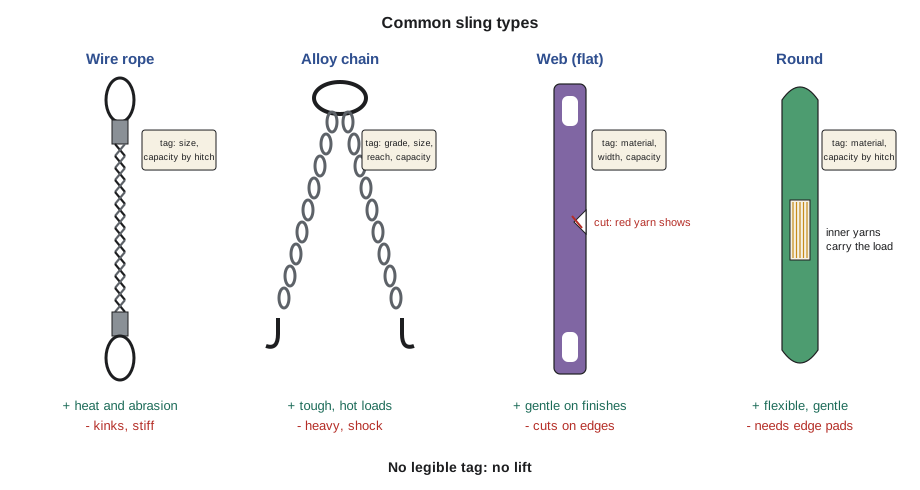
The sling tag
The tag is the sling's identity card. Under the sling standards, each sling must be marked with the manufacturer's name or trademark, the rated capacity for the hitches it is designed for, and, depending on the type, the material, the diameter or size, the grade, the number of legs and the reach. A sling whose tag is missing or unreadable must be removed from service until it is re-tagged by the manufacturer or a qualified person.
| Sling type | What the tag shows | Typical design factor |
|---|---|---|
| Wire rope | Manufacturer, rope diameter, rated capacity in vertical, choker and basket hitches | About 5 to 1 |
| Alloy chain | Grade, chain size, number of legs, reach, rated capacity at stated angles | About 4 to 1 |
| Web | Manufacturer, material (nylon or polyester), width, rated capacity by hitch | About 5 to 1 |
| Round sling | Manufacturer, material, length, rated capacity by hitch | About 5 to 1 |
Tags also tell you which hitches a sling may be used in. Some slings are not rated for choker use, and some fittings are not rated for angles beyond a stated limit. If the hitch or angle you need is not on the tag, do not assume.
Choosing a sling
Luis talks Maya through the choice for each lift by asking five questions:
- How heavy is the load, and what hitch will be used? The sling's rated capacity in that hitch, reduced for the sling angle, must equal or exceed the load share each sling will carry.
- What is the load's surface like? Finished, delicate or polished surfaces call for synthetic slings. Rough, sharp or hot loads call for chain or wire rope, still with protection at sharp corners.
- Are there sharp edges? If so, use edge protection or choose a sling type that resists cutting, and consider whether the edge still reduces capacity.
- What is the environment? Heat, chemicals, sunlight, welding spatter and wet concrete all affect some sling types.
- Is the sling long enough? Too short a sling forces a flat sling angle, which increases the tension dramatically, as Lesson 4 shows.
Worked problem
Choosing slings for the hot water tank
The 1,500 lb stainless steel tank will be lifted with two slings in a vertical basket hitch, so each sling carries half the weight. The shop has round slings rated 2,600 lb vertical, 2,100 lb choker and 5,200 lb basket, and wire rope slings rated 2,400 lb vertical. Which should Luis choose?
Show solution
- Each basket carries 1,500 / 2 = 750 lb.
- A round sling in a vertical basket is rated 5,200 lb, far more than 750 lb.
- The wire rope slings also have enough capacity, but steel would scratch the stainless surface and is stiff to handle around a round tank.
- Round slings are the better choice, with softeners at any sharp lugs or brackets.
Answer: Two round slings in basket hitches: ample capacity and no damage to the tank.
The program below does the first part of that check automatically. Given a load and the number of slings sharing it, it lists which slings in the gang box have enough rated capacity in the chosen hitch. The capacities are an example tag table, not real product values.
# which slings in the box can carry the load in a given hitch? (example tags, lb)
slings = {   # name: {hitch: rated capacity in lb}
    "round sling, small": {"vertical": 2600, "choker": 2100, "basket": 5200},
    "round sling, large": {"vertical": 5300, "choker": 4200, "basket": 10600},
    "web sling, 2 in": {"vertical": 3200, "choker": 2500, "basket": 6400},
    "wire rope, 1/2 in": {"vertical": 2400, "choker": 1800, "basket": 4800},
}
load, n_slings, hitch = 1500, 2, "basket"    # the hot water tank
share = load / n_slings
print(f"each sling carries {share:.0f} lb in a {hitch} hitch")
for name, cap in slings.items():
    c = cap[hitch]
    verdict = "OK" if c >= share else "TOO SMALL"
print(f"{name:18} rated {c:5} lb use {100 * share / c:5.1f} % {verdict}")each sling carries 750 lb in a basket hitch round sling, small rated 5200 lb use 14.4 % OK round sling, large rated 10600 lb use 7.1 % OK web sling, 2 in rated 6400 lb use 11.7 % OK wire rope, 1/2 in rated 4800 lb use 15.6 % OK
This check assumes the slings hang straight down. Lesson 4 adds the effect of sling angle, which can make a sling that looks plenty strong far too weak.
Storing and caring for slings
Slings last longer and stay safe when they are stored properly. Hang them on racks off the ground, away from welding, chemicals, sunlight and traffic. Never leave slings lying where forklifts drive over them, where they sit in puddles of concrete washout, or where welders' sparks can land on them. Wash synthetic slings with clean water if they are contaminated, and let them dry naturally. Keep slings with damaged or unreadable tags separate and marked so nobody uses them by mistake.
Common mistakes
MistakeUsing transport binder chain or hardware-store chain for an overhead lift.
InsteadUse only alloy lifting chain slings with a grade marking and a capacity tag.
MistakeTreating the design factor as spare capacity.
InsteadNever exceed the rated capacity for the hitch and angle you are using.
MistakeWrapping a synthetic sling around a sharp steel edge without protection.
InsteadUse softeners or wear pads at every edge, or a sling type suited to the edge.
MistakeUsing a sling with no tag because it looks new.
InsteadNo tag, no lift. Return it for re-tagging or retire it.
MistakeUsing a nylon sling in wet concrete or a polyester sling in acid.
InsteadMatch the sling material to the chemicals present, or choose chain or wire rope.
MistakeShortening a chain sling by tying a knot in it.
InsteadUse a sling of the right length or one with proper shortening hooks.
Summary and key terms
- Rated capacity (working load limit) is the breaking strength divided by a design factor; never exceed it.
- Wire rope slings are strong and heat resistant but kink and must not be bent sharply.
- Only alloy lifting chain, marked with a grade and tag, may be used for chain slings.
- Web and round slings are light and gentle but must be protected from edges, heat and chemicals.
- Every sling must carry a legible tag showing its capacity for each hitch.
- Choose slings by weight, hitch, surface, edges, environment and length.
- Sling
- A flexible link of rope, chain or synthetic material used to attach a load to a hook.
- Rated capacity
- The maximum load a sling may lift in a stated hitch; also called the working load limit (WLL).
- Design factor
- The ratio of breaking strength to rated capacity, a built-in safety margin.
- IWRC
- Independent wire rope core: a core made of wire rope, stronger than a fiber core.
- Master link
- The large top link of a chain sling that goes on the hook.
- Round sling
- An endless loop of load-bearing fibers inside a protective cover.
- Softener
- Edge protection placed between a sling and a sharp edge; also called a wear pad.
- D/d ratio
- The diameter of the object a wire rope bends around divided by the rope diameter.
Practice problems
Work each problem on paper first, then reveal the answer to check.
What is the difference between rated capacity and breaking strength?
Show answer
Rated capacity is the breaking strength divided by a design factor; it is the most the sling may lift.
Which sling type is best for a polished stainless steel load?
Show answer
A synthetic web or round sling, with softeners at any edges.
Name three things that mean a chain sling comes out of service.
Show answer
Any three of: stretched or twisted links, nicks, gouges or cracks, an opened hook, a missing tag.
Why is polyester a poor choice in fresh concrete?
Show answer
Fresh concrete is alkaline, and polyester is weakened by alkalis.
What do red threads showing through a web sling mean?
Show answer
The sling is cut or worn deeply enough that it must be removed from service.
Why must wire rope slings not be bent around small pins?
Show answer
Sharp bends reduce the rope's strength; the D/d ratio limits apply.
Lesson quiz · 5 questions
Score 60% or more to complete this lesson.
Create a free account to save your progress, take quizzes and earn a certificate.