
TRD-105 · Lesson 2 of 12 · 25 min
Estimating load weight and finding the center of gravity
The first question in every lift is how much the load weighs. It sounds obvious, but loads are misjudged every day on construction sites: a pallet of fittings that turns out to be twice as heavy as it looks, a section of pipe that still has water in it, a concrete block that was cast with steel inside, a piece of equipment with its packing crate and accessories still bolted on. Every capacity decision that follows, the choice of sling, hitch, shackle, hoist and crane configuration, depends on that first number. If it is wrong, every other check is built on sand.
The second question is where the weight is. A load hangs with its center of gravity directly under the hook. If the hook is not above the center of gravity when the load leaves the ground, the load swings or tilts until it is, and a load that tilts can slide out of its slings, swing into a worker or put far more force on one sling than the others. This lesson covers both questions: how to find or estimate the weight, and how to find the center of gravity so the load lifts level.
Where to find the weight
The best number is one that someone has measured or certified. In order of preference, look for:
- The nameplate or data plate on equipment. Mechanical and electrical equipment usually lists its shipping or operating weight. Check which one: operating weight includes fluids, shipping weight may not.
- Shipping documents, bills of lading and delivery tickets. Suppliers usually state the weight of what they ship, including pallets and crates.
- Manufacturer's catalogs and submittals. Pipe, steel shapes, valves and fixtures are listed with weights per piece or per length.
- Markings on the load itself. Precast concrete, steel assemblies and many packaged loads have the weight painted or stencilled on them.
- A load cell or crane load indicator. A dynamometer between the hook and the rigging measures the actual weight when the load is just lifted clear, and most cranes have a load moment indicator that shows it.
When none of these exist, estimate the weight by calculation, and then add a margin. Never guess from appearance. A steel plate looks light until you try to lift a corner; a tote of water looks small until you remember that every liter weighs a kilogram.
Estimating by volume and density
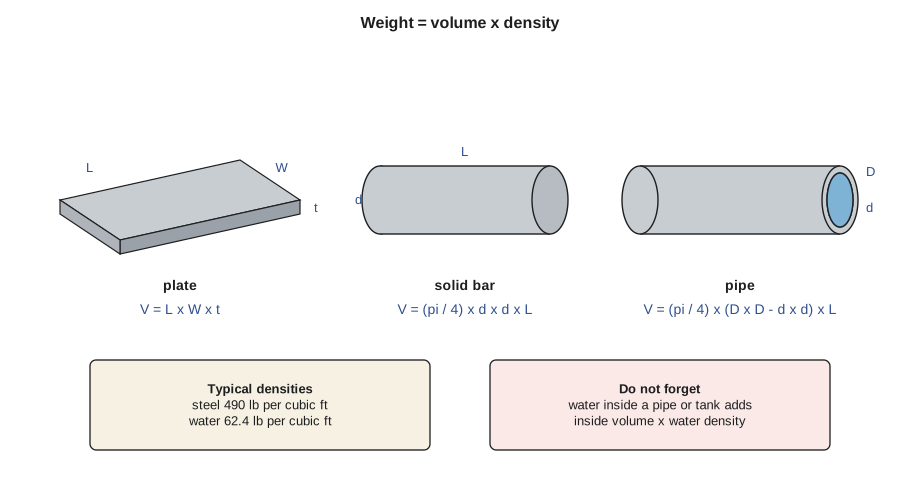
Weight equals volume times density. Work out the volume of the material from its dimensions, multiply by the material's density, and you have its weight. Break complex shapes into simple ones (blocks, cylinders, tubes) and add them up.
Here W is the weight in pounds, V is the volume in cubic feet and the Greek letter rho is the density in pounds per cubic foot. Rigging charts in the United States show capacity in pounds or in tons, where one ton is 2,000 pounds. Be careful: a metric metric ton is 1,000 kilograms, about 2,205 pounds, which is not the same as a US ton.
| Material | Density (lb/ft³) | Rule of thumb |
|---|---|---|
| Steel | 490 | About 3.4 lb per square foot per 1/12 in of thickness |
| Aluminum | 169 | About one third of steel |
| Concrete, reinforced | 150 | About 150 lb per cubic foot |
| Water | 62.4 | About 8.34 lb per gallon |
| Dry softwood lumber | 28 to 35 | About half the weight of water |
| Copper | 556 | A little heavier than steel |
| Gravel or sand | 100 to 125 | Varies with moisture |
These are typical values. Concrete with heavy reinforcing, wet lumber, or soil after rain can be noticeably heavier, which is one reason to add a margin to any estimate.
Worked examples of estimating
Worked problem
A steel plate
Sam Torres's electrical crew needs to lift a steel plate that will cover a floor opening. It measures 8 ft by 4 ft and is 1 in thick. Estimate its weight.
Show solution
- Convert all dimensions to feet: 8 ft by 4 ft by 1/12 ft.
- Volume = 8 × 4 × 0.0833 = 2.67 ft³.
- Weight = 2.67 × 490 = 1,307 lb.
Answer: About 1,310 lb. A plate that size is far too heavy to handle without a hoist.
Worked problem
A section of water-filled pipe
A 20 ft length of 6 in steel pipe, outside diameter 6.625 in and inside diameter 6.065 in, has to be lowered out of a riser. It may still be full of water. Estimate its weight empty and full.
Show solution
- Steel volume = π/4 × (6.625² − 6.065²) × 240 in = 0.785 × (43.89 − 36.78) × 240 = 1,340 in³ = 0.775 ft³.
- Steel weight = 0.775 × 490 = 380 lb.
- Water volume = π/4 × 6.065² × 240 = 6,930 in³ = 4.01 ft³, which weighs 250 lb.
- Full weight = 380 + 250 = 630 lb.
Answer: About 380 lb empty but about 630 lb full: two thirds heavier. Drain it, or rig it for the full weight.
The pipe example is a real trap. Drained systems often hold water in low points, and a section cut out of an old riser can surprise everyone. Plumbers and pipefitters learn to assume a pipe is full until they have proven it is empty.
Things people forget to include
- Contents: water, oil, refrigerant, concrete in a bucket, soil in a bin, or debris in a garbage hopper.
- Packaging and accessories: crates, skids, shipping brackets, loose parts boxed inside, and accessory kits strapped to a unit.
- Ice, snow and mud: a load that sat outside overnight in a Canadian or Midwest winter can carry a surprising amount of ice.
- Rigging weight: on a crane, the hook block, slings, shackles and spreader bar are part of the load the crane must carry. A spreader bar alone can weigh hundreds of kilograms.
- Suction and attachment: a load stuck to the ground by frost, mud or a gasket, or still bolted down, can take far more force to break free than its weight. Free it before lifting, and never use the crane to break it loose.
Experienced riggers add a margin to any estimate. A common practice is to round up and add about 10 percent or more when the weight is calculated rather than certified, but the site's lift plan and the lift director set the rule. When the estimate is close to the capacity of any piece of equipment, get a measured or certified weight before lifting.
The center of gravity
The center of gravity, abbreviated CG, is the point where the whole weight of a load can be thought of as acting. A uniform block or a straight length of pipe has its center of gravity in the middle. A pump skid with a heavy pump at one end and a lighter motor at the other has its center of gravity closer to the pump. A tank half full of water has its center of gravity low and toward the water, and it moves if the water sloshes.
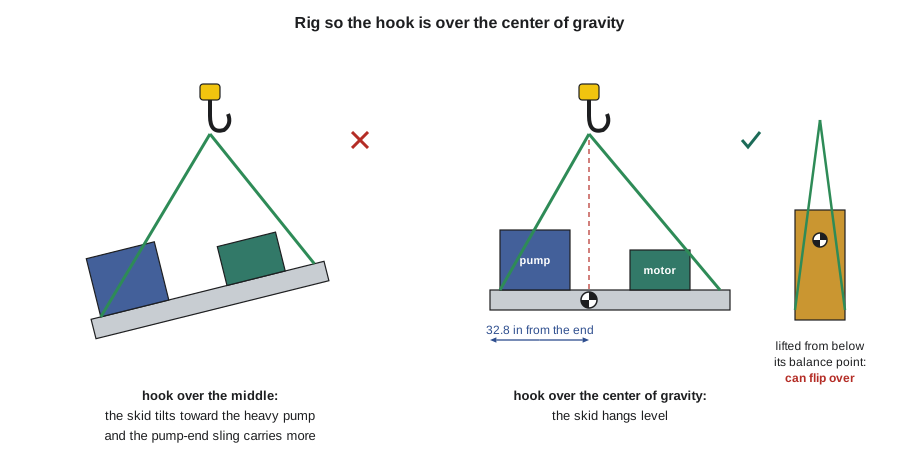
When a load is lifted from a single hook, it rotates until its center of gravity is directly below the hook. If the rigging is attached so the hook is over the center of gravity, the load comes up level. If the hook is off to one side, the load tilts as it leaves the ground, the sling on the heavy side carries more of the weight, and the load may slide or swing. A load that is top-heavy, with its center of gravity above the lifting points, can flip over completely.
Finding the center of gravity by calculation
For a load made of several parts, find the center of gravity by taking moments about one end. Multiply each part's weight by the distance of its own center of gravity from that end, add these products, and divide by the total weight.
Worked problem
A pump skid
An 80 in pump skid weighs 330 lb on its own, with its weight centered at 40 in from the left end. A pump weighing 900 lb sits with its center 16 in from the left end, and a motor weighing 550 lb sits 56 in from the left end. Where is the center of gravity of the whole assembly?
Show solution
- Total weight = 330 + 900 + 550 = 1,780 lb.
- Sum of moments = 330 × 40 + 900 × 16 + 550 × 56 = 13,200 + 14,400 + 30,800 = 58,400 lb·in.
- Center of gravity = 58,400 / 1,780 = 32.8 in from the left end.
Answer: About 32.8 in from the left end, 7.2 in left of the middle. The hook must be placed over that point, not over the middle of the skid.
Finding the center of gravity on site
Not every load comes with a drawing. Manufacturers often mark the center of gravity on equipment with a symbol: a circle divided into quarters with two opposite quarters shaded. If it is not marked, a rigger can find it by a trial lift: lift the load a few centimeters, watch which way it tilts, set it down, adjust the rigging toward the low side, and try again until it lifts level. Never try to correct a tilting load by hand once it is in the air, and never adjust rigging while the load is suspended.
For long loads like pipe and lumber, the center of gravity is near the middle, but bundles can shift as they are lifted. Use two slings spread apart, or a spreader bar, so the load cannot tip or slide out.
Stability: lifting points above the center of gravity
A load is stable when it is lifted from points above its center of gravity. Think of carrying a bucket by its handle: it hangs steady. Try to lift it by straps around its bottom and it wants to flip. Tall equipment such as a cabinet, a transformer or a water heater should be lifted from lugs at the top, or with slings that pass above the center of gravity. If the lifting points are at or below the center of gravity, the load can tip over in the slings, so the rig must be changed or the load must be secured against rotating.
A calculator for load weight and center of gravity
The program below adds up the weights of a load's parts, adds an estimating margin, and works out where the center of gravity lies. It uses the pump skid from the example.
# weight and center of gravity of a pump skid (pounds and inches)
parts = [  # (name, weight lb, distance of its own CG from the left end, in)
    ("skid frame", 330, 40),
    ("pump", 900, 16),
    ("motor", 550, 56),
]
total = sum(w for _, w, _ in parts)
moment = sum(w * x for _, w, x in parts)
cg = moment / total
margin = 0.10                       # 10 % added because the weights are estimated
print(f"total weight      {total:7.0f} lb")
print(f"with 10% margin   {total * (1 + margin):7.0f} lb")
print(f"CG from left end  {cg:7.1f} in  (skid middle is 40.0 in)")
print(f"offset from middle {40 - cg:6.1f} in toward the pump end")total weight 1780 lb with 10% margin 1958 lb CG from left end 32.8 in (skid middle is 40.0 in) offset from middle 7.2 in toward the pump end
The margin is applied to the weight, not the center of gravity. If the center of gravity is uncertain, a trial lift a few centimeters off the ground is the check.
Common mistakes
MistakeGuessing the weight from how big a load looks.
InsteadFind the nameplate, shipping documents or catalog weight, or calculate it from volume and density.
MistakeForgetting the water in a pipe or tank.
InsteadAssume it is full until it is proven empty, and rig for the full weight.
MistakeLeaving out the rigging weight on a crane lift.
InsteadAdd the hook block, slings, shackles and spreader bar to the load.
MistakePlacing the hook over the middle of a load whose weight is uneven.
InsteadFind the center of gravity and rig so the hook is directly above it.
MistakeLifting tall equipment from points near its base.
InsteadLift from points above the center of gravity so the load cannot tip in the slings.
MistakeUsing the crane or hoist to break a frozen or bolted load free.
InsteadFree the load first; the breakout force can far exceed its weight.
Summary and key terms
- Every lift starts with the weight; get it from a nameplate, documents or catalog, or calculate it.
- Weight = volume × density. Break complex loads into simple shapes.
- Include contents, packaging, ice and rigging, and add a margin to estimates.
- A suspended load turns until its center of gravity is under the hook.
- Find the center of gravity by moments, from manufacturer markings or by a careful trial lift.
- Lift from points above the center of gravity for a stable load.
- Density
- The weight of a material per unit of volume.
- Center of gravity (CG)
- The point where the whole weight of a load can be considered to act.
- Moment
- A weight multiplied by its distance from a reference point.
- Load cell
- A device placed in the rigging to measure the actual weight of a load.
- Operating weight
- The weight of equipment including fluids and accessories, as installed.
- Shipping weight
- The weight of equipment as delivered, which may exclude fluids but include packaging.
- Trial lift
- Lifting a load just clear of the ground to check balance, rigging and equipment before the full lift.
- Top-heavy load
- A load whose center of gravity is above its lifting points, which can flip in the slings.
Practice problems
Work each problem on paper first, then reveal the answer to check.
A concrete block measures 3 ft by 2 ft by 2 ft. About how much does it weigh?
Show answer
12 ft³ × 150 lb/ft³ = about 1,800 lb.
A tote holds 275 gallons of water. What does the water weigh?
Show answer
About 275 × 8.34 = 2,290 lb, plus the tote and its cage.
A 10 ft beam weighs 650 lb with a 450 lb motor bolted 8 ft from the left end. Where is the center of gravity?
Show answer
(650 × 5 + 450 × 8) / 1,100 = 6,850 / 1,100 = 6.2 ft from the left end.
Why must the rigging weight be included on a crane lift?
Show answer
The crane carries the hook block, slings and hardware as well as the load.
What does a quartered circle symbol on equipment mark?
Show answer
The center of gravity.
Why is a top-heavy load lifted from bottom points dangerous?
Show answer
It can tip over in the slings because its center of gravity is above the lifting points.
Lesson quiz · 5 questions
Score 60% or more to complete this lesson.
Create a free account to save your progress, take quizzes and earn a certificate.