
TRD-105 · Lesson 10 of 12 · 22 min
Scaffolds: types, erection and inspection
The second half of this course is about access: getting workers safely to places they cannot reach from the floor. Ladders, covered in TRD-101, are for short tasks and climbing between levels. For longer work at height, or work that needs both hands, tools and materials, the usual answers are scaffolds and elevating work platforms. This lesson covers scaffolds. Lesson 11 covers elevating work platforms, and Lesson 12 shows how to choose between them.
At Kingsway Tower, scaffolds are everywhere: frame scaffolds in the stairwells for drywall and fireproofing, a tall system scaffold in the two-story lobby, rolling scaffolds in the parking levels where Maya's crew runs drain and water piping close to the slab soffit, and a suspended platform on the outside face for caulking and glazing repairs. Each one is a temporary structure carrying people and materials, and each one can collapse, tip or let someone fall if it is built or used wrongly.
What makes scaffolds dangerous
Scaffold incidents fall into a few patterns. Workers fall from platforms without guardrails, from unsecured planks, while climbing the frames, or while stepping off onto a building. Scaffolds collapse because of poor footings, missing braces, overloaded platforms or missing ties. Tools and materials fall from platforms onto people below. And scaffolds placed too close to overhead power lines electrocute the people building or using them. Every rule in this lesson targets one of those patterns.
Types of scaffold
- Frame scaffolds: welded steel frames joined by cross braces, with planks or metal decks across the frames. Quick to erect and very common for interior work and building faces.
- System scaffolds: vertical standards with connection points at regular heights, into which ledgers and braces lock. They adapt to irregular shapes and heights, such as the Kingsway Tower lobby, and are often used for tall or heavy-duty work.
- Tube-and-clamp scaffolds: steel tubes connected by clamps at any angle or height. Very flexible but slower to build and dependent on every clamp being correctly tightened, which is why they often need engineering at lower heights.
- Rolling scaffolds: frame or system towers on locking casters, moved between work locations. Popular for ceiling work on flat, level floors.
- Suspended platforms: platforms hung by wire ropes from roof outriggers or davits and raised and lowered by hoists, used on building exteriors. They need specialized training, rescue planning and engineering.
- Mast climbing work platforms: platforms that climb a tied mast up the face of a building. They are covered by their own standards and manufacturer instructions.
Parts of a frame scaffold
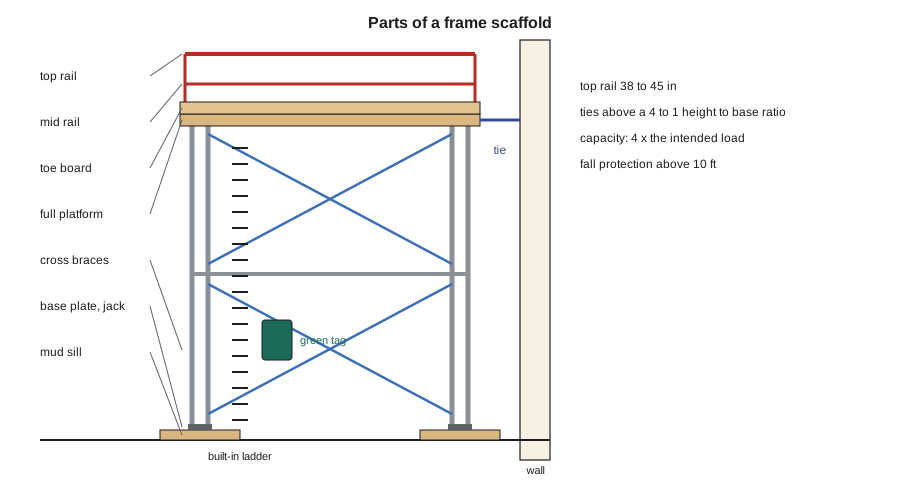
- Mud sills: timber pads under the base plates that spread the load on soil or soft surfaces.
- Base plates and screw jacks: plates that sit on the sills, and adjustable jacks for leveling.
- Frames and cross braces: the frames carry the load; the braces keep them square and stop them racking sideways. A frame scaffold without its braces is not a scaffold.
- Platforms: scaffold-grade planks or manufactured decks, laid across the frames, secured so they cannot slide or lift, and covering the full width of the bay.
- Guardrails: top rail, mid rail and toe board on every open side and end of a platform, to stop falls of people and objects.
- Ties and braces to the building: they stop tall scaffolds from tipping.
- Access: built-in ladders, attachable ladders or stair towers. Climbing the cross braces is not access.
The legal requirements
OSHA's scaffold standard, Subpart L, sets the rules. Each scaffold and component must support its own weight and at least four times the maximum intended load. Working platforms must be fully planked or decked, generally at least 18 inches wide, with planks extending 6 to 12 inches past their supports unless cleated or restrained. Workers on scaffolds more than 10 feet above a lower level need fall protection, guardrails for most supported scaffolds, with top rails between 38 and 45 inches high on scaffolds made since 2000, plus mid rails, and toe boards or screens where objects could fall on people below. Supported scaffolds taller than four times their minimum base width must be restrained by ties, guys or braces at set intervals. A competent person must inspect scaffolds for defects before each work shift and after any event that could affect their integrity, and must supervise erection, moving, alteration and dismantling. Workers must be trained under 1926.454 by a qualified person.
The site's rules often go further. Kingsway Tower requires every scaffold to carry a status tag at the access point and a competent person's daily inspection before use, and only trained scaffold crews may erect or change a scaffold.
Footings and plumb
A scaffold is only as stable as what it stands on. On soil or gravel, base plates sit on mud sills of solid timber that spread the load; never on bricks, concrete blocks, scraps of lumber or barrels, which can crack, roll or sink. On a concrete slab, base plates sit directly on the slab, but the slab must be sound and the scaffold must not stand over openings or weak covers. Screw jacks level the frames; they must not be extended beyond the manufacturer's limit. Frames must be plumb and the platform level. A scaffold that leans or racks is telling you something is wrong.
Platforms and planks
Use only scaffold-grade planks or manufactured platforms, inspected before use. Planks with large splits, cracks, rot, saw cuts or heavy paint that hides defects are rejected. Planks are laid across the full width of the bay with no large gaps, are long enough to overhang their supports by the required amount (enough to be secure but not so much that the overhang becomes a tipping trap), and are cleated, clipped or tied so they cannot slide. Where planks overlap, the overlap is over a support. Never use a single plank or a ladder laid flat as a platform.
Platforms have rated loads. Scaffold duty ratings are often described as light, medium or heavy duty, based on the load per unit area the platform must support. Light duty suits workers with tools; medium and heavy duty suit masonry and material storage. Never stockpile materials on a platform beyond its rating, and keep platforms clear of debris that can trip someone.
Guardrails, falling objects and access
Guardrails go on every open side and end of a platform where a person could fall, including the inside edge if the gap to the building is wide. The top rail must withstand a person falling against it; cross braces alone do not count as a guardrail on most systems unless the manufacturer and the regulation allow it. Toe boards stop tools and materials from being kicked off. Where people work or walk below, add debris netting or screens, and barricade the area under the scaffold.
Access must be safe: built-in ladders, attachable ladders, stair towers or a direct walk-through from the building. Workers climb facing the ladder with three points of contact and carry tools on a belt or haul them up with a rope, not in their hands.
Ties and stability
Tall, narrow scaffolds want to tip, especially when wind pushes on netting or tarps, or when someone pulls or pushes hard on the platform. Ties connect the scaffold to the building at regular vertical and horizontal intervals and stop it from tipping in or out. They are installed as the scaffold goes up and are removed only as it comes down, never earlier. Enclosed or wrapped scaffolds catch far more wind and need engineered tie patterns.
Rolling scaffolds are especially vulnerable. They are used only on firm, level floors, with all casters locked during use, guardrails installed and a height that stays within the manufacturer's height-to-base limits, which are typically lower than for fixed scaffolds; outriggers can widen the base. Kingsway Tower prohibits anyone from riding a rolling scaffold while it is moved. Workers come down, materials are secured or removed, the path is checked for holes, cords and slopes, and the tower is pushed from the base.
Inspection and scaffold tags
Scaffolds change constantly: braces are removed to get material through, planks are borrowed, ties are cut by another trade, a forklift bumps a leg. That is why scaffolds are inspected before use and after anything that could affect them, such as high winds, an impact or a modification. Many sites use a three-color tag at the access point:
| Tag color | Meaning | What you may do |
|---|---|---|
| Green | Inspected and complete; safe to use | Use it within its rated load, following any notes on the tag |
| Yellow | Modified or has special conditions | Use only as the tag directs, for example with a fall arrest harness or a reduced load |
| Red | Not complete, being erected or dismantled, or found unsafe | Do not use; only the scaffold crew may go on it |
If you find a defect, do not fix it yourself unless you are on the scaffold crew. Get off, warn others, and report it. Never remove a brace, plank, guardrail or tie to make your own work easier; ask the scaffold crew to modify it properly and re-inspect.
Power lines and weather
Scaffolds near overhead power lines must keep minimum clearances; OSHA's scaffold standard requires at least 10 feet from insulated or uninsulated lines up to 50 kilovolts, with more for higher voltages, unless the utility de-energizes or relocates the line. Metal scaffolds conduct, and long tubes being erected can swing into a line.
Ice, snow and rain make planks slippery. Clear platforms before use, and stay off scaffolds in high winds or thunderstorms.
Worked example: platform load and ties
Worked problem
A rolling scaffold for overhead piping
Maya and Luis will work from a rolling scaffold with a 7 ft by 5 ft platform rated at 50 lb per square foot (medium duty). They weigh about 165 lb and 200 lb, their tools and fittings weigh 90 lb, and they want to stage four 20 ft lengths of 2 in copper pipe weighing 27 lb each. Is the platform rating enough?
Show solution
- Platform area = 7 × 5 = 35 ft², so its rated load is about 35 × 50 = 1,750 lb.
- Load = 165 + 200 + 90 + 4 × 27 = 563 lb.
- 563 lb is about a third of the rated load, so the platform is adequate.
- But 20 ft pipe on a 7 ft platform overhangs badly and could tip or fall. Stage the pipe on the floor and pass it up one length at a time.
Answer: The load is within the rating, but long pipe should not be stored on the platform.
The program below checks a platform load against its rating and works out how many tie levels a fixed scaffold needs, using the tie rule for this site's jurisdiction.
# scaffold platform load check and tie levels (US units, OSHA 4:1 rule)
import math
length, width = 7, 5                 # platform, ft
rating = 50                          # lb per square foot (medium duty)
cap = length * width * rating
items = {"Maya": 165, "Luis": 200, "tools and fittings": 90, "4 lengths of pipe": 108}
load = sum(items.values())
print(f"platform capacity {cap} lb, load {load} lb ({100*load/cap:.0f}% of rating)")

# ties for a supported scaffold taller than 4 x its minimum base width
height, base = 40, 5                 # ft
first = 4 * base                     # first tie level at 4:1
levels = 0 if height <= first else 1 + math.ceil((height - first) / 20)   # then about every 20 ft (narrow scaffolds)
print(f"{height} ft tall, {base} ft base: first tie at {first} ft, about {levels} tie levels")platform capacity 1750 lb, load 563 lb (32% of rating) 40 ft tall, 5 ft base: first tie at 20 ft, about 2 tie levels
The tie calculation is a rough planning figure. The scaffold manufacturer's instructions, the engineer's design and the regulation set the actual tie pattern, including horizontal spacing and extra ties for wrapped scaffolds.
Common mistakes
MistakeStanding base plates on concrete blocks or scrap wood.
InsteadUse proper mud sills on soil and sound slabs; never improvise footings.
MistakeClimbing the cross braces to reach the platform.
InsteadUse the built-in ladder, an attached ladder or a stair tower.
MistakeRemoving a brace or tie to get material through.
InsteadAsk the scaffold crew to modify the scaffold and re-inspect it.
MistakeRiding a rolling scaffold while it is pushed.
InsteadGet down, secure materials, check the path and push from the base.
MistakeUsing a scaffold with a red tag or no tag.
InsteadUse only scaffolds tagged as inspected and safe, following the tag's notes.
MistakeStoring long or heavy materials on a platform beyond its rating.
InsteadStage materials on the floor and keep the platform load within its duty rating.
Summary and key terms
- Scaffold hazards are falls, collapse, falling objects and electrocution.
- Frame, system, tube-and-clamp and rolling scaffolds each have their own erection rules.
- OSHA requires a 4:1 capacity factor, full planking, fall protection above 10 ft, ties above a 4:1 height-to-base ratio and competent person inspection before each shift.
- Sound footings, braces, full platforms, guardrails with toe boards, ties and proper access are all required.
- Scaffolds are inspected before use and after any change; tags show their status.
- Never modify a scaffold yourself; report defects to the scaffold crew.
- Mud sill
- A timber pad that spreads a scaffold leg's load on soil or soft ground.
- Screw jack
- An adjustable threaded leg used to level a scaffold.
- Cross brace
- A diagonal member that keeps scaffold frames square and stops racking.
- Toe board
- A board along the platform edge that stops tools and materials falling off.
- Tie
- A connection from the scaffold to the building that prevents tipping.
- Bay
- The space between two adjacent scaffold frames or standards.
- System scaffold
- A modular scaffold with standards that have connection points for ledgers and braces at set heights.
- Scaffold tag
- A tag at the access point showing whether a scaffold is inspected and safe to use.
Practice problems
Work each problem on paper first, then reveal the answer to check.
A platform measures 8 ft by 4 ft and is rated light duty, 25 lb per square foot. What can it carry?
Show answer
32 ft² × 25 = 800 lb.
A supported scaffold has a minimum base width of 4 ft. At what height must ties start?
Show answer
When it is taller than 4 × 4 = 16 ft.
Above what height do workers on supported scaffolds need fall protection under OSHA?
Show answer
More than 10 feet above a lower level.
What does a red scaffold tag mean?
Show answer
Do not use; the scaffold is incomplete, being changed or unsafe.
Why are cross braces essential on a frame scaffold?
Show answer
They keep the frames square and stop the scaffold from racking and collapsing.
What should you do if you find a missing guardrail on a scaffold?
Show answer
Get off or stay off, warn others and report it to the scaffold crew; do not fix it yourself unless trained and authorized.
Lesson quiz · 5 questions
Score 60% or more to complete this lesson.
Create a free account to save your progress, take quizzes and earn a certificate.