
TRD-105 · Lesson 1 of 12 · 23 min
Rigging and hoisting on site: roles and responsibilities
Every morning at Kingsway Tower the tower crane swings its first load before most trades have finished their coffee. Bundles of pipe, pallets of drywall, rebar cages, formwork, mechanical units and even portable toilets travel up the outside of the building on a hook. Inside, smaller lifts happen all day: a chain fall hung from a beam clamp lifts a pump onto its pad, a lever hoist pulls a heavy valve into line, a material lift carries boxes of fittings to the eighth floor. Above all of that, workers stand on scaffolds and in elevating work platforms to reach ceilings, walls and the outside face of the building. This course is about the equipment that lifts loads and the equipment that lifts people, and about the habits that keep everyone below and beside them safe.
Maya Chen, the first-year plumbing apprentice with Northbridge Mechanical, met the rigging side of the job in her second week. The crew needed a domestic hot water storage tank moved from the loading dock into the mechanical room on the first parking level. Luis Ferreira, her journeyperson, told her she would not be rigging it alone, but she would be helping, and that meant learning who does what before anyone touched a sling. "Most rigging accidents are not caused by a sling that was too small," he said. "They are caused by somebody who thought somebody else had checked."
Why rigging needs clear roles
When a load is in the air, several people share control of it. The crane or hoist operator controls the motion. The rigger chose and attached the slings and hardware. The signaler tells the operator what to do. The people guiding the load with tag lines keep it from spinning. The supervisor planned the lift and decided who would do each job. If any one of them assumes another has done their part, a gap opens: a sling that nobody inspected, a load weight that nobody confirmed, a drop zone that nobody cleared. Clear roles close those gaps.
Rigging failures tend to be severe. A dropped load or a swinging load can kill or crush in a moment, and struck-by incidents are one of the leading causes of serious injury in construction. The Focus Four hazards covered in TRD-101 (falls, struck-by, caught-in or between, and electrocution) all show up in this course: struck-by from dropped and swinging loads, caught-between when a load is landed, falls from scaffolds and platforms, and electrocution when a boom or a load comes near an overhead power line.
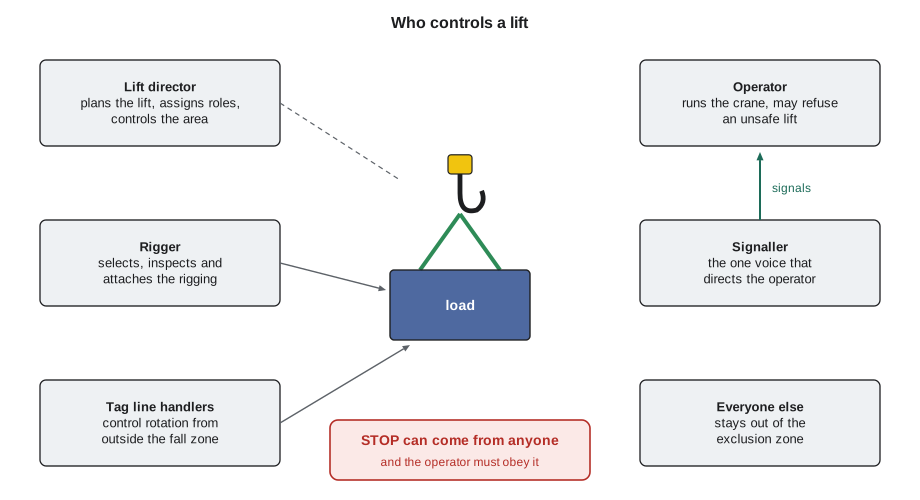
The people in a lift
The supervisor or lift director
Someone must be in charge of each lift. On a small lift with a chain fall, that might be Luis as the journeyperson leading the crew. On a crane lift, it is usually a supervisor or a person named as the lift director in the lift plan. This person confirms the load weight, chooses the equipment, makes sure everyone involved knows their role, checks that the area is controlled and has the authority to stop the job. On bigger or more complex lifts, which Lesson 8 calls critical lifts, the plan is written and reviewed in advance.
The operator
The crane operator controls the machine and is responsible for operating it within its rated capacity. Under OSHA's crane standard for construction, operators of most cranes must be certified for the type and capacity of crane, through an accredited testing organization or an audited employer program, and must also be evaluated by their employer as qualified for the specific equipment. The operator has the right and the duty to refuse a lift that they believe is unsafe, and must obey a stop signal from anyone on site.
Operators of smaller hoisting devices, such as a chain fall or a lever hoist, are often the tradespeople themselves. Maya will operate a chain hoist long before she is allowed near a crane control. The same principle applies: whoever is pulling the chain is responsible for knowing the hoist's capacity and for stopping if something looks wrong.
The rigger
The rigger selects, inspects and attaches the slings and hardware that connect the load to the hook. OSHA's crane standard requires a qualified rigger for crane assembly and disassembly and whenever workers are in the fall zone hooking, unhooking or guiding a load. A qualified rigger is someone the employer has determined can properly rig that particular load, based on a recognized certificate or on extensive knowledge, training and experience; third-party certification is not required by OSHA, although many contractors use it. Hector Ruiz, Stonebridge's lead rigger, rigs most tower crane picks; trade crews like Maya's rig their own smaller lifts under their supervisors, after training.
A good rigger works out the load weight, finds the center of gravity, chooses slings with enough capacity for the hitch and angle, protects the slings from sharp edges, checks every piece of hardware and makes sure the load will hang level and stable. Lessons 2 to 6 cover each of these skills.
The signaler
When the operator cannot see the load or the area where it is moving, a signal person directs the lift. OSHA's crane standard requires a qualified signal person in those situations. The signal person must know the signals used on the site, understand the crane's operations and limits, and pass both a written or oral test and a practical test, assessed by a third-party evaluator or by the employer's own qualified evaluator, with documentation kept at the site. The signal person has no other duties during the lift and stays in clear view of the operator, or uses a radio on a dedicated channel.
There is only one signaler at a time, because two people giving directions is a recipe for confusion. The exception is the stop signal: anyone who sees a hazard can and must give it, and the operator must obey it immediately. Lesson 7 covers signals in detail.
Tag line handlers and everyone else
Tag lines are ropes tied to the load so that workers can control its rotation from a distance. Tag line handlers stand outside the area under the load and never wrap the rope around a hand or body. Everyone else on site has one job during a lift: stay out of the exclusion zone. Kingsway Tower barricades the crane's swing area and the landing zones during picks, and the rule is the same for every trade: never walk under a suspended load, and never let a load be swung over you.
Competent, qualified and trained
OSHA uses two terms that are easy to mix up. A competent person can identify existing and predictable hazards and has the authority to take prompt corrective action, for example by stopping work. A qualified person has a recognized degree, certificate or professional standing, or extensive knowledge, training and experience, and can solve problems related to the subject. Scaffold standards lean on competent persons for inspection; crane standards call for qualified riggers and signal persons.
For an apprentice, the message is simple. You may help with rigging, scaffolds and platforms only after training, under supervision, and only for the tasks you have been trained for. Training is not a one-time event: refresher training is needed when equipment changes, when an incident shows a gap, or when the site rules require it.
The equipment covered in this course
| Category | Examples | Main hazards |
|---|---|---|
| Cranes | Tower crane, mobile crane, boom truck | Overload, tip-over, dropped load, power line contact |
| Below-the-hook rigging | Slings, shackles, hooks, eyebolts, spreader bars | Overloaded or damaged gear, poor hitch, sharp edges |
| Hoists | Chain falls, lever hoists, electric hoists, beam trolleys | Overload, unrated anchor point, side pulls |
| Scaffolds | Frame, system, tube-and-clamp, rolling scaffolds | Falls, collapse, falling objects, poor footing |
| Elevating work platforms | Scissor lifts, boom lifts, mast climbers | Tip-over, ejection, crushing against overhead structure |
| Material hoists | Construction hoists, material lifts | Falling loads, caught-in, gate interlocks bypassed |
Cranes themselves are operated only by certified operators, so this course does not teach crane operation. It teaches what a tradesperson needs to know to work safely around cranes, to rig and signal under supervision, to use small hoists, and to use scaffolds and platforms correctly.
Standards you will hear about
Laws set the minimum. Standards fill in the detail, and many laws refer to them directly. You do not need to memorize them, but you should recognize the names when you see them on a tag, a manual or a lift plan.
- ASME B30.5 covers mobile and locomotive cranes and includes the standard hand signals. ASME B30.3 covers tower cranes, and ASME B30.16 and B30.21 cover overhead hoists and lever hoists.
- ASME B30.9 covers slings, ASME B30.26 covers rigging hardware such as shackles, eyebolts and turnbuckles, and ASME B30.10 covers hooks. These American standards are used across North America, including on many Canadian sites, and manufacturers' tags and charts are based on them.
- The ANSI/SAIA A92 standards cover mobile elevating work platforms: A92.20 for design, A92.22 for safe use and A92.24 for training. They took effect in 2020 and were developed alongside the Canadian CSA B354 series.
- OSHA's construction standards set the legal requirements: Subpart CC for cranes and derricks, 1926.251 for rigging equipment, Subpart L for scaffolds, 1926.453 for aerial lifts and Subpart X for ladders. Ohio private employers are covered by federal OSHA. Kingsway Tower's site rules build on these.
Rules that apply to every lift
Luis gave Maya a short list that he has carried in his head for twenty years. Every lesson in this course expands on one of them.
- Know the weight. Never lift a load whose weight you have not worked out or confirmed.
- Know your gear. Use only rated, tagged, inspected rigging and hoists, within their capacity for the hitch and angle you are using.
- Know your anchor. A hoist is only as strong as the beam or point it hangs from, and that point must be rated or approved for the load.
- Keep out from under. Never stand, walk or work under a suspended load, and keep hands out of pinch points when landing it.
- One signaler, anyone can stop. Agree on signals before the lift, and stop immediately when anyone calls it.
- When in doubt, stop and ask. Stopping a lift costs minutes; a dropped load can cost a life.
Anika Shah, Stonebridge's site safety coordinator, adds one more for Kingsway Tower: every crane lift starts with a short pre-lift meeting where the lift director, operator, rigger and signaler agree on the plan, the signals and the exclusion zone. Even a lift that happens fifty times a day gets a quick check, because the load, the wind and the people change.
Worked example: counting the people in a lift
Worked problem
Assigning roles for the hot water tank
Northbridge must move a 1,500 lb domestic hot water storage tank from the loading dock to its pad in the P1 mechanical room. A forklift will bring it to the door, and a chain hoist on a beam trolley will lift it over a pipe rack and lower it onto the pad. Who is needed, and what does each person do?
Show solution
- Lift lead: Luis, as the journeyperson in charge, confirms the tank weight from the shipping documents, checks that the beam and trolley are rated for it, and briefs the crew.
- Rigger: Luis rigs the tank with two synthetic round slings in a basket hitch, with Maya helping and learning. He inspects every sling and the shackle before use.
- Hoist operator: Maya pulls the hand chain under Luis's direction, keeping the load low and stopping at each of his signals.
- Tag line: a second apprentice controls rotation with a tag line from outside the area under the tank.
- Area control: Dave Kowal, the foreman, has the area taped off and tells the electrical crew working nearby to stay clear until the tank is landed.
Answer: Four or five people, each with a defined job, and one person (Luis) giving directions.
Even a small lift has the same structure as a large crane pick: someone plans it, someone rigs it, someone operates the hoist, someone guides the load, and everyone else stays clear. The program below turns that structure into a simple checklist that refuses to start a lift until every role is filled and every check is done.
# pre-lift checklist: every role filled and every check done before lifting
roles = {"lift lead": "Luis", "rigger": "Luis", "hoist operator": "Maya",
         "tag line": "Jordan", "area control": "Dave"}
checks = {"load weight confirmed": True, "anchor rated for load": True,
          "slings inspected and tagged": True, "hitch capacity > load": True,
          "area barricaded": True, "signals agreed": False}

missing_roles = [r for r, who in roles.items() if not who]
open_checks = [c for c, done in checks.items() if not done]
for r, who in roles.items():
    print(f"{r:15} {who}")
if missing_roles or open_checks:
    print("DO NOT LIFT. Open items:", ", ".join(missing_roles + open_checks))
else:
print("All roles filled and checks complete: lift may proceed.")lift lead Luis rigger Luis hoist operator Maya tag line Jordan area control Dave DO NOT LIFT. Open items: signals agreed
In the example, the crew has not agreed on signals yet, so the checklist stops the lift. Agreeing on signals takes thirty seconds and prevents the most common misunderstanding on a lift: the operator lowering when the rigger meant stop.
Common mistakes
MistakeAssuming someone else inspected the slings.
InsteadThe person attaching the rigging inspects it before every use, every time.
MistakeHaving two people give signals to the operator.
InsteadName one signaler for the lift; anyone may call a stop.
MistakeWalking under a load to save a few steps.
InsteadGo around the barricaded zone; never pass under a suspended load.
MistakeTreating a training card as permission to do any lift.
InsteadDo only the tasks you were trained for, under supervision as an apprentice.
MistakeSkipping the pre-lift talk for a routine pick.
InsteadEvery lift gets a quick check of the weight, rigging, signals and zone.
Summary and key terms
- Several people share control of every lift; clear roles prevent gaps.
- The lift lead plans and controls the lift, the operator runs the equipment, the rigger chooses and attaches the rigging, and one signaler directs the operator.
- Anyone can and must give a stop signal, and the operator must obey it.
- OSHA requires qualified riggers and signal persons for many crane lifts, certified crane operators, and competent persons for scaffolds.
- Know the weight, know your gear, know your anchor, keep out from under, and stop when in doubt.
- Rigging
- The slings, hardware and methods used to attach a load to a hook or hoist.
- Rigger
- A trained worker who selects, inspects and attaches rigging.
- Signaler
- The one person who gives directions to the operator during a lift; also called a signal person.
- Lift director
- The person in charge of planning and controlling a lift.
- Tag line
- A rope attached to a load so workers can control its rotation from a distance.
- Exclusion zone
- The barricaded area under and around a lift that only the lift crew may enter.
- Competent person
- A person with the knowledge, training and experience, and the authority, to identify and control hazards for a task.
- Qualified rigger
- A rigger with the knowledge, training and experience to rig a particular load safely.
Practice problems
Work each problem on paper first, then reveal the answer to check.
Name five roles in a typical crane lift.
Show answer
Lift lead or supervisor, operator, rigger, signaler and tag line handlers (plus everyone else staying clear).
Who may give a stop signal?
Show answer
Anyone who sees a hazard; the operator must obey it immediately.
Why is only one person allowed to signal the operator?
Show answer
Two people giving directions can contradict each other and confuse the operator.
What are the six rules Luis gives Maya?
Show answer
Know the weight, know your gear, know your anchor, keep out from under, one signaler and anyone can stop, and stop and ask when in doubt.
Which Focus Four hazards appear in rigging and access work?
Show answer
Struck-by, caught-between, falls and electrocution: all four.
What does a tag line handler never do with the rope?
Show answer
Wrap it around a hand or body, or stand under the load to use it.
Lesson quiz · 5 questions
Score 60% or more to complete this lesson.
Create a free account to save your progress, take quizzes and earn a certificate.