
SMW-430 · Lesson 2 of 12 · 19 min
Using the exam blueprint and building a study plan
Twelve weeks is enough time to prepare well, but only if the hours go to the right places. Kai's first instinct was to reread his technical training binders from level 1 onward, a plan that would have used most of the twelve weeks on material he already knew. Aggie stopped him and asked for two things instead: the exam blueprint, which shows how much each part of the trade counts, and an honest rating of how ready he felt in each part. This lesson shows how to turn those two pieces of information into a weekly plan, and how to adjust the plan as practice results come in.
Reading the blueprint
The training committee publishes a study blueprint for its final written exam, built from the national curriculum. The blueprint used in this course has five areas: safety, tools and drawings at 20 percent; layout and fabrication at 30 percent; installation of duct systems at 30 percent; ventilation, testing and balancing at 10 percent; and architectural and roofing work at 10 percent. On a 100-question exam, the percentage equals the number of questions. Each area lists the topics from the curriculum that the questions may cover. The weights are the committee's planning figures, not a national standard, so an apprentice in another program checks the blueprint that program publishes.
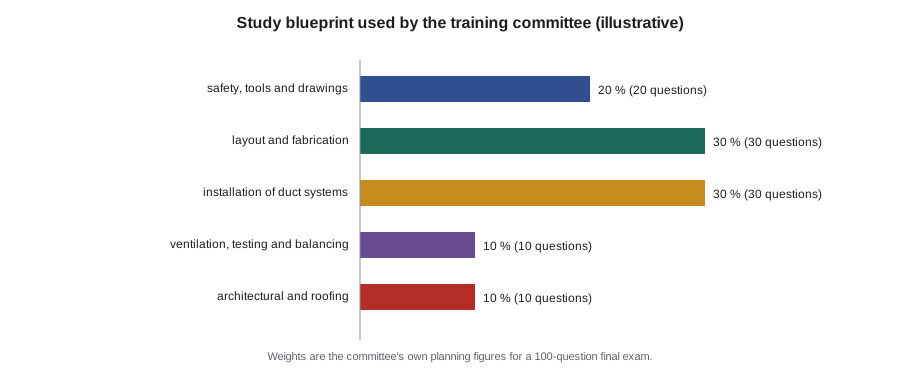
Two lessons follow from the blueprint. First, fabrication and installation together make up about two thirds of the exam, so they deserve about two thirds of the review, unless the apprentice is already very strong in them. Second, the small areas still matter: roofing and maintenance together are worth more questions than the gap between passing and failing for most candidates. Skipping them is a gamble, not a strategy.
The diagnostic test
A self-rating alone is not reliable, because people tend to rate familiar work highly even when they have forgotten the details. So the second input is a diagnostic test: a timed practice set that samples every area, written before any review. Aggie gave Kai a 60-question set built from her own question bank and the self-assessment tools published for the trade, and asked him to rate each area from 1 (not ready) to 5 (very ready) before he saw the results. Comparing the self-rating with the score is often the most useful part of the exercise.
| Area | Kai's self-rating (1 to 5) | Diagnostic score |
|---|---|---|
| Safety, tools and drawings | 4 | 71 % |
| Layout and fabrication | 4 | 68 % |
| Installation of duct systems | 4 | 74 % |
| Ventilation, testing and balancing | 3 | 58 % |
| Architectural and roofing | 3 | 60 % |
Kai's fabrication score surprised him. He had done more fabrication than anything else, but his diagnostic errors were mostly in pattern development questions that needed calculations he had not done by hand since level 2: cone radii, gore angles and triangulated true lengths. On the job, Lin's software or the plasma table's fitting library did much of that work. The exam does not allow software, so the hand methods had to come back.
A weighted study plan
Aggie's method for sharing study hours is simple. Each area gets a priority equal to its exam weight multiplied by a weakness factor, where the weakness factor is six minus the readiness rating. An area worth 30 percent with a rating of 4 gets 30 × 2 = 60 priority points; an area worth 8 percent with a rating of 2 gets 8 × 4 = 32. The available study hours are then shared in proportion to the priority points. The rule pushes time toward areas that are both heavily weighted and weak, while still giving the small areas a fair share.
# Weighted study plan: hours shared by weight x (6 - readiness)
areas = {
    "safety, tools and drawings": (20, 3),
    "layout and fabrication": (30, 3),
    "installation of duct systems": (30, 4),
    "ventilation, testing and balancing": (10, 3),
    "architectural and roofing": (10, 3),
}
hours_per_week = 9
weeks = 10                      # weeks 1-10; weeks 11-12 are for mocks and rest
total = hours_per_week * weeks
pts = {a: w * (6 - r) for a, (w, r) in areas.items()}
s = sum(pts.values())
print(f"total study hours: {total}")
for a, p in pts.items():
    h = total * p / s
print(f"{a:34s} priority {p:4d} hours {h:5.1f} per week {h / weeks:4.1f}")total study hours: 90 safety, tools and drawings priority 60 hours 20.0 per week 2.0 layout and fabrication priority 90 hours 30.0 per week 3.0 installation of duct systems priority 60 hours 20.0 per week 2.0 ventilation, testing and balancing priority 30 hours 10.0 per week 1.0 architectural and roofing priority 30 hours 10.0 per week 1.0
Kai adjusted his ratings after the diagnostic, dropping fabrication from 4 to 3, which moved several hours a week into layout. The plan does not have to be precise. Its purpose is to stop the natural drift toward comfortable topics, and it gives Kai a way to check, each week, whether he is spending time where the marks are.
Building the week
Kai works full days at Eastgate, so his study time is evenings and part of Saturday. Nine hours a week over ten weeks gives 90 hours of focused study before the final fortnight of mock exams and light review. Aggie suggested short, frequent sessions rather than long ones: an hour on three weeknights, a 30-minute drill of mixed calculations on two other nights, and a three-hour block on Saturday morning for a practice set and its review. Each session has one goal, written in a notebook before it starts, such as 'cone patterns: five problems by hand, check each against the formula'.
| Day | Session | Content |
|---|---|---|
| Monday | 60 min | Main area of the week: read, then work problems |
| Tuesday | 30 min | Mixed calculation drill (Lesson 7) |
| Wednesday | 60 min | Main area: problems and job examples |
| Thursday | 30 min | Flash cards on terms, codes and values |
| Friday | rest | No study |
| Saturday | 3 h | Timed practice set, then error log review (Lesson 8) |
| Sunday | 60 min | Second area of the week or catch-up |
The plan uses spaced review. Material studied in week 2 comes back briefly in weeks 3, 5 and 8, either as flash cards or as mixed problems, because memory fades quickly without retrieval. Practice that makes Kai pull an answer out of memory, such as working a problem without notes, builds stronger recall than rereading the binder, even though rereading feels easier.
Tracking progress
Every Saturday practice set goes into a simple drill log: the date, the area, the number of questions, the number correct and the time taken. Kai's targets were 80 percent on topic sets by the end of each area's main week, and a steady rise in mixed sets. A score below target means the plan needs adjusting, not that Kai is failing: either more time goes to that area, or the method changes, for example from reading to working problems.
# Drill log: average score by area and the gap to target
log = [  # (week, area, questions, correct)
    (1, "fabrication", 20, 13), (1, "installation", 20, 15),
    (2, "fabrication", 20, 15), (2, "roofing", 10, 6),
    (3, "fabrication", 20, 16), (3, "service", 10, 6),
    (4, "installation", 20, 17), (4, "roofing", 10, 8),
]
target = 0.80
by = {}
for w, a, n, c in log:
    q, k = by.get(a, (0, 0))
    by[a] = (q + n, k + c)
for a, (n, c) in by.items():
    pct = c / n
    flag = "on track" if pct >= target else f"gap {100 * (target - pct):.0f} points"
print(f"{a:13s} {c:3d}/{n:3d} = {100 * pct:5.1f} % {flag}")fabrication 44/ 60 = 73.3 % gap 7 points installation 32/ 40 = 80.0 % on track roofing 14/ 20 = 70.0 % gap 10 points service 6/ 10 = 60.0 % gap 20 points
Worked problem
Sharing ten hours
Kai has ten extra hours over a long weekend. Two areas compete: one worth 31 percent with a readiness of 3, and one worth 6 percent with a readiness of 2. Using Aggie's priority rule, how should the ten hours be split between them?
Show solution
- Priority of the first area: 31 × (6 − 3) = 93.
- Priority of the second: 6 × (6 − 2) = 24.
- Share: 93 / 117 = 0.79 and 24 / 117 = 0.21.
- Hours: about 8 hours and 2 hours.
Answer: About 8 hours to the heavily weighted area and 2 hours to the small one.
Revising the plan
No plan survives the first month unchanged, and it should not. Aggie built a check into Kai's week: every second Sunday, he updated his readiness ratings from the drill log, reran the weighted plan, and compared the new hours with the old. A change of more than an hour a week in any area meant a real shift, and he wrote down why. In week 4 the plan moved two hours a week from installation to roofing, because his installation sets were above target and his roofing sets were not. In week 7 it moved an hour back to fabrication, because his error log showed formula slips creeping back in pattern problems.
The habit of revising stops two common failures. One is sticking to a plan that has stopped working because it was written down and feels official. The other is changing the plan every few days on a feeling, which means nothing is ever studied long enough to stick. A fixed review point, with data from the log, keeps the plan steady and responsive at the same time.
Study materials
Kai gathered his materials before week 1 so that no study time was lost looking for them. He used the national curriculum outline for the trade, which lists the topics behind each area of the blueprint; the training committee's study guide and sample questions; his related instruction binders from all four years; the duct construction and kitchen exhaust standards Keelson keeps in the shop; and three question banks, one of them Aggie's own. He kept everything in one crate at home, with a separate folder for each area of the blueprint.
The standard or curriculum outline was the most useful single document, because it set the edges of the exam. When Kai was unsure whether a topic was worth his time, he looked it up: if it appeared in the list of tasks and knowledge, it could appear on the exam; if it did not, it could wait. That one check saved him from a weekend he would otherwise have spent on an industrial topic that was not in the outline at all.
Studying with others
Sean Doucette was a year behind Kai, but he joined some of the Saturday sessions, and the two of them found that explaining a topic to each other was among the best forms of review. To explain why a gore elbow has 2(n − 1) half-gores, Kai had to understand it properly, and Sean's questions showed him where his own understanding was thin. Aggie encouraged it, with two rules: each session had a set topic and a time limit, and each person worked the problems alone before comparing answers, so that neither leaned on the other.
Study partners are also a guard against isolation. Twelve weeks of evenings and Saturdays is a long time, and Kai admitted later that the weeks with a partner session were the weeks he kept to the plan. A partner who expects you on Saturday morning is a better motivator than a timetable on the fridge.
Balancing study with work and home
Kai was working full days on Eastgate throughout his preparation, and for a month of it he was also acting lead hand. The plan only worked because it was honest about his life. Aggie asked him to block out his work hours, travel, family commitments and sleep first, and to place study in what was left. Nine hours a week fitted; twelve would not have, and a plan that cannot be kept is worse than a modest plan that is. Kai also told Halima and his family about the exam date, so that overtime requests and weekend plans could take it into account.
The rest night mattered as much as the study nights. Friday had no study at all, by design. Aggie had watched apprentices burn out in week 8 or 9 of a plan that had no rest in it, and arrive at the exam tired and anxious. A night off each week, and a plan that ended with a taper rather than a sprint, kept Kai steady to the end.
Common mistakes
MistakeRereading everything from the beginning.
InsteadUse the blueprint and a diagnostic to put hours where the marks are.
MistakeTrusting self-ratings without testing them.
InsteadWrite a timed diagnostic and compare the results with the ratings.
MistakeSkipping the small areas entirely.
InsteadGive every area some time; small areas still carry several questions.
MistakeLong, unfocused study sessions.
InsteadUse short sessions with one written goal each.
MistakeKeeping no record of practice scores.
InsteadLog every set and adjust the plan to the gaps.
Summary and key terms
- The exam blueprint shows how much each area of the trade counts.
- A timed diagnostic test checks self-ratings against real performance.
- Study hours are shared by exam weight multiplied by weakness.
- Short, frequent sessions with spaced review and retrieval practice work better than long rereading.
- A drill log shows progress and tells you when to change the plan.
- Exam blueprint
- The published weighting of the exam by area of the trade.
- Diagnostic test
- A timed practice set taken before study to measure starting performance.
- Readiness rating
- A self-rating of how prepared you feel in an area, from 1 to 5.
- Spaced review
- Returning to material at increasing intervals to keep it in memory.
- Retrieval practice
- Recalling answers without notes, which strengthens memory.
- Drill log
- A record of practice sets, scores and times.
Practice problems
Work each problem on paper first, then reveal the answer to check.
An area is worth 20 percent and rated 3. What is its priority?
Show answer
20 × (6 − 3) = 60.
Why did Kai's fabrication score fall below his rating?
Show answer
Software had done the pattern calculations on the job, and the exam requires hand methods.
What is the purpose of the Saturday practice set?
Show answer
To practice under time pressure and feed the error log.
A topic set scores 14 of 20 against an 80 percent target. What is the gap?
Show answer
70 percent against 80 percent, a gap of 10 points.
Lesson quiz · 5 questions
Score 60% or more to complete this lesson.
Create a free account to save your progress, take quizzes and earn a certificate.