
SMW-430 · Lesson 12 of 12 · 18 min
The final weeks and certification
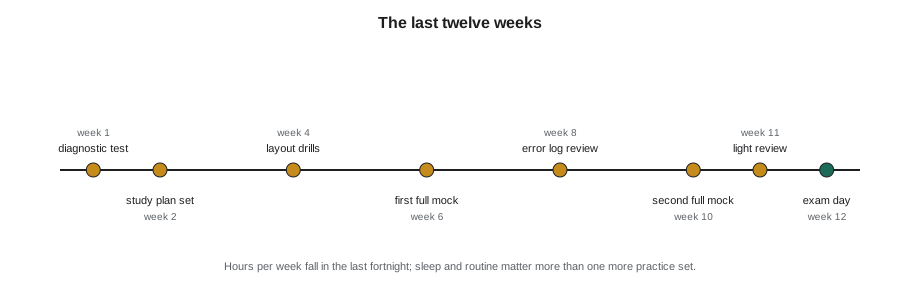
Twelve weeks earlier, Kai had sat a diagnostic test and scored in the low sixties. By week 10 his mocks were near 80 percent, his error log was down to a short repeat list, and his month as acting lead hand on level 3 had ended with the area closed in on time and a punch list of four items. This last lesson covers the final fortnight, exam day, the result and what comes after: the certificate, the first months as a certified journeyperson, and the lead hand role Halima offered him on level 4. It closes the SMW program, so it also looks back at how the pieces of the trade fit together.
The last fortnight
The final two weeks are for keeping what has been learned, not for adding to it. Kai's hours fell from nine a week to about six and then to three, made up of short sessions: the repeat list from the error log, the formula page from memory, flash cards on code values and roofing details, and two half-length mocks. He stopped studying entirely the day before the exam. Aggie's reasoning was simple: tired candidates misread questions, and misreading had been Kai's biggest single cause of error. Sleep, regular meals and normal exercise did more for his score in those two weeks than any extra practice set could have.
# Study hours by week: build, hold, then taper before the exam
plan = {1: 9, 2: 9, 3: 9, 4: 9, 5: 9, 6: 9, 7: 9, 8: 9, 9: 9, 10: 9, 11: 6, 12: 3}
total = sum(plan.values())
for week, h in plan.items():
    print(f"week {week:2d} {'#' * h:10s} {h:2d} h")
print(f"total {total} h; last fortnight {plan[11] + plan[12]} h ({100 * (plan[11] + plan[12]) / total:.0f} % of the total)")week 1 ######### 9 h week 2 ######### 9 h week 3 ######### 9 h week 4 ######### 9 h week 5 ######### 9 h week 6 ######### 9 h week 7 ######### 9 h week 8 ######### 9 h week 9 ######### 9 h week 10 ######### 9 h week 11 ###### 6 h week 12 ### 3 h total 99 h; last fortnight 9 h (9 % of the total)
The day before and the morning of
Kai checked the details of his final exam with the training coordinator: the address, the start time, the identification required and the calculator rules. He packed his bag the night before with photo identification, the confirmation letter, two pencils, an approved calculator with a fresh battery, water and a snack. He drove the route to the training center on the Sunday so there would be no surprises, and on the morning he arrived thirty minutes early.
| When | Check |
|---|---|
| One week before | Confirm time, place, identification and calculator rules |
| Two days before | Last half-length mock or repeat-list review; no new topics |
| The day before | No study; pack the bag; normal meals; early night |
| The morning | Breakfast; leave early; arrive 30 minutes ahead |
| In the room | Read the instructions; note the time; write the formula page on scrap paper if allowed |
In the exam
The exam itself held no surprises, because the mocks had been built to match it. Kai wrote down his key formulas on the scrap paper as soon as he was allowed to, then worked through the questions with the five-step method. He passed his first checkpoint two minutes ahead, marked six questions to come back to, and kept a steady pace. In the last quarter he did what the week 10 mock had taught him: a stretch, a slow breath and a sip of water at the checkpoint. With twenty minutes left he went back to the marked questions, changed one answer for a clear reason, left the others as they were, and checked that every question had an answer.
A note on changing answers. Research on multiple-choice tests suggests that changes made for a clear reason, such as noticing a misread word or a units mistake, more often go from wrong to right than the other way. Changes made on a vague feeling are less reliable. Kai's rule was to change an answer only when he could name the reason.
The result
The results came from the training committee some days later. Kai had passed with a comfortable margin. With his hours, his completed related instruction and his exam pass, the committee recorded his completion and he received his journeyman card and certificate of completion of a registered apprenticeship. Had he failed, the committee would have told him which areas were weakest, and he could have retaken the exam after the waiting period it sets, using the results to aim his review.
Aggie's advice for anyone who does not pass on the first attempt was the same she gave everyone: the result report is a diagnostic test that someone else has paid for. Read it, rebuild the study plan from it, and treat the rewrite as the next mock, not as a judgment.
A journeyman card lets a worker practice the trade. It is not a license to run a business. A sheet metal worker who later wants to contract HVAC work in Cleveland needs a state HVAC contractor license, which requires years of experience, an exam, bonding and insurance, and must also register with the City, as Lin explained in SMW-420.
The first months as a journeyperson
The day the result arrived, Halima offered Kai the lead hand role on Eastgate level 4, starting the next month, with Sean, now in his own exam preparation, and two apprentices. Kai accepted, and asked Aggie whether she would keep coaching him for the first few months. She agreed, on the condition that he coach Sean in turn. That condition is the trade's oldest tradition: knowledge passes from journeyperson to apprentice, and each new journeyperson becomes a teacher.
The first months brought new questions. Kai found that the hardest part of leading was not the technical work but deciding how much to do himself and how much to hand over. Walt's advice was to keep his hands on the tools for part of every day, because a lead hand who stops working loses touch with how long things take, but never so much that the planning slipped. Kai also started a notebook of lessons from each week, a habit he had learned from the error log: what went wrong, why, and what he would do differently.
# Lead hand's first-month review: plan against actual by week
weeks = [  # (week, planned ft of duct hung, actual, defects found, safety observations)
    (1, 300, 240, 3, 4), (2, 330, 310, 2, 5), (3, 360, 370, 1, 6), (4, 360, 355, 1, 6),
]
for w, plan, act, d, s in weeks:
    pct = 100 * act / plan
    print(f"week {w}: {act}/{plan} ft = {pct:3.0f} %, defects {d}, safety observations {s}")
tp = sum(p for _, p, _, _, _ in weeks); ta = sum(a for _, _, a, _, _ in weeks)
print(f"month: {100 * ta / tp:.0f} % of plan; defects falling from {weeks[0][3]} to {weeks[-1][3]}")week 1: 240/300 ft = 80 %, defects 3, safety observations 4 week 2: 310/330 ft = 94 %, defects 2, safety observations 5 week 3: 370/360 ft = 103 %, defects 1, safety observations 6 week 4: 355/360 ft = 99 %, defects 1, safety observations 6 month: 94 % of plan; defects falling from 3 to 1
The first week fell short because Kai planned the work as if he were doing it himself, without allowing for teaching time with the apprentices. By the third week his plans were workable and his crew was meeting them, with fewer defects and more safety observations reported, which Halima took as a sign of a crew that was paying attention.
Looking back on the program
The SMW program began with hand tools, layout and a first pattern in SMW-110 and SMW-120, and it ends with a certified journeyperson leading a crew on a hospital. The pieces connect. Layout and pattern development, from parallel line to triangulation, make fabrication possible. Fabrication, joining and welding turn patterns into fittings, duct, roofing and kitchen exhaust. Installation, ventilation and balancing make those parts into systems that move air where it is needed, at the right rate and pressure. Architectural work and estimating show the trade's range and its business side. And the last two lessons show that once the skills are in place, a journeyperson's value grows with the ability to plan, coordinate, check and teach.
| Courses | What they built |
|---|---|
| SMW-110 to SMW-130 | Tools, safety, drawings, layout and basic fabrication |
| SMW-210 to SMW-230 | Advanced pattern development, fabrication and welding |
| SMW-310 to SMW-330 | Installation, architectural sheet metal and kitchen and industrial exhaust |
| SMW-410 and SMW-420 | Testing and balancing, estimating and the business of the trade |
| SMW-430 | Exam preparation and job leadership |
Worked problem
Planning a rewrite
Sean writes the exam six months after Kai and narrowly misses the pass mark. His result report shows his weakest areas were installation and maintenance. What should his plan look like?
Show solution
- Treat the report as a diagnostic: rate each area again and compare.
- Rebuild the weighted study plan with installation and maintenance at the front.
- Restart the error log with new practice sets and mocks under real conditions.
- Book the rewrite after the waiting period, once the last two or three mocks are clearly above the pass mark.
Answer: Use the report as a diagnostic, rebuild the weighted plan, and book when the mock trend is clearly above the pass mark.
Keeping the certificate current
Certification is a beginning, not an end. Codes and standards change, new materials and methods arrive, and safety training such as working at heights, confined spaces, aerial lifts and first aid must be renewed on a cycle. Kai set up a simple record of every ticket and certificate he held, with its expiry date, so that nothing would lapse without warning. He also kept his flash cards, because the code values and details on them would be useful when he began to coach Sean.
# Ticket and certificate record: what expires in the next six months?
from datetime import date
today = date(2026, 11, 2)
tickets = {
    "journeyman card": None,
    "working at heights": date(2027, 3, 15),
    "aerial work platform": date(2027, 1, 20),
    "first aid and CPR": date(2027, 4, 30),
    "ICRA awareness": date(2026, 12, 10),
}
for name, exp in tickets.items():
    if exp is None:
        print(f"{name:28s} no expiry")
        continue
    days = (exp - today).days
print(f"{name:28s} expires {exp} ({days} days)" + (" renew soon" if days < 90 else ""))journeyman card no expiry working at heights expires 2027-03-15 (133 days) aerial work platform expires 2027-01-20 (79 days) renew soon first aid and CPR expires 2027-04-30 (179 days) ICRA awareness expires 2026-12-10 (38 days) renew soon
Further learning is also part of a career. Some journeypersons go on to specialize in testing and balancing, welding, architectural work or estimating; some become foremen, superintendents, instructors or contractors. Aggie had started as an apprentice on a roofing crew and now trained the trade's next generation. She told Kai that the habits that got him through the exam, planning, measuring progress and fixing causes rather than symptoms, would serve him in every one of those roles.
The program also leaves a record of its own. Kai kept his study plan, his drill log, his error log and his mock results in one folder, and gave a copy to Aggie for her next apprentice. Looking through it a year later, he was struck less by the scores than by the pattern: the biggest gains had come not from more hours but from finding the cause of each error and fixing it. That lesson applied as much to a crew's defects on site as to his own mistakes in a practice set, and it was the one he passed on first when Sean began his own twelve weeks.
Common mistakes
MistakeStudying hard the night before.
InsteadRest the day before; tired candidates misread questions.
MistakeArriving at the exam with no margin.
InsteadCheck the route and arrive thirty minutes early.
MistakeChanging answers on a vague feeling.
InsteadChange an answer only for a reason you can name.
MistakeTreating a failed attempt as a final judgment.
InsteadUse the result report as a diagnostic for the rewrite.
MistakePlanning a crew's work as if doing it all yourself.
InsteadAllow time for teaching and checking.
Summary and key terms
- The last fortnight is for keeping, with hours tapering and no new topics.
- Prepare logistics in advance: identification, calculator, route and arrival time.
- In the exam, use the method, the checkpoints and the marked-question review that the mocks rehearsed.
- Change answers only for a clear reason.
- A pass leads to certification; a fail leads to a better-aimed plan.
- A new journeyperson becomes a teacher, and a lead hand's value grows with planning, coordination and mentoring.
- Trade credential
- The certificate or card that shows a worker is qualified at journey level.
- Result report
- The breakdown of an exam result by area, sent to the candidate.
- Checkpoint
- A planned point in the exam for checking the pace.
- Taper
- A planned reduction in study hours before an exam.
- Rewrite
- A second sitting of an exam after an unsuccessful attempt.
- Lead hand
- A working journeyperson who leads a small crew.
Practice problems
Work each problem on paper first, then reveal the answer to check.
What should the day before the exam look like?
Show answer
No study, a packed bag, normal meals and an early night.
When should an answer be changed?
Show answer
Only when you can name a clear reason.
What is the value of a result report after an unsuccessful attempt?
Show answer
It is a diagnostic for the rewrite plan.
Kai's crew hung 72 of a planned 90 in week 1. What percentage is that?
Show answer
80 percent.
Lesson quiz · 5 questions
Score 60% or more to complete this lesson.
Create a free account to save your progress, take quizzes and earn a certificate.