
SMW-430 · Lesson 11 of 12 · 19 min
Scheduling, coordination and quality control on site
Kai's month as lead hand on Eastgate level 3 taught him that most of the problems that slow a crew down are visible weeks in advance, if someone is looking. A delivery that will arrive after it is needed, a ceiling that will be closed before the duct is tested, an area that two trades plan to use on the same day: each can be seen on paper and solved with a phone call, or found on site and solved with lost days. This lesson covers the tools that let a lead hand look ahead, coordinate with other trades and control quality: the look-ahead schedule, the coordination meeting, the quality checklist, the defect log and the daily record.
From the master schedule to the look-ahead
The general contractor's master schedule shows the whole job, usually by area and by trade, over months or years. It is too coarse for running a crew. The look-ahead schedule breaks the next two or three weeks into tasks a crew can do in a day or a few days, with the people, materials, equipment and access each task needs. Halima prepared Keelson's three-week look-ahead for Eastgate every Thursday, and from his second week Kai drafted the level 3 part of it. Each task on it had a start, a duration, a crew size, and a list of what had to be in place before it could start, such as a delivery, an inspection, or another trade finishing in the area.
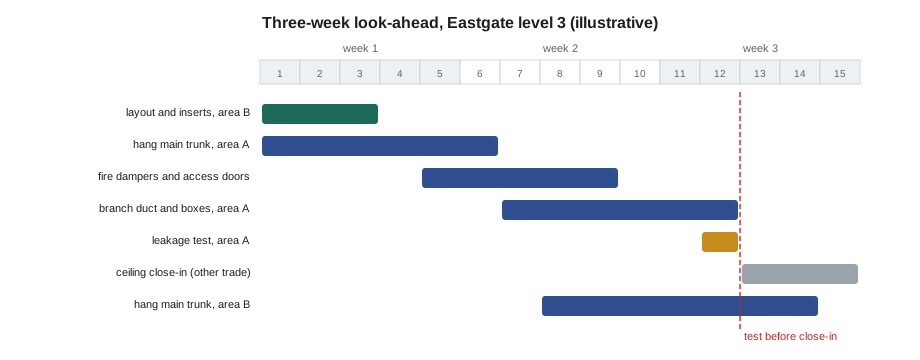
The most important line on the chart is the dashed one. The ceiling contractor planned to start closing area A on day 13, so every piece of duct in area A had to be hung, sealed, tested and signed off by the end of day 12. Working back from that date set the order of everything else: branch duct had to start by day 7, so the main trunk had to be finished by day 6, so the trunk had to start on day 1.
Crew-hours and loading
A look-ahead also shows whether the crew can do what it promises. Each task is given a crew size, and adding up the people needed each day shows the crew loading. If the loading is higher than the crew, the plan will fail unless something changes: a task moves, the crew grows, or the work is done differently. Kai's first draft of the look-ahead overloaded his crew of four on three days.
# Crew-hour look-ahead: people needed each day against the crew available
tasks = [  # (task, start day, duration in days, people)
    ("layout and inserts, area B", 1, 3, 1),
    ("hang main trunk, area A", 1, 6, 2),
    ("fire dampers and access doors", 5, 5, 1),
    ("branch duct and boxes, area A", 7, 6, 2),
    ("leakage test, area A", 12, 1, 2),
    ("hang main trunk, area B", 8, 7, 2),
]
crew, hours = 4, 8
total = 0
for day in range(1, 16):
    need = sum(p for _, s, d, p in tasks if s <= day < s + d)
    total += need * hours
    flag = "  OVER by " + str(need - crew) if need > crew else ""
    print(f"day {day:2d}: {need} people, {need * hours:2d} crew-hours{flag}")
print(f"total {total} crew-hours against {crew * hours * 15} available")day 1: 3 people, 24 crew-hours day 2: 3 people, 24 crew-hours day 3: 3 people, 24 crew-hours day 4: 2 people, 16 crew-hours day 5: 3 people, 24 crew-hours day 6: 3 people, 24 crew-hours day 7: 3 people, 24 crew-hours day 8: 5 people, 40 crew-hours OVER by 1 day 9: 5 people, 40 crew-hours OVER by 1 day 10: 4 people, 32 crew-hours day 11: 4 people, 32 crew-hours day 12: 6 people, 48 crew-hours OVER by 2 day 13: 2 people, 16 crew-hours day 14: 2 people, 16 crew-hours day 15: 0 people, 0 crew-hours total 384 crew-hours against 480 available
The code shows the crew short by one person on days 8 and 9 and by two on day 12, the day of the leakage test. Kai's solution came in two parts. He moved the start of the area B trunk to day 10, when the fire dampers were finished, which removed the overload on days 8 and 9 without touching the close-in date. On day 12 the two people on the area B trunk ran the leakage test instead, with Walt, who ran most of the tests on the job, supervising, and the area B trunk was extended by a day. The total crew-hours did not change; the plan simply fitted the crew.
Crew-hours also connect the look-ahead to the estimate. Lin's estimate for level 3 allowed a set number of labor hours for each area. By comparing the crew-hours used each week with the hours earned, meaning the estimate's hours for the work actually installed, Halima could see whether the job was on budget. Kai did not manage the budget, but he learned why Halima asked for accurate daily hours by area.
Coordination with other trades
On a hospital, the ceiling space is crowded: duct, sprinkler pipe, medical gas, plumbing, electrical cable tray, nurse call and data, all in a few hundred millimeters. Eastgate used a coordinated three-dimensional model, and every trade's work was checked against the others before fabrication. Even so, conflicts turned up on site: a sprinkler main a little lower than modeled, a cable tray installed early in the wrong place. The rule, as Lesson 5 noted, is never to solve a conflict by moving or hanging from another trade's work. The lead hand stops, records the conflict with a photo, a location and a drawing reference, and raises it through the foreman, usually at the weekly coordination meeting or, if urgent, through a request for information to the general contractor.
Kai went to two coordination meetings with Halima. The meetings were short and practical: each trade's foreman reported progress and the next two weeks' areas, conflicts were listed and assigned, and inspection and close-in dates were confirmed. Kai noticed that the foremen who came with their own look-ahead and a list of specific problems got their problems solved first.
| Tool | What it is for | Who keeps it |
|---|---|---|
| Master schedule | The whole job by area and trade | General contractor |
| Look-ahead | The next two or three weeks in detail | Foreman, with lead hands |
| Coordination meeting | Sharing plans and solving conflicts between trades | General contractor chairs; foremen attend |
| Request for information | A formal question about the drawings or specifications | Foreman or project manager |
| Daily log | What happened each day | Lead hand and foreman |
Quality control
Quality control on site means checking work against the drawings, specifications and standards as it is installed, not after it is covered. Keelson's quality plan for Eastgate used checklists for each type of work. The duct installation checklist covered hanger type and spacing, seismic bracing, joint sealing, access doors, fire dampers and their access, insulation clearance and labeling. The lead hand checked each section against the list, signed it, and passed it to the foreman for the leakage test and the final sign-off. Every defect found, by Keelson or by the general contractor's inspector, went into a defect log with its location, type, date found and date fixed.
# QC defect tracking: open items, defects by type and rate per length inspected
defects = [  # (id, area, type, found day, fixed day or None)
    (1, "A", "missing sealant at joint", 3, 4), (2, "A", "hanger spacing", 4, 4),
    (3, "A", "access door missing", 6, 8), (4, "A", "missing sealant at joint", 7, 7),
    (5, "B", "label missing", 9, None), (6, "A", "missing sealant at joint", 10, 11),
    (7, "A", "seismic brace loose", 10, None), (8, "B", "hanger spacing", 11, None),
]
inspected = 1380                 # length of duct inspected so far, ft
by_type = {}
for _, _, t, _, _ in defects:
    by_type[t] = by_type.get(t, 0) + 1
for t, n in sorted(by_type.items(), key=lambda x: -x[1]):
    print(f"{t:26s} {n}")
open_items = [d for d in defects if d[4] is None]
print(f"open: {len(open_items)} -> " + ", ".join(f"#{d[0]} {d[2]} (area {d[1]})" for d in open_items))
print(f"rate: {300 * len(defects) / inspected:.1f} defects per 300 ft inspected")missing sealant at joint 3 hanger spacing 2 access door missing 1 label missing 1 seismic brace loose 1 open: 3 -> #5 label missing (area B), #7 seismic brace loose (area A), #8 hanger spacing (area B) rate: 1.7 defects per 300 ft inspected
The log showed Kai that unsealed joints were the most common defect on his crew's work, three of eight, and that all three had been found before the leakage test, which is exactly when a defect is cheapest to fix. He made sealing the topic of the next toolbox talk, and asked each crew member to seal the joints of every section they hung before moving to the next, rather than leaving sealing for a separate pass. The open items list became the first thing he checked each morning, because an open defect in an area about to be closed in is a defect that will be expensive later.
Punch lists and closing out
At the end of each area, the general contractor and the consultant walk it and issue a punch list of items to finish or correct. A crew that has kept its own quality checklist and defect log will have few punch items, because most defects were found and fixed as the work went in. The lead hand's job at punch-list time is to assign each item, check it when fixed, and report it closed. The same discipline applies to records: test reports, damper inspection records, balancing reports and as-built mark-ups are part of the work the owner receives, and a missing record can hold up the completion of a whole area.
The daily log
Kai's daily log took five minutes at the end of each shift. It recorded who worked and for how long, in which area; what was installed; deliveries received and any problems with them; inspections and tests; conflicts or delays and their causes; safety observations and incidents; and instructions received, with who gave them. Halima explained why it mattered. If a delay later becomes a claim, or an incident is investigated, the daily log is the record of what happened. Notes written on the day are believed; memories written months later are not.
Worked problem
A close-in date moves forward
On day 8, the general contractor asks to bring the area A close-in forward from day 13 to day 11. Branch duct is due to finish on day 12 and the leakage test is planned for day 12. What should Kai do?
Show solution
- Check the look-ahead: branch duct and testing cannot both finish by day 10 with the current crew.
- Work out what it would take: perhaps two extra people on branch duct for days 8 to 10 and a test on day 10.
- Tell Halima the same day, with the options and their crew-hours.
- Make sure the general contractor knows that close-in before the test is signed off is not an option.
Answer: Report the effect with options to Halima at once; do not let the ceiling close before the duct is tested.
Change orders and extra work
Sometimes a site instruction asks for work that is not in the contract: an extra branch, a relocated diffuser, a change to a fire damper location. The lead hand does not refuse it, but does not simply do it either. The instruction is recorded with who gave it, when, and what was asked, and passed to the foreman before the work starts, so that the company can confirm it and price it as a change. Work done without that record is often work done for free, and on a large job the total can be significant. Kai learned this from Halima in his second week, when a nurse manager asked his crew to add a return grille in a staff room.
Common mistakes
MistakePlanning from the master schedule alone.
InsteadUse a look-ahead with tasks, crews, materials and preconditions.
MistakeIgnoring crew loading.
InsteadAdd up the people needed each day and fix overloads before they happen.
MistakeSolving a conflict by moving another trade's work.
InsteadRecord it and raise it through the foreman or a request for information.
MistakeChecking quality after the work is covered.
InsteadUse checklists as the work goes in and test before close-in.
MistakeKeeping no daily record.
InsteadWrite a short daily log every shift.
Summary and key terms
- A look-ahead turns the master schedule into near-term tasks with crews, materials and preconditions.
- Working back from fixed dates, such as close-in, sets the order of the work.
- Crew loading shows whether the plan fits the crew; overloads are fixed on paper, not on site.
- Conflicts between trades are recorded and resolved through the foreman and the coordination process.
- Quality checklists, a defect log and testing before close-in catch defects while they are cheap to fix.
- Daily logs are the record of the job.
- Look-ahead schedule
- A detailed schedule of the next two or three weeks.
- Crew loading
- The number of people a plan needs each day.
- Crew-hours
- People multiplied by hours worked.
- Request for information
- A formal question to the designers about the drawings or specifications.
- Defect log
- A record of defects found, their type, location and status.
- Punch list
- A list of items to finish or correct before an area is accepted.
Practice problems
Work each problem on paper first, then reveal the answer to check.
Close-in is on day 13. When must the leakage test be signed off?
Show answer
By the end of day 12.
A crew of four is planned for five people on one day. What are the options?
Show answer
Move a task, add a person for that day, or change the method.
A sprinkler main is in the duct's path. What do you do?
Show answer
Stop, record it with a photo and location, and raise it through the foreman.
Why write the daily log on the day?
Show answer
Records made at the time are reliable evidence.
Lesson quiz · 5 questions
Score 60% or more to complete this lesson.
Create a free account to save your progress, take quizzes and earn a certificate.