
SMW-430 · Lesson 10 of 12 · 19 min
Leading a crew
Halfway through Kai's exam preparation, Halima Noor, the Keelson foreman on Eastgate, asked him to lead a small crew on level 3 while the lead hand there was off for a month. The crew was Sean Doucette, a fourth-year apprentice close to his own exam; Priya, a first-year in her second month; and Marco, an experienced journeyperson who had come over from another contractor. Kai was nervous: he was used to being the one told what to do. Walt's advice was short. 'You're not their boss. You're the one who makes sure they can do good work safely and go home on time.' This lesson covers what that means in practice, and it draws on the communication and mentoring tasks that the exam includes under common occupational skills.
What a lead hand does
A lead hand is a working member of the crew who also plans the crew's day, keeps it supplied, makes sure the work is done safely and to the drawings, and is the link between the crew and the foreman. The lead hand does not usually hire, fire or discipline; those are the foreman's and the company's jobs. But the lead hand is the person the crew sees first in the morning and last at night, and the way the lead hand works sets the standard for the crew. Kai's list for each day had five parts: the plan, the hazards, the materials, the people, and the record.
| Part | Question for the day | Kai's habit |
|---|---|---|
| Plan | What will the crew finish today? | Two or three clear goals written on the whiteboard at the gang box |
| Hazards | What could hurt someone today? | Hazard assessment done with the crew before work starts |
| Materials | Is everything here, and where will it go? | Check the next day's deliveries before lunch |
| People | Who does what, and who needs help? | Pair the first-year with Marco on tasks new to her |
| Record | What happened, and what changed? | Five lines in the daily log before leaving |
Safety leadership
Every shift on Eastgate started with a job hazard analysis. The crew walked the area, listed the tasks for the day, identified the hazards of each one, and wrote down the controls. Under federal workplace safety rules and Ohio's own requirements, the employer is responsible for the safety program, but anyone who directs work, including a lead hand, is expected to make sure the crew follows it, and workers are entitled to raise safety concerns without retaliation. Kai's first test as a lead hand came on day two, when Sean wanted to finish a hanger from the top step of a stepladder rather than fetch the lift from the next bay. Kai stopped the work, helped Sean move the lift, and said nothing more about it than that. The crew noticed.
Safety leadership is mostly about consistency. A lead hand who enforces the rules only when the safety officer is on the floor teaches the crew that the rules are for show. A lead hand who follows them every time, including when it is inconvenient, teaches the opposite. Kai's own rule was that he would never ask anyone to do something he would not do himself, and never let anyone do something he would not do himself.
Toolbox talks
A toolbox talk is a short safety meeting, usually at the start of a shift or a week, on one topic. The good ones are specific to the work in front of the crew, last five to ten minutes, and get the crew talking. The poor ones are a policy read aloud to people looking at their phones. Kai's first talk was on lift safety, because the crew was moving to a congested area with several lifts and other trades working overhead. He brought the lift to the gang box, asked Marco to show the pre-use inspection, and asked each person to name one thing they would check before raising the platform. It took eight minutes and everyone took part.
Talks work best when they are planned a week ahead and linked to the look-ahead schedule, which Lesson 11 covers. If the crew will be cutting into an existing ceiling next week, the talk this week is on dust and hidden services; if the crew will be welding a grease duct support, it is on hot work permits and fire watch.
Leading by situation
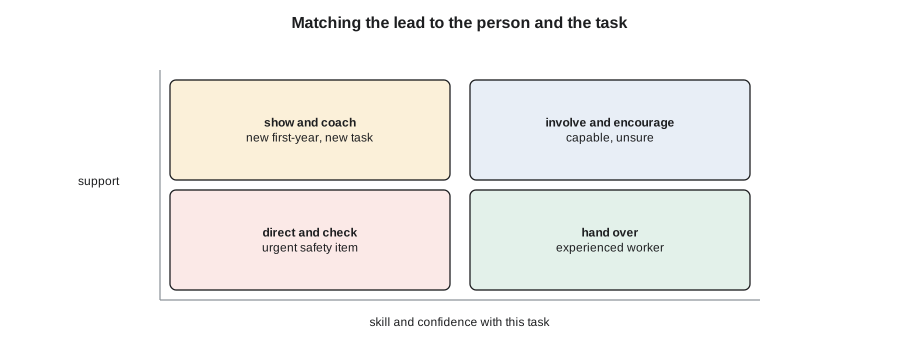
The same lead hand does not lead everyone the same way. A first-year on a new task needs to be shown the task, watched while doing it, and checked. An experienced worker on a familiar task needs to be given the goal and left alone. Between these are workers who are capable but unsure, who need encouragement and involvement in decisions, and moments when there is no time to discuss, such as an urgent safety hazard, when the lead hand simply directs. The skill is matching the approach to the person and the task, not to the person alone: Marco needed coaching on the hospital's infection control rules, which were new to him, even though he needed none on hanging duct.
Mentoring apprentices
Mentoring is one of the trade's oldest duties: every journeyperson was taught by someone, and is expected to teach in turn. It is also listed in the occupational standard, and the exam may ask how to teach a new skill. The method that works on site has four steps. Explain what the task is and why it matters. Show the task at normal speed, then slowly, naming each step. Let the apprentice do it while you watch, correcting as needed. Check the result together and let the apprentice do it again. Kai used this with Priya on the power shear, on drilling and anchoring hangers, and on reading the hanger layout from Lin's drawings.
Good mentors also give apprentices real work, not only fetching and cleaning, and sign their logbooks promptly and accurately. Kai remembered how much it had mattered when Aggie, years before, had let him lay out his first transition on his own and then checked it with him. He made sure Priya's first independent task, setting a row of hangers, was one she could succeed at, and that he checked it with her before the duct went up.
# Crew training matrix: who is signed off for which task
crew = ["Kai", "Marco", "Sean", "Priya"]
tasks = ["lift", "shear", "anchors", "hot work", "ICRA"]
signed = {
    "Kai":   {"lift", "shear", "anchors", "hot work", "ICRA"},
    "Marco": {"lift", "shear", "anchors", "hot work"},
    "Sean":  {"lift", "shear", "anchors", "ICRA"},
    "Priya": {"shear"},
}
print(" " * 7 + "".join(f"{t:>11s}" for t in tasks))
for p in crew:
    print(f"{p:7s}" + "".join(f"{'yes' if t in signed[p] else '-':>11s}" for t in tasks))
for t in tasks:
    gaps = [p for p in crew if t not in signed[p]]
    if gaps:
print(f"{t}: needs training or supervision for {', '.join(gaps)}")lift shear anchors hot work ICRA Kai yes yes yes yes yes Marco yes yes yes yes - Sean yes yes yes - yes Priya - yes - - - lift: needs training or supervision for Priya anchors: needs training or supervision for Priya hot work: needs training or supervision for Sean, Priya ICRA: needs training or supervision for Marco, Priya
The matrix showed Kai at a glance that Marco needed the hospital's infection control risk assessment training, ICRA for short, before he could work above occupied areas, and that Priya could not yet operate a lift or set anchors without direct supervision. He passed both points to Halima the same day.
Communication and conflict
Most problems on a crew start as small misunderstandings. Clear instructions prevent many of them: say what is to be done, where, to what standard, by when, and why, and ask the other person to repeat the key points back. When a problem does arise, the lead hand deals with it early, in private, and about the work rather than the person. In Kai's third week, Marco and Sean disagreed loudly about the order of hanging a run of duct, in front of an electrician's crew. Kai waited until the break, spoke to each of them separately, heard both views, made a decision, and explained it to both together. He did not take sides in public and he did not let it fester.
Respect on site is not optional. Keelson's respectful workplace policy, like federal and state anti-harassment law, requires that harassment and bullying be reported and dealt with. A lead hand who hears a slur or sees an apprentice singled out deals with it on the spot and reports it to the foreman. Crews that treat everyone with respect keep good people, and the trade needs every good person it can find.
Working with the foreman
The lead hand keeps the foreman informed: progress against the plan, materials that are short or wrong, conflicts with other trades, safety concerns and any incident, however small. Kai learned to bring problems to Halima with a suggested solution, and to report bad news early. When a delivery of fire dampers arrived with the wrong sleeve gauge, he told her within the hour, with the packing slip, the drawing reference and a proposal to move the crew to branch duct in area A while the dampers were replaced. She told him later that this was exactly what she needed from a lead hand.
Worked problem
A shortcut on site
It is 3:30 on a Friday. Sean suggests skipping the last section's hanger torque check to finish before the weekend, since the duct 'looks fine'. Marco agrees. What should Kai do?
Show solution
- The check is part of the installation standard and the quality plan.
- Skipping it risks a hanger failure later, above an occupied area.
- Kai explains briefly why the check matters, then splits the section so the three of them finish it in twenty minutes.
- If it cannot be finished, the section is tagged and logged as incomplete for Monday.
Answer: Do the check, share the work to finish quickly, or tag it incomplete; never skip it.
Giving feedback
A lead hand gives feedback all day, mostly in small ways: a word of thanks, a correction, a suggestion. Good feedback is specific, timely and about the work. 'Good job' tells Priya little; 'your hanger row is straight and every rod is cut to length, nice work' tells her exactly what to keep doing. Corrections work the same way: describe what you saw, explain why it matters, and agree on what to do next. Kai found that giving praise when it was earned made his corrections easier to hear, because the crew knew he noticed good work as well as mistakes.
Feedback runs the other way too. Kai asked Marco, who had led crews himself, to tell him at the end of each week one thing he would have done differently. Marco's first answer was blunt: Kai was planning too much of the day in his head and not enough on the whiteboard, so the crew kept asking him what came next. Kai moved the plan to the whiteboard the next Monday, and the questions stopped.
Looking after the crew
A crew works well when its members feel safe, respected and able to speak up. Small things matter: making sure everyone has the tools and protective equipment they need, rotating the unpleasant jobs, noticing when someone is tired or unwell, and making space for questions. Construction has a high rate of mental health problems and a culture that does not always talk about them. Kai did not need to be a counselor, but he did learn where to point people if they needed help, including the company's employee assistance program, and he made sure the crew knew that asking for help was normal.
Kai also learned that looking after the crew includes the end of the day. He kept to the finishing time, cleaned up the area with everyone rather than leaving it to the first-year, and made sure the next morning's plan was on the whiteboard before anyone left, so that the crew could start without waiting for him.
Common mistakes
MistakeEnforcing safety only when the safety officer is present.
InsteadApply the rules every time, the same way.
MistakeReading a policy aloud as a toolbox talk.
InsteadKeep it short, specific and two-way.
MistakeLeading everyone the same way.
InsteadMatch the approach to the person and the task.
MistakeGiving apprentices only fetching and cleaning.
InsteadGive real work, taught in steps and checked.
MistakeSettling a disagreement in public.
InsteadDeal with it early, in private, about the work.
Summary and key terms
- A lead hand plans the crew's day, keeps it safe and supplied, and links the crew with the foreman.
- Safety leadership is consistency: the same rules every time.
- Good toolbox talks are short, specific to the work and get the crew talking.
- Match the lead to the person and the task: show, involve, direct or hand over.
- Teach by explaining, showing, watching and checking.
- Handle conflict early and privately, and report problems with a suggested solution.
- Lead hand
- A working journeyperson who leads a small crew under a foreman.
- Hazard assessment
- A review of the day's tasks, their hazards and the controls, done before work starts.
- Toolbox talk
- A short safety meeting on one topic, usually at the start of a shift.
- Mentoring
- Teaching and guiding an apprentice through real work.
- Training matrix
- A table showing which workers are trained for which tasks.
- Respectful workplace policy
- A company policy that forbids harassment and sets out how complaints are handled.
Practice problems
Work each problem on paper first, then reveal the answer to check.
A first-year is about to use a power shear for the first time. Which approach fits?
Show answer
Show and coach: explain, show, watch and check.
What makes a toolbox talk effective?
Show answer
Short, specific to today's work and two-way.
Two crew members argue in front of another trade. What should the lead hand do?
Show answer
Wait for a private moment, hear both, decide and explain.
Dampers arrive with the wrong sleeves. How should this reach the foreman?
Show answer
Quickly, with the evidence and a proposed solution.
Lesson quiz · 5 questions
Score 60% or more to complete this lesson.
Create a free account to save your progress, take quizzes and earn a certificate.