
SMW-220 · Lesson 6 of 12 · 19 min
Flat oval, double-wall and lined duct
Between plain round duct and plain rectangular duct lies a family of special constructions that the shop sees on almost every larger job. Flat oval duct fits the depth of a shallow ceiling while keeping much of the efficiency of round. Double-wall duct puts insulation between an outer pressure shell and a perforated inner liner, so it is quiet and insulated and can be cleaned. Lined duct has acoustic insulation fixed inside a single-wall duct to absorb fan and air noise. This lesson covers how each is made, where each is used, and the rules for the materials inside them, which bring in fire safety as well as acoustics. St. Brendan's church hall, the Ashgrove library and the Eastgate hospital each needed one of them.
Flat oval duct
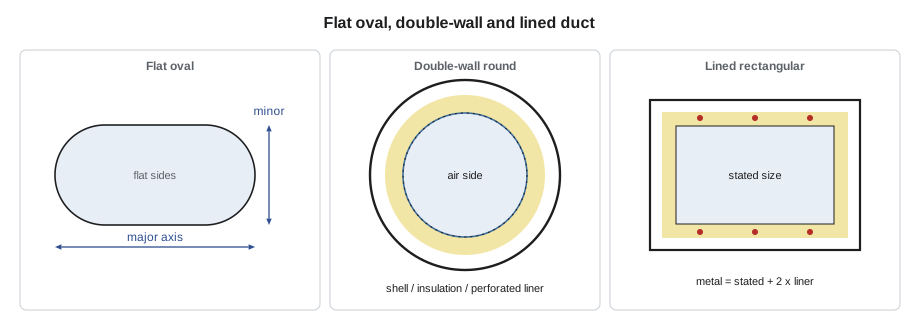
Flat oval duct has two semicircular ends joined by two flat sides. Its size is given as the major axis, the overall width, by the minor axis, the overall depth, which is also the diameter of the round ends. It is made by forming spiral or longitudinal-seam round duct of the right perimeter and then pressing it oval on a flat oval forming machine, which flattens the sides to the required major axis while keeping the ends round.
Flat oval keeps several of round's advantages. Its round ends are in hoop tension, it has few seams, it can be made spiral and it leaks little. But its flat sides behave like the sides of rectangular duct: they flex under pressure, and on large or high-pressure flat oval they need reinforcement, which the standard's flat oval tables give. Under negative pressure, flat oval is weaker than round, because the flat sides want to pull in, so the standard limits it more strictly.
The perimeter and area of flat oval are easy to calculate: the perimeter is the circumference of the round ends, pi times the minor axis, plus twice the flat width, which is the major axis less the minor; the area is the area of the round ends plus the flat width times the minor axis. Fittings for flat oval, elbows, tees and transitions to round or rectangular, are made in the shop by the methods of SMW-120 and SMW-210, and are among the harder layouts in the trade.
Keelson used flat oval in the St. Brendan's church hall, where a new supply main had to run between old timber beams with only about 13 in of clear depth. A 12 in minor axis fitted, and Lin sized a 30 by 12 in flat oval to carry the air. Kai checked its numbers, and the size of liner for a lined branch in the Ashgrove library, with the script below.
# Flat oval sizing and duct liner take-off
import math
major, minor = 30, 12          # flat oval major and minor axes, in
flat = major - minor
perim = math.pi * minor + 2 * flat
area = math.pi * minor ** 2 / 4 + flat * minor
print(f"flat oval {major} x {minor}: perimeter {perim:.1f} in, area {area / 144:.3f} sq ft")
print(f"equal-area round {math.sqrt(4 * area / math.pi):.0f} in diameter")
# liner for a rectangular section: inside surface, adhesive and pins
w, h, length = 24, 16, 60         # net inside size and length, in
t = 1                     # liner thickness, in
lin = 2 * ((w + 2 * t) + (h + 2 * t)) * length / 144
print(f"liner area {lin:.2f} sq ft (sheet size {w + 2 * t} x {h + 2 * t} in)")
print(f"adhesive at {200} sq ft per gal with 90 percent coverage: {lin * 0.9 / 200:.2f} gal")
rows = math.ceil(length / 16) + 1
per_side = lambda side: max(1, math.ceil(side / 16))
pins = rows * 2 * (per_side(w) + per_side(h))
print(f"pins: about {pins} at about {16} in spacing")flat oval 30 x 12: perimeter 73.7 in, area 2.285 sq ft equal-area round 20 in diameter liner area 36.67 sq ft (sheet size 26 x 18 in) adhesive at 200 sq ft per gal with 90 percent coverage: 0.17 gal pins: about 30 at about 16 in spacing
The 30 by 12 flat oval has a perimeter of about 74 in and an area of about 2.3 sq ft, equal to a round of about 20 in. Fitting the same area as a round would have needed 20 in of depth. The liner part of the script is covered below.
Double-wall duct
Double-wall duct, sometimes called dual-wall or insulated duct, is two ducts in one. The outer shell is solid sheet metal that carries the pressure and seals the system. The inner liner is a second, smaller duct, usually of perforated metal, that the air flows through. Between them is a layer of insulation, held in place by the liner and by spacers that keep the two walls apart. The perforations let sound pass from the air stream into the insulation, where it is absorbed, so double-wall duct is quiet; the insulation also keeps heat in or out and stops condensation on the outside.
Double-wall is most common as round and flat oval spiral duct, made on spiral machines that form both walls, and as rectangular duct for plenums and casings. It costs more than single-wall duct with external insulation, but it protects the insulation from the air stream and from damage, it can be cleaned inside without tearing liner, and some specifications require it in hospitals, laboratories and other places where exposed insulation in the air stream is not allowed. Where the inner liner is solid instead of perforated, the duct is insulated but gives little acoustic benefit.
The Eastgate hospital specification called for solid inner liners in all supply duct downstream of the final filters, so that no insulation fibers could reach patient areas and the duct could be cleaned, and for perforated double-wall only in mechanical rooms. Lin's estimate carried both, with the sizes of the inner and outer walls checked on every piece, because the stated size is always the inner, air-side size and the outer shell is larger by twice the insulation thickness plus the spacers.
Lined duct
Lined duct is single-wall rectangular duct with a layer of acoustic insulation, usually fibrous glass or a similar product, fixed to the inside of its walls. The liner absorbs fan noise and the hiss of air through fittings, and it also insulates. It is cheaper than double-wall and is common in supply duct near air handlers and in return duct, where noise travels most easily into rooms.
Because the liner sits inside the duct, the metal must be larger than the stated air-side size by twice the liner thickness in each direction. A 24 by 16 in duct with 1 in liner has metal of 26 by 18 in. Forgetting this is the most common error on lined jobs: a duct built to the stated size with liner inside is too small and starves its outlets, and it will not mate with the next unlined piece.
The liner is fixed in two ways together. Adhesive is applied to the sheet, covering most of its area, usually 90 percent or more, and the liner is pressed into it. Mechanical fasteners, welded pins or adhesive-backed pins with clips, are added at spacings the standard sets, typically closer near the leading edge and corners, so that the liner cannot come loose if the adhesive fails. The liner's air-side surface is coated, and its cut edges, especially the leading edge facing the air stream, are coated or capped with metal nosing so the air does not erode them. At transverse joints the liner is butted tight, and its ends are coated.
The second half of Kai's script sized the liner for a 24 by 16 in library branch 5 ft long with 1 in liner. Each side of liner is cut to the inside of the metal, 26 by 18, giving about 37 sq ft of liner for the section. At an illustrative coverage of 200 sq ft per gallon and 90 percent coverage, it needed under a quarter gallon of adhesive. With pins at about 16 in spacing, it took about 30 pins. Walt's comment was that the pin count looked low for the leading edge, where the standard wants pins closer, and Kai added a row there.
Fire and smoke rules for duct materials
Anything inside or on a duct can feed a fire or produce smoke that the duct then carries through the building, so the building code controls it. In the United States, the International Mechanical Code and NFPA 90A set limits on the flame spread and smoke developed indexes of duct linings, coverings and adhesives, commonly a flame spread index of 25 or less and a smoke developed index of 50 or less, measured by the standard surface burning test, and require labeled, listed products. Liners, adhesives and coatings used at Keelson carried those labels, and the shop kept their data sheets with each job's submittals.
The fabricator's responsibility is to use only the products named in the approved submittals and to keep their labels on the job. Substituting a cheaper adhesive or a different liner without approval can put a building out of code even when the duct looks identical.
Moisture and cleanliness
Fibrous liner can hold moisture and dirt, and in some places that is a concern. Downstream of cooling coils and humidifiers, where the air can be saturated, wet liner can grow mold; many specifications forbid exposed liner there, require a solid inner wall, or require a coated liner rated for the conditions. Hospitals, laboratories and food plants often forbid exposed liner entirely. Liner must also be kept dry and clean in the shop and on site: a lined duct stored outside in the rain or capped badly on a dusty site may have to be rejected. Keelson stored lined pieces indoors, wrapped, and shipped them last, just before installation.
Worked problem
Metal size for lined duct
A duct is shown as 20 by 12 in, lined with 1 in liner. What size must the metal be?
Show solution
- Add twice the liner thickness to each dimension: 20 + 2 = 22, 12 + 2 = 14.
Answer: 22 by 14 in metal; the gauge is chosen from the metal's larger side, 550 mm.
Choosing among them
The designer usually makes the choice, but the fabricator should understand the trade-offs. Flat oval suits shallow spaces where round will not fit and rectangular would be heavy or leaky. Double-wall suits quiet, clean and exposed systems, especially round and flat oval mains, and places where insulation must not be in the air stream. Lined rectangular duct is the economical answer to noise near fans. External insulation, wrapped on the outside of single-wall duct by the insulation trade, is the answer when only heat or condensation matters and noise does not.
Connecting flat oval to round and rectangular
Flat oval systems need transitions to round, at equipment and at branches, and to rectangular, at coils and grilles. A flat oval to round transition is a variation of the eccentric and offset transitions of SMW-210: the round ends of the oval stay round, the flat sides fold into the circle, and the fitting is developed by triangulation between the two outlines. A flat oval to rectangular transition is simpler, because the flat sides of the oval line up with two sides of the rectangle. Kai's St. Brendan's main needed one of each, and he laid both out by calculation before cutting.
Branches off flat oval duct are taken from its flat sides, which are easier to cut and seal than the round ends, using the same conical or bellmouth takeoffs as on rectangular duct. Where the flat sides are wide, the opening is framed so the panel around it does not flex.
Flat oval duct is also sealed and tested like round. Its spiral seam is tight, its joints are made with couplings or flanges sized for oval, and its flat sides are reinforced where the standard's flat oval tables require. At St. Brendan's, where the main ran exposed in the hall, the oval's clean lines were part of the reason the architect chose it, so Kai took extra care that the seams and couplings lined up along the run.
Common mistakes
MistakeBuilding lined duct to the stated size.
InsteadThe stated size is the air-side size; the metal is larger by twice the liner thickness.
MistakeLeaving liner leading edges uncoated.
InsteadCoat or cap the leading edge so the air stream does not erode it.
MistakeRelying on adhesive alone.
InsteadAdd mechanical fasteners at the spacings the standard sets, closer at leading edges.
MistakeSubstituting a liner or adhesive not in the approved submittals.
InsteadUse only listed, approved products with their labels kept.
MistakeTreating flat oval as if it were round under suction.
InsteadIts flat sides pull in; use the standard's flat oval limits and reinforcement.
Summary and key terms
- Flat oval has round ends and flat sides; its perimeter is pi times the minor axis plus twice the flat width.
- Flat oval fits shallow spaces and keeps much of round's efficiency, but its flat sides need reinforcement when large.
- Double-wall duct has a pressure shell, insulation and an inner liner, perforated for sound or solid for cleanliness.
- Lined duct has acoustic liner fixed with adhesive and pins; its metal is larger than its stated size.
- Duct linings, coverings and adhesives must meet the building code's flame spread and smoke limits and carry labels.
- Exposed liner is often forbidden downstream of coils, in hospitals and where duct must be cleaned.
- Flat oval duct
- Duct with two semicircular ends joined by flat sides.
- Major axis
- The overall width of a flat oval duct.
- Minor axis
- The overall depth of a flat oval duct, the diameter of its round ends.
- Double-wall duct
- Duct with a solid outer shell, insulation and an inner liner.
- Duct liner
- Acoustic insulation fixed to the inside of a duct.
- Leading edge
- The edge of a liner facing into the air stream.
Practice problems
Work each problem on paper first, then reveal the answer to check.
What is the perimeter of a 24 by 10 in flat oval?
Show answer
π × 10 + 2 × 14, about 59.4 in.
A 16 by 12 in duct has 1 in liner. What is its metal size?
Show answer
18 by 14 in.
Why might a hospital require solid inner liners?
Show answer
So no insulation fibers reach the air and the duct can be cleaned.
Name two ways duct liner is fixed.
Show answer
Adhesive and mechanical pins with clips.
Lesson quiz · 5 questions
Score 60% or more to complete this lesson.
Create a free account to save your progress, take quizzes and earn a certificate.