
SMW-220 · Lesson 10 of 12 · 19 min
Stainless, aluminum and coated duct for special exhaust
Most duct carries clean, dry air at room temperature, and galvanized steel suits it well. Some duct carries air that would destroy galvanized steel in a few years: steam from a dishwasher, chlorine-laden air from a swimming pool, acid fumes from a laboratory fume hood, or hot, wet air from a process. For those systems the shop works in other materials: stainless steel, aluminum, coated steel and, for some chemical exhaust, plastics. This lesson covers why galvanized steel fails in those places, the alternatives and their properties, how each is fabricated and joined, and how to keep the materials apart in the shop. Kitchen grease exhaust, with its own code rules and welded heavy-gauge construction, is left for SMW-410.
Why galvanized steel fails
Galvanized steel relies on its zinc coating, which protects the steel by corroding slowly in its place. In dry indoor air the zinc lasts for decades. In wet air it corrodes much faster, and in air carrying chlorides, acids or alkalis it can be gone in a few years, after which the steel rusts through. Condensation is the usual trigger: wherever the duct is colder than the dew point of the air inside, water forms on the inside surface and carries whatever is dissolved in the air onto the metal. Exhaust from showers, kitchens, pools and laboratories is often warm and humid, and the duct running through cooler spaces or outdoors is exactly where it condenses.
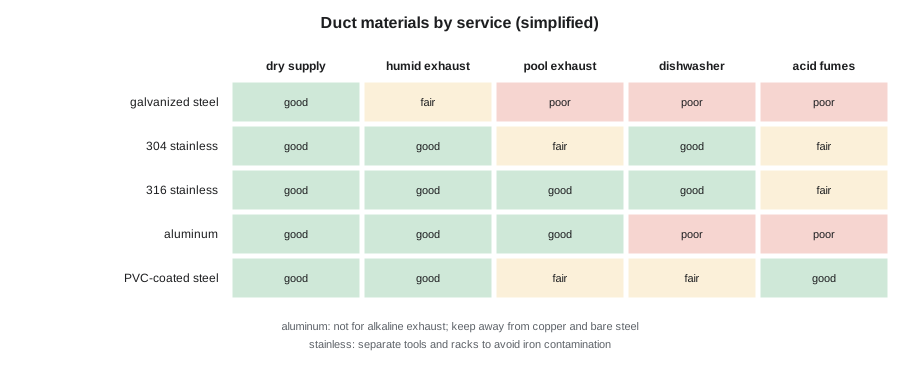
The second cause is chemistry. Fume hood exhaust can carry acids and solvents; dishwasher exhaust carries detergents and alkalis; pool exhaust carries chloramines from the treated water. Each attacks zinc, and some attack steel directly. The specification names the material for each system, based on what the air carries and how hot and wet it is. The fabricator's part is to use exactly what is specified, to keep it from being contaminated, and to join it in a way that does not undo its corrosion resistance.
Stainless steel
Stainless steel resists corrosion because of the chromium in it, which forms a thin, self-healing oxide film on the surface. The two common grades in duct work are type 304, the general-purpose grade, and type 316, which adds molybdenum for better resistance to chlorides and some acids. Dishwasher exhaust, many laboratory exhausts and hospital systems where duct must be cleaned and disinfected are usually 304 or 316. Stainless steel is stronger and harder than galvanized steel, so it needs sharper tools, more force on the brake and slower speeds on the shear and drill, and it springs back more after bending.
Stainless steel duct can be made with mechanical seams and joints sealed with sealant, or welded. Welded stainless duct, using the processes of SMW-230, gives liquid-tight seams for wet exhaust such as dishwasher duct, where condensate must drain without leaking. Welding can damage the corrosion resistance next to the weld if the metal overheats, so welds are made with the right filler and heat input and cleaned afterward. Mechanical seams in stainless duct are sealed with sealants compatible with the service.
Stainless steel loses its protection if it is contaminated by ordinary steel. A stainless sheet scratched with a steel tool, cut on a shear that has just cut carbon steel, or carried on a steel rack picks up iron particles that rust on its surface and can start pitting. Keelson kept a separate set of stainless tools, cleaned the shear and brake before running stainless, stored stainless sheet on its own covered rack and moved it with clean gloves. Fasteners in stainless duct were stainless too.
Aluminum
Aluminum is light, easy to work, and naturally protected by its own oxide film. It resists moist air well and is often used for shower and pool exhaust, for some outdoor duct and for duct where weight matters. It is not suitable for alkaline exhaust, such as dishwasher air, which attacks it, nor for some chemical fumes. Aluminum is much softer than steel and has a lower modulus, so for the same stiffness it is used in thicker sheet; aluminum duct gauges are given in thickness, not in steel gauge numbers. It bends easily, dents easily and must not be dragged across rough benches.
Aluminum must be kept apart from copper and from bare steel. When two different metals touch in the presence of moisture, they form a galvanic couple, and the less noble metal, in this case aluminum, corrodes quickly at the contact. Aluminum duct is joined with aluminum or stainless fasteners, hung with coated or isolated hangers, and kept off copper pipes. In wet service its joints are sealed carefully, because water trapped in a joint is where galvanic and crevice corrosion start.
The Ashgrove retrofit had a small one: the school's pool change rooms exhaust, which Lin specified in aluminum from the grilles to the exhaust fan, with stainless steel screws. The St. Brendan's copper roof job, by contrast, was a reminder of the other side of the rule: no aluminum or galvanized flashing could touch the copper, and the copper's runoff could not drip onto galvanized steel or aluminum below it.
Coated and plastic duct
Some corrosive exhaust is carried in coated steel: galvanized steel with a factory coating of PVC or another plastic on the inside, the outside or both. PVC-coated duct resists many acids and salts, and it is stronger and more fire-resistant than plastic duct. It is fabricated much like galvanized duct, but the coating must not be scratched or burned, so seams are formed carefully, cut edges are sealed with the coating manufacturer's touch-up, and fasteners are coated or covered. Welding is not possible without destroying the coating.
Some laboratory and process exhaust is carried in plastic duct: PVC, polypropylene or fiber-reinforced plastic. Plastic duct is a specialty, made and installed by trained crews, and building codes limit where it may be used because of its fire behavior. Some codes and specifications require fire-rated plastic duct, sprinklers inside large plastic exhaust duct, or limits on its size. Keelson did not make plastic duct; where a job needed it, Lin carried it as a subcontract.
Cost and weight
Special materials cost more, sometimes much more, and they change the weight the field crew must hang. Kai compared five materials for an Eastgate laboratory exhaust run, 42 m, or 140 ft, of 350 mm, or 14 in, round, using illustrative weights and relative costs per unit area.
# Weight and material comparison for a special exhaust duct run
import math
d, length = 14, 1680            # round duct diameter and run length, in
area = math.pi * d * length / 144
mats = [('galvanized steel', '24 ga', 1.156, 1.0), ('304 stainless', '22 ga', 1.26, 4.0), ('316 stainless', '22 ga', 1.26, 5.0), ('aluminum 3003', '0.040 in', 0.57, 2.6), ('PVC-coated galvanized', '24 ga', 1.22, 2.2)]               # (material, thickness, weight per sq ft, relative cost per sq ft)
for name, t, w, c in mats:
    print(f"{name:<28} {t:<9} {area * w:>7.0f} lb   cost index {area * c:>7.0f}")
print(f"surface area {area:.1f} sq ft")galvanized steel 24 ga 593 lb cost index 513 304 stainless 22 ga 647 lb cost index 2053 316 stainless 22 ga 647 lb cost index 2566 aluminum 3003 0.040 in 292 lb cost index 1334 PVC-coated galvanized 24 ga 626 lb cost index 1129 surface area 513.1 sq ft
For the same run, stainless steel cost about four to five times as much as galvanized and weighed about the same; aluminum cost over two and a half times as much but weighed less than half; PVC-coated steel fell in between on cost and weighed a little more than galvanized. The relative costs are illustrative and change with the market, but the pattern is typical, and it is why designers keep special materials to the systems that need them.
Draining and sloping wet exhaust
Wet exhaust duct must drain. Where condensate is expected, the duct is sloped back toward a drain point or toward the source, its joints are made liquid-tight with welded or soldered seams or sealed joints, and drain connections are added at low points. Seams and joints on the bottom of the duct are placed so water does not sit in them; longitudinal seams go on the top or the sides. Dishwasher exhaust in particular is usually specified as welded or liquid-tight stainless duct, sloped to drain, with no fibrous liner and no screws through its bottom.
Pool exhaust carries chloramines that condense where the duct is cold. The usual answers are aluminum or stainless duct, insulation outside so the duct stays warm, and sealed joints. A pool exhaust in galvanized steel typically shows rust streaks at its joints within a few seasons.
Worked problem
Galvanic contact
An aluminum exhaust duct is hung from a bare steel rod with a bare steel strap wrapped tight around it. What will happen over time, and what is the fix?
Show solution
- Where the steel strap touches the aluminum in damp air, a galvanic couple forms.
- The aluminum, the less noble metal, corrodes at the contact.
Answer: Isolate the metals: use a coated or aluminum strap, a plastic isolator, or stainless hardware with isolating washers.
Keeping materials apart in the shop
A shop that works in several materials needs discipline. At Keelson, each material had its own rack, labeled. Stainless steel and aluminum were cut and formed after the machines were wiped clean of steel particles. Scrap was kept separate, which also made it worth more to the recycler. Fasteners were sorted by material in labeled bins, and the job's material list told the bench which fasteners to use. Finished pieces were labeled with their material as well as their piece number, so that a stainless dishwasher duct could not end up on the general exhaust by mistake. Kai learned to read a job's specification for the materials section before picking up any sheet.
Welding, soldering and sealing special materials
Each special material has its own joining rules. Stainless steel for liquid-tight service is welded with filler matched to the base metal, and the heat tint next to the weld is cleaned off afterward, because the discolored layer is less corrosion resistant than the clean surface. Aluminum is welded by the gas tungsten arc or gas metal arc processes with aluminum filler, or joined mechanically with aluminum rivets and sealant. Coated steel is never welded. Sealants for corrosive service must be chosen for the chemicals in the air: a sealant that is fine in a supply duct may soften in solvent-laden exhaust. The specification and the sealant maker's data sheets decide, and the shop keeps the data sheets with the job's submittals.
Where stainless steel or aluminum duct must connect to galvanized duct, as at the boundary between a special exhaust and a general one, the joint is a place where dissimilar metals meet. The designer usually puts that boundary where the air is dry, and the joint is made with isolating gaskets or with fasteners and sealants chosen to avoid galvanic attack.
Hangers and supports for special duct
Special duct needs compatible hangers. Stainless duct in a wet or corrosive area is hung with stainless rods and straps or with coated steel isolated from the duct. Aluminum duct is hung with aluminum straps or with steel hangers separated from it by plastic or rubber isolators. Hangers for heavy welded stainless duct are spaced more closely because of its weight. SMW-310 covers hanger selection in the field, but the shop must supply the right brackets and know where they go, because hanger attachment points are sometimes welded or riveted to the duct in the shop.
Inspecting special duct before shipping
Special duct gets an extra check before it leaves the shop. Kai looked at every stainless piece under good light for scratches, steel particles or heat tint left after welding, and wiped it with the cleaner the specification named. Aluminum pieces were checked for dents and for any steel fasteners that had slipped into the wrong bin. Coated pieces were checked for scratches through the coating and touched up. Each piece's material was written on its label, so the field crew could not mistake a stainless piece for galvanized when they unloaded.
Common mistakes
MistakeUsing galvanized steel for humid, chlorinated or acid exhaust.
InsteadUse the material the specification names for the service.
MistakeCutting stainless on a shear just used for carbon steel.
InsteadClean the machine and use separate tools to avoid iron contamination.
MistakeJoining aluminum duct with plain steel screws or bare steel straps.
InsteadUse aluminum or stainless fasteners and isolate dissimilar metals.
MistakePutting longitudinal seams on the bottom of wet exhaust duct.
InsteadPut seams on the top or sides; slope the duct to drain.
MistakeWelding PVC-coated duct.
InsteadCoated duct is joined mechanically; touch up cut edges with the coating maker's product.
Summary and key terms
- Galvanized steel fails where condensation carries chlorides, acids or alkalis onto it.
- Type 304 stainless suits general corrosive service; 316 adds better chloride resistance.
- Stainless must be kept free of iron contamination, with separate tools, clean machines and stainless fasteners.
- Aluminum is light and resists humid air but not alkaline exhaust; keep it away from copper and bare steel.
- PVC-coated steel resists many chemicals; plastic duct is a specialty with code limits.
- Wet exhaust is sloped to drain, with liquid-tight seams placed off the bottom.
- Stainless steel
- Steel alloyed with chromium, protected by a self-healing oxide film.
- Type 316
- A stainless grade with molybdenum for better chloride resistance.
- Galvanic corrosion
- Corrosion of the less noble of two different metals in contact with moisture.
- PVC-coated duct
- Galvanized steel duct with a factory plastic coating.
- Iron contamination
- Steel particles left on stainless steel that rust and start pitting.
- Condensate
- Water condensed from humid air inside a duct.
Practice problems
Work each problem on paper first, then reveal the answer to check.
Why is aluminum a poor choice for dishwasher exhaust?
Show answer
Alkaline air attacks aluminum.
What does molybdenum add to type 316 stainless?
Show answer
Better resistance to chlorides and some acids.
Where should the longitudinal seams of wet exhaust duct go?
Show answer
On the top or sides, not the bottom.
Why does stainless sheet get its own rack and tools?
Show answer
To keep iron particles off it, which would rust and pit it.
Lesson quiz · 5 questions
Score 60% or more to complete this lesson.
Create a free account to save your progress, take quizzes and earn a certificate.