
SMW-220 · Lesson 1 of 12 · 20 min
Duct systems and the fabricator's role
Second year at Keelson Sheet Metal changes what an apprentice does all day. In the first year, Kai Ferreira learned the tools, the machines, the seams and the patterns. In the second, Walt Szymanski moved him from the layout bench to the fabrication floor, where most of the shop's hours go into one product: duct. This course is about making it. It covers the rectangular, round, spiral and flat oval duct that carries air through buildings, the fittings and dampers that go with it, the casings and plenums that connect it to equipment, and the special materials used where the air is wet, hot or corrosive. It ends with Kai fabricating the whole library supply trunk for the Ashgrove Elementary retrofit, with a full material take-off.
Before the shop can make a single piece of duct, everyone involved needs to understand what the duct does in the building and what the drawings are asking for. This first lesson sets out the parts of a duct system, the quantities that decide how duct is built, the materials the shop uses, and the place of the fabricator between the designer who sizes the system and the field crew who installs it.
What a duct system does
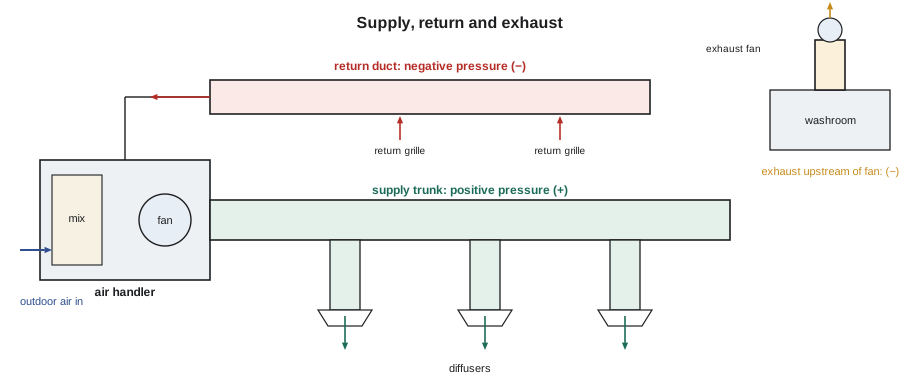
A duct system moves air between a fan and the spaces it serves. In most commercial buildings there are three kinds of duct. Supply duct carries conditioned air from an air handler or rooftop unit to the rooms, ending at diffusers and grilles. Return duct carries room air back to the unit, sometimes through a ceiling plenum instead of duct. Exhaust duct carries air out of the building from washrooms, kitchens, laboratories and process equipment, ending at a fan or a wall or roof outlet. Outdoor air duct brings fresh air in, and transfer ducts move air between spaces.
On the supply side of a fan, the air in the duct is above the pressure of the surrounding room: the duct is under positive pressure, and air leaks out through any gap. On the suction side, the return and most exhaust duct, the air is below room pressure: the duct is under negative pressure, and air leaks in. Positive pressure tries to bulge the sides of a rectangular duct outward and pull its joints apart. Negative pressure tries to collapse the sides inward. A duct has to be built for the pressure it will see, in the direction it will see it, which is why the drawings and specifications always give a pressure class and a sign for each part of the system.
The quantities that matter
Three numbers describe the air in a duct, and every fabricator should be comfortable with all three. The first is the air flow, the volume of air passing a point each second or minute, in cubic feet per minute. The designer works it out from the heating, cooling and ventilation loads of the rooms and writes it on the drawing at each diffuser and each branch. The second is the velocity, the speed of the air, which is the flow divided by the inside area of the duct. The third is the pressure, which comes in two kinds.
- Static pressure is the pressure the air exerts on the walls of the duct, the bursting or collapsing pressure. It is what the duct construction standard sorts into pressure classes, and it is the number that decides the gauge, the joints and the reinforcement.
- Velocity pressure is the pressure equivalent of the air's motion. It is what a pitot tube reads above static, and it grows with the square of the velocity. Fittings lose some of it as turbulence every time the air changes direction or speed, so the designer keeps velocities moderate and fittings smooth.
Static pressure falls along the duct from the fan to the outlets, because every meter or foot of straight duct and every fitting uses some of it up as friction. The highest static pressure in a supply system is right at the fan discharge, and the pressure class the designer assigns usually reflects the highest pressure each section will see, including the extra pressure when dampers close or filters load up.
The Ashgrove library supply trunk is a good example. Lin Zhao's drawing showed it leaving the new rooftop unit at 36 by 18 in, stepping down to 24 by 18 and 18 by 12 as branches came off, with 10 in round branches to the diffusers. Kai ran the numbers on his phone during a break, using the flows from the drawing, and then in the short script below.
# Velocity and velocity pressure along the Ashgrove library supply duct
import math
runs = [('trunk T1', (36, 18), 5100), ('trunk T2', (24, 18), 3180), ('trunk T3', (18, 12), 1480), ('branch', (10,), 530)]               # (piece, duct size, air flow in cfm): rectangular (w, h) or round (d,)
for name, s, q in runs:
    if len(s) == 1:
        a = math.pi * s[0] ** 2 / 4 / 144
        size = f"{s[0]} round"
    else:
        a = s[0] * s[1] / 144
        size = f"{s[0]} x {s[1]}"
    v = q / a
    pv = (v / 4005) ** 2
print(f"{name:<14} {size:>10} in {q:>5} cfm area {a:.3f} sq ft velocity {v:.0f} fpm velocity pressure {pv:.3f} in w.g.")trunk T1 36 x 18 in 5100 cfm area 4.500 sq ft velocity 1133 fpm velocity pressure 0.080 in w.g. trunk T2 24 x 18 in 3180 cfm area 3.000 sq ft velocity 1060 fpm velocity pressure 0.070 in w.g. trunk T3 18 x 12 in 1480 cfm area 1.500 sq ft velocity 987 fpm velocity pressure 0.061 in w.g. branch 10 round in 530 cfm area 0.545 sq ft velocity 972 fpm velocity pressure 0.059 in w.g.
The velocities all came out between about 970 and 1,130 fpm, which is typical of a quiet school supply system: the designer stepped the trunk down as the flow fell, so the speed stayed nearly the same all the way along. The velocity pressures are small, around 0.06 to 0.08 in w.g., far below the static pressure at the unit. That is normal for low-velocity systems. In a high-velocity system, such as the hospital risers Keelson was pricing for Eastgate, velocities run two or three times higher and velocity pressure becomes a much larger share of the total.
The fabricator's place in the job
Duct work passes through several hands before it carries any air. The mechanical engineer designs the system, sizes the duct, sets the pressure classes and writes the specification. The sheet metal contractor's detailer, Lin at Keelson, turns the design drawings into shop drawings: every piece of duct drawn to its exact length and fitting type, coordinated with the structure, the sprinkler pipe, the electrical trays and the ceilings. The shop fabricates each piece to the shop drawing and to the construction standard named in the specification. The field crew, under Sean Doucette, hangs, joins, seals and tests it. The balancing contractor measures and adjusts the flows at the end.
The fabricator's job sits in the middle of that chain, and it has two halves. One is making each piece accurately, to the size and length on the shop drawing, so that it fits in the field without cutting. The other is making each piece right, to the gauge, seams, joints, reinforcement and sealing the standard requires for its size and pressure class, so that it is strong enough, tight enough and quiet enough for the life of the building. Walt put it to Kai on his first morning on the floor: the shop drawing tells you what to make, and the standard tells you how to make it.
A good fabricator also catches problems before they reach the field. A piece whose size does not match the one it connects to, a fitting that cannot be made as drawn, a gauge that looks too light for the pressure class or a missing access door is far cheaper to fix on the bench than in a ceiling. Keelson's rule is that anyone who sees a question on a shop drawing marks it and asks Lin, and nobody builds a piece they think is wrong.
Shapes of duct
Duct comes in three main shapes, and each has a place.
- Rectangular duct fits in shallow ceiling spaces and between beams, connects easily to rectangular equipment openings and grilles, and is made from flat sheet on the brake and Pittsburgh machine. Its flat sides flex under pressure, so it needs heavier gauges, stiffening and reinforcement as it gets larger and the pressure rises. Lessons 3 and 4 cover it.
- Round duct is the strongest and tightest shape for its weight. Pressure puts its wall in simple tension, with no flat sides to flex, so it can be thinner than rectangular duct of the same area. It uses less metal per unit of air carried, has fewer joints to seal and loses less pressure to friction. Spiral duct, made continuously on a spiral machine, is the most common kind in commercial work. Lesson 5 covers it.
- Flat oval duct is a compromise: round ends joined by flat sides, so it fits in a shallow space like rectangular duct but keeps much of the strength and low leakage of round. It is made on spiral machines and then formed oval. Lesson 6 covers it, along with double-wall and lined duct.
The shape is the designer's choice, but the fabricator should know why it was made. At Ashgrove the library trunk was rectangular because the old building's ceiling space was only 20 in deep between the joists and the new ceiling, and the branches were round because round is cheaper and tighter wherever it fits.
Materials
Most HVAC duct is galvanized steel: carbon steel sheet with a zinc coating that protects it from corrosion. SMW-110 covered the coating designations; for ordinary indoor duct, a moderate coating is normal, and heavier coatings are specified for damp places. Where the air is wet, corrosive or hot, or where the duct is exposed in a finished space, other materials are used: stainless steel for laboratory and dishwasher exhaust and for some hospital work, aluminum for wet and humid air such as pool exhaust, and PVC-coated or other coated steel for some chemical fume exhaust. Lesson 10 covers these special materials. Kitchen grease exhaust, with its own heavy-gauge welded construction, is left for SMW-410.
The material decides how duct is joined as well as how it is cut and formed. Galvanized steel is joined with mechanical seams, rivets, screws and sealant; stainless steel and aluminum may be seamed or welded depending on the service, and welding galvanized steel needs care because of the zinc fumes, which SMW-230 covers.
Worked problem
Velocity in a duct
A rectangular duct 24 by 16 in carries 2,540 cfm. What is the air velocity?
Show solution
- Inside area = 24 × 16 ÷ 144 = 2.67 sq ft.
- Velocity = flow ÷ area = 2,540 cfm ÷ 2.67 sq ft = 952 fpm.
Answer: About 950 fpm, a normal low-velocity supply speed.
Noise, leakage and energy
Three things go wrong with duct that the fabricator can prevent. The first is noise. Air rushing through a fitting with a sharp throat, a damper set too far closed, a loose reinforcement rattling or a flat panel drumming as the fan starts all make noise that carries along the duct into classrooms and offices. Duct that is built stiff, with smooth fittings, tight joints and reinforcement fixed firmly, stays quiet. The second is leakage. Every unsealed seam and joint leaks, and in a supply system each liter or cubic foot that leaks is air the fan moved and the unit heated or cooled for nothing. Energy codes now require most duct to be sealed, and some to be tested. The third is failure: a duct built too light for its pressure can bulge, split a seam or collapse, usually at the worst time, when a fire damper closes or a filter blocks.
Each of those failures traces back to construction details: the gauge, the seams, the joints, the reinforcement and the sealing. That is what the construction standard controls, and it is what the rest of this course teaches.
How this course fits the program
SMW-110 introduced the tools, machines and materials. SMW-120 and SMW-210 taught pattern development, so Kai can lay out any elbow, tee, reducer or transition. SMW-130 taught the seams, locks and joints. This course puts those skills together into finished duct built to a standard. After it, SMW-230 covers welding thin-gauge metal, SMW-310 covers installing duct in the field, including hangers, fire and smoke dampers and leakage testing, SMW-410 covers kitchen and industrial exhaust, and SMW-420 covers shop drawings, estimating and the CNC plasma and coil lines.
Common mistakes
MistakeTreating every duct as if it had the same pressure.
InsteadBuild each section for its own pressure class and sign: positive downstream of a fan, negative upstream.
MistakeConfusing velocity pressure with static pressure.
InsteadStatic pressure acts on the walls and decides the construction; velocity pressure is the pressure of the air's motion.
MistakeBuilding a piece that looks wrong because the shop drawing says so.
InsteadMark the question and ask the detailer before cutting metal.
MistakeAssuming round duct needs the same gauge as rectangular of the same area.
InsteadRound duct's wall is in tension, so it can usually be lighter; check the standard's round tables.
MistakeIgnoring noise as a fabrication issue.
InsteadSmooth fittings, firm reinforcement and stiff panels keep a system quiet.
Summary and key terms
- Supply duct downstream of a fan runs at positive pressure; return and most exhaust duct runs at negative pressure.
- Air flow, velocity and pressure describe the air in a duct; velocity is flow divided by inside area.
- Static pressure acts on the duct walls and decides gauge, joints and reinforcement; velocity pressure is the pressure of the air's motion.
- The shop drawing tells the fabricator what to make; the construction standard tells the fabricator how to make it.
- Rectangular, round and flat oval duct each suit different spaces; round is the strongest and tightest for its weight.
- Galvanized steel is the usual material; stainless steel, aluminum and coated steel are used for special exhaust.
- Supply duct
- Duct carrying conditioned air from a unit to the rooms.
- Return duct
- Duct carrying room air back to the unit.
- Exhaust duct
- Duct carrying air out of the building.
- Static pressure
- The pressure air exerts on the walls of a duct, positive or negative.
- Velocity pressure
- The pressure equivalent of the air's motion, rising with the square of velocity.
- Shop drawing
- A drawing showing every piece of duct to its exact size, length and fitting type, coordinated with other trades.
Practice problems
Work each problem on paper first, then reveal the answer to check.
A duct 18 by 12 in carries 1,480 cfm. What is the velocity?
Show answer
Area 1.5 sq ft, so velocity is 1,480 ÷ 1.5, about 990 fpm.
Is a return duct upstream of the fan under positive or negative pressure?
Show answer
Negative: air leaks into it.
Name two reasons a designer might choose round duct over rectangular.
Show answer
Round is stronger for its weight, uses less metal, leaks less and has less friction.
Who decides the pressure class of a duct?
Show answer
The designer, in the drawings and specification; the fabricator builds to it.
Lesson quiz · 5 questions
Score 60% or more to complete this lesson.
Create a free account to save your progress, take quizzes and earn a certificate.