
SLS-256 · Lesson 5 of 12 · 26 min
Trade-ins
▶ Video coming soon A video version of this lesson is on the way.
On a Sunday afternoon in early November, Aiden met Carl's friend Nadine Brule for coffee near the dealership where she sold vehicles. Carl had suggested it. "Trade-ins are where furniture people learn the most from car people," he had said. "We do a little of it. They live on it." Nadine had sold vehicles for eleven years and had a notepad of examples ready. "The first rule," she said, "is that a customer with a trade is making two deals at once: buying a car from you and selling a car to you. If you mix them up, somebody ends up confused, and usually it's the customer."
A trade-in is an item the customer gives the seller as part of the payment for a new one. The seller credits the customer with a trade-in allowance, and the customer pays the difference. Trade-ins are routine in vehicle sales and common in electronics, phones, boats and some equipment. Furniture and appliance stores use them less, usually as promotions or as part of haul-away services. This lesson starts with vehicles, where the ideas are clearest, then applies them to Juniper & Pine.
The net price is what matters
A trade-in deal has three numbers: the price of the new item, the allowance for the trade, and the difference the customer pays. Customers naturally focus on the allowance, because it is the price of something they own and care about. But a high allowance means little if the new item's price has been raised to pay for it. The number that tells a customer what the deal costs is the net price: the new item's price minus the trade-in allowance.
Worked problem
Comparing two vehicle offers
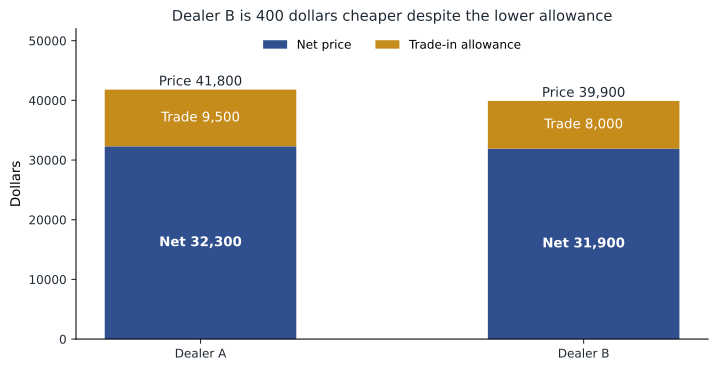
A customer is shopping for a small SUV and trading in a seven-year-old sedan. Dealer A offers the SUV at 41,800 dollars with a trade-in allowance of 9,500 dollars. Dealer B offers the same SUV, with the same options, at 39,900 dollars with an allowance of 8,000 dollars. Which deal costs less before taxes and fees?
Show solution
- Net price at Dealer A:
- \[41{,}800 - 9{,}500 = 32{,}300 \text{ dollars}\]
- Net price at Dealer B:
- \[39{,}900 - 8{,}000 = 31{,}900 \text{ dollars}\]
- Difference:
- \[32{,}300 - 31{,}900 = 400 \text{ dollars}\]
Answer: Dealer B costs 400 dollars less, even though Dealer A offers 1,500 dollars more for the trade. The customer should compare net prices, and taxes and fees on the same basis, not allowances.
Nadine's practice was to separate the two conversations. She agreed the price of the new vehicle first, as if there were no trade, then appraised the trade and explained how she arrived at its value. "If I mix them, the customer can't tell what they're paying for the car," she said. "Separating them is slower, but nobody comes back in a month feeling cheated."
How a trade is valued
Dealers value a trade-in at roughly what they expect to sell it for, minus the cost of reconditioning it, a margin for selling it, and the risk of problems they cannot see. Guides based on recent auction and retail sales give a starting range, and the appraisal adjusts for mileage, condition, options and local demand. A trade is usually worth less to a dealer than the customer could get by selling privately, because the dealer takes on the work, the risk and the wait.
Customers often compare the trade allowance with private-sale prices they see online, and feel short-changed. The honest answer explains the gap: a private sale may bring more money, but it takes time, involves strangers and test drives, and leaves the seller with the paperwork and the risk. A trade is a convenience the customer pays for. Tax rules can narrow the gap.
In South Dakota, vehicles are not subject to the regular sales tax. Instead, the buyer pays a motor vehicle excise tax of 4 in 100 when titling the vehicle, generally on the price after the trade-in allowance. Each 1,000 dollars of trade-in allowance therefore saves the customer about 40 dollars in excise tax compared with selling privately and paying tax on the full price. The customer should confirm the details with the county treasurer, because rules differ for leases and some vehicle types.
Worked problem
Trading in versus selling privately
The sedan in the first example could probably sell privately for about 10,800 dollars. Dealer A allows 9,500 dollars. Taking the tax effect into account, how much more would the customer keep by selling privately?
Show solution
- Excise tax saved by trading in, at 4 in 100:
- \[9{,}500 \times 0.04 = 380 \text{ dollars}\]
- Value of trading in, including the tax saving:
- \[9{,}500 + 380 = 9{,}880 \text{ dollars}\]
- Extra from a private sale:
- \[10{,}800 - 9{,}880 = 920 \text{ dollars}\]
Answer: Selling privately would leave the customer about 920 dollars better off, before the time, advertising and risk of a private sale. Whether that is worth it depends on the customer's time and comfort with selling.
Negative equity
A customer who still owes money on the item they are trading may owe more than it is worth. This is called negative equity, or being "upside down". If the sedan is worth 9,500 dollars but the customer owes 12,400 dollars on the loan, the dealer must pay off the 12,400, and the 2,900-dollar shortfall has to come from somewhere. Usually it is added to the new loan.
Rolling negative equity into a new loan is legal, but it means the customer starts the new loan owing more than the new vehicle is worth, and pays interest on the old car's debt for years. Nadine's rule was to show the customer the shortfall in writing, as a separate line, and to discuss alternatives: a smaller down payment on a less expensive vehicle, waiting until the old loan was further paid down, or paying the shortfall in cash. "The worst thing you can do is hide it in the payment," she said. "Customers find out eventually, and they never forget who did it."
Worked problem
Seeing the shortfall
A customer's trade is worth 9,500 dollars and they owe 12,400 dollars on it. What is the negative equity, and what happens if it is rolled into a new 31,900-dollar purchase financed with no down payment?
Show solution
- Negative equity:
- \[12{,}400 - 9{,}500 = 2{,}900 \text{ dollars}\]
- Amount to finance on a new vehicle whose price, before the trade, is 39,900 dollars:
- \[39{,}900 - 9{,}500 + 12{,}400 = 42{,}800 \text{ dollars}\]
Answer: The customer would borrow 42,800 dollars, 2,900 more than the price of the new vehicle, before taxes and fees. They should see that number clearly and understand the alternatives before agreeing.
Trade-ins and their cousins at Juniper & Pine
Furniture and appliance stores rarely resell what customers trade in, because used furniture and appliances have little resale value and the cost of handling them is high. They use three related tools instead.
- Haul-away. For a fee, usually 39 dollars at Juniper & Pine, the delivery crew removes the old appliance or mattress and sends it for recycling or disposal. In some places, rules on mattress or appliance recycling apply.
- Trade-up events. For a limited time, the store gives a credit toward a new item when the customer gives up an old one, which the crew collects and donates to a charity partner if it is in usable condition.
- Manufacturer or utility rebates. Some appliance manufacturers and electric utilities offer rebates for buying an efficient model or recycling an old refrigerator, which the seller can point to without promising them.
In October 2026, Juniper & Pine ran a three-week trade-up event in upholstery: a 200-dollar credit toward any sectional when the customer's old sofa was collected at delivery, with usable sofas donated to a furniture bank. The Lindqvists, whose sectional was 2,999 dollars before fabric upgrades, used it for an old sofa that had come with the house.
Worked problem
What a trade-up credit is worth
A customer receives a 200-dollar credit on a 2,999-dollar sectional in the trade-up event. Collecting and delivering the old sofa to the furniture bank costs the store about 40 dollars in crew time. What is the credit worth to the customer as a share of the price, and what does it cost the store?
Show solution
- Credit as a share of the price:
- \[\frac{200}{2{,}999} \approx 0.067 \text{, or about 6.7 in 100}\]
- Cost to the store:
- \[200 + 40 = 240 \text{ dollars}\]
Answer: The credit is worth about 6.7 in 100 off to the customer and costs the store about 240 dollars. Bev treated it as a promotion with a purpose: it gave hesitant customers a reason to act, cleared old furniture out of homes, and supported the furniture bank.
Carl's advice on trade-up events matched Nadine's on vehicles. The credit should be presented as what it is, a promotion, and the sectional's price should be the same as it would be without the trade. Raising the price during the event to fund the credit would make the advertised saving false.
Honest trade-in conversations
Whatever the category, trade-in conversations go better when the seller follows a few principles.
- Agree the price of the new item separately from the value of the trade.
- Explain how the trade was valued, including what reduces it, and do not invent a reason to lower it.
- Show the net price, taxes and any negative equity in writing.
- Accept that some customers will sell privately, and tell them honestly if that is likely to suit them better.
- Never let a trade-in or credit hide a higher price on the new item.
Trade-in paperwork and timing
A vehicle trade is not finished when the numbers are agreed. If the customer still owes money on the old vehicle, the dealer must pay off the lender and get the lien released before it can resell the trade. Nadine explained to Aiden's group how her dealership handles this, because the same habits of accuracy apply to any trade or exchange.
- Get a written payout statement. The lender gives the exact amount owed on a stated date, plus a daily interest amount, often called the per diem, for each day after that.
- Check ownership and registration. The name on the registration and the loan must match the person trading the vehicle, and every owner must sign.
- Disclose known problems. The customer should tell the dealer about accident damage or mechanical problems; the dealer should record the condition it relied on in the appraisal.
- Put the deal in writing. The bill of sale should show the price, the trade allowance, the payout the dealer is assuming and the net amount the customer finances or pays.
Worked problem
Paying off a loan a few days late
A customer's payout statement shows 9,840 dollars owing on October 30, with a per diem of 1.85 dollars. The dealer pays the lender on November 6. How much must it pay?
Show solution
- Days after the statement date:
- \[6 + 1 = 7 \text{ days (October 31 to November 6)}\]
- Extra interest:
- \[7 \times 1.85 = 12.95 \text{ dollars}\]
- Payout:
- \[9{,}840 + 12.95 = 9{,}852.95 \text{ dollars}\]
Answer: The dealer pays 9,852.95 dollars. The difference is small, but a deal written on the old figure would be wrong, and on a large loan delayed by a few weeks it would be noticeable. Using the exact figure is part of keeping the net price honest.
Juniper & Pine's trades are simpler, but timing still matters. Old furniture and appliances are removed on the day the new item arrives, so the customer is never without a sofa or a refrigerator. Mattresses taken away must be bagged and are recycled or sent to a mattress recycler where one operates; they are never resold. Items given to the furniture bank are inspected first, and the customer is told plainly that the store cannot promise every item will be accepted.
Common mistakes
MistakeComparing deals by the trade-in allowance.
InsteadCompare the net price, with taxes and fees on the same basis.
MistakeNegotiating the trade and the new item together.
InsteadAgree the new item's price first, then value the trade separately.
MistakeHiding negative equity in a monthly payment.
InsteadShow the shortfall as a separate line and discuss alternatives.
MistakeTelling a customer a trade is worth what private sellers ask online.
InsteadExplain the gap: a trade saves time, risk and sometimes tax, which the allowance reflects.
MistakeRaising a price during a trade-up event to fund the credit.
InsteadKeep the price the same so the promoted saving is real.
Summary and key terms
- A trade-in combines two deals: buying a new item and selling an old one.
- The net price, the new item's price minus the allowance, is what a customer should compare.
- Dealers value trades at expected resale value minus reconditioning, margin and risk, so trades usually bring less than private sales, but taxes on vehicles are generally charged after the trade-in, which narrows the gap.
- Negative equity is the amount owed beyond the trade's value; rolling it into a new loan should be shown clearly.
- Furniture and appliance stores use haul-away, trade-up promotions and rebates instead of reselling trades.
- Honest trade conversations separate the two deals and show every number in writing.
- Trade-in allowance
- The credit a seller gives for an item the customer trades in.
- Net price
- The new item's price minus the trade-in allowance.
- Appraisal
- The seller's assessment of a trade-in's value.
- Negative equity
- The amount by which the loan on a trade-in exceeds its value.
- Trade-up event
- A promotion that gives a credit toward a new item when an old one is given up.
- Haul-away
- A paid service in which the delivery crew removes the customer's old item.
Practice problems
Work each problem on paper first, then reveal the answer to check.
Dealer X offers a vehicle at 36,000 with a 6,000 trade allowance; Dealer Y at 34,500 with 5,000. Which costs less?
Show answer
X: 30,000; Y: 29,500. Dealer Y costs 500 dollars less.
A customer owes 15,000 on a trade worth 11,200. What is the negative equity?
Show answer
15,000 − 11,200 = 3,800 dollars.
At a 4-in-100 excise tax, how much tax does a 7,000-dollar trade-in allowance save?
Show answer
7,000 × 0.04 = 280 dollars.
Lesson quiz · 5 questions
Score 60% or more to complete this lesson.
Create a free account to save your progress, take quizzes and earn a certificate.