
SLS-211 · Lesson 1 of 12 · 17 min
From product selling to consultative selling
▶ Video coming soon A video version of this lesson is on the way.
On the third Wednesday of September 2026, Darnell Brooks booked the small boardroom at Ridgeline Workplace Solutions from eight to nine-thirty and wrote one sentence on the whiteboard: "Nobody buys a printer." Maya Chen, three weeks into her job as an account executive, had just come back from a meeting at Keystone Grain Equipment where she had spent twenty minutes describing the features of Ridgeline's video-meeting rooms. Dale Petrie, the operations director, had listened politely, looked at his watch and asked her to send a brochure.
"What did Dale need?" Darnell asked. Maya did not know. She knew what Ridgeline sold. She did not know what was going wrong at Keystone, what it was costing them, or who would decide whether to fix it. Darnell's point was that customers do not buy equipment or software for its own sake. They buy a change in their situation: fewer embarrassing moments in front of dealers, less time lost to jammed printers, a clinic that runs on time. The seller's job is to understand that situation well enough to help the customer change it.
That Wednesday was the first of Darnell's weekly discovery lab, which ran every Wednesday morning until November 11, 2026. This course follows Maya through those sessions and through the real conversations she held between them with Keystone, Eastgate Physiotherapy, Northfield Family Clinic, Westgate & Rowe and Prairie Valley School District. SLS-120 taught the conversation skills underneath discovery: listening, open and probing questions and rapport. This course builds on them to teach a structured way of finding, sizing and confirming the customer's problem before proposing anything.
Three ways to sell
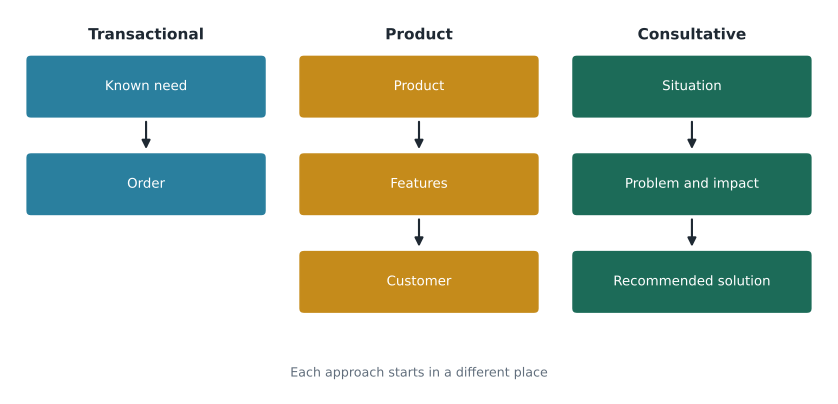
Sales writers have described selling approaches in many ways, but most descriptions contrast three broad styles. They are not rigid categories; most sellers move between them depending on the product and the customer.
| Transactional selling | Product selling | Consultative selling | |
|---|---|---|---|
| Starting point | The customer already knows what they want | The seller's product and its features | The customer's situation and problem |
| Seller's main job | Make buying easy and quick | Explain features and benefits persuasively | Diagnose, then recommend a solution that fits |
| Typical talk | "Which model and when do you need it?" | "Let me show you what this machine can do." | "Tell me what happens when a dealer visit is double booked." |
| Where it fits | Commodity items, repeat orders, simple purchases | Simple products with a clear use | Complex, costly or risky purchases with several decision makers |
| Main risk | Missing a bigger need | Pitching something the customer does not need | Spending time on discovery the customer does not want |
Consultative selling is an approach in which the seller acts like an adviser: they ask questions to understand the customer's goals, problems and constraints, help the customer see the cost of the problem and the value of solving it, and only then recommend a solution, which may be smaller than expected or may not involve the seller's product at all. The term became popular through Mack Hanan's book *Consultative Selling*, first published in 1970, and it has since become the default description of good business-to-business selling.
Product selling starts at the other end. The seller knows the product thoroughly and presents its features and benefits, hoping that one of them will match what the customer needs. This works well when products are simple and needs are obvious. It works badly when the customer has not yet worked out what the problem is, when several people are affected, or when the purchase is expensive enough that the customer needs to justify it to others.
Transactional selling is not a bad word. When a long-standing customer phones to order three more toner cartridges, the right approach is to process the order quickly and accurately, not to run a discovery session. Grace Liu, Ridgeline's sales operations analyst, pointed out that about a third of the company's orders by count are repeat supply orders that need no selling at all. Consultative selling is for the other kind of purchase: the one where the customer is deciding whether, and how, to change something.
Why consultative selling matters more now
Buyers today can learn a great deal about products without speaking to a salesperson. Gartner's research on business-to-business buying has found that buyers spend only a small share of their total buying time, about 17 in 100 by its estimate, meeting potential suppliers, and that time is split between every supplier they consider. A 2025 Gartner survey found that 61 in 100 business buyers said they would prefer a buying experience without a sales representative at all. A seller who only recites product information is offering something the buyer can get from a website.
What buyers cannot easily get from a website is help with their own situation: an outside view of what is really causing their problem, what similar organizations have done, what it is likely to cost and what could go wrong. That is the value a consultative seller adds. It is also why discovery skills have become central to sales training: the conversation is now the seller's main chance to be useful.
There is also a simple commercial reason. Complex purchases involve many people and take a long time, and many of them end with no decision at all. Matthew Dixon and Ted McKenna's research for *The JOLT Effect* (2022), based on about 2.5 million recorded sales conversations, found that between 40 and 60 in 100 of qualified deals in their sample ended in no decision, and that fear of making a mistake explained more of those outcomes than loyalty to the status quo. A seller who has helped the customer understand the problem clearly, and the cost of leaving it alone, gives the customer a reason to act.
What consultative sellers do differently
The difference between a product seller and a consultative seller shows up in behavior, not job titles. Darnell gave his team a list of habits to watch for in their own calls.
| Habit | Product seller | Consultative seller |
|---|---|---|
| First ten minutes | Introduces the company and products | Asks about the customer's situation and goals |
| Questions | Mainly to find a product match | To understand the problem, its causes and its cost |
| Talking time | Seller talks most of the time | Customer talks most of the time |
| When a need appears | Jumps to the product that fits | Asks what it affects and how much it matters |
| Recommendation | Always the seller's product | What fits, even if smaller, phased or not from the seller |
| After the meeting | Sends a brochure | Sends a summary of what was learned and agreed |
Several of these habits sound easy and are hard in practice. The most difficult for Maya was holding back. When Linda Sorensen, Keystone's human resources manager, mentioned that the main boardroom had been double booked during a dealer visit, Maya immediately knew which Ridgeline product would fix it. Every instinct told her to say so. Darnell's advice was to treat that moment as the start of a line of questions, not the end: when did it happen, what did it cost, who noticed, how often does it happen, and what has Keystone already tried? Lesson 10 is devoted to resisting the early pitch.
Consultative does not mean passive
A common misunderstanding is that consultative sellers simply ask questions and wait for customers to tell them what to sell. That is not how good consultative selling works. The seller brings expertise: knowledge of how other organizations have solved similar problems, what typically goes wrong, and what a realistic budget looks like. They share that knowledge as the conversation goes. Lesson 8 covers insight selling, in which the seller deliberately teaches the customer something they did not know about their own situation.
Consultative sellers are also willing to disagree with the customer. If a clinic asks for the cheapest possible printer and its real problem is that staff spend half an hour a day clearing jams on a machine that is too small for the workload, the consultative seller says so, explains why, and recommends something that solves the problem. Agreeing with whatever the customer asks for is order-taking, not consulting.
Finally, consultative sellers are still sellers. They work for a company that needs revenue and profit, and they are measured on results. Discovery is not a polite delay before the pitch; it is the work that makes the eventual recommendation more likely to be accepted, more likely to be large enough to matter and more likely to be renewed. The aim is a decision the customer is glad they made, and a sale the seller is proud of.
The discovery process at a glance
Discovery is the stage of the sales process in which the seller learns enough about the customer's situation, problems, priorities and buying process to decide whether and how to help. It usually takes more than one conversation. In a small sale, one well-prepared call may be enough. In a large sale, such as Prairie Valley's managed print contract, discovery may include site visits, data reviews and meetings with half a dozen people. The rest of this course follows the parts of discovery in roughly the order they happen.
| Lesson | Discovery task | Running example |
|---|---|---|
| 2 | Planning a discovery call: research, objectives and an agenda | Maya's first call with Eastgate Physiotherapy |
| 3 | Choosing questions using SPIN and later models | Keystone's double-booked boardroom |
| 4 | Finding the real problem behind the request | Northfield's request for "more desks" |
| 5 | Quantifying the impact of the problem | Eastgate's printer jams |
| 6 | Mapping the people involved | Prairie Valley's decision group |
| 7 | Learning the decision criteria and process | Westgate & Rowe and Prairie Valley |
| 8 | Teaching the customer something new | An insight on meeting-room use |
| 9 | Designing a solution with the customer | Northfield's expansion |
| 10 | Avoiding the early pitch | Maya's Keystone mistakes |
| 11 | Writing discovery notes and summaries | Eastgate and Westgate & Rowe |
| 12 | A complete discovery role-play | A credit union branch renovation |
A first look at a consultative conversation
Darnell asked Maya to replay the opening of her Keystone meeting and then try it again. The two versions show the difference in a few lines.
| Speaker | Product-led version | Consultative version |
|---|---|---|
| Maya | "Thanks for having me. Ridgeline has been in business for 22 years and we install video rooms for companies like yours." | "Thanks for making the time. Linda mentioned the boardroom was double booked during a dealer visit. Could you tell me what happened?" |
| Dale | "Okay." | "We had six dealers fly in from three provinces and two of our own people had booked the room for a budget meeting." |
| Maya | "Our RoomFlow system shows every room on a screen outside the door." | "What did that mean for the visit?" |
| Dale | "Send me the details." | "We ended up in the lunchroom. One of our biggest dealers made a joke about it in front of everyone. I did not find it funny." |
| Maya | (sends brochure) | "How often does that kind of clash happen?" |
In the second version Maya learned three things in ninety seconds: the problem was real, it had happened in front of customers, and Dale cared about it personally. She had not mentioned a single product. Darnell pointed out that she would earn the right to talk about RoomFlow later, once she knew how often clashes happened, what they cost and what Dale had already tried.
Common mistakes
MistakeOpening a first meeting by presenting the company and its products.
InsteadOpen with the customer's situation, using what you already know to ask a specific question.
MistakeTreating consultative selling as asking questions and waiting.
InsteadBring expertise: share what others have learned, offer an outside view and be willing to disagree.
MistakeRunning a long discovery session for a simple repeat order.
InsteadMatch the approach to the purchase: transactional for simple orders, consultative for complex or risky ones.
MistakeRecommending your product the moment a need appears.
InsteadTreat a stated need as the start of a line of questions about its cause, cost and priority.
MistakeThinking discovery is a polite delay before the real selling.
InsteadTreat discovery as the work that makes the recommendation fit, the deal larger and the customer more likely to renew.
Summary and key terms
- Consultative selling starts with the customer's situation rather than the product.
- The seller acts as an adviser, diagnosing problems and their impact before recommending a solution.
- Transactional selling suits simple repeat purchases; product selling suits simple products with obvious uses; consultative selling suits complex, costly or risky purchases with several decision makers.
- Buyers now spend only a small share of their buying time with suppliers and can find product information online, so the seller's value lies in understanding and improving the buyer's situation.
- Many complex deals end with no decision, often because buyers fear making a mistake.
- Consultative sellers bring expertise, are willing to disagree and remain responsible for results.
- Discovery is the stage in which the seller learns the customer's situation, problems, priorities and buying process, usually over several conversations.
- Consultative selling
- An approach in which the seller diagnoses the customer's situation and problem before recommending a solution that fits.
- Product selling
- An approach that starts with the product and presents its features and benefits to find a match.
- Transactional selling
- Making a simple purchase quick and easy when the customer already knows what they want.
- Discovery
- The stage of the sales process in which the seller learns the customer's situation, problems, priorities and buying process.
- No decision
- The outcome of a sales opportunity in which the customer neither buys nor chooses a competitor.
- Discovery lab
- Darnell's weekly coaching session at Ridgeline, used in this course to follow Maya's discovery work.
Practice problems
Work each problem on paper first, then reveal the answer to check.
A regular customer emails to order four boxes of paper. Which approach fits, and why?
Show answer
Transactional: the customer knows exactly what they want, so the seller should make the order quick and accurate.
Give two habits that show a seller is selling consultatively in the first ten minutes of a meeting.
Show answer
Any two of: asking about the customer's situation before presenting; asking follow-up questions about a stated problem; letting the customer do most of the talking; using prior research to ask a specific question.
Why might a consultative seller recommend a smaller solution than the customer asked for?
Show answer
Because the diagnosis shows a smaller solution solves the real problem; recommending what fits builds trust and long-term business.
Lesson quiz · 5 questions
Score 60% or more to complete this lesson.
Create a free account to save your progress, take quizzes and earn a certificate.