
SLS-210 · Lesson 5 of 12 · 20 min
Cold calling
▶ Video coming soon A video version of this lesson is on the way.
Maya's first cold-calling block, on the morning of Tuesday, September 15, lasted 90 minutes. She dialed 22 numbers, spoke to 4 people and booked nothing. At the Thursday session she played Darnell one of her calls from memory. She had introduced herself, explained that Ridgeline offered managed print, room booking, furniture and workplace technology, described each one, and then asked whether the office manager had a few minutes. The office manager had said no. Darnell asked one question: "In that first 30 seconds, what did you say about her?" Maya realized she had said nothing about the clinic at all.
A cold call is a sales call to someone who has had no recent contact with the seller and has not asked to be called. It is the most feared prospecting channel and one of the most debated. Some trainers say cold calling is dead, because buyers screen calls and prefer to research online. Others point to their own data showing that phone calls still book more meetings than email for many B2B sellers. Both claims usually come from vendors with something to sell, so a careful seller treats them as hints. Ridgeline's own numbers suggest that calls work well for its market, where office managers are often at their desks and appreciate a quick, relevant conversation more than another email. This lesson covers how to prepare, structure and follow up a cold call, how to handle the common responses and what the law says about calling businesses.
Preparing for a calling block
Most of the work of a good cold call happens before the phone rings. For each account on the list, the seller should know the contact's name and role, the trigger or reason for the call, the one question she wants to ask and the specific next step she will suggest. Lesson 3 covered this research. The seller should also prepare her environment: a quiet place, a headset, the CRM open to record each call, and the list in priority order. Calling the best accounts first, while energy is high, makes sense.
Many sellers find it helps to warm up with an easy call, such as a follow-up to an existing customer, before starting cold calls. Others prefer to stand while calling, which some say makes their voice more energetic. These are personal habits rather than rules. What matters is that the block is protected from interruptions and that the seller makes the calls rather than drifting back into research or email.
The structure of a cold call
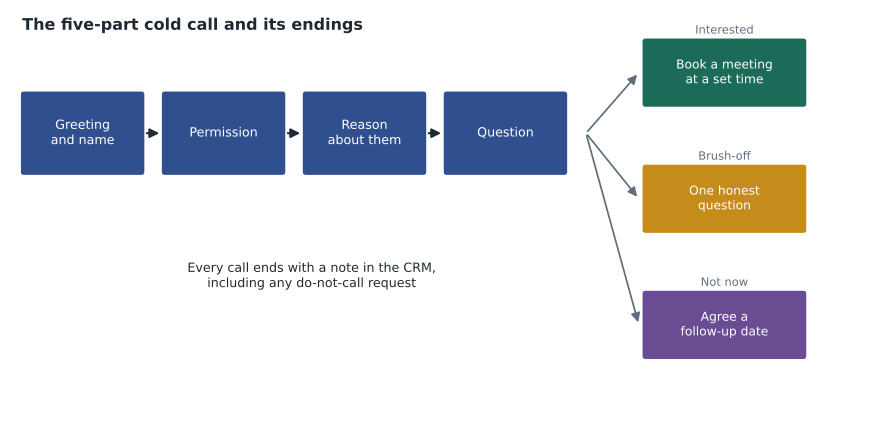
A cold call has very little time to earn attention. The person answering was doing something else and has no reason to stay on the line. A clear structure helps. Ridgeline teaches a five-part call that fits in about two minutes when the answer is no, and leads to a short conversation when it is yes.
| Part | Purpose | Example from Maya's call to Lakeview Veterinary Hospital |
|---|---|---|
| 1. Greeting and name | Say who you are clearly and calmly | "Hi Sandra, it's Maya Chen calling from Ridgeline Workplace Solutions here in Sioux Falls." |
| 2. Permission | Acknowledge the interruption and give control | "I'm calling out of the blue. Do you have 30 seconds for me to tell you why, and then you can decide if it's worth continuing?" |
| 3. Reason about them | Give a relevant reason based on research | "I work with a few clinics that added surgery suites, and they told me their printers couldn't keep up once the paperwork grew." |
| 4. Question | Invite the buyer to talk about their situation | "I'm curious whether that's been an issue for you since the expansion, or whether you've got it under control." |
| 5. Next step | Ask for a small, specific commitment | "Would it be worth 20 minutes next week to compare notes? I could come by Wednesday morning." |
Each part has a reason. The permission opener acknowledges that the call is an interruption, which tends to lower the buyer's guard. Some trainers prefer to skip it and go straight to the reason; both approaches are used successfully, and sellers should try them and compare results. The reason must be about the buyer, drawn from research and phrased so that it can be true without being presumptuous ("a few clinics told me" rather than "you are having trouble with"). The question turns the call into a conversation. And the next step asks for something small and specific: a 20-minute meeting at a named time is easier to accept than a vague "time to chat".
A cold call is not the place for discovery or a product presentation. If the buyer starts describing problems, the seller should listen, ask one or two follow-up questions, and then suggest the meeting: "That sounds like exactly what we should talk through properly. Could we book 20 minutes so I can understand it better?" Trying to diagnose and solve everything on the first call usually means the buyer feels sold to and the meeting never happens. SLS-211 covers discovery.
Gatekeepers
Many calls are answered by a receptionist, an assistant or a main switchboard rather than the contact. These gatekeepers have a job to do, which often includes protecting busy colleagues from sales calls. Trying to trick them, for example by pretending to be a customer or implying a personal relationship, is dishonest and usually backfires: receptionists talk to office managers, and a seller caught bluffing will not get through again. Under the FTC's Telemarketing Sales Rule, which since 2024 also bans misrepresentations in business-to-business calls, misleading statements in a sales call can also break the law.
The honest approach works better. Maya treats the receptionist as a person who knows the office well, gives her name and company, says briefly why she is calling and asks for help: "I'm hoping to speak with Sandra Kim about the clinic's printers. Is she the right person, or is there someone else who handles that?" If the receptionist says the contact does not take sales calls, Maya asks for the best way to reach her, such as email, and thanks the receptionist by name. Over a few calls, a friendly receptionist often becomes the person who says, "She's free now, I'll put you through."
Voicemail
Most cold calls go to voicemail. Sellers disagree about whether to leave messages: few prospects call back, but a short, relevant message can make the follow-up email or the next call more familiar. Ridgeline's practice is to leave a brief voicemail on the first and last call of a sequence, and not on every attempt. A good voicemail is under 30 seconds and gives a name, a company, one relevant reason, a phone number said slowly twice and a mention of what will happen next ("I'll send a short email today as well").
| Part | Words |
|---|---|
| Name and company | "Hi Deb, it's Maya Chen at Ridgeline Workplace Solutions." |
| Reason | "I saw that Sandstone brought both offices together after the merger. A couple of firms we work with found their printing and room bookings got messy after a move like that." |
| Next step | "I'll send you a short email today with what they changed. If it's useful, I'd be glad to talk." |
| Number | "My number is 605-555-0148. That's 605-555-0148." |
The phone number in the table uses the 555-01 range that is reserved for fictional numbers. In real messages, sellers should say their number slowly and twice, because voicemail playback is often poor.
Brush-offs and early objections
Most cold calls that reach a person end with some form of no. Many of these are not real objections but brush-offs: polite ways of ending an unexpected conversation. The aim is not to argue but to find out, in one question, whether there is anything worth pursuing, and then to respect the answer.
| Brush-off | What it often means | A response |
|---|---|---|
| "Just send me some information." | Ending the call politely, or genuine interest | "Happy to. So I send something useful rather than a brochure, is it the printers or the room bookings that matter more right now?" |
| "We already have a supplier." | Satisfied, under contract or not wanting to switch | "That makes sense. Most of our clients had one too. When does your current agreement come up for review?" |
| "We're not interested." | Busy, or truly no need | "Understood, and thanks for telling me. Is that because things are working well, or just not a priority right now?" |
| "Call me in six months." | A real timing issue, or a softer no | "I will. Is there something happening in six months, like a lease ending, that I should know about?" |
| "How did you get my number?" | Concern about privacy | Answer honestly, for example "It's the clinic's main line on your website", and offer not to call again. |
After one honest question, if the answer is still no, the seller should thank the person, confirm any follow-up date and end the call. If the person asks not to be called again, the seller must record that in the CRM and honor it. In the United States, telemarketers must keep an internal do-not-call list and honor requests within a reasonable time, which the FCC has set at no more than 10 business days. Ridgeline simply marks the contact as do-not-call the same day.
The numbers behind calling
Like all prospecting, calling is easier to manage with simple arithmetic. Sellers track dials (calls made), connects (calls answered by the right person), conversations (connects that last beyond the first few seconds) and meetings booked. The ratios vary a lot by market, list quality and time of day, so a seller should measure her own.
Worked problem
How many dials for five meetings?
Over her first four calling blocks, Maya made 88 dials, reached the right person 14 times, had 9 real conversations and booked 3 meetings. If her rates stay the same, how many dials does she need to book 5 meetings in a week?
Show solution
- Meetings per dial: 3 ÷ 88 ≈ 0.034.
- Dials per meeting: 88 ÷ 3 ≈ 29.3.
- Dials for 5 meetings: 5 × 29.3 ≈ 147 dials.
- At about 22 dials per 90-minute block, that is 147 ÷ 22 ≈ 6.7 blocks.
Answer: About 147 dials, or nearly seven 90-minute blocks, which is far more than her two weekly blocks. Maya needs either better rates, through better lists and openers, or other channels such as email and referrals to share the load. Lesson 11 combines them.
By November, after Darnell's coaching on the reason-about-them opener and calling at better times, Maya's connect rate had risen and she was booking a meeting for about every 18 dials. Small improvements in each ratio multiply: a seller who reaches slightly more people, keeps slightly more of them talking and books slightly more meetings can double her results without making more calls.
The law on calling businesses
In the United States, the main federal rules are the Telephone Consumer Protection Act (TCPA), enforced by the FCC, and the FTC's Telemarketing Sales Rule (TSR). The National Do Not Call Registry protects residential and personal numbers, not business lines, so a call to a clinic's main business number is generally not restricted by the registry. Other rules still apply to business calls. Calls or texts to a cell phone using an autodialer or a prerecorded or artificial voice need the person's prior consent, and telemarketing robocalls need prior written consent, whether the phone belongs to a business or not. Telephone solicitations to residences are limited to 8 a.m. to 9 p.m. local time. Since 2024, the TSR's ban on misrepresentations also covers business-to-business calls. Many states add their own rules: South Dakota's Public Utilities Commission keeps a state do-not-call register for residential numbers, and states such as Florida and Oklahoma have strict laws on automated calls. Individuals can sue under the TCPA for 500 dollars per violation, or up to 1,500 dollars if it was willful, so Ridgeline dials manually, calls only published business numbers and calls during business hours
These rules change often, and courts and regulators in both countries have revised them several times in recent years. In 2025 a federal appeals court struck down the FCC's planned one-to-one consent rule before it took effect, and the FCC later deleted it; in September 2026 the FCC also revised its rules on how people can revoke consent to calls and texts. Sellers should follow their company's current policy and ask the compliance team when unsure. SLS-150 covers telemarketing law in more depth.
Common mistakes
MistakeOpening with a description of your company and products.
InsteadOpen with a reason that is about the buyer, drawn from research.
MistakeTrying to do discovery and a presentation on the cold call.
InsteadAsk one or two questions and suggest a short meeting.
MistakeTricking or bluffing past gatekeepers.
InsteadBe honest, ask for help and thank them by name.
MistakeArguing with brush-offs.
InsteadAsk one honest question, then respect the answer and record any do-not-call request.
MistakeCalling personal cell phones with automated dialers or recorded messages.
InsteadDial manually, use published business numbers and follow the telemarketing rules for your country.
Summary and key terms
- A cold call is a sales call to someone who has not recently been in contact or asked to be called.
- Preparation, including a reason, a question and a next step for each account, does most of the work.
- A five-part call uses a greeting, permission, a reason about the buyer, a question and a specific next step.
- Gatekeepers should be treated honestly and with respect; misrepresentation is both ineffective and unlawful.
- Voicemails should be short, relevant and paired with a follow-up email.
- Brush-offs deserve one honest clarifying question, then respect; do-not-call requests must be recorded and honored.
- Tracking dials, connects, conversations and meetings shows where to improve, and small gains in each ratio multiply.
- Business lines are outside the National Do Not Call Registry, but TCPA consent rules for cell phones and robocalls, the TSR and state laws still apply.
- Cold call
- A sales call to a person who has not recently been in contact or asked to be called.
- Gatekeeper
- A person, such as a receptionist, who controls access to a contact.
- Brush-off
- A polite response used to end an unexpected sales conversation.
- Connect rate
- The share of dials that reach the intended person.
- Internal do-not-call list
- A company's own record of people who have asked not to be called.
Practice problems
Work each problem on paper first, then reveal the answer to check.
A seller books 4 meetings from 100 dials. How many dials does she need for 6 meetings at the same rate?
Show answer
100 ÷ 4 = 25 dials per meeting; 6 × 25 = 150 dials.
Write a permission opener in your own words.
Show answer
For example: "I'm calling out of the blue; may I take 30 seconds to say why, and you can tell me if it's worth continuing?"
How should a seller respond to "We already have a supplier"?
Show answer
Acknowledge it and ask one honest question, such as when the current agreement comes up for review.
Why does Ridgeline call only published business numbers, manually, in business hours?
Show answer
To stay within telemarketing rules on personal numbers, automated calls and calling hours, and to respect buyers.
Lesson quiz · 5 questions
Score 60% or more to complete this lesson.
Create a free account to save your progress, take quizzes and earn a certificate.