
ROB-330 · Lesson 5 of 12 · 31 min
Feature matching and robust estimation
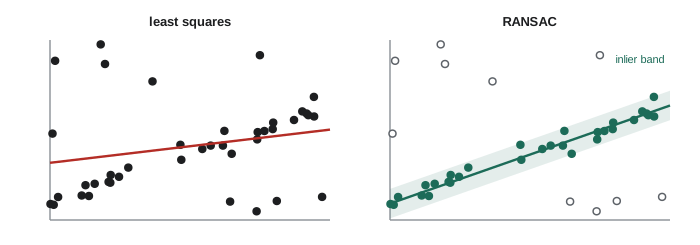
Features and descriptors become useful when they are matched: the same physical point found in two images, or in an image and a stored model. Matches let a robot compute how the camera moved, where a known object sits, how two images align, or how far away a point is. But matching is error-prone. Repeated textures such as shelving, tiles and brickwork produce many similar descriptors, and moving people, reflections and occlusions add matches that obey no consistent geometry. Even a good matcher typically returns 20 % to 50 % wrong matches in a cluttered robot scene, and a single wrong match can wreck an ordinary least-squares fit. This lesson covers how to produce candidate matches and how to estimate geometry robustly in spite of the outliers among them, with RANSAC as the central tool.
Producing candidate matches
The simplest matcher is brute force: for each descriptor in image A, compute its distance to every descriptor in image B and take the nearest. With n features in each image this costs \( n^2 \) distance computations, about a million for 1000 features, which is fine for binary descriptors on a modern CPU but slow for 128-dimensional SIFT vectors at video rates. Approximate nearest-neighbor methods such as k-d trees and the FLANN library find near-best matches much faster with little loss.
Nearest neighbor alone accepts too many bad matches, because every feature has some nearest neighbor even if its true partner is not in the other image. Two filters remove most of them.
- The ratio test (Lowe, 2004): compare the distance to the nearest neighbor \( d_1 \) with the distance to the second nearest \( d_2 \), and accept the match only if \( d_1/d_2 < \tau \), with τ typically 0.7 to 0.8. A genuine match is usually much closer than any alternative; an ambiguous feature on a repeated pattern has two near-equal candidates and is rejected.
- Mutual consistency (cross-checking): accept a match from A to B only if B's best match back is the same feature in A.
After these filters the surviving matches are mostly correct, but not all, and the remaining errors are exactly the ones that look plausible. Geometry has to do the rest.
Worked problem
Applying the ratio test
Three features in image A have nearest and second-nearest distances in image B of (32, 95), (61, 70) and (40, 58). Which pass a ratio test with τ = 0.75?
Show solution
- Feature 1: \( 32/95 = 0.34 \): passes.
- Feature 2: \( 61/70 = 0.87 \): rejected as ambiguous.
- Feature 3: \( 40/58 = 0.69 \): passes.
Answer: Features 1 and 3 pass. Feature 2, whose two best candidates are almost equally close, is the kind that lies on a repeated texture.
Geometric models that matches must obey
Correct matches between two images are not independent: they all obey one geometric relationship determined by the scene and the camera motion. Which relationship depends on the situation.
- A homography H (3 × 3, 8 degrees of freedom) relates two views of a plane, such as a floor, a wall, a shelf front, a printed marker or a table top, or two views from a camera that only rotated. Points map as \( \lambda \tilde{\mathbf{u}}' = H \tilde{\mathbf{u}} \).
- The fundamental matrix F (3 × 3, 7 degrees of freedom) relates two views of a general 3-D scene by \( \tilde{\mathbf{u}}'^{\mathsf{T}} F \tilde{\mathbf{u}} = 0 \); with calibrated cameras it becomes the essential matrix E. Lesson 6 develops this epipolar geometry.
- A rigid transform relates a 3-D model to 3-D measurements, and the perspective-n-point problem relates known 3-D points to their 2-D images (lesson 11).
Each model can be estimated from a small minimal set of matches: four point pairs for a homography, eight (or seven, or five for the calibrated essential matrix) for epipolar geometry, three for a rigid 3-D transform. That minimal set size is what makes RANSAC work.
RANSAC
Random sample consensus, introduced by Fischler and Bolles in 1981 for exactly this kind of problem, inverts the usual approach to fitting. Instead of fitting all the data and hoping outliers average out, it fits many tiny subsets and keeps the model that most of the data agree with.
1. Randomly choose a minimal set of s matches (s = 4 for a homography).
2. Fit the model to those s matches exactly.
3. Count the inliers: matches whose error under this model is below a threshold, such as a reprojection distance of 2 pixels.
4. Repeat for N iterations and keep the model with the most inliers.
5. Refit the model to all its inliers by least squares, which averages out noise.
The method succeeds as soon as one sample happens to contain only inliers. If a fraction w of matches are inliers, a random sample of s is all-inlier with probability \( w^s \), so the probability that N samples all fail is \( (1 - w^s)^N \). Setting that equal to \( 1 - p \), for a desired success probability p, gives the number of iterations:
Worked problem
How many RANSAC iterations?
Estimate a homography (s = 4) from matches that are 60 % inliers, with 99 % confidence of success. Repeat for the 8-point fundamental matrix (s = 8).
Show solution
- Homography: \( w^4 = 0.6^4 = 0.1296 \); \( N = \log(0.01)/\log(0.8704) = -4.605/-0.1388 = 33.2 \), so 34 iterations.
- Eight-point: \( w^8 = 0.6^8 = 0.0168 \); \( N = -4.605/\log(0.9832) = -4.605/-0.01694 = 272 \) iterations.
Answer: About 34 iterations for a homography but about 272 for the eight-point algorithm. Larger minimal sets need far more samples, which is why the five-point algorithm is preferred for calibrated cameras.
Because the inlier ratio is usually unknown in advance, implementations adapt N as they go: they start with a pessimistic guess and recompute N from the best inlier ratio found so far, stopping early when a good model appears. The inlier threshold should match the expected measurement noise, typically two to three times the standard deviation of keypoint location error.
import numpy as np
rng = np.random.default_rng(3)

def fit_h(a, b):
    """Homography from >= 4 point pairs by DLT (a, b are N x 2)."""
    rows = []
    for (x, y), (u, v) in zip(a, b):
        rows.append([x, y, 1, 0, 0, 0, -u * x, -u * y, -u])
        rows.append([0, 0, 0, x, y, 1, -v * x, -v * y, -v])
    H = np.linalg.svd(np.array(rows))[2][-1].reshape(3, 3)
    return H / H[2, 2]

def apply_h(H, a):
    p = np.hstack([a, np.ones((len(a), 1))]) @ H.T
    return p[:, :2] / p[:, 2:]

H_true = np.array([[1.10, 0.05, 30.0], [-0.03, 0.95, 12.0], [2e-4, 1e-4, 1.0]])
n_in, n_out = 120, 80
a = rng.uniform(0, 640, (n_in + n_out, 2))
b = apply_h(H_true, a) + rng.normal(0, 0.7, a.shape)        # 0.7 px noise
b[n_in:] = rng.uniform(0, 640, (n_out, 2))                  # 40 % outliers

# plain least squares on everything
H_ls = fit_h(a, b)

# RANSAC
best = np.zeros(len(a), bool)
for it in range(500):
    idx = rng.choice(len(a), 4, replace=False)
    H = fit_h(a[idx], b[idx])
    err = np.linalg.norm(apply_h(H, a) - b, axis=1)
    inl = err < 2.0
    if inl.sum() > best.sum():
        best = inl
H_r = fit_h(a[best], b[best])

test = rng.uniform(0, 640, (200, 2))
for name, H in [("least squares", H_ls), ("RANSAC", H_r)]:
    e = np.linalg.norm(apply_h(H, test) - apply_h(H_true, test), axis=1)
    print("%-13s mean error on fresh points: %7.2f px" % (name, e.mean()))
print("RANSAC inliers: %d of %d (true inliers %d)" % (best.sum(), len(a), n_in))least squares mean error on fresh points: 4428.19 px RANSAC mean error on fresh points: 0.32 px RANSAC inliers: 119 of 200 (true inliers 120)
Homographies in robot practice
Planes are everywhere in built environments, and homographies exploit them. A robot can map a floor-facing camera's image onto a top-down 'bird's-eye' view by computing the homography between the image and the ground plane from four known floor points, a standard trick for mobile robots and lane detection. Image stitching for inspection or mapping aligns overlapping views of a flat surface or views from a camera that rotates about its center. And a homography between a known planar object, such as a printed label or the face of a box, and its image can be decomposed into the camera's rotation and translation relative to that plane, given the intrinsics.
Worked problem
Mapping a pixel to the floor
A homography from image pixels to floor coordinates in millimeters is \( H = \begin{bmatrix} 2 & 0 & -640 \\ 0 & -3 & 2160 \\ 0 & 0.001 & 1 \end{bmatrix} \). Where on the floor is the point seen at pixel (400, 600)?
Show solution
- Multiply: \( H [400, 600, 1]^{\mathsf{T}} = [2(400) - 640,\; -3(600) + 2160,\; 0.001(600) + 1] = [160,\; 360,\; 1.6] \).
- Divide by the third component: \( (160/1.6,\; 360/1.6) = (100, 225) \) mm.
Answer: The point is 100 mm to the side and 225 mm ahead on the floor. The division by 1.6 is the perspective effect: points higher in the image are farther away.
Beyond basic RANSAC
Many refinements exist. PROSAC samples the best-ranked matches first, often finding a good model in a handful of iterations. MLESAC and MSAC score models by the total error of inliers rather than just counting them, which separates models with similar inlier counts. Local optimization (LO-RANSAC) refits each promising model to its inliers before counting again. MAGSAC avoids choosing a single threshold by marginalizing over a range. For very high outlier rates, graduated non-convexity and robust cost functions such as the Huber and Cauchy losses, used inside least-squares solvers, down-weight large errors smoothly instead of discarding them. Libraries such as OpenCV expose these as flags (for example the USAC methods in findHomography), so choosing one is usually a matter of configuration.
Robust estimation is also a safety matter. A robot that acts on a pose computed from a bad set of matches can drive into an obstacle or crush a part. Production systems therefore check the result: a minimum number of inliers, a maximum reprojection error, a plausible motion compared with wheel odometry, and a covariance estimate from the final least-squares fit. If the checks fail, the right action is to report low confidence and fall back, not to act on the answer.
Worked problem
Is the result trustworthy?
A robot's pose estimate from 500 matches has 37 inliers at a 2-pixel threshold. The previous frame had 310 inliers, and wheel odometry reports 4 cm of motion while the vision estimate reports 38 cm. What should the robot do?
Show solution
- Inlier ratio: \( 37/500 = 7.4\% \), far below the 62 % of the previous frame.
- The vision motion disagrees with odometry by almost a factor of ten.
Answer: Treat the estimate as unreliable: reject it, rely on odometry for this frame, and flag degraded vision (perhaps from motion blur, glare or a moving crowd). Acting on it could move the robot 34 cm in the wrong direction.
Common mistakes
MistakeAccepting every nearest-neighbor match
InsteadApply a ratio test and cross-checking before geometric estimation.
MistakeFitting a model by least squares to all matches
InsteadUse RANSAC or a robust cost function, then refit to the inliers.
MistakeRunning a fixed, small number of RANSAC iterations regardless of the inlier ratio
InsteadCompute N from the inlier ratio and minimal set size, adapting as better models are found.
MistakeUsing a homography for a general 3-D scene with large camera translation
InsteadUse epipolar geometry (F or E) unless the scene is planar or the camera only rotates.
MistakeActing on a pose with few inliers or implausible motion
InsteadCheck inlier counts, reprojection error and consistency with other sensors, and fall back if they fail.
Summary and key terms
- Brute-force or approximate nearest-neighbor matching produces candidate correspondences between descriptors.
- The ratio test and cross-checking remove most ambiguous and inconsistent matches.
- Correct matches obey a single geometric model: a homography for planes or pure rotation, epipolar geometry for general scenes.
- RANSAC fits minimal samples repeatedly and keeps the model with the most inliers, then refits to all inliers.
- The number of iterations is \( N = \log(1-p)/\log(1-w^s) \), growing rapidly with minimal set size s.
- Homographies give bird's-eye views, image stitching and poses relative to planar objects.
- Robust estimates must be checked for inlier count, error and plausibility before a robot acts on them.
- Correspondence
- A pair of image features believed to show the same physical point.
- Ratio test
- Accepting a match only if it is clearly closer than the second-best candidate.
- Cross-checking
- Accepting a match only if each feature is the other's best match.
- Outlier
- A data point that does not fit the true model.
- Inlier
- A data point consistent with a model within a threshold.
- RANSAC
- Random sample consensus: robust fitting by repeated minimal sampling.
- Minimal set
- The smallest number of data points that determines a model.
- Homography
- A projective mapping between two views of a plane, or two views from a rotating camera.
- Robust cost function
- A loss such as Huber that down-weights large errors in least squares.
- FLANN
- A library for fast approximate nearest-neighbor search.
Practice problems
Work each problem on paper first, then reveal the answer to check.
How many point pairs determine a homography?
Show answer
Four.
Ratio 50/60: does it pass a 0.8 ratio test?
Show answer
No; 0.83 exceeds 0.8.
With w = 0.5 and s = 4, what is the chance that one sample is all inliers?
Show answer
1/16, or 6.25 %.
How many iterations give 99 % success for w = 0.8, s = 4?
Show answer
About 9.
Name two situations where a homography relates two images.
Show answer
A planar scene, or a camera that only rotates.
What is the final step after finding the best RANSAC model?
Show answer
Refit to all its inliers by least squares.
How should the inlier threshold relate to keypoint noise?
Show answer
About two to three times its standard deviation.
Why is the five-point algorithm preferred over the eight-point one in RANSAC?
Show answer
A smaller minimal set needs far fewer iterations.
Name a RANSAC variant that samples the best matches first.
Show answer
PROSAC.
Give one plausibility check on a vision pose estimate.
Show answer
Agreement with wheel odometry, or a minimum inlier count.
Lesson quiz · 5 questions
Score 60% or more to complete this lesson.
Create a free account to save your progress, take quizzes and earn a certificate.