
RAC-430 · Lesson 6 of 12 · 17 min
Air-side and heat pump faults
Many service calls blamed on refrigerant are really air problems. A blocked filter, a crushed duct or a blower set to the wrong speed changes every refrigerant reading, and a technician who goes straight to the gauges can spend an hour chasing a charge problem that does not exist. Dana had seen it so often that she made Theo say the rule aloud: "Airflow first, then refrigerant." This lesson reviews air-side faults in furnaces, air handlers and coils, then the faults particular to heat pumps: reversing valves, defrost, supplementary heat and balance points.
The calculations here are the ones the exam uses most often in this area: airflow from a furnace temperature rise, sensible heat from airflow and temperature difference, and total external static pressure against the equipment's rating. RAC-330 covered them in detail; this lesson uses them for diagnosis.
Airflow problems and their signatures
Low airflow across an evaporator lowers the evaporator temperature, so suction pressure and superheat fall, and in humid weather the coil may ice, as lesson 4's pattern for low evaporator airflow showed. Across a furnace heat exchanger, low airflow raises the temperature rise, can trip the high-limit switch and shortens the heat exchanger's life. Across a heat pump's indoor coil in heating mode, which is the condenser, low airflow raises head pressure and can trip the high-pressure switch on mild days.
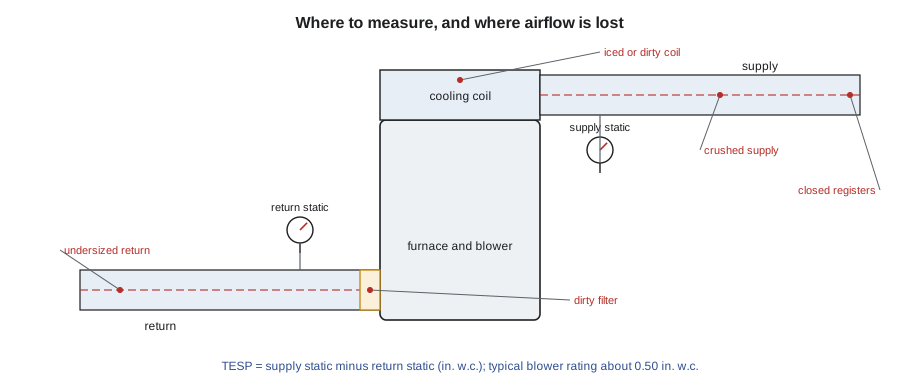
The common causes are simple: dirty filters, dirty coils, closed or blocked registers and grilles, crushed or disconnected ducts, undersized returns, a blower set to the wrong speed or tap, a slipping belt on larger units and failed or failing blower motors and capacitors. The Novak house in RAC-330 had a noisy, hard-working blower because a single return could not move the air; a second return dropped the total external static pressure from well above the rating to within it and cut the blower's power by about a third.
Too much airflow is less common but real: a blower set to high speed for cooling in a humid climate can reduce dehumidification, because the coil runs warmer and air passes too quickly to drop its moisture. The clinic's operatories in RAC-330 needed a dehumidification mode for exactly that reason. In heating, very high airflow gives a low supply air temperature that occupants feel as drafts.
Measuring airflow in the field
Several field methods estimate airflow. A gas furnace's temperature rise method uses the heat delivered, input times efficiency, and the measured rise to calculate airflow; manufacturers give an allowed rise range on the rating plate. Total external static pressure, measured at the air handler and compared with the manufacturer's blower table, gives airflow for a given blower setting. A flow hood or a pitot traverse measures airflow directly at registers or in ducts, and RAC-330 described how. On the exam, the temperature rise and sensible heat calculations appear far more often than the instruments.
# Air side checks: airflow from temperature rise and the sensible capacity of a cooling coil
def furnace_cfm(input_btuh, efficiency, rise_f):
    return input_btuh * efficiency / (1.08 * rise_f)
for rise in (40, 50, 65):
    print(f"temperature rise {rise} F -> airflow {furnace_cfm(60000, 0.95, rise):5.0f} cfm")
def sensible_btuh(cfm, return_f, supply_f):
    return 1.08 * cfm * (return_f - supply_f)
print(f"cooling, 1,000 cfm, 75 F return, 55 F supply: {sensible_btuh(1000, 75, 55):,.0f} Btu/h sensible")
print(f"cooling, 700 cfm, 75 F return, 47 F supply:   {sensible_btuh(700, 75, 47):,.0f} Btu/h sensible (low airflow, cold coil)")
static = {"supply": 0.42, "return": -0.44}           # in. w.c., measured at the air handler
tesp = static["supply"] - static["return"]
print(f"total external static pressure: {tesp:.2f} in. w.c. against a typical rating of 0.50 -> {'high' if tesp > 0.5 else 'ok'}")temperature rise 40 F -> airflow 1319 cfm temperature rise 50 F -> airflow 1056 cfm temperature rise 65 F -> airflow 812 cfm cooling, 1,000 cfm, 75 F return, 55 F supply: 21,600 Btu/h sensible cooling, 700 cfm, 75 F return, 47 F supply: 21,168 Btu/h sensible (low airflow, cold coil) total external static pressure: 0.86 in. w.c. against a typical rating of 0.50 -> high
The furnace example shows how strongly airflow depends on the rise: the same furnace moves about a third less air when the rise climbs from the low end to the high end of a typical range. The cooling example shows two coils delivering nearly the same sensible capacity, one with design airflow and a moderate temperature drop, the other with too little air and a very cold coil. The second one is the one that freezes. The static pressure reading shows a system working against far more resistance than the blower was rated for; the cause is in the ducts, filters or coil, not the refrigerant.
Heat pump faults: the reversing valve
A heat pump's reversing valve switches the roles of the indoor and outdoor coils. Its common faults are a coil that does not energize, a pilot circuit that does not shift the slide, a slide that sticks partway and a slide whose seals leak so that hot gas bypasses to the suction side. Each has a signature.
If the valve does not shift, the system runs in the wrong mode: cooling when heating is called, or the reverse. Check first whether the control is energizing the valve's solenoid in the right mode. On most systems the valve is energized in cooling, on the O terminal, while some brands energize it in heating, on B; the smart thermostat on a house call in RAC-130 had been set to the wrong convention. If the solenoid is energized and the valve does not shift, a light tap with the system running and a good pressure difference may free a sticking slide, but a valve that sticks once will stick again.
If the slide leaks internally, some hot discharge gas passes straight to the suction side. The system runs with low capacity in both modes, high suction pressure, low head pressure and a compressor that seems weak. The confirmation is temperature: the suction line leaving the valve to the compressor is warmer than the line coming into the valve from the active evaporator coil, by more than a degree or two. That is how Theo found the Ruiz house's twelve-year-old heat pump in RAC-320 bypassing; a compressor test alone would have wrongly condemned the compressor.
Defrost faults
In heating, the outdoor coil runs below freezing and frosts. The defrost system reverses the cycle briefly to melt the frost. Too little defrost leaves the coil blocked with ice, capacity falls, suction pressure falls and the unit may trip on low pressure. Too much defrost wastes energy and cools the house. The defrost control initiates on time, on a temperature and time combination, or on demand, using coil and air temperatures, and terminates on coil temperature or a maximum time, as RAC-230 explained.
The common faults are a defrost sensor that has slipped from its proper position on the coil, a failed sensor, a failed defrost board, an outdoor fan that does not stop during defrost, a reversing valve that does not shift and a coil that cannot drain because the unit sits too low or the base pan is blocked. The Lindqvist heat pump's iced coil in RAC-230 came from a sensor clip that had slid toward the warmer discharge line, so the board saw a coil warmer than it really was and terminated defrost early. Most defrost boards have a test mode that forces a defrost; using it and watching the sequence, with temperatures and pressures, finds most faults.
Normal frost and defrost puzzle customers. A heat pump that steams during defrost, makes a whooshing sound when the valve shifts and blows cool air briefly is working as designed. The Haddads' ductless unit in RAC-230 defrosted about every 45 minutes in damp, near-freezing weather, which was normal; the explanation, not a repair, solved that call.
Supplementary heat and balance points
Below the balance point, a heat pump alone cannot meet the heating load, and supplementary heat makes up the difference: electric resistance strips, or in a dual-fuel system, a furnace. Faults show as high bills, discomfort in cold weather or heat that comes on too early. Electric strips that run whenever the heat pump runs, from a miswired thermostat or a failed outdoor thermostat, can double heating costs. Strips that do not run when needed leave the house cold in the coldest weather, which is why the Ruiz house's outdoor lockout setting in RAC-320 was chosen with care.
Dual-fuel systems switch between heat pump and furnace at a changeover temperature. The Lindqvist system's changeover depended on whether the economic or the thermal balance point was higher, which in RAC-320 depended on local energy prices. A changeover set in the wrong place does not break anything, but it wastes money, and a customer complaint about bills is often a controls question in disguise.
| Complaint | Possible causes | Check |
|---|---|---|
| Heat pump blows cool air in heating | Reversing valve not shifting, defrost cycle, low charge, wrong O/B setting | Mode, valve solenoid, line temperatures, setup |
| Outdoor coil covered in ice | Defrost sensor slipped or failed, board fault, fan not stopping, poor drainage | Force a defrost and watch the sequence |
| Low capacity in both modes | Reversing valve bypassing, undercharge, low airflow | Temperature across the valve's suction ports, readings |
| High bills in winter | Strips running with the heat pump, changeover set wrong | Strip current, thermostat settings, outdoor lockout |
| Furnace high limit trips | Dirty filter, closed registers, blower speed, blocked return | Temperature rise and static pressure |
| Water dripping from the air handler | Blocked condensate drain or trap, iced coil melting, missing secondary pan | Drain, trap, coil, pan and safety switch |
Condensate faults deserve a word because they cause damage out of all proportion to their cost. A blocked trap or drain line, an unsloped line, a missing vent or a failed condensate pump floods ceilings and floors, and a coil that iced from low airflow can release its water all at once when it melts. A float switch in the secondary pan or drain line that stops cooling when water backs up is required in many installations and cheap insurance in all of them.
Comfort complaints that are not faults
Some air-side calls end with no repair at all, because the system is doing what it was designed to do. A heat pump's supply air in heating is often around 86 to 95 °F, much cooler than a gas furnace's, and it can feel cool on a hand even while it heats the house well. A two-story house with one system may always be warmer upstairs in summer, and the fix there is zoning, balancing or a second system, not a refrigerant repair. A variable-speed system that runs almost continuously at low speed is working as intended, and customers used to on-off equipment sometimes call because it never seems to stop.
Those calls still deserve the full method: complaint, look, measure and compare. A measured supply temperature, airflow and temperature split that match the manufacturer's data are the evidence that the system is sound, and explaining them to the customer, with numbers, often solves the problem. Theo kept a short sheet of normal operating values for heat pumps, furnaces and air conditioners in his van for exactly these calls.
A worked question
A typical exam question in this area reads: "A gas furnace's high limit trips after about ten minutes of operation. The filter is new. The temperature rise is well above the range on the rating plate. What should be checked next?" The options were the gas pressure, the blower speed setting and supply registers, the flame sensor and the thermostat anticipator. A high rise with a new filter points to low airflow, so the blower setting, registers and ducts are next. Gas pressure would matter if the rise were high with normal airflow, which a static pressure reading would show.
Common mistakes
MistakeGoing to the gauges before checking filters, coils and airflow.
InsteadAirflow first, then refrigerant.
MistakeCondemning a compressor on a heat pump with low capacity in both modes.
InsteadCheck the reversing valve for internal bypass by temperature first.
MistakeTreating normal defrost as a fault.
InsteadSteam, a whoosh and brief cool air during defrost are normal.
MistakeSetting a dual-fuel changeover without checking the balance points.
InsteadUse the thermal and economic balance points for the local prices.
MistakeClearing a blocked condensate drain without checking why the coil iced.
InsteadFind the airflow or charge fault behind an iced coil.
Summary and key terms
- Low airflow lowers evaporator temperatures in cooling, raises the temperature rise in furnaces and raises head pressure in heat pump heating.
- Temperature rise, sensible heat and total external static pressure calculations estimate airflow in the field.
- A reversing valve that bypasses gives low capacity in both modes; the valve's suction-side temperatures confirm it.
- Defrost faults usually come from sensors, boards, fans or drainage; the board's test mode helps find them.
- Supplementary heat and changeover settings are common causes of high bills and cold-weather complaints.
- Condensate faults cause expensive damage; drains, traps and float switches need checking on every call.
- Temperature rise
- The increase in air temperature across a furnace, used with the input to estimate airflow.
- Total external static pressure
- The pressure difference the blower works against outside the equipment, measured at the air handler.
- Reversing valve bypass
- Internal leakage of hot gas to the suction side through a worn or stuck slide.
- Balance point
- The outdoor temperature at which a heat pump's capacity equals the heating load.
- Demand defrost
- Defrost started when temperatures show the coil is frosted, rather than on a fixed time.
Practice problems
Work each problem on paper first, then reveal the answer to check.
A furnace delivers 57,000 Btu/h of heat with a 55 F rise. What is the airflow?
Show answer
57,000 ÷ (1.08 × 55) = about 960 cfm.
What sensible capacity does 1,100 cfm give with a 20 F drop?
Show answer
1.08 × 1,100 × 20 = 23,760 Btu/h.
The line from the active evaporator coil to the reversing valve is 40 F and the line from the valve to the compressor is 52 F. What does that suggest?
Show answer
Hot gas bypassing inside the valve.
Supply static is 0.36 in. w.c. and return static is −0.38. What is the total external static pressure?
Show answer
0.74 in. w.c.
Lesson quiz · 5 questions
Score 60% or more to complete this lesson.
Create a free account to save your progress, take quizzes and earn a certificate.