
RAC-430 · Lesson 2 of 12 · 17 min
Using the exam blueprint and building a study plan
On the second Thursday, Dana spread three things on the table: Theo's diagnostic results, a calendar of the twelve weeks to the exam and the outlines of the three exams, which Dana had turned into a single study blueprint. "Your time is the scarce thing," she said. "About eight hours a week, around full-time work. That's under a hundred hours. We're going to spend them where the marks are."
This lesson explains how an exam blueprint is built, how to read it, and how to turn it and a candidate's own weaknesses into a study plan with hours, topics and checkpoints. The same method works for any certification exam, and for the continuing education a certified mechanic will need for the rest of a career.
What a blueprint is
Most professional exams are built from a blueprint, sometimes called a content outline or table of specifications. The exam's owner divides the work into knowledge areas, decides how many questions each area gets and writes questions to fill each area. NATE publishes knowledge area outlines for its core and specialty exams, and Kentucky's department lists the code books the journeyman exam is based on. Neither gave Theo one neat table for all three exams, so Dana built a study blueprint from them: six areas, weighted by how much of each exam they covered and how often they came up in the journeyman exam's code books. It was Northfield's own planning tool, not an official weighting, and Dana said so.
| Study area | Weight in Northfield's blueprint | Mainly from |
|---|---|---|
| Safety, codes and refrigerant rules | 15 % | NATE core, EPA 608 review, Kentucky code books |
| Refrigeration circuit and charging | 20 % | NATE core and specialty |
| Electrical and controls | 20 % | NATE core and specialty |
| Heat pumps and air side | 20 % | NATE specialty, International Residential Code |
| Installation and start-up | 15 % | International Residential Code, NATE specialty |
| Gas heat and hydronics | 10 % | National Fuel Gas Code, Kentucky exam |
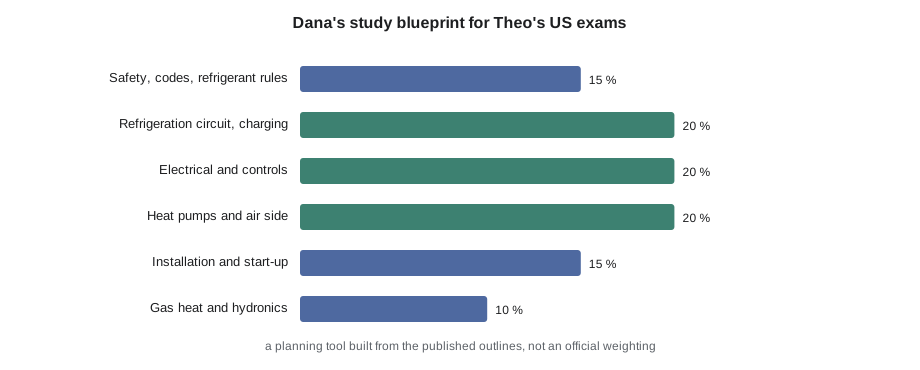
Reading the blueprint properly
Even an unofficial blueprint says a lot. The three largest areas, refrigeration circuits, electrical and controls and heat pumps and the air side, are where troubleshooting lives, and together they made up 60 % of Dana's blueprint. Safety and codes, at 15 %, look small, but many code questions on an open-book exam are free marks for a candidate who knows where to look and expensive for one who does not. Gas heat and hydronics, at 10 %, was Theo's weakest area by far, because Northfield's Louisville work was mostly heat pumps; ten percent of a 60-question exam is six questions, more than enough to decide a pass.
Within each block, the occupational standard lists the tasks and the knowledge each requires. Dana had Theo go through those lists line by line and mark each with a rating from 1 to 5: 1 for never done it and could not explain it, 3 for done it with help and could explain the basics, 5 for could do it alone and teach it. The ratings were meant to be honest rather than flattering. Rating something a 4 because it sounds familiar defeats the purpose; the test is whether you could answer a question on it without help today.
From blueprint to hours
The plan Dana used gives each block a share of the available hours proportional to its weight multiplied by a need factor, six minus the self-rating. A block with a high weight and a low rating gets the most time; a block with a small weight and a high rating gets the least, but never zero, because every block needs review. The script applies that rule to Theo's ratings and the hours available.
# A weighted study plan: more hours where the exam weight is high and Theo's self-rating is low
blocks = {  # block: (exam weight %, Theo's self-rating 1 to 5)
    "Safety, codes and refrigerant rules": (15, 2),
    "Refrigeration circuit and charging": (20, 4),
    "Electrical and controls": (20, 2),
    "Heat pumps and air side": (20, 4),
    "Installation and start-up": (15, 3),
    "Gas heat and hydronics": (10, 1),}
hours_available = 90
need = {b: w * (6 - r) for b, (w, r) in blocks.items()}
total = sum(need.values())
print(f"study hours available: {hours_available}")
for b, (w, r) in blocks.items():
    h = hours_available * need[b] / total
    print(f"{b:38s} weight {w:3d} %  rating {r}  hours {h:5.1f}")
weakest = max(need, key=need.get)
print(f"largest share goes to: {weakest}")study hours available: 90 Safety, codes and refrigerant rules weight 15 % rating 2 hours 17.1 Refrigeration circuit and charging weight 20 % rating 4 hours 11.4 Electrical and controls weight 20 % rating 2 hours 22.9 Heat pumps and air side weight 20 % rating 4 hours 11.4 Installation and start-up weight 15 % rating 3 hours 12.9 Gas heat and hydronics weight 10 % rating 1 hours 14.3 largest share goes to: Electrical and controls
The result gave electrical and controls the largest share, because a heavy weight met a weak rating. Gas heat and hydronics, which Theo had rated a 1, got far more time than its 10 % weight alone would give. Refrigeration circuits and heat pumps, where Theo was strong, got less, but still enough for a full review, because 40 % of the blueprint lived there. Dana rounded the hours, added a two-hour block for mock exam review each week from week 7 and wrote the plan on the calendar.
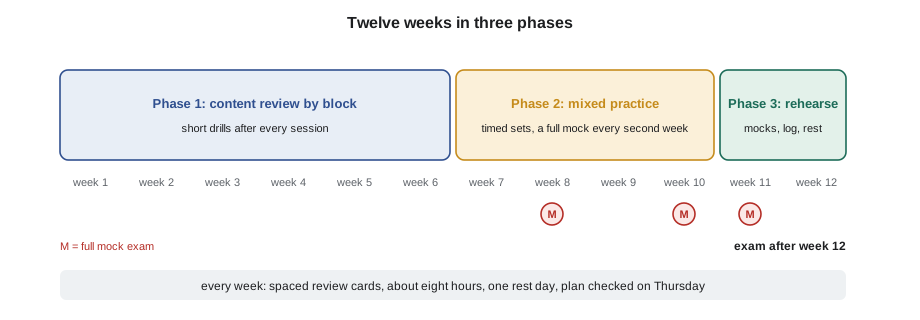
Three phases
The calendar had three phases. In weeks 1 to 6, Theo worked through the content block by block, weakest first within each week, using his notes from the earlier courses, the code books and the occupational standard. Each session ended with ten or fifteen practice questions on that block, scored and logged. In weeks 7 to 10, the practice became mixed: sets of 30 to 50 questions from all blocks, timed, with a full-length mock exam every second week. The purpose of mixing is to practice switching between topics, as the real exam does, and to keep earlier blocks from fading. In weeks 11 and 12, the work was rehearsal: full mocks under exam conditions, review of the error log and rest.
Dana insisted on spacing. A topic studied once for four hours is mostly forgotten in a month; the same topic studied for one hour in four sessions spread over three weeks is mostly remembered. Each block appeared at least twice in the first six weeks and was revisited through mixed practice afterwards. Lesson 10 adds a schedule for reviewing missed questions at increasing intervals, which is one of the most effective study methods known.
Making the hours real
A plan on a calendar is worthless if the hours do not happen. Theo was working full time, with an on-call week every month, a partner and a young dog. Dana asked him to look at his actual week and find the hours before agreeing to the plan, not after. They settled on two evening sessions of 90 minutes, Thursday afternoons with Dana, and a three-hour block on Saturday mornings, about eight hours a week, with the on-call weeks lighter and the following weeks heavier to catch up. Theo kept a log of the hours he actually studied, block by block, and compared it with the plan every Thursday.
Short, regular sessions beat long, rare ones. A 90-minute session with a clear target, such as ten electrical calculation problems and a review of the ones missed, gets more done than a whole Sunday with a textbook and no target. Dana's rule for every session was: know what you are going to do before you sit down, do it, write down what you got wrong.
Some study is better done at work. Theo kept a short list of topics in his van: the questions from the week's practice sets that he had got wrong, written on cards. On a call, he would look for the thing on the card, a defrost termination setting, a nameplate rating, a code label, and connect the exam question to real equipment. Dana found that the cards learned on the job were the ones that stuck.
When the plan has to change
Plans change. In week 4, a heat wave filled every on-call shift and Theo lost a week. Dana did not stretch the plan; she cut it. The lowest-priority review hours moved into later weeks, and the mixed practice started on time. In week 8, Theo's mock exam showed his planning installation score had risen to 72 % but his commissioning score had fallen. They moved two hours from planning to commissioning for the next two weeks. The plan was a tool, adjusted every Thursday against the evidence, not a promise made in week 1.
Study materials and where to find them
Dana's list of study materials was short and deliberate. NATE's knowledge area outlines for the core and the heat pump service specialty came first, because they describe what those exams cover. Next came the Kentucky code books, the International Residential Code and the National Fuel Gas Code in the editions the department lists, which were both study material and the books Theo would use in the exam room. Then came the EPA Section 608 study guide Theo had used in his first year, for review. Last came Northfield's practice bank. Theo's notes from four years of courses, including this program, filled the gaps.
She was firm about what not to use. Websites and videos that claim to show the real exam questions are unreliable, often wrong and, where they reproduce real questions, a breach of the exam rules that can cost a candidate the result. Long textbooks read from cover to cover waste hours on material that carries few marks. And study groups that become social evenings are pleasant but rarely raise scores, although a study partner who quizzes you and is quizzed in turn can be valuable. Theo found one: a second-year apprentice preparing for a different exam, who met him for an hour on Sunday afternoons to swap question cards.
Planning around the person
A study plan has to fit a person's life as well as the exam. Theo's partner worked shifts, his on-call week came every fourth week, and he coached a youth hockey team on Wednesday evenings. The plan protected those commitments rather than pretending they did not exist; a plan that requires a candidate to give up everything for twelve weeks usually collapses in the fourth. Dana also asked Theo to choose a reward for the end of each phase, something small and certain, because twelve weeks is long enough for motivation to fade, and a visible marker of progress helps.
Two more things went into the plan. One was a single rest day each week with no study at all, which Dana insisted on after watching earlier apprentices burn out. The other was a short written statement, pinned above Theo's desk at home, of why he was doing it: the certificate, the pay step it brought, and the chance to teach the next apprentice. When the plan felt like a chore, that statement did more than any schedule.
Tracking the plan
Theo tracked the plan on a single sheet: one row per week, one column per block, with planned and actual hours side by side and his practice score for that block at the end of the week. A glance at the sheet each Thursday showed three things at once: whether the hours were happening, whether they were going to the right blocks and whether the scores were moving. When the actual hours for a block fell behind the plan for two weeks running, that block went to the top of the next week's sessions. The sheet took five minutes a week to keep and saved far more than that in arguments with himself about what to study next.
Common mistakes
MistakeSpending study time evenly across all topics.
InsteadWeight time by the blueprint and by your own need.
MistakeRating yourself by how familiar a topic sounds.
InsteadRate by whether you could answer a question on it without help today.
MistakeSkipping small blocks such as safety and documents.
InsteadSmall blocks are often the cheapest marks on the exam.
MistakeStudying each topic once in a long session.
InsteadSpread topics over several shorter sessions and revisit them.
MistakeKeeping a plan unchanged when the evidence changes.
InsteadReview the plan weekly against practice scores and actual hours.
Summary and key terms
- An exam blueprint sets how many questions each part of the trade gets.
- Without one official table, a study blueprint built from the published outlines still guides the hours.
- Honest self-ratings by task show where the gaps are.
- Hours in proportion to weight times need put time where the marks are.
- Three phases: content review, mixed practice with mocks, rehearsal and rest.
- Spaced, regular sessions with a target beat long, rare ones; the plan is adjusted weekly.
- Blueprint
- A table showing how an exam's questions are divided among parts of the work.
- Knowledge area
- One of the divisions of an exam's content outline, such as those NATE publishes.
- Self-rating
- A candidate's honest estimate of current ability on a task, used to direct study time.
- Spaced practice
- Studying a topic in several sessions spread over time rather than all at once.
- Mixed practice
- Practice sets that combine topics, as the real exam does.
Practice problems
Work each problem on paper first, then reveal the answer to check.
An area weighted 10 % on a 60-question exam is how many questions?
Show answer
Six.
Two areas: one weighted 20 % rated 4, one weighted 10 % rated 1. Which gets more hours under weight × (6 − rating)?
Show answer
20 × 2 = 40 against 10 × 5 = 50: the second.
Why should Dana's blueprint be described as a planning tool?
Show answer
It was built from published outlines, not issued by the exam owners.
What should happen when a week of study is lost?
Show answer
Cut the lowest-priority review rather than delaying mixed practice.
Lesson quiz · 5 questions
Score 60% or more to complete this lesson.
Create a free account to save your progress, take quizzes and earn a certificate.