
RAC-430 · Lesson 3 of 12 · 18 min
A systematic diagnostic method for every system
The first content block Theo studied was the one that tied the whole program together: troubleshooting. He had diagnosed hundreds of faults by now, from the Haddads' ductless unit in his first year to Grand Valley's ammonia receiver in his fourth. What he had never done was write down the method he used. Dana asked him to, and then took it apart. "Half of this is good habits and half is luck," she said. "On the exam there's no luck. You get a paragraph of readings and four answers. You need a method that works on paper as well as on a roof."
This lesson sets out a diagnostic method that works on any refrigeration or air conditioning system, small or large, and shows how the same method answers exam questions. The next four lessons apply it to refrigeration circuit faults, electrical and control faults, air-side and heat pump faults and commercial and industrial systems.
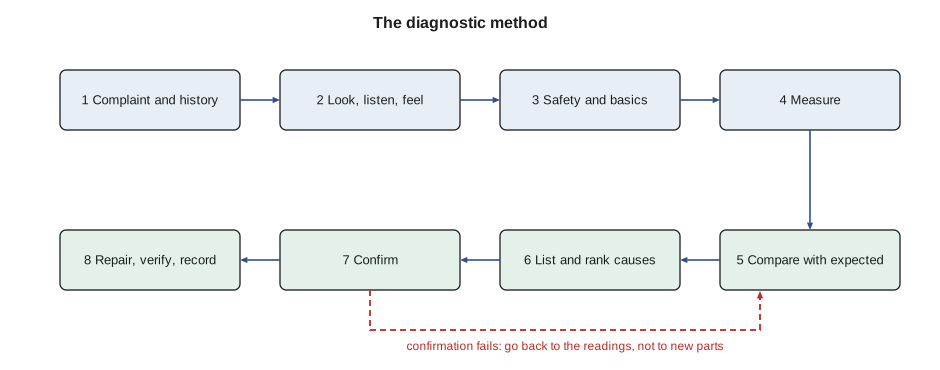
The method in eight steps
Every good troubleshooter follows some version of the same sequence, whether they think of it that way or not. Writing it down makes it reliable, teachable and fast.
Step 1: get the complaint and the history. What exactly is wrong, according to the person who called? When did it start? Has anything changed: a power outage, a recent repair, new equipment nearby, a change in the weather, a new tenant? Has it happened before? The complaint is not a diagnosis. "It's not cooling" can mean a dead compressor, a dirty filter, a setpoint someone changed or a space whose load has doubled. The history often points straight at the cause: a unit that stopped working after the utility worked on the street, as the clinic's rooftop unit did in RAC-210, should make anyone think about phase rotation before anything else.
Step 2: look, listen and feel before connecting anything. Is the unit running? What does it sound like? Is the coil frosted, wet or dry? Are fans turning? Is anything burnt, oily, loose or wet? Oil stains point to leaks, a burnt smell to electrical faults, a frosted suction line to low airflow or overfeeding. Many faults are found in this step, and on the exam many questions describe what the technician sees and hears, not just what the gauges say.
Step 3: check safety and the basics. Is the equipment safe to work on? Is the power correct at the unit: voltage, phases, disconnect, fuses? Is the control calling? Is the thermostat set correctly? Are filters, coils and drains clean? A large share of service calls end here, and checking the basics first is cheap.
Step 4: measure the operating condition. With the system running and stable, take the readings that describe it: suction and discharge or liquid pressures with their saturation temperatures, suction line and liquid line temperatures for superheat and subcooling, air or water temperatures in and out of both heat exchangers, amps and volts at the compressor and fans. A reading means little on its own. Write down the set.
Step 5: compare with what is expected. Every reading has an expected value for the conditions: the manufacturer's charging chart or performance data, the design superheat, a normal condenser split, rated amps for the voltage. The comparison is what makes a reading useful. A suction pressure is neither high nor low until you know what the evaporator should be doing with that load and that airflow.
Step 6: list possible causes and rank them. From the pattern of readings, list every cause that fits, then rank them by how likely each is and how quick it is to check. Test the likely and quick ones first.
Step 7: confirm before repairing. A hypothesis is not a diagnosis until a test confirms it. Low suction and high superheat fit an undercharge, but they also fit a restricted drier; a temperature drop across the drier, or a leak found with a detector, confirms which. Replacing parts to see whether the fault goes away is expensive guessing.
Step 8: repair, verify and record. After the repair, run the system and take the same readings again. They should now match what is expected. Then write down what was found, what was done and the final readings. The record is what lets the next technician, or you in six months, see the trend.
Ranking causes: likely and quick first
Step 6 is where experienced technicians save the most time, and it can be made explicit. For each possible cause, estimate two things: how likely it is, given the readings and the history, and how many minutes it takes to check. Then check them in order of likelihood divided by time. A cause that is fairly likely and takes two minutes to check goes before one that is slightly more likely but takes twenty. The script applies that rule to a walk-in cooler call: the box is warm and the compressor is running.
# Ranking possible causes: probability of the cause divided by the minutes needed to check it
calls = {
    "walk-in cooler warm, compressor running": [
        # cause, estimated probability from the readings and history, minutes to check
        ("dirty or iced evaporator coil", 0.30, 5),
        ("evaporator fan motor failed", 0.20, 4),
        ("low charge from a leak", 0.25, 20),
        ("TXV bulb loose or lost charge", 0.10, 15),
        ("compressor valves worn", 0.10, 25),
        ("controller setpoint changed", 0.05, 2)]}
for call, causes in calls.items():
    print(call)
    ranked = sorted(causes, key=lambda c: c[1] / c[2], reverse=True)
    for i, (cause, p, minutes) in enumerate(ranked, 1):
        print(f"  {i}. {cause:32s} p = {p:.2f}  check {minutes:2d} min  score {p / minutes:.3f}")
print(f" total probability listed: {sum(c[1] for c in causes):.2f}")walk-in cooler warm, compressor running 1. dirty or iced evaporator coil p = 0.30 check 5 min score 0.060 2. evaporator fan motor failed p = 0.20 check 4 min score 0.050 3. controller setpoint changed p = 0.05 check 2 min score 0.025 4. low charge from a leak p = 0.25 check 20 min score 0.013 5. TXV bulb loose or lost charge p = 0.10 check 15 min score 0.007 6. compressor valves worn p = 0.10 check 25 min score 0.004 total probability listed: 1.00
A dirty or iced coil and a failed evaporator fan come first: both are quite likely and both can be checked by opening the door and looking. A changed setpoint is unlikely, but checking it takes two minutes, so it comes before the leak search, which takes twenty. Worn compressor valves, the least likely and slowest to prove, come last. The estimates are judgments, and they change with the history: at a restaurant where staff had changed the controller's setpoint before, Theo would put that first.
The same ranking works on paper. An exam question that asks for the first thing to check is usually asking for the cause that is both plausible and quick to verify, or the step that makes the situation safe, not the most complicated possibility. Questions that ask for the most likely cause are asking for the best fit to the readings given.
Common traps
Dana listed the habits that lead technicians astray, all of which she had seen and some of which she had committed herself.
Fixing the symptom instead of the cause. A compressor that tripped on its overload can be reset, and it will run until it trips again. Why did it trip? A walk-in that iced up can be defrosted by hand, but why did it ice? The defrost termination thermostat at the restaurant in RAC-210 had worked loose; manual defrosts would never have found that.
Adding refrigerant without knowing why it is low. Low charge means a leak. Topping up without finding the leak breaks the refrigerant rules in both countries for most systems and guarantees another call. The seniors' residence chiller in RAC-120 lost refrigerant through a transducer flare and a weeping relief valve; each top-up only hid the problem until someone did the leak rate.
Trusting one reading. A single pressure, a single amp reading or one thermometer can mislead. Gauges drift, temperature clamps slip off pipes, and a reading taken before a system has settled means nothing. At the residence's make-up air unit in RAC-230, a corroded splice made a sensor read three degrees low; only a second, independent thermometer showed it.
Stopping at the first fault found. Systems often have more than one problem. A dirty condenser and an overcharge produce high head pressure together, and fixing one leaves the other. After a repair, the readings should match the expected values completely; if they do not, there is something else.
Skipping the record. Without readings written down, there is no trend, and slow faults, such as a condenser approach rising week by week, are invisible.
| Step | On a service call | On an exam question |
|---|---|---|
| Complaint and history | Ask the customer and read the service records | Read the whole stem; note what changed |
| Look, listen, feel | Frost, oil, noises, smells, fans | Note every described observation |
| Safety and basics | Power, controls, filters, coils | Prefer answers that make it safe or check basics first |
| Measure and compare | Readings against charts and design | Compare the given readings with normal values |
| List and rank | Likely and quick causes first | Eliminate options that do not fit every reading |
| Confirm | A test that proves the cause | Choose the answer that fits all the evidence |
| Repair, verify, record | Readings after the repair | A question may ask how to confirm a repair |
Safety is part of the method
Every step of the method has a safety side, and exam questions test it. Before measuring, confirm the equipment is safe: electrical hazards, pressure, rotating parts, refrigerant in a confined space, hot surfaces. Before opening a circuit, isolate and lock it out, and recover the refrigerant. Before entering a machinery room with a detector alarm, check readings from outside and follow the procedure, as RAC-420 described. When an exam question offers one answer that fixes the fault quickly and another that makes the situation safe first, the safe answer is almost always the key. A competent mechanic does not take shortcuts that put people at risk, and the exam is written by competent mechanics.
Communication is part of the method too. The customer needs to know what was found, what it costs, what the options are and what to watch for. The record goes to the service manager. Some findings, such as a refrigerant leak above a reporting threshold, a damaged gas appliance or an unsafe electrical condition, must be reported, and the procedures in RAC-120 and RAC-130 set out when.
Using the method on paper
Dana gave Theo a practice question to try the method on: "A walk-in cooler is at 48 °F instead of 36 °F. The compressor is running. Suction pressure is low, superheat is low, and the evaporator coil is covered in ice. What is the most likely cause?" The four options were low refrigerant charge, a failed evaporator fan motor, a dirty condenser and an overcharge. Theo went through the steps. The observation of ice and low superheat ruled out low charge, which gives high superheat. A dirty condenser raises head pressure and does not ice the evaporator. An overcharge gives high head pressure and high subcooling, and the stem said nothing about either. A failed evaporator fan stops air crossing the coil, so the refrigerant does not boil off fully, superheat falls, suction pressure falls and the coil ices. The method gave the answer in under a minute.
The point was not that Theo could not have guessed. It was that the method made every option either fit or fail against the readings, so the answer did not depend on a feeling. The next four lessons build the tables of patterns that make step 5 and step 6 fast.
Writing it down as you go
Dana's last point about the method was practical. On a busy day, steps 4, 5 and 8 are the ones that get skipped, because measuring, comparing and recording all take time. The cure is a reading sheet: a printed card or phone form with spaces for the standard set of readings and their expected values side by side. Filling in the expected value next to each reading forces the comparison, and the finished sheet is the record. Theo had used one since RAC-110; for the exam, he practiced filling one in from each question's stem before looking at the options.
Common mistakes
MistakeStarting with the gauges before looking at the unit.
InsteadLook, listen and feel first; many faults are visible.
MistakeDiagnosing from one reading.
InsteadTake a full set of readings at stable operation and compare each with its expected value.
MistakeReplacing parts to see if the fault goes away.
InsteadConfirm the cause with a test before repairing.
MistakeTopping up refrigerant without finding the leak.
InsteadLow charge means a leak; find and repair it, and follow the refrigerant rules.
MistakeChoosing the fastest fix when a question offers a safe first step.
InsteadMake it safe first; the safe answer is usually the key.
Summary and key terms
- The eight steps: complaint and history; look, listen, feel; safety and basics; measure; compare; list and rank; confirm; repair, verify and record.
- Readings only mean something when compared with expected values for the conditions.
- Rank possible causes by likelihood divided by time to check.
- Confirm before repairing, and look for a second fault after the first is fixed.
- Safety and communication are steps in the method, not extras.
- On exam questions, eliminate every option that does not fit all the evidence in the stem.
- Complaint
- What the customer reports, which is not yet a diagnosis.
- Baseline readings
- A full set of measurements at stable operation, compared with expected values.
- Hypothesis
- A possible cause that fits the readings, not yet confirmed.
- Confirmation test
- A measurement or check that proves or rules out a hypothesis.
- Verification
- Readings after a repair showing the system now operates as expected.
Practice problems
Work each problem on paper first, then reveal the answer to check.
A cause has probability 0.4 and takes 20 minutes to check; another has 0.2 and takes 4 minutes. Which first?
Show answer
The second: 0.2 ÷ 4 = 0.05 against 0.4 ÷ 20 = 0.02.
Why is "it's not cooling" not a diagnosis?
Show answer
It describes the symptom; many different causes produce it.
What should a technician do after a repair?
Show answer
Run the system, take the same readings, compare with expected values and record them.
An exam option fixes a fault fast but leaves a hazard; another makes it safe first. Which is usually the key?
Show answer
The one that makes the situation safe first.
Lesson quiz · 5 questions
Score 60% or more to complete this lesson.
Create a free account to save your progress, take quizzes and earn a certificate.