
RAC-430 · Lesson 12 of 12 · 18 min
The final weeks and certification
With ten days left, Theo's third mock was marked, his readiness rule was met and Dana changed the tone of the Thursday sessions. "The learning's mostly done," she said. "What's left is keeping it, sleeping, and turning up on the day calm. And one more thing: a day on the road with me, to put it all together." This lesson covers the last two weeks before the exam, the day itself, the capstone service day that closed the program and what comes after certification.
Projecting the score
On the first evening of the last ten days, Dana and Theo looked at the mock results one more time, weighted by the blueprint, to see where the last marks were.
# Readiness: weight the latest mock scores by the exam blueprint to project a score
blocks = {  # block: (exam weight %, score on mock 1, score on mock 2) as fractions
    "Safety, codes and refrigerant rules": (15, 0.77, 0.83),
    "Refrigeration circuit and charging": (20, 0.88, 0.88),
    "Electrical and controls": (20, 0.76, 0.80),
    "Heat pumps and air side": (20, 0.87, 0.88),
    "Installation and start-up": (15, 0.79, 0.80),
    "Gas heat and hydronics": (10, 0.65, 0.72),}
for k in (1, 2):
    proj = sum(w * s[k - 1] for w, *s in blocks.values()) / 100
    print(f"mock {k}: projected score {proj:.1%}")
weak = [b for b, (w, s1, s2) in blocks.items() if s2 < 0.70]
print("blocks still under 70 % on mock 2:", ", ".join(weak) if weak else "none")
gain = max(blocks, key=lambda b: blocks[b][0] * (1 - blocks[b][2]))
print(f"most points still available in: {gain}")mock 1: projected score 80.1% mock 2: projected score 82.8% blocks still under 70 % on mock 2: none most points still available in: Electrical and controls
Both of the last two mock sets projected above 80 %. Only gas heat and hydronics had been under 70 % on the second, and nothing was under 70 % on the third. The area with the most points still available was electrical and controls: still the place where a fifth of the weight met a score that had only just reached 80 %. Dana's advice for the last ten days was to keep reviewing the error log across all areas, with extra short sets on electrical and controls and a last pass through the National Fuel Gas Code tabs for the open-book exam.
The last two weeks
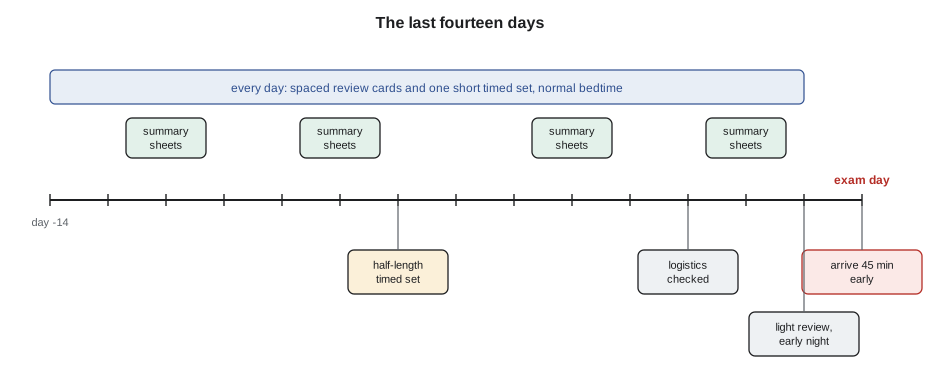
The last two weeks are for consolidation, not new learning. A candidate who discovers a new topic ten days out should study its basics, because every mark counts, but should not let it crowd out the review of everything already learned. Dana's plan for those days had four parts. Each evening, the spaced review cards due that day, then one short mixed set of 20 to 30 questions, timed, logged as usual. Twice in the week, a review of the summary sheets Theo had made for each block: one page per block, in his own words, with the formulas and rules he kept missing. On the weekend, a half-length timed set to keep the pace fresh, but not a full mock, which in the last week tires more than it teaches. And every day, enough sleep.
Sleep is not a soft extra. Memory is consolidated during sleep, and a tired candidate reads stems less carefully, makes more calculation slips and runs out of concentration earlier, exactly the errors Theo's Pareto table had shown. Staying up late the night before an exam to cram is one of the surest ways to lose marks. Dana's rule was a normal bedtime all week and no studying after dinner on the last evening.
Logistics and the day itself
Three days before each exam, Theo checked the logistics: the booking confirmation, the time and address of the testing center, the identification required, the list of permitted items and the calculator he would use, which had to be one the rules allowed, and for the Kentucky exam, the code books with only the permanent tabs the rules allowed. He drove the route at the same time of day to see the traffic. He laid out what he would bring the night before.
On the day, he ate a normal breakfast, arrived about 45 minutes early and spent the waiting time not studying but walking around the block. In the room, he wrote his checkpoint times on the scratch paper provided before starting, then followed the habits he had practiced: read the whole stem, circle the key words, answer or flag, keep to the checkpoints, use the reserve for flagged questions and never leave a blank. At the 50 and 100 question marks he took the two-minute stretch he had rehearsed.
Nerves are normal. A pounding heart and dry mouth at the start of an exam are the body's response to something that matters, and they fade within minutes once work starts. Two habits help. Starting with a slow, careful read of the first few questions settles the mind better than racing. And when a hard question triggers panic, flagging it and moving to the next, which is usually easier, breaks the spiral. Theo had practiced both in his mocks.
The result
Theo passed all three. The NATE core and air-to-air heat pump service specialty results came at the testing center, and he was certified in the specialty for two years. The Kentucky journeyman exam result came from the department a few weeks later, and with his verified experience his journeyman HVAC mechanic license followed. Dana framed a copy of the license for the shop wall, next to her own.
Not every candidate passes the first time, and nobody should treat a failed attempt as a verdict. The score report by block shows where the marks fell short, the error log shows why, and the method in this course applies just as well to a second attempt as a first. Most people who fail and then follow a plan built on their score report pass the next time.
The capstone: one day, four calls
The week before the exam, Dana took Theo out for a full day of service calls, with one rule: he would lead every call, from the first question to the record, and she would only watch. It was the last practical test of the program, and each call used several lessons of this course.
The first call was Harvest Lane, where the ice cream island had warmed overnight. Theo got the history first: the island had been fine until the defrost at two in the morning. He looked before measuring: ice in the drain pan and the drain line frozen solid. The drain line heater's circuit read open. The defrost water had refrozen in the drain, backed up into the pan and iced the coil. He confirmed the heater had failed, replaced it, cleared the drain and the ice with a manual defrost, verified the next defrost cleared normally and recorded it. Lesson 7's walk-in and case faults, lesson 3's method.
The second call was the Bauer house, where the communicating thermostat showed a communication fault and the system had stopped. The outdoor unit was powered and its board showed a fault light. Theo checked the bus wiring at both ends: a landscaper's spade had nicked the cable where it ran along the foundation, and one conductor was open. He repaired the cable in a proper enclosure, checked polarity and termination, cleared the faults and verified operation through the thermostat's diagnostic screen. Lesson 5's communicating systems.
The third call was Riverbend, where Grace Adeyemi wanted a second opinion on a condenser approach that had risen steadily for six weeks on the screw chiller. Theo read the logs, as lesson 7's script had, saw the steady rise with a steady evaporator approach and recommended tube cleaning at the next shutdown and a check of the water treatment program, which turned up a chemical feed pump that had lost prime a month and a half before.
The fourth call was the brewery's walk-in cooler, warm and with a hissing at the condensing unit. Theo's readings gave low suction, high superheat and low subcooling: an undercharge, lesson 4's first pattern. An electronic detector and bubbles found a cracked flare at the liquid line solenoid. He recovered the remaining charge, replaced the flare with a brazed fitting under nitrogen, pressure tested with nitrogen, evacuated to the micron level the procedure required and held a decay test, weighed in the charge, verified superheat and subcooling, leak tested the repair, recorded the refrigerant recovered and added as Northfield's Section 608 procedures required, and explained the repair and its cost to the head brewer. Every layer of lesson 8 in one call.
At the end of the day, Dana gave her verdict in one sentence. "You didn't guess once." It was the highest praise she gave.
After certification
Certification is a beginning. Theo's journeyman license must be renewed each year with the continuing education Kentucky requires, and after the required years as a journeyman he can sit the master exam and qualify to run a business. His NATE certification lasts two years and is renewed with continuing education hours or a retest. His EPA certification does not expire, but the rules under it keep changing, as the AIM Act rules showed. New refrigerants, new codes and new equipment arrive every year, and the earlier courses in this program will date; manufacturers' training, industry associations and code update courses keep a mechanic current. Some mechanics go on to supervise, estimate, teach, inspect or start businesses, and a few go on to engineering.
Theo's next step was already decided. Ingrid had asked him to join the industrial group full time, and he had said yes, on one condition: that he could keep the Thursday afternoons for Northfield's new first-year apprentice, who started the week after his result arrived. On the apprentice's first morning, Theo gave her a notebook and told her what Dana had told him four years earlier: write down what you see, what you measure and what you got wrong. The method in this course started there.
What a mechanic owes the trade
Dana ended her last Thursday session with a short talk that had nothing to do with the exam. The certificate, she said, is a promise to customers and to the public that the person holding it can be trusted with equipment that can injure, poison or burn. Keeping that promise means following the rules when no one is watching: recovering refrigerant on the small job at the end of a long day, locking out the disconnect when it would be quicker not to, reporting the cracked heat exchanger even when the customer does not want to hear it, and refusing work that is beyond one's training. It also means passing on what one knows, as she had to Theo and as he would to the next apprentice.
She also reminded him that the trade is changing quickly. In the four years of Theo's apprenticeship, A2L refrigerants arrived in residential equipment, low-GWP limits reached chillers and commercial systems, heat pumps took over much of the heating market, and carbon dioxide spread from supermarkets into rinks and warehouses. The next ten years will bring as much change again. A mechanic who keeps learning will find more work and better work; one who stops will find the work drifting away.
Using this course after the exam
The method in this course does not stop being useful after the exam. The diagnostic steps, the pattern tables, the error log and the spaced review cards are all tools a working mechanic can keep using: the method on every call, the pattern tables as a check when a fault is puzzling, and the error log as a record of the calls that went wrong and why. Theo kept his index card box. A year later, it held cards from real calls rather than practice questions, reviewed on the same schedule, and his callbacks were the lowest in the shop.
Dana's last piece of advice was about the morning after the result. Whatever it says, she told Theo, go to work the next day and do one job properly from start to finish. A certificate changes what a mechanic is allowed to do. It does not change how a mechanic does it. That is up to the person every day.
Common mistakes
MistakeLearning new topics at length in the last week.
InsteadCover new basics briefly; spend the time on review of what is already learned.
MistakeSitting a full mock in the last few days.
InsteadUse short and half-length sets; a full mock that late tires more than it teaches.
MistakeCramming late the night before.
InsteadNormal bedtime all week; no study on the last evening.
MistakeDiscovering the identification or calculator rules on the day.
InsteadCheck logistics three days out and lay everything out the night before.
MistakeTreating certification as the end of learning.
InsteadKeep current with renewals, continuing education and new codes and refrigerants.
Summary and key terms
- Weight the last mock scores by the blueprint to see where the last marks are.
- The last two weeks are for spaced review, short timed sets, summary sheets and sleep.
- Check logistics early; on the day, follow the habits practiced in the mocks.
- Nerves fade once work starts; a slow start and flagging hard questions help.
- A failed attempt is information for a better plan, not a verdict.
- A journeyman license, NATE and EPA certification open the work; renewals and continuing education keep a mechanic current.
- Consolidation
- Review that strengthens what has been learned rather than adding new material.
- Summary sheet
- A one-page review of an area in the candidate's own words.
- Score report
- The result of an exam, usually with a breakdown by area.
- Master license
- The Kentucky license that allows a person to run an HVAC contracting business, after years as a journeyman and a further exam.
- Continuing education
- Training after certification to keep knowledge current.
Practice problems
Work each problem on paper first, then reveal the answer to check.
What should a candidate do with a new topic discovered ten days before the exam?
Show answer
Learn its basics briefly without crowding out review.
Why is a full mock avoided in the last few days?
Show answer
It tires more than it teaches; short sets keep the pace fresh.
What should be written on the scratch paper at the start?
Show answer
The checkpoint times.
A walk-in has low suction, high superheat and low subcooling, and a hiss. What is the sequence after finding the leak?
Show answer
Recover, repair, pressure test with nitrogen, evacuate and decay test, weigh in the charge, verify, leak test and record as the rules require.
Lesson quiz · 5 questions
Score 60% or more to complete this lesson.
Create a free account to save your progress, take quizzes and earn a certificate.