
RAC-430 · Lesson 1 of 12 · 18 min
Certification exams today and how they are built
Theo Martel came back from his six months in Ingrid Sorensen's industrial group in late October with a full logbook and one thing left to finish: the exams that would turn four years of work into a journeyman license and a set of certifications. Dana Okafor, who had trained him since his first week, booked a meeting room at Northfield for every Thursday afternoon until the exam and wrote one sentence on the whiteboard: "Know the exam before you study for it."
This course is the last one in the program. It does two jobs. First, it pulls together the troubleshooting that the earlier courses taught system by system, residential to industrial, into one method Theo can use on any call and on any exam question. Second, it treats the exam itself as a job to plan: what it covers, how it is scored, how to study for it in the time available, how to practice, and how to walk in on the day ready. This first lesson describes the exams Theo faces and how they are built, because everything else in the course depends on that.
Dana's view was blunt. "Most people who fail aren't short of knowledge. They're short of a plan. They study what they like, skip what they don't, never sit a full-length practice exam and then run out of time on the day. We are not going to do any of that."
Credentials in the United States
The United States has no single national license for HVAC-R mechanics. What a technician needs depends on the state and sometimes the city, and most technicians collect several credentials over a career. Theo needed three things. The first was federal: EPA Section 608 certification, which anyone who opens refrigerant circuits must hold. He had earned universal certification in his first year, as RAC-120 described, and it does not expire. The second was state: in Kentucky, HVAC work is licensed by the Department of Housing, Buildings and Construction, and a journeyman HVAC mechanic license is required to do the work under a master contractor. The third was voluntary but valued by employers and customers: NATE certification, which tests both general knowledge and a chosen specialty. Other voluntary programs exist, such as the certifications offered by HVAC Excellence and by ESCO Group, and some employers and schools prefer them; Northfield's customers asked about NATE most often, so Dana chose it.
Kentucky's department sets the experience required for each license level. Recent summaries describe the journeyman requirement as two years and about 3,000 hours of work under a licensed master contractor, or other approved combinations of school and experience; the department's current rule is what counts. The journeyman exam is open book, using the code books the department lists, and a master license requires further years as a journeyman and a separate exam that includes business and law. Many other states work in a similar way, and some cities license HVAC work separately, so a technician who moves must start by asking who licenses the work there.
How the exam is built
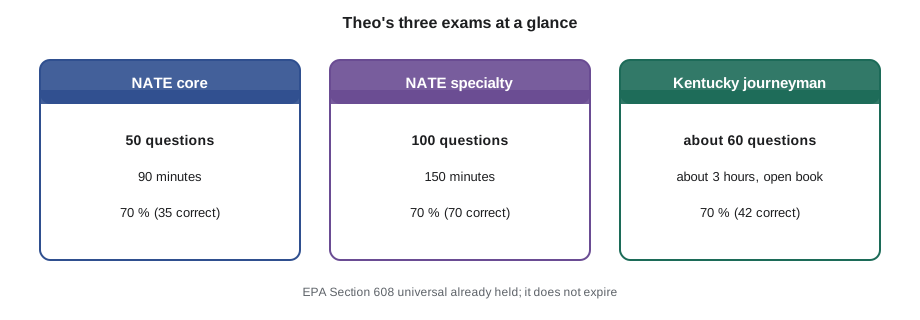
Theo's three exams were built differently. The NATE core exam, as NATE and prep providers describe it, has 50 multiple-choice questions in 90 minutes, and a specialty exam has 100 questions in 150 minutes; each needs 70 % to pass, and both must be passed for certification in a specialty. Theo chose the air-to-air heat pump service specialty, which matched most of his work. NATE certification lasts two years and is renewed with continuing education hours or by retaking the specialty exam. Kentucky's journeyman exam, as recent summaries describe it, has about 60 questions in about three hours, open book, with a 70 % pass mark. The department's own exam information lists the code books allowed, which for the journeyman exam include the International Residential Code and the National Fuel Gas Code in the editions the department names.
Across all three exams, the questions come in three broad types. Knowledge questions test whether a candidate knows a fact, a term or a rule. Application questions give a situation and ask what to do or what the result will be: a set of readings and the likely fault, a load and the required capacity, a code requirement for a given installation. Critical thinking questions combine several pieces of information and ask for a judgment: the first thing to check, the most likely cause, the safest order of steps. The NATE specialty exams lean heavily toward application, and the open-book Kentucky exam tests whether a candidate can find and apply the right section of a code book quickly.
Pacing: the arithmetic of time
Dana's first exercise was arithmetic. Knowing how long an exam lasts is not enough; a candidate needs checkpoints, so that by a given minute a given number of questions should be answered. Without checkpoints, people spend twenty minutes on three hard questions early on and finish the exam in a rush, making mistakes on easy questions they knew. The script works out a pace that keeps some time in reserve for flagged questions and a final review, then lists the checkpoints.
# Pacing checkpoints for Theo's three US exams
exams = {  # name: (questions, minutes); Kentucky figures as published in recent summaries
    "NATE core": (50, 90),
    "NATE heat pump service specialty": (100, 150),
    "Kentucky HVAC journeyman (open book)": (60, 180)}
for name, (q, m) in exams.items():
    reserve = round(m * 0.12)
    pace = (m - reserve) / q
    marks = [round(k * pace) for k in (q // 4, q // 2, 3 * q // 4, q)]
    need = int(-(-q * 0.70 // 1))
    print(f"{name}: {q} questions in {m} min, {pace:.2f} min each, reserve {reserve} min")
    print(f"   checkpoints at quarter, half, three quarters, end: minutes {marks}")
print(f" 70 % means at least {need} of {q} correct")NATE core: 50 questions in 90 min, 1.58 min each, reserve 11 min checkpoints at quarter, half, three quarters, end: minutes [19, 40, 58, 79] 70 % means at least 35 of 50 correct NATE heat pump service specialty: 100 questions in 150 min, 1.32 min each, reserve 18 min checkpoints at quarter, half, three quarters, end: minutes [33, 66, 99, 132] 70 % means at least 70 of 100 correct Kentucky HVAC journeyman (open book): 60 questions in 180 min, 2.63 min each, reserve 22 min checkpoints at quarter, half, three quarters, end: minutes [40, 79, 118, 158] 70 % means at least 42 of 60 correct
The three exams have very different paces. The NATE core allows about 1.6 minutes a question and the specialty about 1.3, so they reward quick recognition. The open-book Kentucky exam allows more than 2.5 minutes a question, because many answers must be found in a code book, and the risk there is slow searching rather than slow reading. Theo wrote each set of checkpoints on an index card and would practice against them until they felt automatic.
What a well-written question looks like
Dana spent the rest of the first afternoon showing Theo how exam questions are put together, because a candidate who understands the construction reads them better. Each question has a stem, which sets out the situation and asks the question, and four options: one correct answer, called the key, and three distractors. Good distractors are not silly. They are the answers that people with a common misunderstanding, a missing step or a careless reading would choose. A distractor in a superheat question might be the answer you get by subtracting the wrong temperatures. A distractor in a code question might be a rule that applies to a different occupancy or refrigerant.
That has two consequences. First, an option that looks familiar is not necessarily right; it may have been written to look familiar. Second, the stem carries all the information needed, and nothing outside it: if the stem says the system has a TXV, the answer cannot depend on it having a piston. Questions are written to have one defensible answer from the information given, not to trick anyone, but they do test whether the candidate reads carefully. Words such as first, most likely, best, except and not change the question completely, and lesson 10 returns to them.
| Question type | What it asks | Example stem |
|---|---|---|
| Knowledge | A fact, term, symbol or rule | What is the function of a crankcase heater? |
| Application | What to do, or the result, in a given situation | A system has 4 F of superheat and 27 F of subcooling with high head pressure. What is the most likely cause? |
| Critical thinking | A judgment combining several facts | A compressor has tripped on its internal overload three times today. What should be checked first? |
Theo's starting point
Before planning, Dana wanted a baseline. On the second Thursday, Theo sat a 50-question diagnostic test drawn from Northfield's practice bank, under exam conditions, with no notes. He scored 64 %. The result was not a surprise and not a disaster: it was below the pass mark, as most first attempts are, and it showed where the work was. He did well on refrigeration circuit questions, which he had lived with for four years, and on the commercial refrigeration questions from his Harvest Lane work. He did badly on code questions, on electrical calculations he no longer did by hand, and on two topics he had barely touched: hydronic heating and some of the installation planning content, which in his work had always been done by someone else.
"That's normal," Dana said. "You know what you do every day. The exam covers the whole trade. Now we know what to fix." Lesson 2 turns that baseline into a study plan weighted by the exam's own blueprint, and lessons 3 to 9 work through the content. Lessons 10 to 12 cover exam technique, full mock exams and the final weeks.
There was one more thing Dana wanted Theo to understand on the first day. Certification is not the end of learning. A license and a certification tell employers you met a standard. They don't tell anyone you know every system you'll meet. The habits this course builds, a method for every problem and an honest record of what you got wrong, are the same habits that make a good mechanic for the next thirty years.
Booking the exam and the rules on the day
Each of Theo's exams had its own booking. NATE exams are sat at approved testing organizations or proctored online, and the candidate chooses the core and the specialty when registering. Kentucky's journeyman exam is booked through the department's process, which includes an application showing the experience required, the fee and a photograph, and the department's exam information lists the code books allowed in the room. In each case the candidate brings photo identification, phones and notes stay outside, and the proctor can end the exam for anyone who breaks the rules. Score reports usually show performance by area, which is useful for a rewrite. Each body sets its own waiting periods and fees for retakes, so it is worth reading the rules before the first attempt, not after.
Dana made Theo read the rules aloud. "Somebody every year turns up with the wrong ID, or with a calculator that isn't allowed, or thinking they can bring a cheat sheet. Don't let paperwork cost you a sitting." Theo put the booking confirmation, the list of permitted items and a printed map to the exam center in the front of his binder.
What the exam is not
It helps to be clear about what the exam does not test. It does not test speed with tools, the quality of a braze joint or the feel of a stiff valve, which the apprenticeship assessed on the job. It does not test any one manufacturer's equipment, so questions use generic descriptions and typical values. And it does not reward guessing what the writer meant. Every question is meant to have one answer that a competent mechanic would choose from the information given. When a question seems to have two right answers, the usual reason is a word in the stem that the candidate has skimmed past, such as first or most likely, and lesson 10 deals with that.
It also does not cover everything with equal weight. Some parts of the trade appear in many questions and some in only a few. Knowing which is which, and planning study time to match, is the subject of lesson 2.
Common mistakes
MistakeStarting to study without reading the exam's own description.
InsteadFind out the number of questions, time, pass mark and what the standard or outline covers before planning.
MistakeStudying only the topics you work with every day.
InsteadThe exam covers the whole trade; a baseline test shows the gaps.
MistakeTreating the pass mark as a target to scrape past.
InsteadAim well above it in practice; scores on the day vary.
MistakeGoing into the exam without time checkpoints.
InsteadWork out a pace with a reserve and practice against checkpoints.
MistakeChoosing the option that looks most familiar.
InsteadDistractors are written to look familiar; work from the stem.
Summary and key terms
- Theo needed EPA 608 (already held), a Kentucky journeyman license and NATE core plus a specialty, each exam needing 70 %.
- Questions test knowledge, application and critical thinking, with the balance leaning toward application.
- Each question has a stem, a key and three plausible distractors written around common mistakes.
- A pace with a reserve and written checkpoints prevents running out of time.
- A baseline test under exam conditions shows where to focus.
- Certification confirms a standard has been met; learning continues after it.
- Journeyman license
- A state license to perform HVAC work, usually under a master contractor; in Kentucky it is issued by the Department of Housing, Buildings and Construction.
- NATE
- North American Technician Excellence, a voluntary certification with a core exam and specialty exams.
- EPA Section 608
- Federal certification required to service refrigerant circuits; universal covers all equipment types.
- Stem
- The part of a multiple-choice question that sets out the situation and asks the question.
- Distractor
- An incorrect option written to attract candidates with a common misunderstanding.
- Key
- The correct option in a multiple-choice question.
Practice problems
Work each problem on paper first, then reveal the answer to check.
With a 12 % reserve, how many minutes per question does the NATE specialty exam allow?
Show answer
(150 − 18) ÷ 100 = 1.32 minutes.
How many correct answers does 70 % of 60 require?
Show answer
42.
Why does the open-book exam allow more time per question?
Show answer
Many answers must be found and applied from a code book.
Which of Theo's credentials does not expire?
Show answer
EPA Section 608 certification.
Lesson quiz · 5 questions
Score 60% or more to complete this lesson.
Create a free account to save your progress, take quizzes and earn a certificate.