
RAC-130 · Lesson 2 of 12 · 20 min
Electrical quantities, Ohm's law and power
The dental clinic's rooftop unit had electric heat strips for the first cold mornings of the season, and the office manager called because the clinic "felt cold even though the heat was running". Raj, Northfield's senior technician, took Theo along. At the unit Raj measured the voltage at the heater terminals, the current through each heater element and the resistance of one element with the power locked out. "Three numbers," he said, writing them on the work order. "Volts, amps and ohms. If you understand how they fit together, you can tell me whether these heaters are doing their job before we even look at the airflow."
This lesson builds that understanding. It introduces electric charge, voltage, current, resistance, power and energy, Ohm's law and the power formulas, and shows how technicians use them every day: to check heaters, to compare equipment ratings at different voltages, to estimate operating costs and to make sense of what a meter shows.
Charge, conductors and insulators
All matter is made of atoms, and atoms contain positively charged protons and negatively charged electrons. In metals such as copper and aluminum, some electrons are only loosely held and can drift from atom to atom. When a voltage is applied, these free electrons move through the metal, and that movement of charge is an electric current. Materials with many free electrons are conductors. Materials in which electrons are tightly held, such as rubber, PVC, glass, dry wood and the enamel on motor windings, are insulators.
No material is a perfect conductor or a perfect insulator. Copper wire has a small resistance that rises with length and falls with size. Insulation lets a tiny leakage current pass, and that leakage rises when insulation is wet, dirty, overheated or damaged by acid from a burnt-out compressor. Much of electrical troubleshooting comes down to finding a conductor that has become an insulator, such as a broken wire or burnt contact, or an insulator that has started to conduct, such as a winding shorted to the compressor shell.
Voltage, current and resistance
Voltage is the electrical pressure that pushes charge around a circuit. It is measured in volts, symbol V. A voltage always exists between two points: between the two legs of a 240-volt supply, between a hot leg and ground, or between the R and C terminals of a thermostat. A meter measures voltage by touching two points, and a reading of zero between two points means only that there is no pressure difference between them, not necessarily that neither is live.
Current is the rate at which charge flows, measured in amperes, or amps, symbol A. One ampere is a flow of one coulomb of charge per second, which is about six billion billion electrons each second. Current flows only in a complete loop, from the source, through the load and back to the source. A clamp meter measures current by sensing the magnetic field around one conductor.
Resistance is the opposition to current, measured in ohms, symbol Ω. Every load, such as a heater element, a motor winding or a contactor coil, has resistance or the related quantity impedance. Wires, contacts and connections should have almost none. Resistance is measured with an ohmmeter, which sends its own small current through the component, so resistance must always be measured with the power off and the component isolated.
A water analogy helps at first. Voltage is like water pressure, current is like the flow rate, and resistance is like the narrowness of the pipe. More pressure pushes more flow through the same pipe; a narrower pipe passes less flow at the same pressure. The analogy breaks down eventually, but it explains why a loose connection, which acts like a partly closed valve, starves a motor of voltage and heats up at the same time.
Ohm's law
In 1827 the German physicist Georg Ohm showed that for many conductors the current is proportional to the voltage. Ohm's law states the relationship:
where V is in volts, I in amperes and R in ohms. If two of the quantities are known, the third can be calculated. A heater element of 11.5 ohms connected to 240 volts draws 240 ÷ 11.5, or about 20.9 amperes. A contactor coil that draws 0.25 amperes from a 24-volt transformer has a resistance, or more strictly an impedance, of about 96 ohms. Ohm's law applies directly to resistive loads such as heaters and incandescent lamps. For motors, coils and transformers in AC circuits, the opposition to current includes reactance as well as resistance, which Lesson 4 explains, but the habit of thinking in volts, amps and ohms still applies.
Electric power
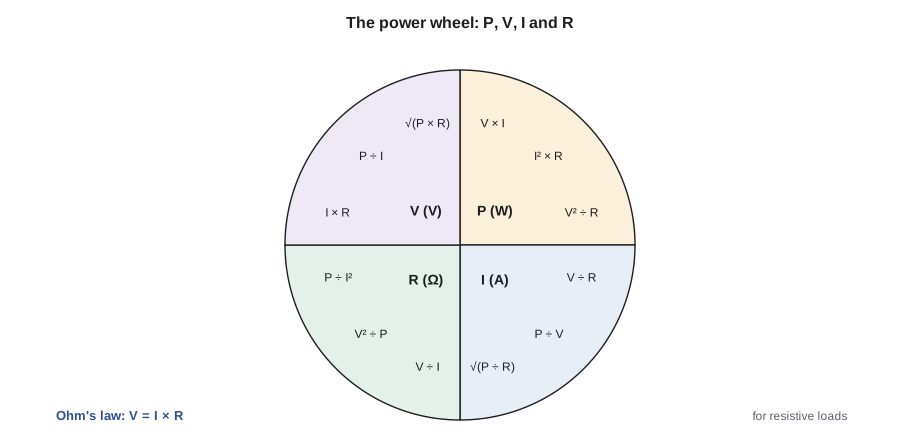
Power is the rate of doing work or converting energy, measured in watts, symbol W. A thousand watts is a kilowatt, kW. In a resistive circuit, power is the product of voltage and current:
The second and third forms come from combining the first with Ohm's law. Each is useful in a different situation. P = I²R explains why a poor connection carrying a large current overheats: a connection with a resistance of only 0.05 ohms carrying 30 amperes dissipates 30² × 0.05, or 45 watts, about the heat of a small soldering iron, concentrated in one terminal. P = V²/R explains why a heater rated for 240 volts produces much less heat when connected to 208 volts: power falls with the square of voltage.
Equipment nameplates give power in watts or kilowatts for heaters, and current in amperes for motors, along with the rated voltage. In air conditioning, cooling capacity is given in Btu per hour or tons, which is a rate of heat removal, not the electrical power drawn. The relationship between them, the efficiency, appears on the yellow energy label and in ratings such as the EER, SEER2 and COP covered in RAC-110 and later courses.
Energy and what it costs
Energy is power multiplied by time. The joule is the SI unit, but electrical energy is normally billed in kilowatt-hours, kWh: one kilowatt for one hour. A 5-kilowatt heat strip running for three hours uses 15 kWh. The customer's bill multiplies the energy by the price per kWh, plus delivery and other charges.
Technicians use energy estimates to explain options to customers: what it costs to run electric heat compared with a heat pump, how much a failed defrost board that leaves the heat strips on all day might add to a bill, or how much a dirty condenser coil increases the compressor's power draw.
Checking the clinic's heat strips
Back on the clinic roof, Raj's readings were 236 volts at the heater terminals, and 16.4 amperes, 16.5 amperes and 0 amperes through the three heater elements. With the power locked out, one element measured 14.4 ohms and the element with no current showed an open circuit, OL on the meter, meaning infinite resistance.
Worked problem
How much heat are the strips producing?
Each element is rated 4 kW at 240 V. Using Raj's readings, find the rated resistance of an element, the actual power of each working element, and the total heat compared with the 12 kW the clinic should get.
Show solution
- \[R_{\text{rated}} = \frac{V^2}{P} = \frac{240^2}{4000} = 14.4\ \Omega\]
- \[P_{1} = V \times I = 236 \times 16.4 \approx 3870\ \text{W}, \quad P_{2} = 236 \times 16.5 \approx 3890\ \text{W}\]
- \[P_{\text{total}} \approx 3870 + 3890 + 0 \approx 7.8\ \text{kW} \quad \text{vs.} \quad 12\ \text{kW rated}\]
Answer: The measured resistance matches the rated 14.4 ohms, so the two working elements are healthy and produce close to their rating at the slightly low voltage. The third element is open. The clinic is getting about two thirds of its electric heat, which matches the complaint. Raj replaced the open element and then checked why it had failed, because elements usually burn open from low airflow or a failed limit switch.
The example shows the logic of electrical checks. A reading means little alone; it means something when compared with what it should be. The nameplate gives the rated values; Ohm's law and the power formulas turn the readings into the same units so the comparison is possible.
Rated voltage and actual voltage
Much commercial equipment in North America is rated for 208 volts or 240 volts, or for both, written 208/230 V. A building fed from a 120/208-volt three-phase system supplies 208 volts between hot legs; a house fed at 120/240 volts supplies 240 volts. A heater rated at 240 volts and installed on 208 volts produces only (208/240)², or about 75 percent, of its rated heat. Motors are less simple, because they draw more current to keep up their power output when voltage is low, which raises their temperature. Lesson 4 explains the voltage ranges equipment is designed for.
# Heater strip check: Ohm's law and power at the actual voltage
rated_kw, rated_v = 4.0, 240.0
r = rated_v**2 / (rated_kw * 1000)          # ohms, from P = V^2 / R
print(f"rated resistance: {r:.1f} ohms, rated current: {rated_v / r:.1f} A")
for v in (240, 236, 230, 208):
    i = v / r
    p = v * i
print(f"at {v} V: {i:5.1f} A, {p / 1000:4.2f} kW ({p / (rated_kw * 1000):4.0%} of rating)")rated resistance: 14.4 ohms, rated current: 16.7 A at 240 V: 16.7 A, 4.00 kW (100% of rating) at 236 V: 16.4 A, 3.87 kW ( 97% of rating) at 230 V: 16.0 A, 3.67 kW ( 92% of rating) at 208 V: 14.4 A, 3.00 kW ( 75% of rating)
The code reproduces the hand calculation and shows the effect of voltage. At 208 volts the same element delivers only about 3 kW. A technician replacing a heater kit should match it to the building's actual supply voltage, not just to the unit's model number.
# What an open heater element costs, and what heat strips cost to run
price = 0.14     # dollars per kWh, an illustrative Kentucky commercial price
hours = 6        # hours of heater operation per cold day
for kw in (12.0, 7.8):
    kwh = kw * hours
    print(f"{kw:4.1f} kW for {hours} h = {kwh:5.1f} kWh, about {kwh * price:5.2f} dollars")
# Heat lost by the open element over the same time
lost_kwh = (12.0 - 7.8) * hours
print(f"heat not delivered: {lost_kwh:.1f} kWh, about {lost_kwh * 3412:,.0f} Btu")12.0 kW for 6 h = 72.0 kWh, about 10.08 dollars 7.8 kW for 6 h = 46.8 kWh, about 6.55 dollars heat not delivered: 25.2 kWh, about 85,982 Btu
Electric resistance heat converts every kilowatt-hour into the same amount of heat, about 3,412 Btu, which is why it is simple and reliable but expensive to run. A heat pump moves two to four times as much heat as the electrical energy it uses, which is the reason heat pumps are replacing resistance heat in many buildings.
Prefixes and reading the meter
Electrical quantities span a huge range, so metric prefixes are used on both sides of the border. A milliampere, mA, is one thousandth of an ampere; a microampere, µA, is one millionth. A kilohm, kΩ, is a thousand ohms, and a megohm, MΩ, is a million. A microfarad, µF, the unit for capacitors, is one millionth of a farad. Digital meters often switch prefixes automatically, so the symbol on the display matters as much as the number: 1.25 kΩ and 1.25 MΩ differ by a factor of a thousand. Theo learned this when he recorded a compressor winding-to-ground reading of "2.0" without noticing whether the display said kΩ or MΩ; one is a failed compressor and the other a reading worth watching.
| Prefix | Symbol | Multiplier | Example in HVAC-R |
|---|---|---|---|
| mega | M | 1,000,000 | Insulation resistance in MΩ |
| kilo | k | 1,000 | Heater power in kW; thermistor resistance in kΩ |
| milli | m | 0.001 | Flame rectification current; shock current in mA |
| micro | µ | 0.000001 | Capacitor ratings in µF; flame sensor current in µA |
Direct and alternating current
Direct current, DC, flows steadily in one direction, as from a battery or the DC bus inside a drive. Alternating current, AC, reverses direction many times a second; North American power alternates at 60 cycles per second, or 60 hertz. Almost all HVAC-R equipment runs on AC from the utility, while the electronics inside thermostats, control boards, electronically commutated motors and inverter drives convert it to DC internally. For heaters, Ohm's law and the power formulas work the same with AC as with DC when voltages and currents are measured as RMS values, which every true-RMS meter does. Lesson 4 explains RMS and the behavior of motors and coils on AC.
Common mistakes
MistakeMeasuring resistance with the power on.
InsteadLock out and isolate the component; an ohmmeter supplies its own current and can be damaged or give false readings.
MistakeRecording a reading without its prefix.
InsteadWrite the unit and prefix every time: kΩ and MΩ differ by a thousand.
MistakeAssuming a 240-volt heater gives full output on 208 volts.
InsteadPower falls with the square of voltage, to about 75 percent at 208 volts.
MistakeIgnoring a warm terminal because the current is normal.
InsteadHeat at a connection is I²R; even a small resistance at high current needs repair.
MistakeTreating a heat strip that reads correct current as proof the heat is working.
InsteadCheck every element, and check limits and airflow.
Summary and key terms
- Voltage is electrical pressure in volts, current is flow in amperes, and resistance is opposition in ohms.
- Ohm's law: V = IR; for resistive loads it links the three quantities exactly.
- Power in watts: P = VI = I²R = V²/R; heater output falls with the square of voltage.
- Energy is power times time, billed in kWh; 1 kWh of resistance heat is about 3,412 Btu.
- Compare readings with rated values: nameplate data plus Ohm's law shows whether a load is working.
- Watch prefixes: m, µ, k and M change a value by factors of a thousand.
- Voltage
- The electrical pressure between two points, in volts.
- Current
- The rate of flow of electric charge, in amperes.
- Resistance
- Opposition to current, in ohms.
- Ohm's law
- V = I × R for resistive circuits.
- Power
- The rate of converting energy, in watts.
- Kilowatt-hour
- One kilowatt for one hour; the unit of electrical energy on bills.
- Open circuit
- A break in a circuit; infinite resistance, shown as OL on a meter.
- Short circuit
- An unintended low-resistance path that bypasses the load.
- RMS
- The effective value of an AC voltage or current, equal in heating effect to the same DC value.
Practice problems
Work each problem on paper first, then reveal the answer to check.
A 24-volt contactor coil measures 12 ohms. What current would it draw if it behaved as a pure resistance?
Show answer
I = 24 ÷ 12 = 2 A; in practice the coil's impedance when energized is higher, so it draws less.
What power does a 10-ohm heater produce on 240 volts?
Show answer
P = V²/R = 240² ÷ 10 = 5,760 W.
A connection carries 25 A and has 0.1 Ω of resistance. How much heat does it produce?
Show answer
P = I²R = 625 × 0.1 = 62.5 W.
How much energy does a 1.5 kW fan heater use in 8 hours?
Show answer
1.5 × 8 = 12 kWh.
Lesson quiz · 5 questions
Score 60% or more to complete this lesson.
Create a free account to save your progress, take quizzes and earn a certificate.