
RAC-110 · Lesson 8 of 12 · 22 min
Refrigerants: families, safety groups and the phasedown
Northfield's shop has a rack of refrigerant cylinders along one wall, and on Theo's third week Dana asked him to inventory it. He found more than he expected: R-410A for most of the residential air conditioners and heat pumps, R-134a for the glycol chiller and some older equipment, a blend for the brewery's walk-in cooler, two cylinders of R-32 and R-454B for the new heat pumps, a recovery cylinder of R-22 pulled from an old unit, and a sealed case of small propane-charged parts for a display cooler. "Ten years ago that rack was half R-22," Dana said. "Ten years from now it will look different again. Learn why each one is there, and you will understand where the trade is going."
This lesson surveys refrigerants: what makes a good one, how they are named, how their safety is classified, and why the rules about them keep changing. RAC-120 covers the regulations and handling in detail.
What makes a good refrigerant
No refrigerant is perfect. Each is a compromise between several properties. Thermodynamically, it should boil at a useful low temperature at a pressure not far below atmospheric, so the low side does not run in a deep vacuum, and condense at a moderate pressure at normal condensing temperatures, so the high side does not need extremely heavy construction. It should have a large latent heat and a dense vapor, so that a small compressor moves a lot of heat. It should be chemically stable inside the system, compatible with the oils, metals, seals and motor insulation it touches, and easy to detect when it leaks. It should be low in toxicity and flammability. And it should do as little harm as possible if it escapes: no ozone depletion and a low global warming potential.
Those goals conflict. Very stable molecules, like the CFCs, are safe in a building but survive long enough in the atmosphere to cause harm. Molecules that break down quickly in the air, like the hydrocarbons and the newer HFOs, tend to be at least slightly flammable. Natural refrigerants such as ammonia and carbon dioxide are excellent for the climate but bring toxicity or very high pressures. The history of refrigerants in Lesson 1 is the history of these trade-offs.
How refrigerants are named
Refrigerants are identified by an R-number defined in a standard published by ASHRAE, and the same numbering appears in the international standard ISO 817. The number encodes the molecule or the type of mixture, so the number alone tells an experienced technician a lot.
| Series | What it covers | Examples |
|---|---|---|
| Low numbers (R-11 to R-152a) | Single molecules based on methane or ethane, with the digits encoding the numbers of carbon, hydrogen and fluorine atoms | R-22, R-32, R-134a |
| 400 series | Zeotropic blends, with a temperature glide; a letter shows the proportions | R-404A, R-407C, R-410A, R-448A, R-454B |
| 500 series | Azeotropic blends that boil like a single substance | R-502, R-507A |
| 600 series | Other organic compounds, including the hydrocarbons isobutane and normal butane | R-600a |
| 700 series | Inorganic compounds; the digits after 7 give the molar mass | R-717 (ammonia), R-718 (water), R-744 (carbon dioxide) |
| 1000 series | Unsaturated compounds, including the hydrofluoroolefins (HFOs) | R-1234yf, R-1234ze(E) |
For single methane and ethane compounds, the digits are a code. Reading from the right, the last digit is the number of fluorine atoms, the next is one more than the number of hydrogen atoms, and the next is one less than the number of carbon atoms (dropped when it is zero); any remaining bonds are chlorine. R-22 is therefore one carbon, one hydrogen, two fluorines and one chlorine: chlorodifluoromethane. R-134a is two carbons, two hydrogens and four fluorines, and the letter a marks one particular arrangement of the atoms. The code is useful mainly because it shows, at a glance, whether a molecule contains chlorine.
Refrigerant families
Refrigerants fall into a few families, and the family largely decides how a refrigerant affects the atmosphere.
- CFCs, chlorofluorocarbons, contain chlorine, fluorine and carbon but no hydrogen. They are extremely stable and have high ozone depletion potentials. Examples are R-11 and R-12. Their production ended in developed countries in the 1990s under the Montreal Protocol.
- HCFCs, hydrochlorofluorocarbons, contain hydrogen as well, which makes them break down sooner in the lower atmosphere, so they deplete less ozone. R-22 was the standard air conditioning refrigerant for decades. New production for servicing is now essentially over in Canada and the United States, and remaining systems run on recovered and reclaimed refrigerant.
- HFCs, hydrofluorocarbons, contain no chlorine and do not deplete ozone, but many have high global warming potentials. R-134a, R-404A, R-407C and R-410A are the HFCs a technician meets most often today.
- HFOs, hydrofluoroolefins, are HFC-like molecules with a double bond between carbon atoms, which makes them break down within days or weeks in the atmosphere. Their global warming potentials are very low, but most are mildly flammable. R-1234yf and R-1234ze(E) are examples, and many new low-GWP blends mix HFOs with HFCs such as R-32.
- Hydrocarbons, such as propane (R-290) and isobutane (R-600a), have excellent properties and negligible global warming potential but are highly flammable. They are now common in household refrigerators and self-contained display cases, where charges are small.
- Natural inorganic refrigerants, ammonia (R-717) and carbon dioxide (R-744), have been used for well over a century. Ammonia is efficient and cheap but toxic and mildly flammable, and it is used in industrial systems and arenas. Carbon dioxide is non-flammable and has a GWP of 1, but runs at very high pressures; it is growing quickly in supermarkets and heat pump water heaters. RAC-420 covers both.
Safety groups
ASHRAE Standard 34, mirrored by ISO 817, assigns each refrigerant a safety group made of a letter and a number. The letter is the toxicity class: A for lower toxicity, B for higher toxicity, based on the concentration that people can be exposed to over a working lifetime without harm. The number is the flammability class: 1 for no flame propagation in standard tests, 2L for lower flammability with a very low burning velocity, 2 for flammable, and 3 for higher flammability. Codes such as the mechanical refrigeration safety codes in Canada and the United States use these groups to set how much refrigerant may be used in a space, where machinery rooms are needed and what detection and ventilation are required.
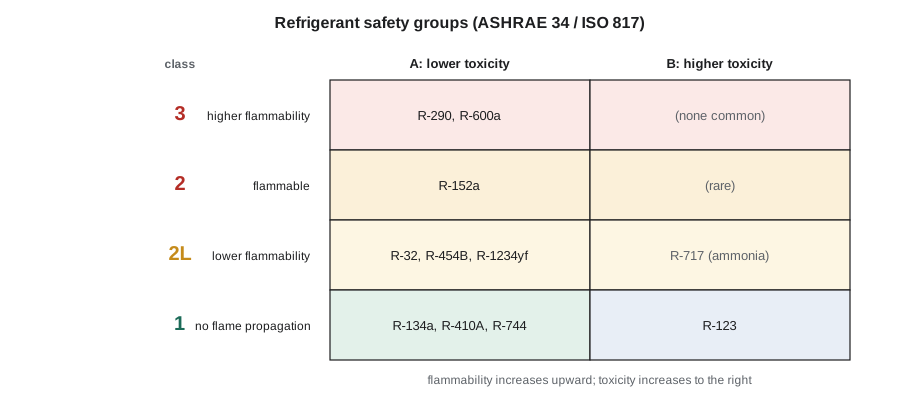
A1 refrigerants such as R-410A and R-134a are not flammable and have low toxicity, but they are not harmless. All refrigerant vapors are heavier than air except ammonia, and a large leak into a basement or a closed machine room can displace oxygen and cause suffocation without warning. Breathing high concentrations can cause heart rhythm problems, and refrigerants exposed to flames or very hot surfaces can break down into toxic and corrosive gases. A2L refrigerants such as R-32 and R-454B are hard to ignite and burn slowly, but they can burn, so equipment, service tools and procedures are designed for them, and RAC-120 covers the rules. A3 refrigerants such as propane need strict charge limits, ignition-source control and training.
Cylinders tell you what is inside by their label, not their color. Industry guidelines have moved all refrigerant cylinders to a single neutral color, so the label must be read every time. Cylinders of flammable refrigerants carry a red band, and A2L cylinders use left-hand threaded valve connections, so that they cannot easily be connected to equipment meant for other refrigerants. RAC-120 covers the current marking and transport rules.
Ozone depletion and global warming potential
Two numbers describe a refrigerant's effect on the atmosphere. Ozone depletion potential, ODP, compares the ozone a kilogram of the substance destroys with the ozone destroyed by a kilogram of R-11, which is set at 1. Only refrigerants containing chlorine or bromine have an ODP above zero. Global warming potential, GWP, compares the warming effect of a kilogram released to the air over a set period, usually 100 years, with the effect of a kilogram of carbon dioxide, which is set at 1. Regulations in Canada and the United States use GWP values from a specific assessment of the Intergovernmental Panel on Climate Change, so published values can differ slightly from source to source.
| Refrigerant | Family | Safety group | ODP | GWP (100-year, approx.) | Boiling point at 1 atm, approx. | Typical use |
|---|---|---|---|---|---|---|
| R-22 | HCFC | A1 | 0.055 | 1,810 | −41 °F | Older air conditioners, now service only |
| R-134a | HFC | A1 | 0 | 1,430 | −15 °F | Chillers, medium-temperature refrigeration |
| R-404A | HFC blend | A1 | 0 | 3,922 | −52 °F | Older commercial refrigeration |
| R-410A | HFC blend | A1 | 0 | 2,088 | −61 °F | Air conditioners and heat pumps |
| R-32 | HFC | A2L | 0 | 675 | −61 °F | New air conditioners and heat pumps |
| R-454B | HFO/HFC blend | A2L | 0 | about 470 | −59 °F | New air conditioners and heat pumps |
| R-1234yf | HFO | A2L | 0 | less than 5 | −21 °F | Vehicle air conditioning, some chillers |
| R-290 | Hydrocarbon | A3 | 0 | 3 | −44 °F | Small self-contained refrigeration |
| R-717 | Ammonia | B2L | 0 | 0 | −28 °F | Industrial refrigeration, arenas |
| R-744 | Carbon dioxide | A1 | 0 | 1 | sublimes at −109 °F | Supermarkets, heat pump water heaters |
The GWP column explains much of what is happening in the trade. A kilogram of R-404A that leaks has roughly the same warming effect as almost four tons of carbon dioxide; a kilogram of R-410A, about two tons. Because leaks from refrigeration and air conditioning are common, and charges in supermarkets can run to hundreds of kilograms, HFC refrigerants became a significant source of greenhouse gas emissions. The response has two parts: stop making high-GWP refrigerants in such quantity, and stop them leaking out of the systems that use them.
Worked problem
The carbon dioxide equivalent of a charge
The ductless heat pump holds 2.4 lb of R-410A. A newer model with the same capacity holds 2.1 lb of R-32. What is the carbon dioxide equivalent of each charge, the mass times the GWP?
Show solution
- \[\text{CO}_2\text{e}_{\text{R-410A}} = 2.4\ \text{lb} \times 2088 \approx 5010\ \text{lb} \approx 2.5\ \text{short tons}\]
- \[\text{CO}_2\text{e}_{\text{R-32}} = 2.1\ \text{lb} \times 675 \approx 1420\ \text{lb} \approx 0.71\ \text{short tons}\]
Answer: The R-32 charge carries a little over a quarter of the warming potential of the R-410A charge, because the refrigerant has a lower GWP and the system needs a slightly smaller charge. That difference is what the phasedown is designed to capture across millions of systems.
# Carbon dioxide equivalent of refrigerant charges (approximate 100-year GWP values)
gwp = {"R-22": 1810, "R-134a": 1430, "R-404A": 3922, "R-410A": 2088, "R-448A": 1387,
       "R-32": 675, "R-454B": 466, "R-290": 3, "R-744": 1}
LB_PER_METRIC_TON = 2204.6
systems = [  # (description, refrigerant, charge in lb)
    ("ductless heat pump", "R-410A", 2.4),
    ("ductless heat pump, newer model", "R-32", 2.1),
    ("brewery walk-in cooler", "R-448A", 10.0),
    ("glycol chiller", "R-134a", 7.0),
    ("old grocery display case system", "R-404A", 40.0),
    ("self-contained display cooler", "R-290", 0.26),
]
for name, ref, lb in systems:
    mt = lb * gwp[ref] / LB_PER_METRIC_TON
print(f"{name:32s} {ref:7s} {lb:6.2f} lb {mt:7.2f} metric tons CO2e")ductless heat pump R-410A 2.40 lb 2.27 metric tons CO2e ductless heat pump, newer model R-32 2.10 lb 0.64 metric tons CO2e brewery walk-in cooler R-448A 10.00 lb 6.29 metric tons CO2e glycol chiller R-134a 7.00 lb 4.54 metric tons CO2e old grocery display case system R-404A 40.00 lb 71.16 metric tons CO2e self-contained display cooler R-290 0.26 lb 0.00 metric tons CO2e
The program shows why commercial refrigeration has been a focus of the phasedown. A single old display case system on R-404A carries the warming potential of dozens of household heat pumps, and such systems have historically leaked a significant share of their charge each year. The propane display cooler, by contrast, carries almost nothing.
The phasedown
The Montreal Protocol of 1987 controls ozone-depleting substances, and it is widely considered the most successful environmental treaty ever: the ozone layer is slowly recovering. CFC production ended in developed countries in the 1990s, and HCFCs such as R-22 have been phased out step by step since. The Kigali Amendment, agreed in 2016 and in force since 2019, added HFCs to the protocol. It does not ban HFCs outright; it sets a schedule for each country to reduce its production and consumption, measured in carbon dioxide equivalent. Canada and the United States are on the schedule for developed countries, which reaches an 85 percent reduction from the baseline by 2036.
In the United States, the American Innovation and Manufacturing (AIM) Act of 2020 directs EPA to phase down HFC production and consumption on a schedule matching the Kigali Amendment, to restrict high-GWP HFCs in new equipment sector by sector, and to manage refrigerants in existing equipment. Section 608 of the Clean Air Act governs handling: technician certification, recovery, leak repair for larger systems and a ban on venting. RAC-120 covers these rules and prepares you for the Section 608 exam.
For a technician, the phasedown means three things. First, new equipment is moving to lower-GWP refrigerants: residential air conditioners and heat pumps from R-410A to A2L refrigerants such as R-32 and R-454B; commercial refrigeration from R-404A to lower-GWP blends, carbon dioxide and hydrocarbons; chillers to HFOs and their blends. Second, high-GWP refrigerants for servicing existing equipment will become scarcer and more expensive, which makes recovery and reclaiming more valuable and leak repair more important. Third, technicians must be trained and equipped for flammable refrigerants, which changes tools, procedures and the way a job is set up.
Refrigerant oils
Refrigerant does not travel alone. The compressor needs oil to lubricate its moving parts, and some of that oil circulates around the system with the refrigerant and must return to the compressor. The oil and refrigerant must be compatible: the oil must mix with the refrigerant well enough to be carried back from the evaporator. CFCs and HCFCs used mineral oil and alkylbenzene oil. HFCs and HFOs do not mix well with mineral oil, so they use synthetic polyolester (POE) or polyvinyl ether (PVE) oils, and automotive systems use polyalkylene glycol (PAG) oil. POE oil absorbs moisture from the air quickly, which is one more reason systems must be kept sealed and evacuated thoroughly. Always use the oil the compressor manufacturer specifies.
Never mix refrigerants
Every system is designed and charged for one refrigerant, shown on the nameplate. Adding a different refrigerant, or topping up a system with one it was not built for, creates an unknown mixture with unpredictable pressures and temperatures, can damage the compressor, makes the refrigerant impossible to reclaim, and in the case of a flammable refrigerant added to a system not designed for it, creates a fire hazard. Converting a system to a different refrigerant, called a retrofit, is done only with a refrigerant approved for that use and following the procedures for it, and the system is relabeled. Recovered refrigerant is kept in separate cylinders for each type.
Common mistakes
MistakeIdentifying a cylinder by its color.
InsteadRead the label; cylinders now share one color, with a red band for flammable contents.
MistakeTreating A1 refrigerants as harmless.
InsteadThey can displace oxygen in enclosed spaces and decompose into toxic gases in flames.
MistakeConfusing ODP and GWP.
InsteadODP measures ozone damage relative to R-11; GWP measures warming relative to carbon dioxide.
MistakeTopping up a system with whatever refrigerant is on the truck.
InsteadUse only the refrigerant on the nameplate, or a proper retrofit with relabeling.
Summary and key terms
- A good refrigerant balances thermodynamic performance, safety, compatibility and environmental impact.
- R-numbers identify refrigerants; 400 and 500 series are blends, 700 series are inorganic, 1000 series include HFOs.
- Families: CFCs and HCFCs (ozone depleting), HFCs (high GWP), HFOs, hydrocarbons and natural refrigerants.
- Safety groups combine toxicity (A, B) and flammability (1, 2L, 2, 3).
- Kigali phases down HFCs by 85 percent by 2036 in Canada and the US; new equipment is moving to A2L, A3 and natural refrigerants.
- Each refrigerant needs its compatible oil, and refrigerants must never be mixed.
- ODP
- Ozone depletion potential, relative to R-11.
- GWP
- Global warming potential over a set period, usually 100 years, relative to carbon dioxide.
- Safety group
- The ASHRAE 34 or ISO 817 class combining toxicity (A or B) and flammability (1, 2L, 2 or 3).
- A2L
- Lower toxicity, lower flammability with a low burning velocity; examples R-32 and R-454B.
- HFO
- Hydrofluoroolefin, a very low GWP refrigerant with a carbon double bond.
- Zeotropic blend
- A refrigerant mixture that boils over a temperature glide.
- Kigali Amendment
- The 2016 amendment to the Montreal Protocol that phases down HFCs.
- POE oil
- Polyolester oil, the usual lubricant for HFC systems; it absorbs moisture readily.
Practice problems
Work each problem on paper first, then reveal the answer to check.
What is the safety group of R-32, and what does it mean?
Show answer
A2L: lower toxicity, lower flammability with a low burning velocity.
A system holds 4.4 lb of R-404A. What is its carbon dioxide equivalent?
Show answer
4.4 × 3,922 ≈ 17,260 lb, or about 7.8 metric tons.
Using the R-number code, does R-22 contain chlorine?
Show answer
Yes: one carbon, one hydrogen and two fluorines leave one bond for chlorine.
Why do HFOs have very low GWPs?
Show answer
Their carbon double bond makes them break down within days or weeks in the atmosphere.
Lesson quiz · 5 questions
Score 60% or more to complete this lesson.
Create a free account to save your progress, take quizzes and earn a certificate.