
RAC-110 · Lesson 6 of 12 · 21 min
The vapor-compression cycle
After the brewery decided to cool its fermenters directly, Northfield sold them a small glycol chiller: a packaged refrigeration system that chills a mixture of water and propylene glycol, which is pumped through jackets on the fermenters. On the day it arrived, Dana took the side panels off before it was installed and walked Theo around the inside with a marker, writing on each pipe what the refrigerant inside it would be doing. "Follow one kilogram of refrigerant around this loop," she said, "and you will understand every refrigeration system you ever work on. The parts get bigger or smaller, but the loop is always the same."
This lesson follows the refrigerant around the vapor-compression cycle: what happens to it in each of the four main components, what state it is in at each point, and where heat enters and leaves.
Four components, four processes
Every vapor-compression system has four essential components joined in a closed loop. The evaporator absorbs heat from the space or product being cooled, as low-pressure refrigerant boils inside it. The compressor draws the vapor from the evaporator and compresses it to a high pressure and temperature. The condenser rejects heat to the surroundings as the high-pressure vapor cools and condenses into liquid. The metering device, also called the expansion device, drops the liquid's pressure back down to evaporator pressure, so that it can boil again at a low temperature. Then the cycle repeats.
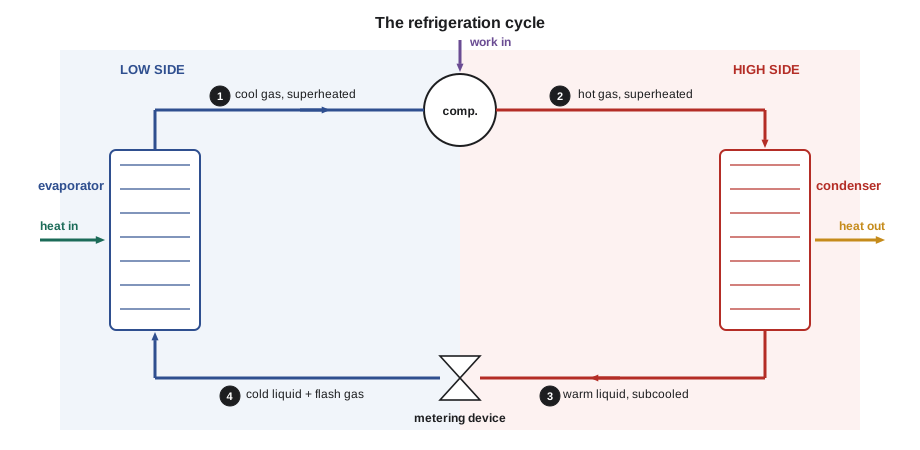
The compressor and the metering device divide the system into two halves. The high side runs from the compressor discharge through the condenser to the inlet of the metering device, and everything in it is at roughly the condensing pressure. The low side runs from the outlet of the metering device through the evaporator to the compressor suction, and everything in it is at roughly the evaporating pressure. The high-side gauge reads the first, and the low-side gauge reads the second.
| Point | Location | Pressure | State of the refrigerant | What is happening |
|---|---|---|---|---|
| 1 | Evaporator outlet and suction line | Low | Superheated vapor, cool | Vapor travels to the compressor |
| 2 | Compressor discharge | High | Superheated vapor, hot | Vapor has been compressed; work has been added |
| 3 | Condenser outlet and liquid line | High | Subcooled liquid, warm | Liquid travels to the metering device |
| 4 | Metering device outlet, evaporator inlet | Low | Cold mixture of liquid and flash vapor | Liquid starts to boil, absorbing heat |
The evaporator: absorbing heat
Start at the inlet of the evaporator, point 4. The refrigerant arrives as a cold mixture of mostly liquid with some vapor, at low pressure. Its temperature is the saturation temperature for that pressure, well below the temperature of the glycol or air it is cooling. Heat flows from the warmer glycol through the tube walls into the refrigerant, and the liquid boils. As long as liquid remains, the boiling refrigerant stays at the same saturation temperature, absorbing latent heat. This is the useful part of the cycle: the heat absorbed here is the refrigeration the customer pays for.
Near the outlet of the evaporator, the last of the liquid boils away. From there to the outlet, the refrigerant is all vapor, and it keeps picking up a few degrees of sensible heat. Vapor warmer than its saturation temperature is superheated, and the amount of superheat at the evaporator outlet is one of the most important readings in the trade, because it shows whether the evaporator is being fed the right amount of liquid. A little superheat proves that all the liquid has boiled off and that only vapor will reach the compressor. Lesson 7 explains how to measure it.
In the glycol chiller, the refrigerant is R-134a, and it boils at about 14 °F in a plate heat exchanger while glycol flows through the other side, entering at about 30 °F and leaving at about 25 °F. In a walk-in cooler, the evaporator is a finned coil with fans, and the refrigerant boils at a few degrees below the box temperature, typically about 10 to 15 degrees Fahrenheit colder than the air returning to the coil.
The compressor: adding work
The compressor pulls the low-pressure vapor out of the evaporator, which keeps the evaporator pressure low so that the refrigerant there keeps boiling at a low temperature. It then squeezes the vapor into a smaller volume. Compressing a gas raises both its pressure and its temperature, because the work done on the gas goes into it as energy. The vapor leaving the compressor at point 2 is hot and highly superheated, often 30 to 50 degrees above its condensing temperature. In most small systems, the vapor also passes over the motor windings on its way into the compressor, cooling the motor and picking up its heat as well.
The compressor is the only component that adds energy to the refrigerant from outside the cycle. Everything else either moves heat in, moves heat out or drops pressure. It is also the component that must never be fed liquid. Compressors are built to compress vapor; liquid does not compress, and a slug of liquid entering the cylinders or scrolls can break valves, wash oil from bearings and destroy the compressor. That is why the superheat at the evaporator outlet matters so much.
In the glycol chiller, the compressor raises the pressure from about 29 psia to about 148 psia, a compression ratio of about five, and the discharge vapor leaves at roughly 140 to 160 °F.
The condenser: rejecting heat
The hot vapor flows through the discharge line to the condenser, which is cooled by outdoor air in most small systems and by water in many larger ones. In the first part of the condenser, the vapor gives up its superheat and cools to its condensing temperature. Then it condenses, giving up its latent heat at a constant temperature, the saturation temperature for the high-side pressure. Near the outlet, the last of the vapor has condensed, and the liquid cools a few degrees below its condensing temperature. That is subcooling, the condenser-side partner of superheat.
All the heat that entered in the evaporator, plus the heat of compression and the motor heat, leaves in the condenser. The condenser therefore rejects more heat than the evaporator absorbs, as Lesson 1's energy balance showed. To reject heat, the refrigerant must be hotter than the air or water cooling it. On a hot day, the condensing temperature rises with the outdoor air temperature, the high-side pressure rises with it, and the compressor works harder.
The glycol chiller's air-cooled condenser sits beside the brewery's loading door. On a design summer day with outdoor air at 86 °F, the refrigerant condenses at about 104 °F, at about 148 psia (133 psig), and leaves the condenser as liquid at about 95 °F, with about 9 °F of subcooling.
The metering device: dropping the pressure
The warm, high-pressure liquid travels through the liquid line to the metering device: a capillary tube, a fixed orifice, a thermostatic expansion valve or an electronic expansion valve. Whatever its type, it is a restriction that holds back the high-side pressure and lets refrigerant through to the low side at a controlled rate. As the liquid passes through, its pressure drops suddenly to the evaporator pressure. At that lower pressure, the warm liquid is far above its new saturation temperature, so part of it boils instantly, and the heat to boil it comes from the rest of the liquid, which cools to the new saturation temperature.
The vapor formed this way is called flash gas. It has absorbed heat from the liquid, not from the space being cooled, so it does no useful refrigeration. Flash gas is an unavoidable cost of the cycle, and reducing it is one reason subcooling is valuable: the colder the liquid arriving at the metering device, the less of it must flash to cool the rest. The metering device does no work and exchanges no heat with the surroundings; it only drops the pressure. Lesson 10 introduces the types, and RAC-220 covers them in detail.
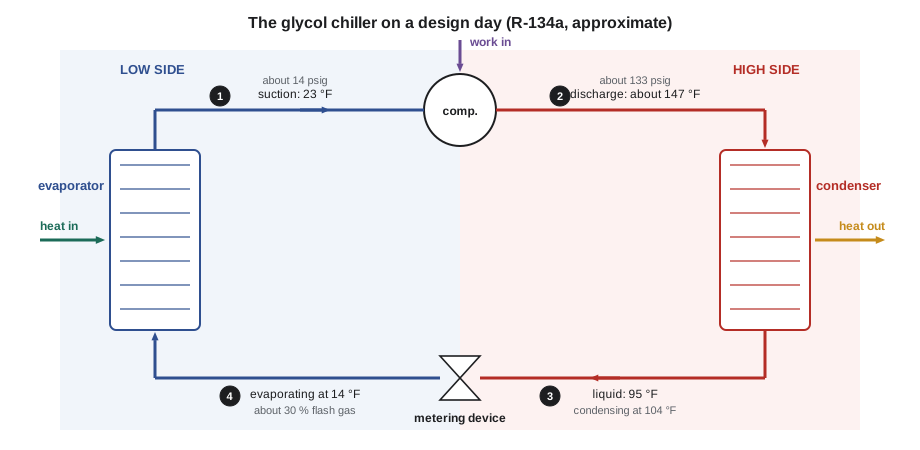
Following one kilogram around the loop
The amount of heat each pound of refrigerant picks up in the evaporator is called the refrigerating effect. It is the difference between the energy content of the vapor leaving the evaporator and the liquid entering the metering device. Lesson 9 shows how to read these energy contents, called enthalpies, from a chart. For the glycol chiller, as approximate values, the vapor leaving the evaporator carries about 107 Btu/lb and the liquid entering the metering device about 43 Btu/lb, so each pound picks up about 64 Btu in the evaporator. The capacity of the system then fixes how much refrigerant must circulate.
Worked problem
How much refrigerant circulates?
The glycol chiller is rated at 24,000 Btu/h (2 tons) of cooling at these conditions. What mass of R-134a must circulate each hour?
Show solution
- \[q_{\text{RE}} = 107 - 43 = 64\ \text{Btu/lb}\]
- \[\dot{m} = \frac{24\,000\ \text{Btu/h}}{64\ \text{Btu/lb}} \approx 375\ \text{lb/h}\]
Answer: About 375 lb every hour circulates through a system that holds only a few pounds of refrigerant. Each pound goes around the loop many times an hour.
# Mass flow and flash gas in the glycol chiller (approximate R-134a values, Btu/lb)
h_liquid_in = 43.4       # liquid at 95 F entering the metering device
h_f_evap = 16.6          # saturated liquid at 14 F
h_g_evap = 105.1         # saturated vapor at 14 F
h_evap_out = 107.1       # vapor leaving the evaporator with about 9 F superheat
v_suction = 1.64         # ft3/lb, approximate specific volume of the suction vapor

flash = (h_liquid_in - h_f_evap) / (h_g_evap - h_f_evap)
effect = h_evap_out - h_liquid_in
print(f"flash gas at the evaporator inlet: {100 * flash:.0f} % of the mass")
print(f"refrigerating effect: {effect:.1f} Btu/lb")
for capacity in [12000, 24000, 48000]:
    m = capacity / effect                      # lb/h
    cfm = m * v_suction / 60                   # ft3/min of suction vapor
print(f"{capacity:6d} Btu/h: {m:5.0f} lb/h, suction vapor {cfm:5.1f} ft3/min")flash gas at the evaporator inlet: 30 % of the mass refrigerating effect: 63.7 Btu/lb 12000 Btu/h: 188 lb/h, suction vapor 5.1 ft3/min 24000 Btu/h: 377 lb/h, suction vapor 10.3 ft3/min 48000 Btu/h: 754 lb/h, suction vapor 20.6 ft3/min
The program shows two things. About 30 percent of the refrigerant flashes to vapor as it passes the metering device, so only about 70 percent of the liquid arriving at the evaporator is left to do useful work. And the compressor must move a volume of low-pressure vapor, not a mass: the suction vapor is thin, and the lower the evaporating pressure, the thinner it gets, so the same compressor moves less refrigerant and less heat as the evaporator temperature falls. That is why a freezer needs a larger compressor than a cooler of the same capacity.
Running the cycle backwards: the heat pump
A heat pump uses the same four components to move heat into a building instead of out. In heating mode, the outdoor coil becomes the evaporator, absorbing heat from outdoor air even when it is well below freezing, because the refrigerant inside boils at an even lower temperature. The indoor coil becomes the condenser, releasing that heat plus the compressor's work into the house. A reversing valve, a four-way valve near the compressor, swaps the discharge and suction connections between the two coils to change modes. The metering arrangement is designed to work in both directions.
The ductless system Theo started up in Lesson 4 is a heat pump. In summer, it cools the attic bedroom by pumping heat outdoors; in winter, it heats the same room by pumping heat in. Because it moves heat rather than making it, it can deliver two to four units of heat for each unit of electricity, which is why heat pumps are replacing fuel-burning furnaces in many homes. In cold weather, the outdoor coil can frost up, and the system periodically reverses into a defrost cycle to melt it. RAC-320 covers heat pumps in detail.
Reading the cycle with gauges and a thermometer
With gauges on the suction and liquid or discharge service ports and a thermometer clamped to the lines, a technician can read the whole cycle. The suction pressure gives the evaporating temperature from the P-T chart. The suction line temperature, compared with it, gives the superheat. The high-side pressure gives the condensing temperature. The liquid line temperature, compared with it, gives the subcooling. Those four numbers, with the air or water temperatures across the coils, tell most of the story of what a system is doing. The next lesson shows how.
Common mistakes
MistakeThinking the compressor makes the cold.
InsteadThe compressor adds work and raises pressure; the cooling happens in the evaporator as liquid boils.
MistakeExpecting the evaporator to absorb as much heat as the condenser rejects.
InsteadThe condenser rejects the evaporator's heat plus the compressor's work and motor heat.
MistakeThinking the metering device cools the refrigerant by removing heat.
InsteadIt only drops the pressure; part of the liquid flashes, and that boiling cools the rest.
MistakeAllowing liquid to return to the compressor.
InsteadCompressors are built for vapor; superheat at the evaporator outlet protects them.
Summary and key terms
- The cycle has four components: evaporator, compressor, condenser and metering device.
- The compressor and metering device split the system into a high side and a low side.
- Refrigerant absorbs heat by boiling in the evaporator and rejects it by condensing in the condenser.
- Compression adds work, raising pressure and temperature; the discharge vapor is highly superheated.
- The metering device drops pressure; some liquid flashes to vapor, which does no useful cooling.
- Mass flow equals capacity divided by refrigerating effect.
- A heat pump runs the same cycle with a reversing valve to move heat into a building.
- Evaporator
- The heat exchanger where low-pressure refrigerant boils, absorbing heat from the space or product.
- Compressor
- The pump that raises refrigerant vapor from evaporating pressure to condensing pressure.
- Condenser
- The heat exchanger where high-pressure refrigerant rejects heat and condenses to liquid.
- Metering device
- The restriction that drops liquid refrigerant from high-side to low-side pressure and controls flow to the evaporator.
- High side
- The part of the system at condensing pressure, from compressor discharge to metering device inlet.
- Low side
- The part of the system at evaporating pressure, from metering device outlet to compressor suction.
- Flash gas
- Refrigerant that boils as it passes the metering device, cooling the remaining liquid.
- Refrigerating effect
- The heat absorbed per unit mass of refrigerant in the evaporator.
- Reversing valve
- The four-way valve that swaps the roles of the coils in a heat pump.
Practice problems
Work each problem on paper first, then reveal the answer to check.
Name the state of the refrigerant in the liquid line.
Show answer
Subcooled liquid at high pressure.
A system has a refrigerating effect of 65 Btu/lb and a capacity of 12,000 Btu/h. What is the mass flow?
Show answer
12,000 / 65 ≈ 185 lb/h.
In heating mode, which coil of a heat pump is the evaporator?
Show answer
The outdoor coil.
Why does a lower evaporating temperature reduce what a given compressor can move?
Show answer
The suction vapor is less dense, so each stroke or revolution moves less mass of refrigerant.
Lesson quiz · 5 questions
Score 60% or more to complete this lesson.
Create a free account to save your progress, take quizzes and earn a certificate.