
RAC-110 · Lesson 4 of 12 · 24 min
Pressure, vacuum and gauges
Theo's first real lesson with the gauges came on a start-up. A new ductless heat pump had been installed in the attic of an old brick house, and the line set had been brazed and pressure tested with dry nitrogen. Dana connected the manifold, opened the nitrogen and stopped at a reading on the dial. "What is the pressure in that pipe?" Theo read the needle. Dana shook her head. "That is what the gauge says. The pressure in the pipe is more than that, because the gauge does not count the atmosphere. If you do not know which pressure you are looking at, you will make mistakes with every table and every chart in this trade."
This lesson covers what pressure is, the units used for it, the difference between gauge and absolute pressure, vacuum, and the gauges technicians use to read all of it.
What pressure is
Pressure is force spread over an area. A gas exerts pressure because its molecules are constantly striking the walls of its container; each impact pushes a little, and billions of impacts each second add up to a steady force. Heat the gas and the molecules move faster and hit harder, so the pressure rises. Squeeze the gas into a smaller space and more molecules hit each square centimeter, so the pressure rises again. A liquid exerts pressure because of its weight and because it transmits any pressure applied to it equally in all directions.
In the US trade, pressure is measured in pounds per square inch (psi). SI data, used on some imported equipment, gives pressure in kilopascals (kPa), bar or megapascals; one psi is about 6.895 kPa, and one bar is about 14.5 psi. Small pressures, such as the static pressure in a duct, are measured in inches of water column, and vacuums in inches of mercury or in microns.
Pressure can store a lot of energy, and the force it produces on a surface grows with the area. That is why a small leak at a gauge port is a hiss, but a failed end cap on a receiver or a cylinder valve knocked off can be lethal.
Worked problem
The force on a receiver's end cap
A liquid receiver has an inside diameter of 6 in. The refrigerant inside is at 250 psi above atmospheric pressure. What net force does the pressure exert on one end cap?
Show solution
- \[A = \frac{\pi d^2}{4} = \frac{\pi \times 6^2}{4} \approx 28.3\ \text{in}^2\]
- \[F = P\,A = 250\ \tfrac{\text{lb}}{\text{in}^2} \times 28.3\ \text{in}^2 \approx 7070\ \text{lb}\]
Answer: About 7,070 lb, roughly the weight of a large pickup truck and a loaded trailer, pushing on a disc the size of a dinner plate. Pressure vessels are built and tested for this, but heating a cylinder, overfilling it or brazing near a pressurized line can push them past their limits.
Atmospheric pressure
The air above us has weight, and at sea level it presses down with a standard atmospheric pressure of 101.325 kPa, which is 14.696 psi, or 29.92 inches of mercury, and 101.325 kPa in SI units. Atmospheric pressure falls with altitude, because there is less air above, and it varies a few percent with the weather. Louisville sits about 140 m (460 ft) above sea level, where the normal pressure is about 14.4 psi; in a mountain city at 5,300 ft, it is about 12.2 psi.
A barometer measures atmospheric pressure. The classic one is a glass tube of mercury, closed at the top and standing in a dish: the atmosphere holds the mercury up to a height of about 29.92 in at sea level. That is where the units of inches and millimeters of mercury come from, and why vacuum is still measured in them.
Gauge pressure and absolute pressure
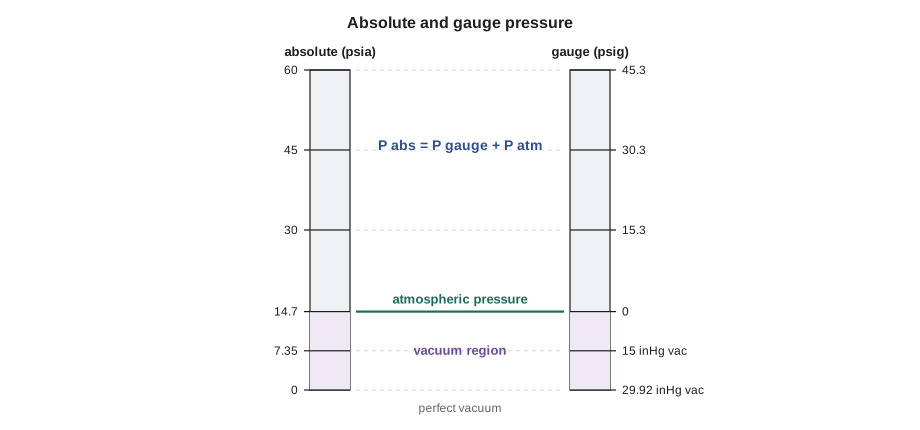
Most pressure gauges read zero when they are open to the atmosphere. They measure gauge pressure: the pressure above atmospheric. A tire gauge reading 32 psi means the air in the tire is 32 psi above the air outside. Absolute pressure is measured from a perfect vacuum, zero pressure. The two are related by the atmospheric pressure.
The letter after psi tells you which: psig is gauge, psia is absolute. Refrigerant property tables and the pressure-enthalpy diagrams in Lesson 9 use absolute pressure; most gauges and pressure-temperature charts printed for technicians use gauge pressure. Always check which one a table uses.
Worked problem
Gauge to absolute
Theo's low-side gauge reads 118 psig on a running system, and his high-side gauge reads 375 psig. Atmospheric pressure is 14.7 psi. What are the absolute pressures, and what is the compression ratio, the absolute discharge pressure divided by the absolute suction pressure?
Show solution
- \[P_{\text{low,abs}} = 118 + 14.7 = 132.7\ \text{psia}\]
- \[P_{\text{high,abs}} = 375 + 14.7 = 389.7\ \text{psia}\]
- \[\text{ratio} = \frac{389.7}{132.7} \approx 2.94\]
Answer: 132.7 psia and 389.7 psia, a compression ratio of about 2.9. Using gauge pressures would give 375/118 ≈ 3.2, which is wrong, and the error grows as suction pressure falls: on a freezer with a low suction pressure, the gauge ratio can be wildly too high.
Compression ratio is one example of a calculation that must use absolute pressure. The gas laws, refrigerant tables and compressor data all do too. The rule is simple: whenever pressures are multiplied, divided or used in a formula with other properties, convert them to absolute first.
Vacuum
A vacuum is any pressure below atmospheric. In the trade, vacuums matter in two places: some low-temperature systems run with their suction side below atmospheric pressure, and every system must be evacuated, pumped down to a deep vacuum, before it is charged with refrigerant. Evacuation removes air, which would raise head pressure and carry oxygen into the system, and moisture, which would react with refrigerant oil to form acids, freeze in metering devices and corrode parts.
Vacuum is measured in several ways. Compound gauges, the low-side gauges on a manifold, read below zero in inches of mercury vacuum, from 0 at atmospheric pressure to about 30 at a near-perfect vacuum. That scale is too coarse for evacuation: the last few thousandths of an inch of mercury are where all the moisture is. A micron gauge measures absolute pressure in microns of mercury, where one micron is a thousandth of a millimeter of mercury. Atmospheric pressure is 760,000 microns. A common target for a finished evacuation is 500 microns or lower, held steady when the pump is isolated, but always follow the equipment manufacturer's instructions.
| Condition | Absolute pressure | Gauge reading | Microns of mercury |
|---|---|---|---|
| Standard atmosphere | 14.7 psia | 0 psig | 760,000 |
| Half an atmosphere | 7.35 psia | 15 inHg vacuum | 380,000 |
| Water boils at room temperature | about 0.34 psia | about 29.2 inHg vacuum | about 17,500 |
| Water boils at its freezing point | about 0.089 psia | about 29.7 inHg vacuum | about 4,600 |
| Typical evacuation target | about 0.0097 psia | about 29.9 inHg vacuum | 500 |
The table shows why a micron gauge is essential. Water boils at room temperature when the pressure falls below about 17,500 microns, and the vacuum pump removes moisture by boiling it off. At 500 microns, water boils far below its freezing point, so even moisture in cold corners of the system is pulled out as vapor. A compound gauge cannot tell 17,500 microns from 500: both read nearly 30 inches of vacuum.
Worked problem
Converting a vacuum
A compound gauge reads 28 inHg vacuum. What is the absolute pressure in psia and in microns, assuming a standard atmosphere?
Show solution
- \[P_{\text{abs}} = (29.92 - 28) = 1.92\ \text{inHg}\]
- \[P_{\text{abs}} = 1.92 \times 0.4912\ \tfrac{\text{psi}}{\text{inHg}} \approx 0.94\ \text{psia}\]
- \[1.92\ \text{inHg} \times 25.4\ \tfrac{\text{mm}}{\text{in}} \times 1000\ \tfrac{\text{micron}}{\text{mm}} \approx 48\,800\ \text{microns}\]
Answer: About 0.94 psia, or nearly 49,000 microns: almost a hundred times too high for a finished evacuation, even though the gauge needle looks close to the end of its scale.
# Gauge, absolute and vacuum conversions
PSI_PER_INHG = 0.4912
MICRONS_PER_PSI = 51715      # 1 psi = 51.7 mm of mercury

def atm_psia(elevation_ft):
    # standard atmosphere model, good to a fraction of a percent below 10,000 ft
    elevation_m = elevation_ft * 0.3048
    return 14.696 * (1 - 2.25577e-5 * elevation_m) ** 5.25588

p_atm = atm_psia(460)         # about the elevation of Louisville
print(f"atmospheric pressure at 460 ft: {p_atm:.2f} psia")

for gauge_psi in [375, 118, 0]:
    absolute = gauge_psi + p_atm
    print(f"{gauge_psi:5d} psig -> {absolute:7.2f} psia")

for inhg_vac in [15, 25, 29]:
    absolute = p_atm - inhg_vac * PSI_PER_INHG
print(f"{inhg_vac:5.1f} inHg vacuum -> {absolute:6.3f} psia = {absolute * MICRONS_PER_PSI:8.0f} microns")atmospheric pressure at 460 ft: 14.45 psia
375 psig -> 389.45 psia
118 psig -> 132.45 psia
0 psig -> 14.45 psia
15.0 inHg vacuum -> 7.085 psia = 366419 microns
25.0 inHg vacuum -> 2.173 psia = 112395 microns
29.0 inHg vacuum -> 0.209 psia = 10785 micronsThe program uses the local atmospheric pressure rather than the sea-level standard, which matters at altitude: a compound gauge reads vacuum relative to the local atmosphere, so at Louisville's elevation it can never read more than about 29.4 inches of vacuum. On the vacuum side, the deepest reading in the list shows the problem again: 29 inches of vacuum on a compound gauge is still several thousand microns, far from a finished evacuation.
Pressure in liquids
A column of liquid exerts pressure because of its weight: the pressure at the bottom is the density times the acceleration due to gravity times the height. This matters in refrigeration when liquid refrigerant must rise from a condenser on the ground to an evaporator on an upper floor. Liquid refrigerant has a density of roughly 60 to 75 lb/ft³, so each foot of lift costs roughly 0.4 to 0.5 psi, and a lift of 20 ft costs roughly 8 to 10 psi of liquid line pressure, which can be enough to start the liquid flashing into vapor before it reaches the metering device.
Lesson 7 shows why this matters: the liquid must stay subcooled all the way to the metering device, and a lift, a long run or a restriction can use up the subcooling.
Gauges and manifolds
The traditional analog gauge uses a Bourdon tube: a curved, flattened metal tube that straightens slightly as pressure inside it rises, moving a needle through a linkage. It reads gauge pressure, and many refrigeration gauges also carry printed temperature scales for common refrigerants, which Lesson 5 explains. Digital gauges use electronic pressure sensors, read to finer resolution, carry pressure-temperature tables for dozens of refrigerants and often calculate superheat and subcooling with clamp-on temperature probes.
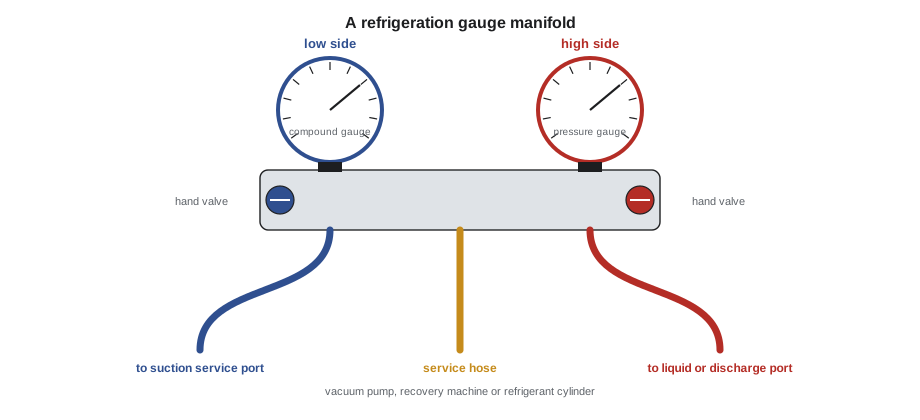
A gauge manifold connects the gauges to the system. The low-side gauge, traditionally blue, is a compound gauge that reads both vacuum and pressure and connects to the suction side. The high-side gauge, traditionally red, reads higher pressures and connects to the discharge or liquid side. The center hose, traditionally yellow, connects to a vacuum pump, recovery machine or refrigerant cylinder. Hand valves on the manifold open each side to the center hose; with both closed, each gauge simply reads its own side of the system. Hoses carry low-loss fittings or ball valves so that only a small amount of refrigerant escapes when they are disconnected.
Gauges have accuracy limits, and analog gauges drift. A gauge should read zero when open to the atmosphere; if it does not, it needs recalibrating, which on analog gauges is done with an adjusting screw. Hoses and gauges must be rated for the pressures of the refrigerant: gauges and hoses for older, lower-pressure refrigerants are not safe on R-410A or carbon dioxide systems. Rules for connecting and disconnecting without releasing refrigerant are part of RAC-120.
Pressure safety
Pressure is the hazard a refrigeration technician lives with every day. Cylinders must never be heated with a torch or left in a hot vehicle, never be filled beyond their rated fill, and always be secured upright. Pressure testing new piping is done with dry nitrogen through a regulator, never with oxygen, which explodes in contact with oil, and never with compressed air or refrigerant. Systems have pressure relief devices, and a technician never defeats a high-pressure control or relief valve to get a system running. Eye protection and gloves are worn whenever hoses are connected or disconnected, because liquid refrigerant flashing to vapor at atmospheric pressure can be cold enough to freeze skin and eyes instantly.
Common mistakes
MistakeUsing gauge pressure in a ratio or a property table that expects absolute.
InsteadAdd atmospheric pressure first; ratios, gas laws and most property tables use absolute pressure.
MistakeTrusting a compound gauge to show a finished evacuation.
InsteadOnly a micron gauge reads the deep vacuum range where moisture is removed.
MistakePressure testing with oxygen or compressed air.
InsteadUse dry nitrogen through a regulator; oxygen with oil is explosive and air brings in moisture.
MistakeUsing standard sea-level atmospheric pressure everywhere.
InsteadAt altitude, atmospheric pressure is lower; use the local value for absolute conversions.
Summary and key terms
- Pressure is force per unit area: kPa and bar in SI, psi in imperial units, inches of mercury and microns for vacuum.
- Standard atmospheric pressure is 101.325 kPa, 14.696 psi or 29.92 inHg, and it falls with altitude.
- Absolute pressure equals gauge pressure plus atmospheric pressure; ratios and property tables need absolute.
- Vacuum is pressure below atmospheric; evacuation targets are measured in microns with a micron gauge.
- A column of liquid exerts pressure ρgh, which matters for liquid line lifts.
- Manifolds, hoses and gauges must be rated for the refrigerant, and pressure testing uses dry nitrogen.
- Pressure
- Force per unit area.
- Gauge pressure
- Pressure measured above atmospheric pressure (psig).
- Absolute pressure
- Pressure measured from a perfect vacuum (psia).
- Atmospheric pressure
- The pressure of the air, 14.696 psi at sea level on a standard day.
- Vacuum
- Any pressure below atmospheric.
- Micron
- One thousandth of a millimeter of mercury, used for deep vacuum; atmosphere is 760,000 microns.
- Compound gauge
- A gauge that reads both vacuum and positive pressure, used on the low side.
- Compression ratio
- Absolute discharge pressure divided by absolute suction pressure.
Practice problems
Work each problem on paper first, then reveal the answer to check.
A gauge reads 50 psig. What is the absolute pressure at a standard atmosphere?
Show answer
50 + 14.7 = 64.7 psia.
Suction is 17 psig and discharge 203 psig. What is the compression ratio?
Show answer
(203 + 14.7) / (17 + 14.7) = 217.7 / 31.7 ≈ 6.9.
What is 1,000 microns in psia?
Show answer
1,000 / 51,715 ≈ 0.019 psia.
Why must a system be evacuated before charging?
Show answer
To remove air, which raises head pressure and brings oxygen, and moisture, which forms acids, freezes in metering devices and corrodes parts.
Lesson quiz · 5 questions
Score 60% or more to complete this lesson.
Create a free account to save your progress, take quizzes and earn a certificate.