
RAC-110 · Lesson 3 of 12 · 25 min
Temperature, sensible heat and latent heat
The brewery's head brewer, Priya, met Dana and Theo at the cooler door with a question. "Our fermenters finish at 64 °F, and we crash-cool each batch to 37 °F in the cold room before kegging. On those days the cooler struggles. Is the system too small?" Dana did not answer straight away. She asked how much beer was in a batch, how fast it needed to cool, and whether the brewery ever put ice in the cooler. Then she sat down with Theo and a calculator. "Before we can say whether it is too small," she said, "we have to know how much heat is in that beer."
This lesson covers temperature and its scales, and the two kinds of heat that every refrigeration calculation uses: sensible heat, which changes temperature, and latent heat, which changes state.
Temperature and its scales
Temperature measures how hot or cold something is: in physical terms, the average kinetic energy of its molecules. It is not the same as heat. A bathtub of warm water holds far more heat than a cup of boiling water, but the cup is at the higher temperature. Heat flows from the higher temperature to the lower, whichever body holds more heat in total.
Two everyday scales are used in the trade. The Celsius scale puts the freezing point of water at 0 °C and its boiling point at sea-level pressure at 100 °C. The Fahrenheit scale puts the same two points at 32 °F and 212 °F, so it has 180 Fahrenheit degrees where Celsius has 100, and each Celsius degree is 1.8 Fahrenheit degrees. Two absolute scales start at absolute zero, the temperature at which molecular motion is at its minimum: the kelvin scale uses Celsius-sized degrees and puts absolute zero at 0 K, which is −273.15 °C, and the Rankine scale uses Fahrenheit-sized degrees and puts absolute zero at 0 °R, which is −459.67 °F. Absolute scales are needed in gas laws and radiation.
A temperature difference converts differently from a temperature. A difference of 10 Celsius degrees is a difference of 18 Fahrenheit degrees, with no 32 added, because the offset cancels when one temperature is subtracted from another. Superheat, subcooling and the temperature drop across a coil are all differences. Mixing up the two rules is one of the most common conversion errors in the trade.
Worked problem
Converting temperatures and differences
A freezer runs at −10 °F. What is that in °C and in degrees Rankine? The air across its evaporator drops by 11 Fahrenheit degrees. What is that drop in Celsius degrees?
Show solution
- \[T_{^\circ\text{C}} = \frac{-10 - 32}{1.8} \approx -23.3\ ^\circ\text{C}\]
- \[T_{^\circ\text{R}} = -10 + 459.67 = 449.67\ ^\circ\text{R}\]
- \[\Delta T_{^\circ\text{C}} = \frac{11}{1.8} \approx 6.1\ ^\circ\text{C} \quad (\text{no } -32 \text{ for a difference})\]
Answer: −10 °F is about −23.3 °C and 449.67 °R. The 11-degree Fahrenheit drop is about a 6.1-degree Celsius drop.
Technicians measure temperature with several kinds of instrument. Thermistors, whose electrical resistance changes with temperature, are used in most digital thermometers, clamp-on pipe probes and the sensors inside modern equipment. Thermocouples, made of two dissimilar metal wires that produce a small voltage, cover a wide range and are used for flue gases and high temperatures. Bimetal and liquid-filled dial thermometers still appear on equipment panels. Infrared thermometers read surface temperature from a distance, with the emissivity caution from Lesson 2. Whatever the instrument, a good technician checks it against a known reference, such as a properly made ice bath at 32 °F, before trusting it.
Sensible heat
Sensible heat is heat that changes a substance's temperature without changing its state. It is called sensible because you can sense it with a thermometer. The amount needed depends on the mass, the temperature change and the specific heat, which is the heat needed to raise one unit of mass by one degree.
In US units, Q is in Btu, m in pounds, c in Btu per pound per degree Fahrenheit and ΔT in Fahrenheit degrees. Water has a specific heat of 1.0 Btu/(lb·°F), by the definition of the Btu, and that is high: water takes a lot of heat to warm and gives a lot back when it cools, which makes it a good medium for carrying heat in chillers and hydronic systems. In SI data, the same specific heat is about 4.19 kJ/(kg·K).
| Substance | Approximate c, Btu/(lb·°F) | Notes |
|---|---|---|
| Water (liquid) | 1.00 | High; good heat carrier |
| Ice | 0.50 | About half that of water |
| Steam or water vapor | 0.48 | Varies with pressure and temperature |
| Beer | 0.96 | Slightly less than water |
| Air (dry) | 0.24 | Used in airflow calculations |
| Aluminum | 0.215 | Coil fins |
| Steel | 0.12 | Compressor shells, shelving, carcasses |
| Copper | 0.092 | Tubing |
Worked problem
How much heat is in the beer?
A batch is 130 gallons of beer, about 1,090 lb at 8.4 lb per gallon, with a specific heat of about 0.96 Btu/(lb·°F). It must cool from 64 °F to 37 °F in 6 hours. How much heat must be removed, and at what average rate?
Show solution
- \[Q = m\,c\,\Delta T = 1090 \times 0.96 \times (64 - 37) \approx 28\,300\ \text{Btu}\]
- \[\dot{Q} = \frac{28\,300\ \text{Btu}}{6\ \text{h}} \approx 4700\ \text{Btu/h}\]
Answer: About 28,300 Btu, at an average of about 4,700 Btu/h over six hours. The cooler's system is rated at 9,000 Btu/h, and the box's other loads take more than half of that, so on crash-cooling days the beer adds a load the system was never sized for. The answer was a glycol jacket on the fermenters, not a bigger cooler.
Product loads like the beer are often the largest part of a refrigeration load in commercial work, and they are easy to forget because they are not part of the building. A grocery delivery of warm produce, a restaurant's hot stock pots put straight into the walk-in, or a load of fresh meat all bring sensible heat that the system must remove. Lesson 11 builds a full load estimate from these pieces.
Latent heat
Latent heat is heat that changes a substance's state without changing its temperature. While ice melts at 32 °F, adding heat does not warm the mixture; it loosens the bonds between water molecules until all the ice has turned to water. While water boils at 212 °F at sea level, adding heat does not raise its temperature; it turns liquid into vapor. The word latent means hidden: a thermometer does not show this heat, but it is there, and it is released again when the vapor condenses or the water freezes.
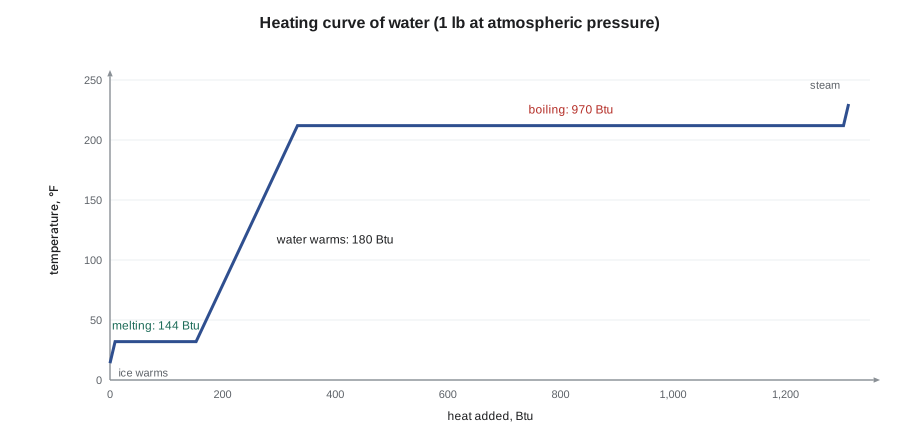
Latent heats are large compared with sensible heats. Melting one pound of ice takes about 144 Btu, the same heat that would warm that pound of water by 144 degrees Fahrenheit. Boiling one pound of water at 212 °F takes about 970 Btu, more than five times the heat needed to bring it from freezing to boiling. These are the latent heat of fusion and the latent heat of vaporization of water.
Worked problem
From ice to steam
How much heat takes 1 lb of ice at 14 °F to steam at 230 °F at atmospheric pressure? Use the approximate values in the tables.
Show solution
- \[Q_1 = 1 \times 0.50 \times 18 = 9\ \text{Btu} \quad \text{(warm the ice)}\]
- \[Q_2 = 1 \times 144 = 144\ \text{Btu} \quad \text{(melt it)}\]
- \[Q_3 = 1 \times 1.0 \times 180 = 180\ \text{Btu} \quad \text{(warm the water)}\]
- \[Q_4 = 1 \times 970 = 970\ \text{Btu} \quad \text{(boil it)}\]
- \[Q_5 = 1 \times 0.48 \times 18 \approx 9\ \text{Btu} \quad \text{(superheat the steam)}\]
- \[Q = 9 + 144 + 180 + 970 + 9 = 1312\ \text{Btu}\]
Answer: About 1,312 Btu, and the two latent steps account for 1,114 Btu, or 85 percent of it. The same pattern holds for refrigerants: most of the heat a refrigerant carries is latent heat.
# Heating curve of water: sensible and latent steps (approximate properties)
c_ice, c_water, c_steam = 0.50, 1.0, 0.48     # Btu/(lb F)
h_fusion, h_vap = 144.0, 970.0                # Btu/lb
m = 1.0                                       # lb
steps = [
    ("warm ice 14 to 32 F",      m * c_ice * 18),
    ("melt ice at 32 F",         m * h_fusion),
    ("warm water 32 to 212 F",   m * c_water * 180),
    ("boil water at 212 F",      m * h_vap),
    ("superheat steam to 230 F", m * c_steam * 18),
]
total = sum(q for _, q in steps)
running = 0.0
for name, q in steps:
    running += q
    kind = "latent" if "melt" in name or "boil" in name else "sensible"
    print(f"{name:26s} {q:7.0f} Btu  {kind:8s} running total {running:6.0f} Btu")
latent = m * (h_fusion + h_vap)
print(f"latent share of the total: {100 * latent / total:.0f} %")warm ice 14 to 32 F 9 Btu sensible running total 9 Btu melt ice at 32 F 144 Btu latent running total 153 Btu warm water 32 to 212 F 180 Btu sensible running total 333 Btu boil water at 212 F 970 Btu latent running total 1303 Btu superheat steam to 230 F 9 Btu sensible running total 1312 Btu latent share of the total: 85 %
Why latent heat runs the refrigeration cycle
A refrigerant is chosen so that it boils at a useful low temperature in the evaporator and condenses at a useful high temperature in the condenser. While it boils, it absorbs its latent heat of vaporization at a nearly constant temperature, which lets a small amount of refrigerant carry a large amount of heat and keeps the evaporator coil at an even temperature from inlet to outlet. In the condenser, the reverse happens: the vapor gives up its latent heat as it condenses. If refrigerants only carried sensible heat, like water in a chiller loop, a system would need to pump far more of them and the coils would have large temperature changes along their length.
Refrigerants have smaller latent heats than water. As approximate teaching values, R-134a absorbs about 85 Btu/lb as it boils at an evaporator temperature near 32 °F, and R-410A about 95 Btu/lb. Water's 970 Btu/lb looks far better, but water would have to boil at a deep vacuum to reach refrigeration temperatures, and its vapor takes up an enormous volume at those pressures. Lesson 8 explains how refrigerants are chosen, and Lesson 5 explains why the boiling temperature depends on pressure.
Latent heat also matters on the air side of an air conditioner. Room air contains water vapor. When it crosses an evaporator coil colder than its dew point, some of that vapor condenses on the fins and drips into the drain pan. Condensing that water releases its latent heat into the coil, so the coil must absorb it. Part of an air conditioner's capacity goes to cooling the air, the sensible load, and part goes to removing moisture, the latent load. Lesson 12 returns to this split.
Ice, the original refrigerant
Before mechanical refrigeration, ice was the refrigerant, and it worked because of its latent heat of fusion. An ice box held a block of ice in an insulated compartment, and as heat leaked in, the ice melted at 32 °F, holding the box near that temperature until it was gone. The trade's unit of capacity, the ton of refrigeration, comes from this history: it is the cooling effect of melting one short ton (2,000 lb) of ice in 24 hours. Lesson 11 works out its value.
Worked problem
Making ice
The community arena's ice machine in the snack bar makes 220 lb of ice per day from tap water at 59 °F. Ignoring the cooling of the ice below the freezing point, what average refrigeration rate does it need just for the water?
Show solution
- \[Q_{\text{sensible}} = 220 \times 1.0 \times (59 - 32) = 5940\ \text{Btu}\]
- \[Q_{\text{latent}} = 220 \times 144 = 31\,680\ \text{Btu}\]
- \[\dot{Q} = \frac{5940 + 31\,680}{24\ \text{h}} \approx 1570\ \text{Btu/h}\]
Answer: About 1,570 Btu/h on average, and 84 percent of it is the latent heat of freezing. Real machines need more because they also cool the ice below 32 °F, lose heat through the cabinet and spend part of each cycle harvesting.
Common mistakes
MistakeConverting a temperature difference with the +32 or −32 offset.
InsteadDifferences convert by the factor 1.8 alone.
MistakeTreating temperature and heat as the same thing.
InsteadTemperature is a level; heat is an amount of energy. A large cool mass can hold more heat than a small hot one.
MistakeForgetting latent heat when estimating a load.
InsteadFreezing product, condensing moisture and melting ice all involve latent heat, often the largest part.
MistakeExpecting a thermometer to rise while ice is melting.
InsteadDuring a change of state the temperature stays constant while latent heat is absorbed.
Summary and key terms
- Temperature measures molecular motion; °C and °F are everyday scales, and K and °R are absolute.
- °F = 1.8 °C + 32 for temperatures, but differences convert by 1.8 alone.
- Sensible heat changes temperature: Q = mcΔT.
- Latent heat changes state at constant temperature: Q = m h, with large values for melting and boiling.
- Refrigerants carry most of their heat as latent heat, boiling in the evaporator and condensing in the condenser.
- The ton of refrigeration comes from the latent heat of melting ice.
- Temperature
- A measure of the average kinetic energy of molecules, read on a thermometer.
- Absolute zero
- The lowest possible temperature, 0 K or −273.15 °C (0 °R or −459.67 °F).
- Sensible heat
- Heat that changes temperature without a change of state.
- Latent heat
- Heat absorbed or released during a change of state at constant temperature.
- Specific heat
- The heat needed to raise a unit mass of a substance by one degree.
- Latent heat of fusion
- The heat needed to melt a unit mass of a solid at its melting point.
- Latent heat of vaporization
- The heat needed to boil a unit mass of a liquid at its boiling point.
Practice problems
Work each problem on paper first, then reveal the answer to check.
Convert 40 °F to °C.
Show answer
(40 − 32) / 1.8 ≈ 4.4 °C.
How much heat cools 440 lb of water by 18 °F?
Show answer
440 × 1.0 × 18 = 7,920 Btu.
How much heat freezes 110 lb of water already at the freezing point?
Show answer
110 × 144 = 15,840 Btu.
A coil drops air temperature by 20 °F. What is the drop in Celsius degrees?
Show answer
20 / 1.8 ≈ 11.1 °C.
Lesson quiz · 5 questions
Score 60% or more to complete this lesson.
Create a free account to save your progress, take quizzes and earn a certificate.