
RAC-110 · Lesson 1 of 12 · 22 min
The HVAC-R trade and how refrigeration changed the world
Theo Martel started at Northfield Mechanical on a cold Monday in January, which his new supervisor said was the best time to learn refrigeration, because nothing was broken yet. Northfield is a mid-sized heating, ventilation, air conditioning and refrigeration contractor in Louisville, Kentucky, with eleven service vans, a small shop and a mix of customers that covers almost the whole trade: homes with furnaces and heat pumps, a dental clinic with a rooftop unit, a craft brewery with a walk-in cooler and glycol chiller, a seniors' residence, two restaurants and a community ice arena.
Theo's mentor is Dana Okafor, a senior service technician with nineteen years in the trade, a journeyman HVAC license and universal refrigerant certification. Theo is a first-year apprentice who has finished the common trades courses, including TRD-102, and he has a notebook, a borrowed set of gauges and a lot of questions. This course follows his first months, and the later RAC courses follow the same company, the same customers and the same two people as Theo works toward his own license.
Dana's first lesson was not about tools. It was about what the trade is for. "Everything we do comes down to moving heat from where it is not wanted to where it does not matter," she said. "A refrigerator does not make cold. It pumps heat out of a box and dumps it into the kitchen. An air conditioner pumps heat out of a house and dumps it outdoors. A heat pump runs the same machine the other way and pumps heat from the outdoor air into the house. If you understand how heat moves, the rest of this job is detail."
What the trade does
The HVAC-R trade covers four connected kinds of work. Refrigeration keeps products cold: food in walk-in coolers and display cases, medicines in pharmacy refrigerators, beer and wine in cellars, ice on a rink. Air conditioning controls the temperature and humidity of air for people and processes: homes, offices, hospitals, data centers. Heat pumps use the refrigeration cycle to heat buildings and water, and they are now a large and growing share of the work as buildings move away from burning fuel. Ventilation and air distribution move the air itself, bringing in fresh air and carrying heat and moisture to and from the equipment.
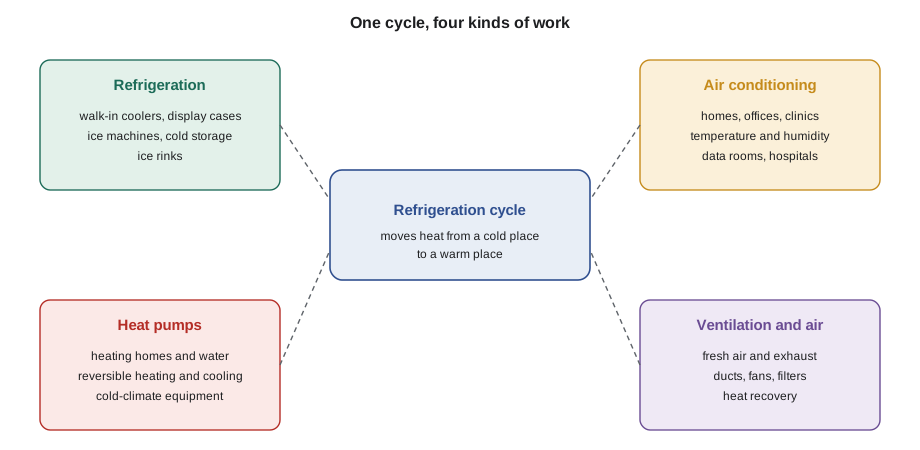
Within those areas, technicians specialize. Residential technicians install and service furnaces, central air conditioners, heat pumps and ductless systems. Commercial refrigeration technicians work on walk-ins, display cases, ice machines and the parallel rack systems in supermarkets. Light commercial technicians look after rooftop units on stores and offices. Large-system technicians run and repair chillers, cooling towers and building automation in hospitals, universities and towers. Industrial technicians work on ammonia and carbon dioxide systems in cold storage warehouses, food plants and arenas. The principles in this course are the same for all of them.
| Sector | Typical equipment | Typical customer at Northfield |
|---|---|---|
| Residential | Furnaces, central air conditioners, heat pumps, ductless systems, heat recovery ventilators | Homes in the suburbs and older houses downtown |
| Light commercial | Rooftop units, split systems, small walk-in coolers | The dental clinic and the two restaurants |
| Commercial refrigeration | Walk-in coolers and freezers, display cases, ice machines, rack systems | The craft brewery and a neighborhood grocery |
| Large systems | Chillers, cooling towers, air handlers, building automation | The seniors' residence central plant |
| Industrial | Ammonia and carbon dioxide systems, large freezers, rinks | The community ice arena |
How refrigeration changed the world
For most of history, the only cold available was natural cold. People cut ice from lakes in winter and stored it in insulated ice houses packed with sawdust. By the nineteenth century, ice harvesting was a large industry: ice was shipped by rail and by sea to cities and to hot climates, and an iceman delivered blocks to household ice boxes. Natural ice had obvious problems. A warm winter meant a shortage, the supply depended on the weather and distance, and ice cut from polluted lakes and rivers was not clean.
Mechanical refrigeration grew from scientific work on evaporation and gases. Scientists had known since the eighteenth century that evaporating liquids absorb heat, which is why sweat cools the skin. In 1834, Jacob Perkins patented a closed vapor-compression machine: a liquid evaporated at low pressure to absorb heat, a pump compressed the vapor, and the vapor condensed back to liquid at high pressure, giving its heat away. That is still the basic cycle in almost every refrigerator, air conditioner and heat pump made today. Through the second half of the century, engineers built practical machines using ether, ammonia and carbon dioxide, and Carl von Linde's ammonia machines of the 1870s made reliable industrial refrigeration possible for breweries, meat packers and cold stores.
The twentieth century brought refrigeration into homes and comfort cooling into buildings. In 1902, Willis Carrier designed a system to control humidity in a printing plant, and the idea of controlling both temperature and moisture became modern air conditioning. Household refrigerators replaced ice boxes from the 1920s onward. Early household machines used toxic or flammable refrigerants such as sulfur dioxide, methyl chloride and ammonia, and leaks injured and killed people. Chemists searched for a safer working fluid and, around 1930, introduced the chlorofluorocarbons, or CFCs, which were non-toxic, non-flammable and stable. CFCs made refrigeration safe enough for every kitchen and became the standard refrigerants for half a century.
The stability that made CFCs safe in a kitchen turned out to be the problem. In the 1970s, scientists showed that CFCs released into the air drift intact to the stratosphere, where ultraviolet light breaks them apart, and the freed chlorine destroys ozone, the layer that screens out harmful ultraviolet radiation. The Montreal Protocol of 1987 began the phase-out of CFCs and later of the HCFCs that replaced them. Their replacements, the HFCs, do not harm ozone but are powerful greenhouse gases, so the Kigali Amendment of 2016 began a phasedown of HFCs too. Refrigerants, and the rules for handling them, are still changing, which is why this program has a whole course on them.
| Period | Development | Why it mattered |
|---|---|---|
| Before about 1850 | Natural ice harvested from lakes and stored in ice houses | Cold depended on the winter and on distance from the lakes |
| 1834 | Jacob Perkins patents a closed vapor-compression machine | The basic cycle still used today |
| 1870s | Practical ammonia machines for breweries, meat packing and cold stores | Reliable industrial refrigeration |
| 1902 | Willis Carrier designs humidity control for a printing plant | The start of modern air conditioning |
| 1920s to 1930s | Household refrigerators; CFCs introduced around 1930 | Safe refrigeration for every kitchen |
| 1987 | Montreal Protocol | Phase-out of CFCs and then HCFCs to protect the ozone layer |
| 2016 | Kigali Amendment | Phasedown of high-GWP HFCs |
It is hard to overstate how much refrigeration changed daily life. Food can be stored safely for weeks and shipped across continents, which cut food poisoning and food waste and changed what people eat. Vaccines and many medicines depend on a cold chain from the factory to the clinic. Air conditioning made hot regions livable year-round, made tall glass office buildings possible, and keeps hospitals, laboratories and data centers running. Heat pumps are now one of the main tools for cutting the emissions from heating buildings. All of it runs on equipment that someone has to install, charge, repair and maintain.
The technician's job
A day at Northfield shows what that job involves. In the morning, Dana and Theo cleaned the condenser coil on the brewery's walk-in cooler, which had been running long and warm because the coil was packed with dust and malt husk. Before lunch they replaced a failed capacitor on a homeowner's outdoor unit. In the afternoon, they started up a new ductless heat pump in a renovated attic, which meant pressure testing the new piping, pulling a deep vacuum, releasing the factory charge and checking the system's temperatures and pressures. The last call was an alarm at the dental clinic, where the rooftop unit had tripped on a high-pressure control.
Each of those calls used the same skills: measuring temperatures and pressures, reading what they say about the refrigerant inside, and comparing the result with how the system should behave. A technician who knows the theory can look at two gauges and a thermometer and tell whether a system is short of refrigerant, overcharged, starved of airflow or suffering from a dirty condenser. A technician who does not know the theory replaces parts until the problem goes away, which costs the customer money and often fails. Dana put it bluntly: "The gauges tell you everything if you know the language. This course is the language."
The trade also carries real hazards, and safe habits start on the first day. Refrigerant systems run at pressures several times higher than a car tire. Liquid refrigerant released onto skin can cause frostbite in seconds. Many refrigerants are heavier than air and can displace oxygen in a basement or machine room. Some newer refrigerants are mildly flammable and a few are highly flammable. The work involves high-voltage electricity, brazing torches, rooftops and ladders, and heavy equipment. Theo's first assignment was to read the company's safety program, and every lesson in this course points out where the physics connects to a hazard.
Becoming a refrigeration mechanic
In the United States, there is no single national license for HVAC-R work. Licensing is set by states and sometimes by cities and counties. Kentucky licenses HVAC journeymen and master HVAC contractors through the state, with experience requirements and exams, and Louisville enforces those licenses on permits it issues. Many technicians learn through a registered apprenticeship that combines several years of paid on-the-job training with classroom hours; others take a college or trade school program and then build experience. One requirement is national: under Section 608 of the Clean Air Act, anyone who maintains, services, repairs or disposes of equipment that could release refrigerant must hold EPA Section 608 certification, which RAC-120 prepares you for.
Either way, the path is long because the job is broad. A refrigeration mechanic is part mechanic, part electrician, part pipefitter and part diagnostician, and needs enough science to understand why a system behaves the way it does. This program is built in that order: principles first, then refrigerant handling, electrical work, components, metering and charging, controls, and finally the specialized systems and the certification review.
Worked problem
How much heat does a refrigerator move?
A household refrigerator draws 150 W of electrical power while its compressor runs. Its manufacturer's data says it moves heat out of the cabinet at about 1.5 times the rate it uses power. How much heat does it remove from the cabinet, and how much heat does it reject into the kitchen, while it runs?
Show solution
- \[Q_{\text{removed}} = 1.5 \times 150\ \text{W} = 225\ \text{W}\]
- \[Q_{\text{rejected}} = Q_{\text{removed}} + W = 225 + 150 = 375\ \text{W}\]
Answer: It removes about 225 W from the cabinet and rejects about 375 W into the kitchen. The kitchen gets warmer, not cooler, which is why opening the refrigerator door to cool a room never works: the heat goes in a circle, and the motor's power is added on top.
That example contains the whole idea of the trade in two lines. The heat removed from the cold space plus the work put in by the compressor equals the heat rejected to the warm space. Lesson 11 returns to this energy balance as the coefficient of performance, the number that tells a customer how much heat they get moved for each unit of electricity they buy.
Dana had Theo work the same balance for the brewery's walk-in cooler as a habit. The cooler's condensing unit sits on the roof, and in summer it rejects the heat from inside the box, plus the compressor's power, plus the heat from the fans, all into the air above the building. When the coil is dirty, the unit cannot get rid of that heat fast enough, the pressures climb, the compressor works harder, and the box warms. Seeing the system as a heat pump with a source and a sink is the first step to diagnosing it.
# Energy balance for a refrigeration machine: heat in + work in = heat out
machines = [
    ("household refrigerator", 150, 1.5),
    ("brewery walk-in cooler", 1100, 2.4),
    ("ductless heat pump (cooling)", 900, 3.8),
]
print(f"{'machine':30s} {'power W':>8s} {'removed W':>10s} {'rejected W':>11s}")
for name, power, ratio in machines:
    removed = ratio * power      # heat pumped out of the cold space
    rejected = removed + power   # all of it ends up in the warm space
print(f"{name:30s} {power:8.0f} {removed:10.0f} {rejected:11.0f}")machine power W removed W rejected W household refrigerator 150 225 375 brewery walk-in cooler 1100 2640 3740 ductless heat pump (cooling) 900 3420 4320
The program prints the same balance for three machines Theo saw in his first week. The ratio, heat removed per unit of power, is the coefficient of performance, and it varies widely: the ductless heat pump moves almost four times its own power in heat, while the refrigerator moves only one and a half. Later lessons show where those differences come from.
How this course is organized
The twelve lessons of this course build the language Dana talked about. Lessons 2 to 4 cover the physics: energy and heat transfer, temperature, sensible and latent heat, and pressure, vacuum and gauges. Lesson 5 brings them together in the pressure-temperature relationship, the single most important idea for reading gauges. Lessons 6 and 7 follow refrigerant around the vapor-compression cycle and introduce superheat and subcooling. Lesson 8 surveys the refrigerants themselves. Lesson 9 draws the cycle on a pressure-enthalpy diagram, the map engineers and technicians use to see what a system is doing. Lesson 10 introduces the four main components. Lesson 11 covers refrigeration load, capacity and performance, and Lesson 12 introduces psychrometrics, air conditioning and the first tools of the trade.
The course uses numbers throughout, and each lesson has worked examples and short Python programs that do the arithmetic a technician does in the field or that a manufacturer's app does on a phone. Property values for refrigerants are given as approximate values for teaching, rounded from standard tables. In the field, technicians read them from the pressure-temperature chart for the exact refrigerant, from the equipment manufacturer's data or from a digital gauge set that carries the tables.
This course uses the units American technicians use every day: pounds per square inch, degrees Fahrenheit, British thermal units and tons. Some equipment data, especially for imported equipment, is given in SI units, and Lesson 11 shows how to convert.
Common mistakes
MistakeThinking a refrigerator or air conditioner makes cold.
InsteadIt moves heat from a cold place to a warm one. Cold is just the absence of heat; the machine pumps the heat away.
MistakeThinking the heat rejected outdoors equals the heat removed indoors.
InsteadThe rejected heat is larger: it includes the compressor's work as well as the heat removed.
MistakeTreating refrigerant history as trivia.
InsteadEach refrigerant change came from a safety or environmental problem, and the rules that followed shape what technicians may do today.
MistakeLearning to replace parts before learning the cycle.
InsteadDiagnosis depends on reading pressures and temperatures, which depends on understanding the cycle.
Summary and key terms
- HVAC-R covers refrigeration, air conditioning, heat pumps and ventilation, all built on the same heat-moving cycle.
- Refrigeration moved from harvested ice to mechanical vapor-compression machines in the nineteenth century, and into homes and buildings in the twentieth.
- Refrigerants changed from toxic and flammable early fluids to CFCs, then HCFCs and HFCs, and now to low-GWP fluids, under the Montreal Protocol and the Kigali Amendment.
- Heat rejected by a machine equals the heat it removes plus the work it uses.
- In the US, states and cities license HVAC work, and EPA Section 608 certification is required nationally for refrigerant work.
- Refrigeration
- Moving heat out of a space or product to keep it below the temperature of its surroundings.
- Heat pump
- A machine that uses the refrigeration cycle to move heat into a building or water, often reversible for cooling.
- Vapor-compression cycle
- The cycle of evaporation, compression, condensation and expansion that moves heat in almost all refrigeration equipment.
- CFC
- Chlorofluorocarbon, an early stable refrigerant family phased out because it destroys stratospheric ozone.
- HFC
- Hydrofluorocarbon, a refrigerant family with no ozone depletion but a high global warming potential, now being phased down.
- Montreal Protocol
- The 1987 international treaty that phases out ozone-depleting substances; its 2016 Kigali Amendment phases down HFCs.
Practice problems
Work each problem on paper first, then reveal the answer to check.
A freezer removes 300 W of heat from its cabinet while its compressor uses 200 W. How much heat does it reject?
Show answer
300 + 200 = 500 W.
Why did early household refrigerants cause injuries?
Show answer
Several, such as sulfur dioxide, methyl chloride and ammonia, were toxic or flammable, and leaks in homes harmed people.
What problem did HFCs solve, and what problem do they have?
Show answer
They do not deplete ozone, but they are powerful greenhouse gases, so they are being phased down.
Name the four areas of HVAC-R work.
Show answer
Refrigeration, air conditioning, heat pumps and ventilation (air distribution).
Lesson quiz · 5 questions
Score 60% or more to complete this lesson.
Create a free account to save your progress, take quizzes and earn a certificate.