
PYTH-270 · Lesson 9 of 12 · 26 min
Working with legacy code
▶ Video coming soon A video version of this lesson is on the way.
Most professional programming is not writing new code on a blank page. It is changing code that already exists, was written by someone else, possibly years ago, often under deadline, and usually without the documentation or tests you would like. Michael Feathers, in his book Working Effectively with Legacy Code, gave a blunt definition: legacy code is simply code without tests. By that definition, Ridgeline's process_order, written in a hurry two years ago and never tested, is legacy code, even though Jordan wrote it.
The earlier lessons showed what good design looks like. This lesson is about getting there from where you actually are, safely, without a risky rewrite and without stopping the business. Ridgeline cannot close the online shop for a month while Jordan redesigns it. The techniques here, characterization tests, seams, sprouting and wrapping new code, small refactorings and the strangler fig, let a team improve a design one safe step at a time while continuing to ship features.
The temptation to rewrite
Faced with process_order, Sam's first suggestion was to throw it away and write a clean version from scratch. Lena told him why that rarely works. The old code, however ugly, contains years of small decisions and fixes: the rounding rule the accountant insisted on, the special case for the Alder Hotel's net-60 terms, the workaround for the payment provider's habit of timing out on Mondays. Many of those decisions are written down nowhere else. A rewrite tends to lose them, takes longer than planned, and must chase a moving target as the old system keeps changing.
Joel Spolsky called the full rewrite the single worst strategic mistake a software company can make. That is too strong as a rule, since sometimes replacement really is right, but the usual better path is incremental: put tests around the existing behavior, improve the structure in small steps, and replace parts gradually while the system keeps running.
The legacy change algorithm
Feathers describes a routine for changing legacy code safely. First, identify the change points: the places where the change must be made. Second, find test points: places where you can observe the behavior of the code around the change. Third, break dependencies that prevent you from getting that code into a test, such as a hard-coded database connection or a call to the real clock. Fourth, write tests that pin down the current behavior. Fifth, make the change and refactor, with the tests telling you whether anything else changed.
The third step is where most of the difficulty lies, and the fourth is where most people skip ahead. Without tests, every refactoring is a gamble; with them, the structure can change boldly because mistakes show up in seconds.
Characterization tests
When you do not know exactly what code is supposed to do, you can still record what it does. A characterization test, sometimes called a golden master or snapshot test, runs the existing code on a range of inputs and records the outputs, then asserts that the code keeps producing them. It documents actual behavior, not intended behavior, including any bugs, because the first goal is to change the structure without changing the behavior. Bugs found along the way are noted and fixed afterwards, as separate, deliberate changes.
def legacy_total(kind, qty, price, code=""):
    t = qty * price
    if kind == "W":
        t = t - t * 15 / 100
    if kind == "O" and code == "WELCOME10":
        t = t * 0.9
    if kind == "O" and t < 50:
        t = t + 8.95
    return round(t, 2)

cases = [("C", 2, 18.5), ("O", 1, 18.5), ("O", 3, 18.5), ("W", 10, 18.5),
         ("O", 1, 18.5, "WELCOME10"), ("O", 3, 18.5, "WELCOME10"), ("X", 1, 18.5)]
golden = {case: legacy_total(*case) for case in cases}
for case, result in golden.items():
print(case, "->", result)('C', 2, 18.5) -> 37.0
('O', 1, 18.5) -> 27.45
('O', 3, 18.5) -> 55.5
('W', 10, 18.5) -> 157.25
('O', 1, 18.5, 'WELCOME10') -> 25.6
('O', 3, 18.5, 'WELCOME10') -> 58.9
('X', 1, 18.5) -> 18.5Look closely at the output and you will find surprises worth recording: an unknown customer type X is silently treated like a cafe customer, and the promotion code is applied before the shipping threshold, so a discount can push an order below 50 and add a shipping fee. Rosa may decide those are bugs, but that is a separate decision. The golden master makes sure the refactoring does not change them by accident.
Try it yourself
Refactor without changing behavior
The setup contains a hidden copy of legacy_total(kind, qty, price, code="") from the listing above. Write new_total(kind, qty, price, code="") with a clearer structure: named constants, a dictionary of customer-type discounts, and separate small steps for the promotion and shipping.
The tests compare new_total with legacy_total on hundreds of inputs, including the odd cases, so the behavior must match exactly.
def new_total(kind, qty, price, code=""):
    t = qty * price
    if kind == "W":
        t *= 0.85
    if kind == "O":
        if t < 50:
            t += 8.95
        if code == "WELCOME10":
            t *= 0.9
    return round(t, 2)
Seams: places to change behavior without editing
Feathers defines a seam as a place where you can alter behavior without editing the code in that place. Seams are how you get legacy code into a test: you replace a dependency that would send real emails, charge real cards or read the real clock with something the test controls. Python offers several kinds. A parameter seam adds a parameter with a default, as in lesson 2's clock injection. An object seam passes in an object whose methods can be replaced. A module seam replaces a module-level name during a test, which is what unittest.mock.patch and pytest's monkeypatch do.
Module seams are the quickest way to start testing untouchable code, but they test the code as it is, tangled dependencies and all. Parameter and object seams improve the design as they go, because they make dependencies explicit. A good habit is to use patching to get the first characterization tests in place, then introduce proper parameters and remove the patches as the code improves.
import datetime

SENT = []

def send_email(to, text):          # imagine this talks to a real mail server
    SENT.append((to, text))

def remind_stale_bags(bags):
    """Legacy: reads the real clock and sends real email."""
    for bag in bags:
        if (datetime.date.today() - bag["roasted"]).days > 30:
            send_email("kai@ridgeline.example", f"{bag['sku']} is past its sell-by window")

# A module seam for a first test: replace send_email with a fake while the test runs.
from unittest import mock
captured = []
with mock.patch(f"{__name__}.send_email", lambda to, text: captured.append(text)):
    remind_stale_bags([{"sku": "RC-104", "roasted": datetime.date(2000, 1, 1)}])
print(captured)
print(SENT, "(the real send_email was never called)")['RC-104 is past its sell-by window'] [] (the real send_email was never called)
Try it yourself
Introduce parameter seams
remind_stale(bags) reads the real clock with date.today() and calls the module-level send_email. Change it to remind_stale(bags, today=None, send=None): when today is None use date.today(), and when send is None use send_email.
Bags more than 30 days past their roasted date trigger send("kai@ridgeline.example", "<sku> is past its sell-by window"). Return the number of reminders sent. Existing callers that pass only bags must keep working.
from datetime import date

OUTBOX = []

def send_email(to, text):
    OUTBOX.append((to, text))

def remind_stale(bags):
    count = 0
    for bag in bags:
        if (date.today() - bag["roasted"]).days > 30:
            send_email("kai@ridgeline.example", f"{bag['sku']} is past its sell-by window")
            count += 1
    return count
Sprout and wrap: adding features without making it worse
Sometimes you must add a feature to legacy code before you can test or refactor it properly. Two techniques keep the new code clean even when the surrounding code is not. Sprout method: write the new behavior as a new, fully tested function, and add one line in the legacy code to call it. Wrap method: rename the old function, and create a new function with the old name that calls it and adds the new behavior before or after. Both keep the new logic out of the tangle, so the tangle does not grow and the new code starts life with tests.
When Rosa asked for gift wrapping at 4.50 per wrapped item, Jordan did not add another branch inside process_order. He wrote gift_wrap_fee(items) as a pure function with its own tests, then added one line to process_order that adds its result to the total. When process_order is finally refactored, the fee function will move into the new design unchanged.
Try it yourself
Sprout a tested function
Sprout a new function gift_wrap_fee(items) where items is a list of (sku, qty, wrapped) tuples: the fee is 4.50 for each wrapped unit, so a line of 3 wrapped bags costs 13.50. Return the fee rounded to 2 decimal places.
Then add one line to the legacy checkout_total(items) so that it adds gift_wrap_fee(items) to the subtotal before rounding. Prices come from the provided PRICES dictionary.
PRICES = {"RC-101": 18.50, "RC-102": 22.00, "RC-104": 20.25}

def checkout_total(items):
    subtotal = 0
    for sku, qty, wrapped in items:
        subtotal = subtotal + PRICES[sku] * qty
    return round(subtotal, 2)
Small, safe refactorings
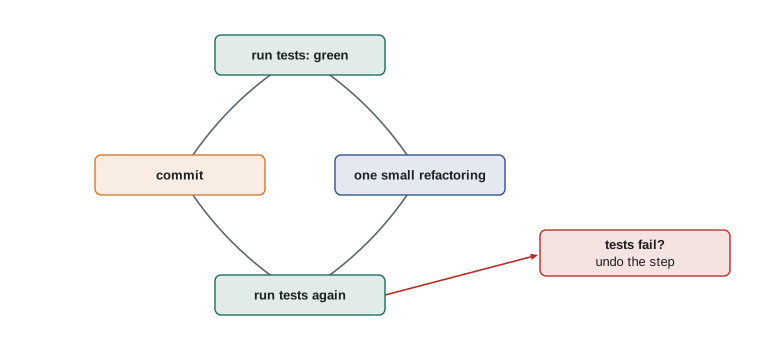
With tests in place, structure improves through a sequence of small refactorings, each of which keeps the code working. Martin Fowler's book Refactoring catalogs dozens; a handful do most of the work. Extract function pulls a coherent block into a named function. Rename gives a variable or function a name that says what it means. Introduce parameter object replaces a long list of parameters that travel together with a dataclass. Replace conditional with polymorphism or a dictionary turns a repeated if-chain on a type code into strategies. Move function puts code next to the data it uses.
Each step should be small enough that, if the tests fail, the cause is obvious, and each should be a separate commit in version control with a clear message, so any step can be reviewed or undone on its own. Editors and tools such as PyCharm's refactoring menu or the rope library can perform renames and extractions automatically and safely across a whole project.
The strangler fig
For replacing large parts of a system, Martin Fowler borrowed an image from rainforests: the strangler fig, a vine that grows around a host tree, gradually taking over until the old tree can be removed. Applied to software, you put a thin routing layer in front of the old code, build new functionality beside it, and send more and more requests to the new code until nothing reaches the old code and it can be deleted. At every point the system works, and the riskiest moment of a big-bang switch-over never happens.
Ridgeline's checkout uses this approach. A small function, checkout(order), first sent only wholesale orders to the new OrderService and everything else to process_order. Once wholesale had run without problems for two weeks, online orders followed, then cafe sales, and finally process_order was deleted in a commit that Jordan describes as the most satisfying of his career.
def process_order_legacy(order):
    return f"legacy handled {order['kind']} order {order['id']}"

def new_order_service(order):
    return f"new service handled {order['kind']} order {order['id']}"

MIGRATED = {"wholesale"}                 # grows as each kind is moved over

def checkout(order):
    """The strangler: one routing point in front of old and new code."""
    if order["kind"] in MIGRATED:
        return new_order_service(order)
    return process_order_legacy(order)

orders = [{"id": 2101, "kind": "wholesale"}, {"id": 2102, "kind": "online"}]
for o in orders:
    print(checkout(o))
MIGRATED.add("online")
print(checkout(orders[1]))new service handled wholesale order 2101 legacy handled online order 2102 new service handled online order 2102
Worked problem
Planning a safe change to legacy code
Rosa wants process_order to support subscription orders, which get 10 off and free shipping. process_order has no tests and calls the real payment provider. Jordan plans the work with Lena.
Show solution
- Change point: the pricing section of process_order; test point: its return value and the charge it requests.
- Break the dependency: introduce an object seam by passing the payment provider in as a parameter with the current provider as the default.
- Characterize: record outputs for cafe, online, wholesale and promotion cases with a fake provider, as a golden master.
- Sprout: write subscription_price(subtotal) as a new, tested pure function, and add one line calling it for subscription orders.
- Refactor in small steps under the golden master, committing each, and plan the strangler route for the full OrderService.
Answer: Find the change point, add a seam, write characterization tests, sprout the new rule, then refactor in small committed steps.
Common mistakes
MistakeRewriting a working legacy system from scratch.
InsteadImprove it incrementally, and replace parts gradually with a strangler fig.
MistakeRefactoring code that has no tests.
InsteadWrite characterization tests first, even if they only record current behavior.
MistakeFixing bugs in the middle of a refactoring.
InsteadRecord the bug, finish the behavior-preserving step, then fix it as a separate change.
MistakeAdding new branches inside an already tangled function.
InsteadSprout a new tested function, or wrap the old one.
MistakeLeaving mock.patch calls in place forever.
InsteadUse patching to get started, then introduce parameter or object seams and remove the patches.
MistakeMaking one huge refactoring commit.
InsteadTake small steps, run the tests after each, and commit each separately.
Summary and key terms
- Legacy code is code without tests; most professional work changes such code.
- Full rewrites often lose hidden knowledge and overrun; incremental improvement is usually safer.
- The legacy change algorithm: find change points and test points, break dependencies, write tests, then change and refactor.
- Characterization tests record what code actually does so refactoring cannot change it by accident.
- Seams let tests replace dependencies: parameters, objects, or patched module names.
- Sprout and wrap add features in new, tested code without growing the tangle.
- Refactor in small steps with tests and commits; the strangler fig replaces large parts gradually.
- legacy code
- Code without tests, in Michael Feathers's definition.
- characterization test
- A test that records and preserves the current behavior of existing code.
- golden master
- A recorded set of outputs used to detect any change in behavior.
- seam
- A place where behavior can be changed without editing the code there.
- parameter seam
- A seam created by adding a parameter, often with a default, for a dependency.
- monkeypatching
- Replacing a name in a module or object at run time, usually in tests.
- sprout method
- Adding new behavior as a new tested function called from legacy code.
- wrap method
- Renaming a function and wrapping it in a new function that adds behavior.
- extract function
- A refactoring that moves a block of code into a new named function.
- strangler fig
- Gradually routing functionality from an old system to a new one until the old one can be removed.
Practice problems
Work each problem on paper first, then reveal the answer to check.
What is Michael Feathers's definition of legacy code?
Show answer
Code without tests.
Should a characterization test assert the intended behavior or the actual behavior?
Show answer
The actual behavior, including bugs, so refactoring changes nothing by accident.
Name three kinds of seam available in Python.
Show answer
Parameter seams, object seams and module seams through patching.
When would you sprout a method instead of editing the legacy function directly?
Show answer
When adding a feature to code that cannot yet be tested or refactored, to keep the new logic clean and tested.
Why commit after each small refactoring?
Show answer
So each step can be reviewed or undone on its own, and failures are easy to trace.
What is the main advantage of the strangler fig over a big-bang replacement?
Show answer
The system works at every point and the switch-over happens gradually, so there is no single risky cut-over.
Lesson quiz · 5 questions
Score 60% or more to complete this lesson.
Create a free account to save your progress, take quizzes and earn a certificate.