
PRIN-160 · Lesson 3 of 12 · 25 min
How Practitioner questions are written
Practitioner questions are built around a project, not a definition. Each one asks you to apply the method to what is happening in the scenario: whether an action is appropriate, which product should contain some information, which role should make a decision, or how the method should be tailored. PRIN-150 introduced a five-step method for scenario questions. This lesson looks at the questions themselves, style by style, so that you know what each style is testing and where marks are usually lost. Ana's practice on a scenario built from the Ridgeline treatment plant upgrade runs through the lesson.
The scenario booklet and additional information
The booklet describes an organization, a project and its people, usually with extracts from management products such as a business case summary, a project product description, a stage plan or a risk register. Questions refer to the booklet and some add further information that applies only to that question or that section. Additional information changes the situation for those questions only, so it should not be carried forward to others. A simple habit prevents a common error: when you read additional information, write the question numbers it applies to in the margin of your answer notes.
The booklet is written to contain both good and poor practice. A project manager in the scenario may produce a risk register with no owners, or a board may ask for weekly highlight reports on a small project. Questions then ask you to judge those choices. Do not assume that everything described in the booklet is correct; the scenario is a test bed, not a model answer.
| Booklet element | What questions do with it |
|---|---|
| Organization and context | Test who the business layer is and what tailoring the context justifies |
| Project management team | Test whether roles are combined appropriately and who can decide |
| Management product extracts | Test whether a product contains the right information, or which product should |
| Recent events | Test which process is running and what should happen next |
| Additional information per question | Changes the situation for those questions only |
Classic multiple choice
Classic questions carry one mark and have four options with one correct answer. They are the closest to Foundation in form, but the stem almost always refers to the scenario: 'The project manager has done X. Which statement is correct?' or 'Which is the most appropriate action for the project manager to take?' The key is the option that best fits PRINCE2 as tailored for this project. Two options are often defensible in general; the scenario detail decides between them.
Words such as most appropriate, least appropriate, best, first and next matter. 'First' asks for the immediate step, which is often capturing or examining an issue before deciding anything. 'Next' assumes the previous step has been done. 'Least appropriate' reverses the whole question. Read the stem twice before reading options, as in Foundation.
Yes or no, because
Some classic questions present a statement about the scenario and ask whether it is appropriate, with four options of the form 'Yes, because ...' and 'No, because ...'. You earn the mark only if both the judgment and the reason are right. This style catches candidates who get the judgment right for the wrong reason. Two options will usually share the right judgment with different reasons, and only one reason will be a genuine PRINCE2 justification for this scenario.
| Option | Judgment | Reason | Correct? |
|---|---|---|---|
| A | Yes | Because the executive must always chair the board | No: true-sounding but irrelevant and absolute |
| B | Yes | Because the senior supplier role can be held by more than one person, with conflicts managed | Yes: the judgment and reason fit the scenario |
| C | No | Because only one person can hold each board role | No: the reason is false |
| D | No | Because suppliers should not sit on the board | No: suppliers are represented by the senior supplier role |
The technique is to decide the judgment first from your own analysis, then compare the reasons offered for that judgment. If none of the reasons for your judgment is valid, revisit the judgment: occasionally the scenario contains a detail you missed.
Matching questions
Matching questions carry three marks. You are given three items, such as three situations, three pieces of information or three actions, and a list of five or six options, such as products, roles or processes. Each item is matched to one option, and an option may be used once, more than once or not at all. Each correct match earns one mark, so partial credit is possible.
The phrase 'once, more than once or not at all' is important. Candidates sometimes assume each option is used once, as in a puzzle, and talk themselves out of a correct answer because they have already used that option. Treat each item as an independent one-mark question that happens to share a list.
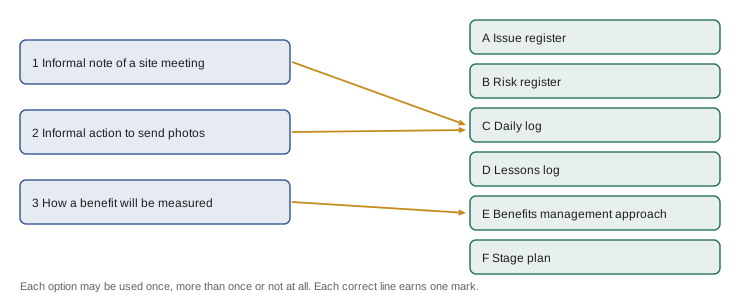
| Item (treatment plant, stage 3) | Options: A Issue register; B Risk register; C Daily log; D Lessons log; E Stage plan; F Benefits management approach | Answer |
|---|---|---|
| The project manager notes that a site meeting with the regulator went well and records an informal action to send photos. | Informal actions and notes are recorded in the project manager's diary of events | C |
| The project manager records that the concrete supplier may raise prices next quarter, with an owner and response. | An uncertain future event with an owner and response | B |
| The project manager records how the reduced filter backwash water will be measured after handover. | How and when benefits will be measured | F |
Questions about tailoring
Practitioner questions frequently test tailoring, because tailoring is a principle and applying it is the core Practitioner skill. Typical stems ask whether a tailoring decision in the scenario is appropriate, or which tailoring would be most appropriate for a described situation. The test is always the same: does the decision keep the purpose of the element while changing its form, frequency or formality to suit the project? A combined product, a lighter report, or a shared role can all be appropriate; removing a decision point, an accountability or the business justification is not.
On the treatment plant, Ana's board meets around the city council cycle and the state revolving fund's approval timetable, so the stage boundaries are tailored to those decision points. A question that criticizes the boundaries for being uneven in length would be wrong, because management stages are set by decision points, not by calendar regularity.
How partial marks add up
Because matching questions award a mark per item, a candidate who is confident about two of the three items should still answer the third with a reasoned choice. The program below compares the expected score from blind guessing with the score from careful elimination on a mixed paper, to show why it is worth working every item.
classic, matching = 40, 10           # an illustrative mix: 40 one-mark questions, 10 three-mark questions
marks = classic + 3 * matching
print(f"total marks: {marks}")

def expected(p_classic, p_match_item):
    return classic * p_classic + matching * 3 * p_match_item

print(f"blind guessing: {expected(0.25, 1/6):.1f} marks")
profiles = {"weak": (0.55, 0.50), "borderline": (0.62, 0.58), "solid": (0.72, 0.70)}
for name, (pc, pm) in profiles.items():
    e = expected(pc, pm)
    verdict = "pass" if e >= 42 else "fail"
print(f"{name:<11} classic {pc:.0%}, matching items {pm:.0%}: expected {e:.1f} -> {verdict}")total marks: 70 blind guessing: 15.0 marks weak classic 55%, matching items 50%: expected 37.0 -> fail borderline classic 62%, matching items 58%: expected 42.2 -> pass solid classic 72%, matching items 70%: expected 49.8 -> pass
Blind guessing averages about 15 marks, far below the pass mark. A borderline candidate, right on 62 % of classic questions and 58 % of matching items, expects about 42, which is exactly the pass mark. Small improvements in accuracy on matching items carry triple weight, which is why lesson 11 recommends practicing matching questions deliberately.
Ana's first scenario paper
Ana sat a timed practice paper based on a utility scenario and scored 39 of 70. Her review found three patterns. Seven marks went on 'yes or no, because' questions where she picked the right judgment with the wrong reason. Six went on matching questions where she refused to reuse an option. Five went on questions where she applied the standard method and ignored tailoring stated in the booklet. None of these were knowledge gaps; all were technique. Her next two papers scored 46 and 52.
Worked problem
A tailoring judgment
Additional information for questions 20 to 24: the treatment plant board has agreed that, during construction stages, the project manager will send a highlight report every month and a one-page dashboard every two weeks to the executive only. Question 22 asks: 'Is it appropriate for the executive alone to receive the fortnightly dashboard?'
Show solution
- Locate: construction stages, controlling a stage, reporting.
- Classify: tailoring of the progress practice and communication.
- Rule: highlight reports go to the board at agreed intervals; additional reporting can be tailored as long as the board receives what it needs to direct by exception.
- Apply: the monthly highlight report still goes to the whole board; the fortnightly dashboard is extra information agreed with the executive.
- Choose the reason that matches: yes, because the board as a whole still receives regular highlight reports and the extra dashboard is an agreed tailoring for the executive's needs.
Answer: Yes, because the board still receives highlight reports at the agreed interval and the extra dashboard is a legitimate tailoring.
Questions about products in the booklet
Many Practitioner questions quote an extract from a management product in the scenario booklet and ask whether its content is appropriate. A risk register extract might show a risk with no owner, a threat described as an issue, or a response that is really a description of the risk. A highlight report extract might contain decisions that belong to the board, or omit the forecast against tolerances. To answer these questions, compare the extract with the purpose and composition of that product as the manual describes it. The test is not whether the extract is complete in every detail, because tailoring allows lighter products, but whether it does the job the product exists to do for this project.
Ana built a short checklist for product questions. What is the product for? Who produces it, and who receives or approves it? Does the extract contain information that belongs in a different product? Does it miss something the product must provide for this project's decisions? Is the format a legitimate tailoring, such as a dashboard in place of a written report? With the checklist, she found that most product questions could be answered from knowledge, with the manual used only to confirm a specific composition detail. Her scores on product questions rose from about half to about three quarters over two practice papers.
A final point about wording: the booklet and the options use PRINCE2 7 terms, and the examiners expect you to recognize them precisely. A 'change control approach' is not the same as an 'issue register', and a 'stage plan' is not the same as a 'work package'. When an option uses a term that is close to, but not the same as, the one the question needs, treat it as a probable distractor.
Common mistakes
MistakeCarrying additional information into questions it does not apply to.
InsteadNote which questions each piece of additional information covers.
MistakeAssuming everything in the booklet is good practice.
InsteadJudge the scenario's choices against the method and its tailoring.
MistakeChoosing the right judgment with the wrong reason.
InsteadDecide the judgment, then test each reason offered for it.
MistakeRefusing to reuse an option in a matching question.
InsteadOptions may be used once, more than once or not at all.
MistakeIgnoring the difference between first, next, most and least.
InsteadReread the stem and answer what it asks.
Summary and key terms
- Practitioner questions apply the method to a scenario booklet, sometimes with extra information for specific questions.
- Classic questions are worth one mark; 'yes or no, because' questions need both judgment and reason right.
- Matching questions are worth three marks, one per item, and options may be reused or not used.
- The booklet contains good and poor practice to be judged, not copied.
- Tailoring questions test whether purpose is kept while form, frequency or formality changes.
- Matching items carry heavy weight, so small accuracy gains there matter.
- Classic question
- A one-mark question with four options and one correct answer.
- Matching question
- A three-mark question matching three items to a list of options.
- Yes or no, because
- A classic question in which both the judgment and the reason must be correct.
- Additional information
- Extra scenario detail that applies only to specified questions.
- Partial credit
- Marks earned for some but not all parts of a question.
- Most appropriate
- The option that best fits PRINCE2 as tailored for the scenario.
Practice problems
Work each problem on paper first, then reveal the answer to check.
How many marks is a classic question worth?
Show answer
One.
How many marks is a matching question worth, and how are they earned?
Show answer
Three, one for each correctly matched item.
Can a matching option be used twice?
Show answer
Yes; options may be used once, more than once or not at all.
What must be right in a 'yes or no, because' question?
Show answer
Both the judgment and the reason.
Does additional information apply to every question?
Show answer
No, only to the questions it specifies.
Is everything described in the booklet correct practice?
Show answer
No; the booklet includes choices to be judged.
Where are informal notes and actions recorded?
Show answer
In the daily log.
What decides the length of management stages?
Show answer
Decision points, not calendar regularity.
What is the expected score from blind guessing in the example mix?
Show answer
About 15 of 70.
Which three technique errors cost Ana marks?
Show answer
Wrong reasons in 'because' questions, refusing to reuse matching options, and ignoring stated tailoring.
Lesson quiz · 5 questions
Score 60% or more to complete this lesson.
Create a free account to save your progress, take quizzes and earn a certificate.