
PRIN-160 · Lesson 11 of 12 · 25 min
Timing, elimination, mock exams and error logs
Knowing the method is necessary but not sufficient. Candidates who know enough to pass still fail when they run short of time, misread questions under pressure, or practice in ways that feel productive but do not improve their scores. This lesson brings together the exam technique that turns knowledge into marks: time budgets for both exams, systematic elimination, how to build and sit mock exams, and how to keep an error log that tells you exactly what to study next. Dev and Ana's practice records show how much difference these habits make.
Time budgets
Foundation gives 60 minutes for 60 questions. Most prepared candidates finish in 35 to 45 minutes, so the budget is generous, but it is worth having checkpoints: question 20 by minute 18, question 40 by minute 36, and all 60 answered by minute 50, leaving ten minutes to review flagged questions. Candidates who finish very quickly should use the spare time to reread negative questions, which is where most careless errors hide.
Practitioner gives 150 minutes for 70 marks. PRIN-150 suggested about ten minutes to read the scenario booklet and fifteen minutes in reserve for review, leaving about 125 minutes, or roughly 1.8 minutes per mark. A three-mark matching question therefore gets about five and a half minutes, and a one-mark classic question just under two. Some sections are harder than others, so a progress check every half hour is more useful than timing every question.
| Exam | Checkpoint | Target |
|---|---|---|
| Foundation | Minute 18 | Question 20 answered |
| Foundation | Minute 36 | Question 40 answered |
| Foundation | Minute 50 | All 60 answered; review flagged questions |
| Practitioner | Minute 10 | Scenario booklet read and marked |
| Practitioner | Minute 70 | About 33 marks attempted |
| Practitioner | Minute 135 | All questions attempted; 15 minutes to review |
If you fall behind a checkpoint, the cause is almost always one of three things: long manual searches, rereading the scenario booklet for every question, or agonizing between two options. The cures are the ninety-second lookup limit from lesson 4, marking the booklet on the first read so you can return to the right section quickly, and the rule that a choice between two equally plausible options should take no more than a minute before you flag it and move on.
Systematic elimination
Elimination is more reliable than recognition under pressure. Rather than looking for the right answer, look for reasons each wrong answer is wrong. PRINCE2 distractors fall into recognizable families, and most options can be eliminated with one of five tests.
| Test | Eliminate options that... |
|---|---|
| Principle test | Break a principle, such as removing a board decision or the business justification |
| Role test | Give a decision or activity to the wrong role or level |
| Process test | Put an activity in the wrong process or at the wrong time |
| Product test | Put information in the wrong management product |
| Scenario test | Ignore the scenario's stated tailoring, tolerances or authority limits |
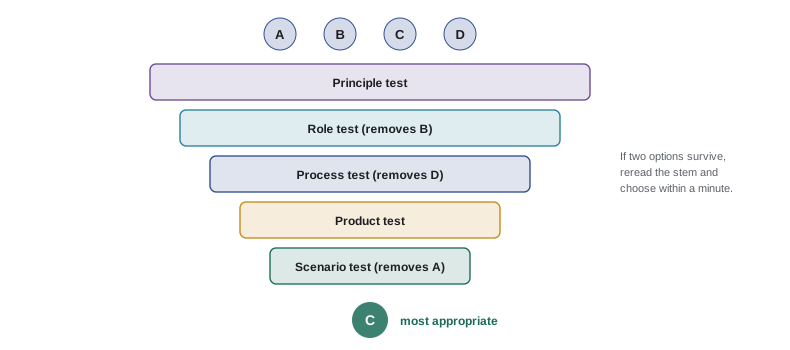
When two options survive all five tests, reread the stem. The difference is usually in a word such as first, next, most or least, or in a detail of the scenario that one option respects and the other ignores. If the difference is a checkable fact in Practitioner, a quick lookup may settle it. If not, choose, flag and move on.
Building and sitting mock exams
A mock exam is only useful if it is realistic. That means the same length, the same time limit, the same conditions and, for Practitioner, the same book. Sit it in one sitting, without notes, and without checking answers until the end. Partial mocks, open-ended review sessions and untimed practice all have their place, but they do not tell you whether you will pass.
Sources of practice questions vary in quality. Official sample papers from the examination institute are the closest to the real exam and should be saved for the later weeks, when they will give the most accurate reading of readiness. Questions written by training organizations and study guides add volume but may differ in style. Questions you write yourself, as PRIN-150 suggested, are excellent for understanding distractors, though not for measuring readiness. This course's quizzes and exam are original practice in the exam styles.
Two or three full mocks are usually enough for Foundation; four or five for Practitioner. More mocks without proper review tend to produce the same score repeatedly, because the candidate keeps making the same mistakes.
The error log
The error log is the single most useful study tool for exam preparation. For every question you get wrong in practice, and every one you got right by guessing, record the topic, the question style, and the reason for the error. Reasons fall into a few categories: did not know the fact, knew the fact but misapplied it to the scenario, misread the question, ran out of time, or changed a correct answer. Each category has a different cure.
| Error reason | Cure |
|---|---|
| Did not know the fact | Revise that topic; add it to a daily review sheet |
| Misapplied to the scenario | Practice the five-step method on more scenarios in that area |
| Misread the question | Use the reading routine; underline key words |
| Ran out of time | Use checkpoints and the lookup limit |
| Changed a correct answer | Change answers only for a specific reason, not a feeling |
Ana's error log after her second mock showed a clear pattern. Of 24 lost marks, 9 were misapplications on issues and change authority questions, 6 were misreadings of 'least appropriate', 5 were knowledge gaps on the products appendix and 4 were time pressure in the final section. She spent the next week on change authority scenarios and product composition drills, and her third mock rose from 46 to 52.
errors = [  # (topic, reason) for each lost mark in a mock, invented data
    ("issues", "misapplied"), ("issues", "misapplied"), ("issues", "misapplied"), ("progress", "misapplied"),
    ("issues", "misapplied"), ("risk", "misapplied"), ("issues", "misapplied"), ("organizing", "misapplied"),
    ("issues", "misapplied"),
    ("plans", "misread"), ("quality", "misread"), ("principles", "misread"), ("risk", "misread"),
    ("processes", "misread"), ("issues", "misread"),
    ("products", "unknown"), ("products", "unknown"), ("products", "unknown"), ("quality", "unknown"),
    ("products", "unknown"),
    ("processes", "time"), ("processes", "time"), ("progress", "time"), ("risk", "time"),
]
from collections import Counter
by_reason = Counter(r for t, r in errors)
by_topic = Counter(t for t, r in errors)
print(f"lost marks: {len(errors)}")
print("by reason:", ", ".join(f"{k} {v}" for k, v in by_reason.most_common()))
print("by topic: ", ", ".join(f"{k} {v}" for k, v in by_topic.most_common(4)))
top_reason, top_topic = by_reason.most_common(1)[0][0], by_topic.most_common(1)[0][0]
print(f"focus next week: {top_reason} errors, especially on {top_topic}")lost marks: 24 by reason: misapplied 9, misread 6, unknown 5, time 4 by topic: issues 7, products 4, risk 3, processes 3 focus next week: misapplied errors, especially on issues
The summary points to one clear priority: misapplication on issues questions. That is far more useful than 'revise everything', and it explains why targeted study raised Ana's score faster than another mock would have.
Changing answers
Research on multiple-choice exams generally finds that when candidates change answers for a reason, they more often move from wrong to right than the reverse. The popular advice to always trust your first instinct is not well supported. The useful rule is narrower: change an answer when you can name a specific reason, such as a misread word, a scenario detail you missed, or a fact you have now checked. Do not change it because the option you chose suddenly feels too easy.
Ana's employer counts exam preparation time toward the professional development hours in her annual plan, so she logs mock exams and error reviews alongside her other training. Keeping the error log in the same document made it easy to show her manager what she had studied.
Worked problem
Dev's timing problem
Dev's third Foundation mock scored 44, but he finished with only two minutes left and had not reviewed any flagged questions. His error log showed five errors on negative questions he had answered in the first ten minutes. What should he change?
Show solution
- The low time margin suggests he is overthinking early questions; his checkpoint at minute 18 shows only 15 questions answered.
- He applies a firm one-minute rule for any question with two plausible options: choose, flag, move on.
- He reserves the last ten minutes for flagged questions and negative stems.
- On the next mock he reaches question 20 by minute 17 and finishes with twelve minutes to review.
Answer: His fourth mock scored 49: the review time recovered three of the negative-question errors.
Practicing matching questions deliberately
Lesson 3 showed that matching items carry triple weight, so it pays to practice them on their own. A useful drill is to take a list of six management products, roles or processes and write ten short situations, each of which matches one of them, with some options used twice and some not at all. Then swap drills with a study partner, or answer your own a few days later. Matching questions reward the ability to recognize what a situation is really about, which is exactly the skill this drill builds.
When answering matching questions in a mock, treat each item as a separate one-mark question. Read the item, decide what it is about using the five-step method, and only then look at the option list. Candidates who read the option list first tend to choose by word association, matching 'quality' in an item to 'quality register' in the list even when the item is really about acceptance criteria, which belong in the project product description.
Study partners and groups
Studying with a partner or a small group adds something solo study cannot: someone else's errors. When a partner explains why they chose a wrong option, you often recognize a trap you have not yet fallen into. Groups work best with structure: each member brings two original questions to each session, the group answers them silently, and then each question's author explains the key and the distractors. Thirty minutes a week of this kind of discussion is often worth more than an extra hour of solo reading.
Dev studied alone but used the library's staff learning channel to post one question a day for colleagues who were also learning the method. Ana joined two colleagues at Ridgeline who were preparing for Foundation; explaining scenario reasoning to them, she said, was the fastest way she found to discover which parts of the method she only half understood.
Keeping practice sessions short and frequent
Spacing practice over many days produces better retention than cramming the same total time into a few long sessions, a finding that study research has shown repeatedly. For exam preparation, that means twenty or thirty minutes of mixed questions on most days is more effective than a single three-hour session at the weekend. Mixing topics within a session, rather than practicing one topic at a time, also helps, because the exam itself mixes topics and rewards the ability to recognize what each question is about.
Dev's best weeks followed this pattern: a short session of fifteen mixed questions most mornings before work, a longer review of his error log on Saturday, and one timed mock every second weekend. Ana followed a similar rhythm, with scenario practice in place of short-answer questions.
Common mistakes
MistakeSitting mock after mock without reviewing errors.
InsteadReview every error and classify its cause before the next mock.
MistakeUsing official sample papers in the first week.
InsteadSave them for the final weeks to measure readiness.
MistakeSpending several minutes choosing between two plausible options.
InsteadChoose within a minute, flag and return if time allows.
MistakeChanging answers because they feel too easy.
InsteadChange only for a specific, nameable reason.
MistakeIgnoring timing checkpoints.
InsteadCheck progress at fixed points and adjust early.
Summary and key terms
- Foundation allows a minute a question; aim to finish by minute 50 and review.
- Practitioner allows about 1.8 minutes per mark after reading and review time.
- Eliminate options with the principle, role, process, product and scenario tests.
- Mock exams must be realistic in length, timing, conditions and reference material.
- An error log classifies every lost mark by topic and reason and points to the next priority.
- Change answers only for a specific reason.
- Time budget
- A plan for the time available per question or mark.
- Checkpoint (exam)
- A fixed time at which progress is compared with a target.
- Elimination
- Removing options that can be shown to be wrong.
- Mock exam
- A full-length timed practice exam under realistic conditions.
- Error log
- A record of lost marks with their topics and causes.
- Flagging
- Marking a question to return to if time allows.
Practice problems
Work each problem on paper first, then reveal the answer to check.
By what minute should a Foundation candidate aim to have answered question 40?
Show answer
About minute 36.
How many minutes per mark does Practitioner allow after reading and review time?
Show answer
About 1.8.
Name the five elimination tests.
Show answer
Principle, role, process, product and scenario.
What should you do if two options survive elimination?
Show answer
Reread the stem, check a fact if possible, then choose within a minute and flag.
When should official sample papers be used?
Show answer
In the final weeks, to measure readiness.
Name four error categories.
Show answer
Any four of: unknown fact, misapplied, misread, time, changed a correct answer.
What was the focus from Ana's error log?
Show answer
Misapplied issues questions.
When should you change an answer?
Show answer
When you can name a specific reason.
How many full mocks are usually enough for Practitioner?
Show answer
About four or five, with review.
What fixed Dev's timing problem?
Show answer
A one-minute rule for hard choices and reserved review time.
Lesson quiz · 5 questions
Score 60% or more to complete this lesson.
Create a free account to save your progress, take quizzes and earn a certificate.