
PRIN-160 · Lesson 10 of 12 · 25 min
Practicing the processes II: controlling, delivering, boundaries and closing
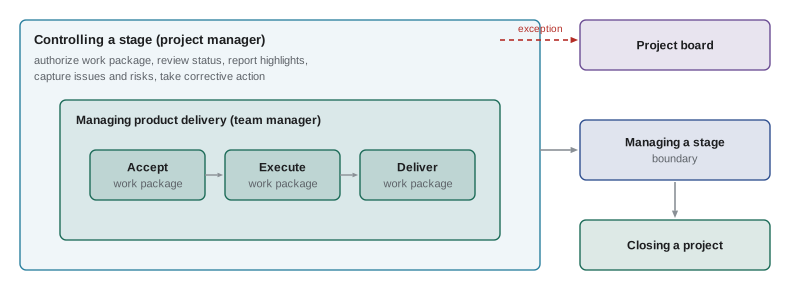
The four remaining processes run the project from its first delivery stage to its end. Controlling a stage is the project manager's day-to-day process; managing product delivery is the team manager's process for delivering work packages; managing a stage boundary prepares the board's decision at the end of each stage; and closing a project brings the project to a controlled end. These processes generate many Practitioner questions, because most scenario events happen during delivery stages. This lesson revises each process and then works through original practice questions on Ridgeline's outage alert app, which Ana managed, and the Harbor City makerspace refit, which Dev managed.
Controlling a stage: revision points
| Point | What to remember |
|---|---|
| Trigger | Authorization of a stage by the board (or an exception plan) |
| Purpose | Assign work, monitor it, deal with issues, report progress to the board and take corrective action within stage tolerance |
| Work package activities | Authorize a work package; review work package status; receive completed work packages |
| Monitoring and reporting | Review the stage status; report highlights |
| Issues and risks | Capture and examine issues and risks; escalate issues and risks; take corrective action |
| Who | The project manager |
Corrective action and escalation form a pair. If a problem can be solved within stage tolerance and the project manager's authority, the project manager takes corrective action and records it. If stage tolerance is forecast to be exceeded, the project manager escalates with an exception report. Options that escalate problems that are within tolerance, or that fix problems that are outside it without telling the board, are classic distractors.
Managing product delivery: revision points
| Point | What to remember |
|---|---|
| Trigger | An authorized work package from the project manager |
| Purpose | Control the link between the project manager and the team managers by agreeing requirements for acceptance, execution and delivery |
| Activities | Accept a work package; execute a work package; deliver a work package |
| Reporting | Checkpoint reports to the project manager at agreed intervals |
| Issues | Team managers raise issues with the project manager when work package tolerance is threatened |
| Delivery | Products are approved by the authorities named in their product descriptions, then the work package is returned as complete |
Managing product delivery is tailored heavily on agile projects, where a work package might cover a release or a set of sprints, and checkpoint reports might be replaced by sprint reviews and a team dashboard. The purpose stays the same: the project manager and team manager agree what is to be delivered, within what tolerances, and how progress and completion will be reported.
Managing a stage boundary: revision points
| Point | What to remember |
|---|---|
| Trigger | The end of a stage approaching, or an exception plan being requested |
| Purpose | Give the board enough information to review the current stage, approve the next stage plan, review the updated project plan and confirm continued business justification |
| Activities | Plan the next stage; update the project plan; update the business case; report the stage end; produce an exception plan |
| Outputs | Next stage plan or exception plan; updated project plan and business case; end stage report |
| Lessons | The end stage report can include a lessons report if useful |
Closing a project: revision points
| Point | What to remember |
|---|---|
| Trigger | The end of the final stage approaching, or premature closure requested by the board |
| Purpose | Provide a fixed point to confirm acceptance of the project product and recognize that objectives have been achieved, or that the project has nothing more to contribute |
| Activities | Prepare planned closure; prepare premature closure; hand over products; evaluate the project; recommend project closure |
| Outputs | End project report; lessons report; updated benefits management approach; draft closure notification |
| Who decides | The project manager recommends closure; the board authorizes it in directing a project |
| Premature closure | Salvage useful products, record what was done, and hand over what can be used |
Foundation-style practice
| Question | Options | Answer and reasoning |
|---|---|---|
| Which process includes 'accept a work package'? | A. Controlling a stage; B. Managing product delivery; C. Managing a stage boundary; D. Directing a project | B. |
| Which is an output of managing a stage boundary? | A. Highlight report; B. Checkpoint report; C. End stage report; D. Project brief | C. |
| Who authorizes project closure? | A. The project manager; B. The project board; C. The team manager; D. Project assurance | B. The project manager recommends; the board authorizes. |
| Which activity belongs to controlling a stage? | A. Hand over products; B. Take corrective action; C. Plan the next stage; D. Execute a work package | B. |
| Which process produces an exception plan when the board requests one? | A. Managing a stage boundary; B. Closing a project; C. Managing product delivery; D. Starting up a project | A. |
Practitioner-style practice: the outage alert app
Scenario extract. Ridgeline's outage alert app is in its second release stage. Ana, as project manager, has authorized a work package to the vendor's team for push notifications and the map view, with tolerance of plus or minus one sprint and must-have scope fixed. The vendor's team lead reports in sprint 5 that the map provider changed its license terms, which will add 12 thousand a year in running costs; the stage cost tolerance is 20 thousand. In sprint 6 the team lead reports that the map view will slip by two sprints because of the change.
| Question | Analysis | Answer |
|---|---|---|
| Who should the team lead raise the license change with? | It affects the work package; the team lead works in managing product delivery. | With Ana, as an issue. |
| Ana judges the 12 thousand within stage tolerance and her authority. What should she do? | Within tolerance and authority, corrective action is appropriate, recorded in the issue register and reflected in the business case at the boundary. | Take corrective action and record it; update the business case at the stage boundary because running costs change. |
| The two-sprint slip exceeds the work package tolerance. Is an exception report to the board needed? | Work package tolerance is Ana's; she checks whether stage tolerance is threatened. If the stage can absorb it, she adjusts; if not, she escalates. | Only if stage tolerance is forecast to be exceeded; otherwise Ana handles it within the stage. |
| At the end of the release stage, what should Ana prepare for the board? | Managing a stage boundary. | An end stage report, the next stage (release) plan, an updated project plan and an updated business case. |
Practitioner-style practice: closing the makerspace
Scenario extract. The Harbor City makerspace refit finished its last stage. All products have been accepted except the laser cutter's fume extraction, which the supplier will deliver four weeks late. Dev wants to close the project now and treat the extractor as a follow-on action. The library's facilities team will maintain the space.
| Question | Analysis | Answer |
|---|---|---|
| Can the project close with the extractor outstanding? | Closure confirms acceptance; incomplete products can be handed over as follow-on actions if the board agrees. | Yes, if the board agrees; the end project report records the follow-on action and who owns it. |
| Who should receive the follow-on action recommendation? | Follow-on actions go to the people who will own the products after the project. | The facilities team, through the board's closure notification and handover. |
| Who authorizes closure? | Directing a project. | The project board, on Dev's recommendation. |
The makerspace's fume extraction is also a workplace safety matter for library staff under occupational safety and health rules, so the follow-on action names the facilities manager as owner and the board's closure notification asks for confirmation before the laser cutter is used with patrons.
Escalation logic in code
The decision rules for corrective action and escalation are simple enough to write as a function, which is a good way to test your understanding. The program below applies them to the outage app events.
def route(level, within_wp, within_stage, within_project):
    if level == "team":
        return "team manager handles" if within_wp else "issue to project manager"
    if within_stage:
        return "project manager takes corrective action"
    if within_project:
        return "exception report to the board"
    return "board escalates to the business layer"

events = [
    ("map terms change, 12k/yr", "pm", True, True, True),
    ("map slip 2 sprints, team view", "team", False, True, True),
    ("map slip, stage can absorb", "pm", False, True, True),
    ("map slip, stage cannot absorb", "pm", False, False, True),
    ("vendor exits, project at risk", "pm", False, False, False),
]
for name, level, wp, stage, project in events:
print(f"{name:<32} -> {route(level, wp, stage, project)}")map terms change, 12k/yr -> project manager takes corrective action map slip 2 sprints, team view -> issue to project manager map slip, stage can absorb -> project manager takes corrective action map slip, stage cannot absorb -> exception report to the board vendor exits, project at risk -> board escalates to the business layer
The output mirrors the routing rule from lesson 8. Writing it as code is not something the exam asks for, but candidates who can state the rule this precisely rarely miss escalation questions.
Worked problem
Premature closure
Question: 'The council cancels the outage alert app after release 2 because a regional emergency alert system will replace it. What should the project manager do FIRST?' Options: (a) hand over all products to operations; (b) prepare premature closure, identifying products that can be completed, salvaged or handed over; (c) send an exception report; (d) produce the next stage plan.
Show solution
- Locate: the board has decided to close early, so closing a project begins.
- Classify: premature closure.
- Rule: premature closure records what has been done, salvages useful products and makes handover arrangements.
- Eliminate (a): handover follows preparation. Eliminate (c): the decision is already made. Eliminate (d): there is no next stage.
- Choose (b).
Answer: (b). Preparing premature closure comes first.
Highlight reports versus end stage reports
Two of the progress products in these processes are frequently confused. A highlight report is time-driven: the project manager sends it to the board at the frequency agreed in the PID, summarizing progress in the stage, forecasts against tolerances, issues and risks, and products completed. An end stage report is event-driven: the project manager produces it in managing a stage boundary, reviewing the whole stage's performance, the business case, risks, issues and lessons, together with the request to approve the next stage plan. If a question describes a report at a fixed interval during a stage, it is a highlight report; if it describes a review at the end of a stage, it is an end stage report.
A related point concerns the timing of lessons. Lessons can be reported at the end of a stage, as part of the end stage report, when they would benefit the rest of the project or the organization straight away, and at closure in a lessons report. Candidates who think lessons are only reported at closure often miss questions about managing a stage boundary.
Finally, remember that the board can ask for an exception plan at any time during a stage, not only at its planned end. When it does, managing a stage boundary runs early to produce that plan, and the current stage continues under the board's direction until the exception plan is approved.
Common mistakes
MistakeEscalating problems that are within stage tolerance.
InsteadTake corrective action within tolerance and authority.
MistakeFixing problems outside stage tolerance without telling the board.
InsteadSend an exception report when stage tolerance is threatened.
MistakeThinking the project manager authorizes closure.
InsteadThe project manager recommends; the board authorizes.
MistakeForgetting to update the business case at stage boundaries.
InsteadManaging a stage boundary updates the business case.
MistakeRefusing to close with any follow-on actions.
InsteadFollow-on actions can be handed over if the board agrees.
Summary and key terms
- Controlling a stage: authorize and review work packages, report highlights, handle issues and risks, take corrective action or escalate.
- Managing product delivery: accept, execute and deliver work packages, with checkpoint reports.
- Managing a stage boundary: plan the next stage, update the project plan and business case, report the stage end, or produce an exception plan.
- Closing a project: planned or premature closure, handover, evaluation and a recommendation to close.
- The board authorizes closure; follow-on actions go to those who will own the products.
- Corrective action within tolerance, escalation beyond it.
- Work package
- The set of information about products to be delivered, handed to a team manager.
- Corrective action
- Action taken by the project manager to resolve a deviation within tolerance.
- End stage report
- The project manager's report to the board at the end of a stage.
- End project report
- The report given at closure reviewing the project against its plan and business case.
- Follow-on action
- Recommended action on unfinished work, issues or risks after the project closes.
- Premature closure
- Closing a project before its planned end on the board's instruction.
Practice problems
Work each problem on paper first, then reveal the answer to check.
Name the three activities of managing product delivery.
Show answer
Accept, execute and deliver a work package.
Who authorizes work packages?
Show answer
The project manager.
What does the project manager do with a deviation within stage tolerance?
Show answer
Takes corrective action and records it.
Which process produces an exception plan?
Show answer
Managing a stage boundary.
Name two outputs of managing a stage boundary.
Show answer
Any two of: next stage plan, updated project plan, updated business case, end stage report, exception plan.
Who authorizes project closure?
Show answer
The project board.
Can a project close with outstanding products?
Show answer
Yes, as follow-on actions if the board agrees.
Why is the business case updated after the license change?
Show answer
Running costs have changed.
What comes first in premature closure?
Show answer
Preparing premature closure: identifying products to complete, salvage or hand over.
Where are checkpoint reports sent?
Show answer
To the project manager.
Lesson quiz · 5 questions
Score 60% or more to complete this lesson.
Create a free account to save your progress, take quizzes and earn a certificate.