
PRIN-140 · Lesson 12 of 12 · 25 min
Capstone: from mandate to authorized project, with exam strategy
This capstone runs the three early processes end to end on a second case, Harbor City Libraries, the invented public library system from PRIN-130 and PRIN-131. PRIN-130 built its business case, team and plans; PRIN-131 controlled its pilot branch stage. Here we go back to the start and follow the library from the mandate, through starting up, the decision to initiate, initiation and the decision to authorize the project. The lesson ends with exam strategy for questions on these processes. All figures are illustrative.
The mandate
The library board, Harbor City's governing body for its libraries, minutes the following: staff spend too much time on routine checkouts and returns, and room bookings are error-prone; the chief librarian is asked to bring forward a proposal for self-service and online booking across the six branches within three months; total spending must not exceed 1.2 million. This is the project mandate. It names a likely executive (the chief librarian), states the problem, gives a deadline for a decision and sets a cost ceiling, which becomes a project tolerance. It also hints at a solution (self-service), which starting up should examine rather than accept blindly.
| Mandate content | Implication for starting up |
|---|---|
| Problem: staff time on routine transactions; booking errors | Outline business case must quantify time freed and errors avoided |
| Proposed lead: chief librarian | Appoint as executive first |
| Decision within three months | Starting up and initiation must be short and proportionate |
| Ceiling of 1.2 million | Recorded as the project cost limit set by the business layer |
| Six branches | Natural basis for a pilot and staged rollout |
| Hint of self-service | Examine options; do not assume the answer |
Starting up
The library board appoints the chief librarian as executive, and she appoints the library's project lead as project manager. Previous lessons come from the city's earlier customer portal project, which left accessibility testing to the end and lost six weeks, and from a neighboring library system's self-service rollout, which found that uptake depended heavily on staff encouraging patrons in the first month. The project management team is designed: the manager of branch services as senior user; the city IT manager and, once contracted, the RFID kiosk vendor's delivery manager as senior suppliers; a city internal audit analyst and an uninvolved branch manager as assurance; the library's administrative officer as project support.
The outline business case compares do nothing, online booking only, and booking plus self-service. The self-service option costs about 900 thousand in year 0 and 200 thousand in year 1, freeing staff time and shortening queues, but its value depends on patron uptake. The project approach is to buy proven products, pilot one branch, then roll out in two groups, with accessibility testing built into each product's quality criteria from the start. The project brief assembles these, with the library board's tolerances, and the initiation stage plan proposes about six weeks of initiation.
Directing: authorize initiation
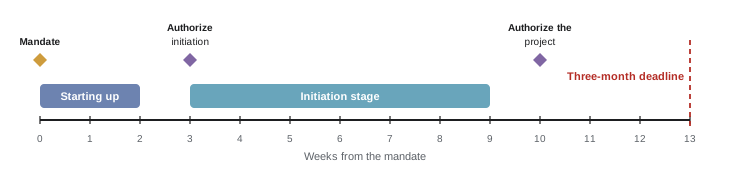
The board reviews the project brief and initiation stage plan at the end of week 2 and meets in week 3. It confirms that the outline business case suggests the project is worthwhile but highlights uptake as the key uncertainty; that the team is complete except the kiosk vendor, which the city IT manager covers for now; that the approach applies previous lessons; and that six weeks of initiation is proportionate. It authorizes initiation with tolerances of ±10 % on a small initiation budget and +2 weeks, and the executive informs the library board and branch managers.
Initiating
During initiation the project manager agrees tailoring (one PID with approaches as short sections; registers in a shared workbook; fortnightly highlight reports), prepares the management approaches, sets up controls, creates the project plan and refines the business case. The digital and data approach covers patron borrowing data and booking records, which are personal information. The commercial approach covers the kiosk procurement. The benefits management approach defines how staff hours, booking errors and queue times will be measured, with the pilot designed to measure uptake before rollout.
Because patron records are personal information, Harbor City Libraries' digital and data approach must reflect state law protecting library records, which most states have, and the library's privacy policy, and its accessibility criteria reflect the ADA, including the Department of Justice web accessibility rule for state and local governments.
| Stage | Duration | Budget ($000) | Stage cost tolerance | Decision at the end |
|---|---|---|---|---|
| 1 Initiation | About 6 weeks | 30 | ±10 % | Authorize the project |
| 2 Pilot branch | About 25 weeks | 360 | +5 % | Is uptake high enough to justify rollout? |
| 3 Rollout group A (three branches) | About 20 weeks | 370 | +5 % | Continue to the final group? |
| 4 Rollout group B and closure | About 20 weeks | 340 | +5 % | Accept and close |
Checking the whole package
The code below brings together several of the checks from this course and applies them to Harbor City Libraries: whether the early processes fit within the three-month deadline, whether the stage budgets stay within the library board's ceiling, whether stage tolerances nest within the remaining headroom, and whether every acceptance criterion has a quality method.
deadline_weeks = 13
timeline = [("Starting up", 2), ("Board: authorize initiation", 1), ("Initiation stage", 6), ("Board: authorize project", 1)]
elapsed = sum(w for _, w in timeline)
print(f"Mandate to authorized project: {elapsed} weeks (deadline {deadline_weeks}) ->", "ok" if elapsed <= deadline_weeks else "late")
ceiling = 1200
stages = {"Initiation": (30, 0.10), "Pilot": (360, 0.05), "Group A": (370, 0.05), "Group B": (340, 0.05)}
budget = sum(b for b, _ in stages.values())
headroom = ceiling - budget
stage_tol = sum(b * t for b, t in stages.values())
print(f"Planned cost {budget} thousand; ceiling {ceiling}; project headroom {headroom} thousand ({headroom / budget:.1%})")
print(f"Stage tolerances total {stage_tol:.1f}; reserve left {headroom - stage_tol:.1f} thousand ->", "ok" if stage_tol <= headroom else "do not nest")
criteria = {"Kiosk usable by wheelchair users": "accessibility audit", "Booking double-bookings under 2 a month": "pilot data review",
            "Checkout under 30 seconds for 90 % of patrons": "timed observation", "Staff time freed measured": None}
missing = [c for c, m in criteria.items() if not m]
print("Criteria without a quality method:", missing if missing else "none")Mandate to authorized project: 10 weeks (deadline 13) -> ok Planned cost 1100 thousand; ceiling 1200; project headroom 100 thousand (9.1%) Stage tolerances total 56.5; reserve left 43.5 thousand -> ok Criteria without a quality method: ['Staff time freed measured']
The early processes take ten weeks, within the three-month deadline. The planned cost of 1,100 thousand leaves 100 thousand of headroom under the library board's ceiling, about 9 %, and the stage tolerances use 56.5 thousand of it, leaving a reserve of 43.5 thousand. One acceptance criterion, measuring staff time freed, has no method; it is really a benefit measure rather than an acceptance criterion, so it belongs in the benefits management approach, with a time-sampling study before and after the pilot. The project manager moves it there and assembles the PID.
Directing: authorize the project
In week 10 the board reviews the PID and the pilot branch stage plan prepared at the stage boundary. It checks that the detailed business case still justifies the project, noting that the case depends on uptake and that the pilot stage is designed to measure it; that the project plan fits within the library board's ceiling with a reserve; that the approaches are consistent; and that the benefits approach will show whether staff time is actually freed. It authorizes the project and the pilot branch stage, with the tolerances above, and the executive reports the decision to the library board within the three-month deadline.
| Decision point | Inputs | Decision | Who is informed |
|---|---|---|---|
| Week 3: authorize initiation | Project brief; initiation stage plan | Approved with ±10 % and +2 weeks | Library board; branch managers |
| Week 10: authorize the project | PID; pilot branch stage plan | Approved; pilot stage authorized with +5 % and +3 weeks | Library board; city IT; staff union representatives; branch staff |
Exam strategy for the early processes
PRIN-120 described the exam formats used in recent years; check the current details with PeopleCert before booking. The Foundation exam was described as 60 multiple-choice questions in 60 minutes, closed book, with a pass mark of 36. The Practitioner exam was described as 70 questions in 150 minutes, open book with the official manual only, with a pass mark of 60 %. Foundation questions on these processes test definitions, purposes, sequence and roles. Practitioner questions place you in a scenario and ask what the right action, product or decision is at a particular moment.
| Question pattern | What it tests | Reasoning tip |
|---|---|---|
| Which process is pre-project? | Lifecycle structure | Starting up is pre-project; the board's decision to initiate creates the project |
| Who appoints the project manager? | Roles and sequence | The executive, after being appointed by the business layer |
| Which product supports the decision to initiate? | Products and decisions | Project brief and initiation stage plan; the PID comes later |
| What should the project manager do next? | Sequence of activities | Check where the scenario is in the process and what the next activity produces |
| Is this action appropriate? | Principles and tailoring | Prefer proportionate actions that keep the purpose and decisions |
| Who approves this? | Responsibility | Board roles approve; the project manager produces; assurance reviews |
Three traps recur. The first is confusing the project brief with the PID: if a question mentions the outline business case or the initiation stage plan, you are in starting up; if it mentions management approaches, the project plan or the detailed business case, you are in initiation. The second is confusing ownership with drafting: the executive owns the business case even if the project manager writes it. The third is overdoing it: an answer that adds more documents, more meetings or more approvals is not automatically better. PRINCE2 favors the option that achieves the purpose proportionately.
| If the scenario mentions… | You are probably in… |
|---|---|
| A mandate; appointing the executive; previous lessons; the outline business case; the project approach | Starting up a project |
| A request to initiate; authorizing initiation; giving advice; an exception report | Directing a project |
| Tailoring requirements; management approaches; project controls; the project plan; the detailed business case; the PID | Initiating a project |
| A stage plan for the next stage; an end stage report | Managing a stage boundary (PRIN-141) |
Using the manual in the Practitioner exam
In an open-book exam, the manual is a reference, not a textbook. Before the exam, learn where the process chapters are, where each process's activities and their inputs and outputs are listed, where the management product outlines are, and where the role descriptions sit. Mark them with tabs if the rules allow. During the exam, use the manual to confirm a detail you are unsure of, such as which product is an output of a particular activity, rather than to learn a topic for the first time. If a question can be answered by reasoning from purpose and roles, answer it and move on.
Worked problem
A Practitioner-style reasoning chain
Harbor City Libraries' project manager has just finished the project brief. The kiosk vendor has offered to start installing kiosks in the pilot branch immediately, at no extra cost, so the project can 'save time'. What should the project manager do, and why?
Show solution
- Locate the process: the project brief has just been finished, so the project is still in starting up; initiation has not been authorized.
- No project exists yet, and no delivery stage has been authorized; installing kiosks is delivery work.
- Starting delivery now would bypass the board's decisions to initiate and to authorize the project, and would commit the library to a vendor before the commercial approach and procurement rules have been applied.
- The correct action is to decline for now, complete the initiation stage plan and send the request to initiate to the board.
- Record the vendor's offer in the daily log; it may inform the commercial approach in initiation.
Answer: Decline: the project is pre-project and no delivery has been authorized. Complete starting up and request authorization to initiate.
Common mistakes
MistakeStarting delivery work during starting up because a supplier offers.
InsteadWait for the board's authorizations; record the offer.
MistakeTreating a solution hinted at in the mandate as decided.
InsteadExamine options in the outline business case.
MistakePutting benefit measures among acceptance criteria.
InsteadMeasure benefits through the benefits management approach.
MistakeIn the exam, choosing the answer with the most documents or meetings.
InsteadChoose the proportionate answer that achieves the purpose.
MistakeUsing the manual in the exam to learn topics from scratch.
InsteadUse it to confirm details; reason from purpose and roles first.
Summary and key terms
- Harbor City Libraries ran from mandate to authorized project in ten weeks, within its three-month deadline.
- Starting up appointed the executive and team, applied lessons, examined options and assembled the brief.
- The board authorized initiation after checking justification, team, approach and proportionality.
- Initiation tailored the method, prepared approaches, set controls, planned the project and refined the business case.
- Checks confirmed the stage budgets and tolerances nest within the library board's ceiling.
- In exams, locate the process from scenario clues, distinguish ownership from drafting and favor proportionate answers.
- Request to initiate
- The request from starting up for the board to authorize initiation.
- Request to deliver
- The request from initiation for the board to authorize the project.
- Headroom
- The difference between the planned cost and the cost limit set by the business layer.
- Benefit measure
- A measure used to show whether a benefit has been realized, managed through the benefits approach.
- Open-book exam
- An exam in which candidates may consult a specified reference, here the official manual.
Practice problems
Work each problem on paper first, then reveal the answer to check.
What made the library board's minutes a mandate?
Show answer
They triggered starting up, named a likely executive, stated the problem and set constraints.
How many weeks did Harbor City Libraries take from mandate to authorized project?
Show answer
Ten.
What is the project's headroom under the ceiling?
Show answer
100 thousand (about 9 %).
How much reserve remains after stage tolerances?
Show answer
43.5 thousand.
Why was 'staff time freed' moved out of the acceptance criteria?
Show answer
It is a benefit measure, managed in the benefits management approach.
Which lesson from the portal project shaped the approach?
Show answer
Building accessibility testing into quality criteria from the start.
Which two products did the board review in week 10?
Show answer
The PID and the pilot branch stage plan.
What clue suggests a scenario is in initiation?
Show answer
References to management approaches, project controls, the project plan, the detailed business case or the PID.
What is the trap of 'more is better' answers?
Show answer
PRINCE2 favors proportionate actions; more documents or meetings are not automatically correct.
Why decline the vendor's early installation offer?
Show answer
The project is pre-project; no delivery has been authorized and procurement rules have not been applied.
Lesson quiz · 5 questions
Score 60% or more to complete this lesson.
Create a free account to save your progress, take quizzes and earn a certificate.